
A 10-ton rating alone doesn’t tell you whether a forklift will suit your operation. For 10 ton electric forklift procurement, compare rated capacity with the load centre and the load you actually handle: one listed 10-ton four-wheel electric forklift has a rated capacity of 10,000 kg and a 600 mm load centre. Battery choice and site conditions also shape whether the truck fits daily work.
It’s easy to focus on capacity first. But a truck with the right rated capacity may still be a poor fit if its load centre, dimensions or turning requirements don’t suit the loads and work areas. Start by defining the task, then compare each machine against it.
This guide explains how to assess electric forklift capacity, load centre and wheelbase, compare battery options, and account for maintenance and procurement needs. You’ll come away with a practical framework for weighing 9-18-tonne electric trucks and identifying the specifications that matter most to your operation.
Key Takeaways
- Match rated capacity to the actual load and its load centre, rather than relying on the headline tonnage alone.
- Compare battery options against shift patterns, charging access, temperature conditions and the equipment’s expected working life.
- Assess load centre and wheelbase together to understand how the truck will handle loads and move through your operating space.
- Include serviceability and battery-charging requirements in the procurement decision, not just the initial equipment specification.
- Use your load profile and site requirements to narrow the 9-18-tonne electric forklift range to options that fit the work.
Lithium-ion battery options and Battery as a Service
Battery selection affects shift planning, charging access and equipment use over time. Compare the power source with the work pattern, and include chargers and battery arrangements in the procurement scope.
Battery Chemistry Options
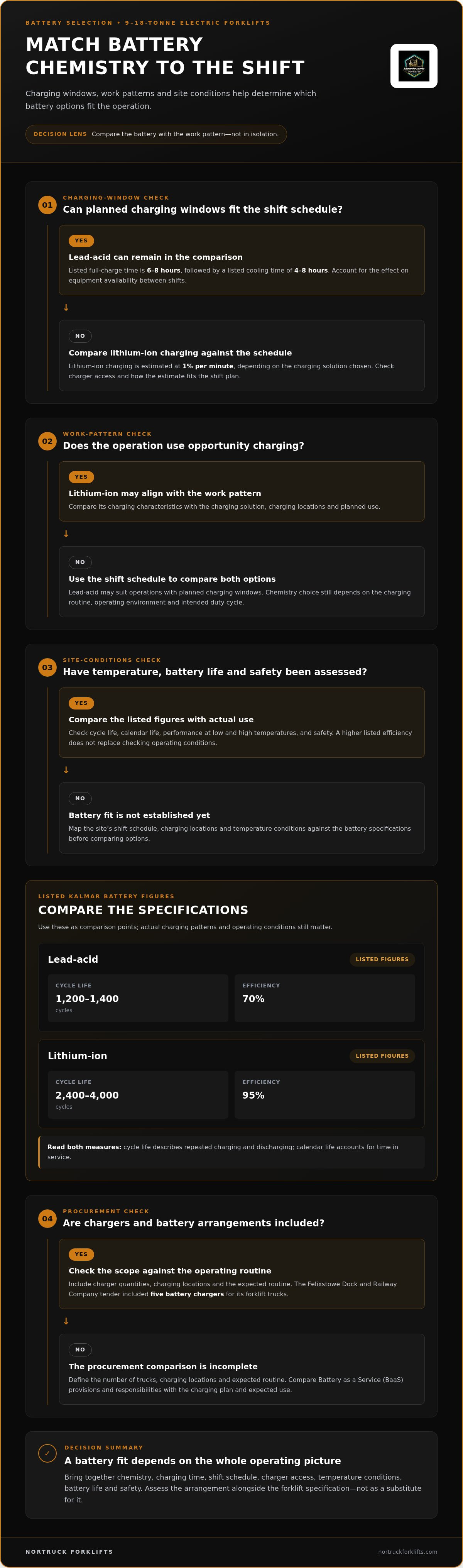
Kalmar 9-18-tonne electric forklifts are available with lead-acid or lithium-ion power sources. Lead-acid batteries may suit operations with planned charging windows, while lithium-ion can align with work patterns that use opportunity charging. Compare the installation, charging routine and operating environment alongside the truck specification, rather than selecting chemistry in isolation.
The U.S. Environmental Protection Agency recommends considering calendar and cycle life, performance at low and high temperatures, and safety when assessing battery specifications. For a practical comparison, map each option against the site’s shift schedule, charging locations and temperature conditions. This helps establish whether a battery suits the intended duty cycle.
Battery Life and Efficiency
Listed Kalmar lead-acid battery figures are 1,200 to 1,400 cycles and 70% efficiency. The lithium-ion option is listed at 2,400 to 4,000 cycles and 95% efficiency. Treat these as comparison points, then assess how actual charging patterns and operating conditions fit the planned use.
Cycle life describes repeated charging and discharging, while calendar life accounts for time in service. Compare both measures and consider how often the equipment will operate. A higher listed efficiency may support energy use, but it doesn’t replace checking battery performance against operating temperatures and safety requirements.
Battery Charging and Charger Procurement
The listed full-charge time for Kalmar lead-acid batteries is 6-8 hours, followed by a listed cooling time of 4-8 hours. That schedule affects equipment availability between shifts. Lithium-ion charging is estimated at 1% per minute, depending on the charging solution chosen. Align charging time with the shift plan and charger access.
Include chargers in the procurement scope from the outset. The Felixstowe Dock and Railway Company tender included five battery chargers for its forklift trucks, illustrating that charger quantities can form part of an equipment package. Define the number of trucks, charging locations and expected routine before determining charger requirements.
Battery as a Service
Battery as a Service (BaaS) treats battery access as a service arrangement rather than only as a separately acquired asset. Compare the agreement’s battery provision and responsibilities with the operation’s charging plan and expected use. Assess the arrangement alongside equipment specifications, not as a substitute for them.
Build the comparison around practical needs: battery chemistry, charging access, operating conditions and expected use over time. For example, a site with limited charging windows should compare the stated charging characteristics with its shift schedule. This connects battery choice, chargers and equipment availability in a single procurement decision.
10-18-Ton electric forklift range
A 10-ton electric forklift sits within the broader heavy-duty class, but its rated capacity alone doesn’t establish fit. Compare the load, operating conditions and truck configuration before selecting a powered model for your operation.
Total cost of ownership: Compare an electric forklift with diesel or LPG over its working life, including acquisition, energy, maintenance, battery and charging equipment, and operational downtime. The balance depends on duty cycle, energy use, service needs and charging arrangements. Purchase price alone can’t determine which power source costs less overall.
U.S. OSHA standards: OSHA’s powered industrial truck requirements are relevant to forklift operation in the United States. Procurement and operating plans should account for operator training, equipment suitability, inspection and safe operating practices; a 10-ton capacity rating alone doesn’t establish safe or compliant use.
Manufacturers: Kalmar offers a 9-18-tonne electric forklift range, with lifting capacities from 9,000-18,000 kg. This includes the 10-tonne class. Compare an exact model’s rated capacity and configuration with the loads and tasks it must handle, rather than assuming every truck in a manufacturer’s range has identical specifications.
Risks and limitations: Heavy-duty electric trucks need charging arrangements that match the work schedule. Capacity also depends on load position: moving the load centre farther from the truck reduces the maximum load it can handle. Site dimensions, turning space, surface conditions and operating temperatures can also affect suitability and productivity.
Kalmar fits its 9-18-tonne electric forklifts with the EGO cabin as standard. Treat that as one specification, not a substitute for assessing the whole truck. For a sound comparison, align the rated load with attachments, lift height, load centre and the movements required at your site.
Use this sequence to narrow the range:
- Record the heaviest load and how it sits on the forks.
- Identify the lift height and attachment requirements.
- Map travel routes, turning areas and working surfaces.
- Match expected shifts with charging access and equipment availability.
- Compare the resulting requirements with the manufacturer’s model data.
This approach keeps the decision tied to real operating demands, whether the truck will work in a warehouse, yard or industrial facility. For a capacity-led review of heavy-lift equipment options, compare the application and truck specifications together before settling on a configuration.
Load centre and wheelbase specifications
A listed 10-ton electric forklift has a rated capacity of 10,000 kg, a 600 mm load centre, and a lift-height range of 3000-5000 mm. The FB100 measures 2270 mm wide, has a 2850 mm wheelbase, and is 4480 mm long to the fork face without forks.
Those figures describe a specific configuration, not every 10-ton truck. Load position, mast and attachments can affect capacity and dimensions, so assess them against the actual handling task.
Load Centre and Rated Capacity
The load centre is the horizontal distance from the fork face to the load’s centre of gravity. A 600 mm load centre is the listed specification for the FB100. If cargo extends farther forward, the increased leverage can reduce the capacity the truck can safely handle.
Kalmar’s 9-18-tonne electric forklifts have load centres ranging from 600 to 1,200 mm. This range matters when loads are long, unevenly distributed or handled with attachments. Compare the load centre on the capacity data with the load’s actual centre of gravity, rather than assuming rated tonnage applies to every load shape.
Wheelbase, Dimensions and Site Fit
The FB100’s 2850 mm wheelbase is the distance between its axles. Wheelbase affects the truck’s footprint and maneuvering characteristics. Kalmar’s 9-18-tonne electric forklift range has wheelbases from 2,800 to 3,500 mm, so site layout should inform model selection.
Check the full travel path, not only the parking bay. Check the truck’s turning radius and aisle requirement against the site layout before selecting it. Compare these figures with aisle geometry, corners and loading points to assess whether the truck can maneuver through the operation.
Also account for the forklift’s overall dimensions and fork configuration. The FB100’s outside overall length to the fork face is 4480 mm without the forks, and its forks measure 1520 × 175 × 85 mm. Its fork spread ranges from 515 mm to 2055 mm. These measurements help determine whether the truck can approach, engage and carry the intended load within the available space.
Turning Specifications into a Procurement Check
Use a consistent comparison for each candidate: rated capacity, load centre, lift height, wheelbase, overall dimensions, turning radius and fork details. For example, a 10,000 kg rating paired with a 600 mm load centre does not establish capacity for a load whose centre sits farther forward. Match every measurement to the load and route.
- Record the load’s weight, length and centre of gravity.
- Compare the load centre with the forklift’s capacity data.
- Measure aisle widths, corners and turning areas against truck dimensions.
- Confirm lift height and fork dimensions suit the handling task.
These checks also connect equipment choice with site priorities. Kalmar says its electric forklifts produce zero carbon emissions at the point of use, which may matter to operations assessing emissions alongside capacity and fit.
Maintenance and serviceability
For an industrial forklift, serviceability affects availability throughout its working life. Compare warranty coverage, parts planning and delivery timing alongside the truck’s operating requirements.
Warranty and Service Plans
Listed warranty terms provide a concrete starting point for comparison: major forklift components have coverage for 24 months or 2,000 work hours, while specified systems have coverage for 12 months or 1,200 work hours. These are different coverage periods and apply to different component groups, so assess each against the equipment’s expected use.
Service-plan scope and delivery lead times depend on the selected truck, configuration and supply arrangements. Compare what scheduled maintenance covers, which components are included, and how the delivery schedule fits the planned start of operations. These details shape lifecycle planning as well as the warranty period.
Parts Availability
Parts planning can reduce disruption when a component needs replacing. A U.S. Bureau of Mines report says equipment spare parts are usually purchased with the equipment and generally consist of a one-year supply. This offers a practical procurement example: identify the parts needed for the intended operation and consider whether to include them with the equipment.
For a heavy-duty forklift, plan around its configuration and the components most relevant to its work. Keep parts identification aligned with the equipment specification so purchasing and maintenance teams can match components to the truck. Account for storage and inventory handling in the parts plan, too.
Planning Maintenance and Delivery
Maintenance planning starts before delivery. Decide who will perform routine checks, how maintenance records will be kept, and how the equipment will be taken out of service when work is required. These steps connect warranty terms with day-to-day responsibilities, rather than treating coverage as a substitute for maintenance planning.
Delivery planning affects operations, too. A truck that arrives before the work area, charging arrangements or operators are ready can delay deployment. Coordinate delivery with site preparation and commissioning tasks, then align the planned start date with the procurement schedule.
Use a written comparison to assess each offer on the same basis:
- Record warranty duration and which component groups it covers.
- Define the service-plan tasks and maintenance responsibilities.
- Identify parts to purchase with the equipment and plan their storage.
- Align delivery timing with site readiness and operational start-up.
For example, a procurement team comparing two industrial trucks can set out warranty periods, parts arrangements and delivery sequencing side by side. This makes operational trade-offs visible and keeps the purchase decision connected to serviceability after delivery.
Electric forklift truck procurement
A clear procurement process turns operating requirements into comparable offers. Define the task first, then apply the same specification and evaluation criteria to each proposal.
A 10-ton electric forklift procurement specification and request for proposals (RFP) should describe the load, duty, site and delivery requirements. It should also request the truck configuration, battery and charger details, warranty terms, service scope and delivery schedule.
Procurement Specification Requirements
Describe the trucks you need using measurable operating requirements. Include rated capacity, load centre, lift height, fork and attachment needs, overall dimensions, turning requirements, battery chemistry and charging arrangements. These details let suppliers explain how their proposed equipment fits the work, rather than relying on a capacity label alone.
Separate essential requirements from preferences. State which loads and site conditions the truck must handle, then request supporting specifications for the proposed configuration. Include new or used equipment only if both suit the purchase, and make the delivery location and schedule clear.
- Describe the loads, handling tasks and expected operating pattern.
- Specify capacity, load centre, lift height and required attachments.
- Record site access, aisle, turning and floor conditions.
- Request battery, charger, warranty and service information.
- Set delivery requirements and identify whether new or used trucks qualify.
RFP Preparation
An RFP should give every respondent the same submission instructions and evaluation framework. Request technical details, delivery information, sustainability information and a clear list of deviations from the specification. This makes proposals easier to compare against operational priorities, rather than weighing unlike offers informally.
A Northwest Seaport Alliance solicitation sought one 10,000 lb capacity and one 20,000 lb capacity zero-emission electric fork truck. It accepted new or used trucks. The notice listed technical, price and delivery, sustainability, and deviations as bid-scoring criteria, without percentage weightings.
That example shows why an RFP should distinguish required performance from acceptable alternatives. In the Northwest Seaport Alliance process, questions were due February 17, 2026, at 2:00 PM PDT, and bids were due March 10, 2026, at 2:00 pm. A planned procurement should likewise state its question period, submission deadline and response format.
Before issuing the RFP, have operations, maintenance and purchasing teams review a draft. Operations can validate the work profile, maintenance can assess service and parts needs, and purchasing can align the evaluation criteria. Compare each response against the same requirements and document where proposed trucks meet or differ from them.
A sound final decision weighs technical fit, delivery, sustainability and deviations together. This keeps the purchase tied to the work and makes the reasons for selecting a proposal clear to the team.
Nortruck Forklifts: Kalmar Heavy Lift Trucks
Nortruck Forklifts helps buyers assess heavy lifting requirements and source machinery suited to their operation. For demanding loads, Kalmar Heavy Lift Trucks provide a relevant option to evaluate against capacity, load centre, site layout and charging needs. Nortruck also offers Baumann Sideloaders, Combi-Lift 4-way Trucks and specialized heavy-duty electric trucks for applications with different handling requirements.
When you’ve defined the loads, working environment and equipment requirements but need help matching them to machinery, Nortruck can advise. Its sales and sourcing services cover new and used heavy lifting equipment, helping you compare options against your 10 ton electric forklift procurement specification.
For a practical discussion about your requirements, contact Nortruck Forklifts or visit nortruckforklifts.com.
Turn your equipment decision into an operating plan
A considered 10 ton electric forklift procurement decision should carry through beyond purchase approval. Build a shared operating plan that assigns responsibility for equipment use, routine checks, charging coordination and performance review. Involve operators and maintenance staff alongside purchasing, so the selected truck’s role is clear before it enters service.
Set a baseline for the work the equipment must support, then review how well the chosen configuration fits actual tasks after deployment. This gives your team a practical way to identify adjustments to scheduling, operating procedures or future equipment requirements. Keep the original decision criteria with the procurement record so later reviews remain tied to operational needs.
When you’re ready to discuss heavy-lifting equipment for your application, Nortruck Forklifts can help you consider suitable options.
A clear plan makes the transition from procurement to daily operation more purposeful. Move forward with the requirements that matter most to your team.
Frequently Asked Questions
Which electrically powered 9-18T forklift truck should I choose?
Choose a truck whose configuration matches the load profile and worksite, rather than selecting by tonnage alone. Kalmar’s 9-18-tonne electric range gives buyers capacity options across heavy-duty applications. For example, compare how often your operation handles maximum loads, whether loads vary in shape, and how the truck must approach them. These details help narrow the suitable capacity and configuration for your daily tasks.
Why is it important to understand the correct requirements and specifications before purchasing a forklift?
Clear requirements help prevent a mismatch between the truck and the work it must perform. Before purchase, document representative loads, operating routes, work surfaces and the movements needed at loading points. A truck for a production line, for example, may face different access constraints from one moving goods across an open yard. A defined operating profile also gives the purchasing team a consistent basis for comparing proposals.
What battery types, capacities, and charging times are available for 10-ton electric forklifts?
Kalmar’s 9-18-tonne electric forklifts offer lead-acid and lithium-ion power options. For the FB100, the listed battery rating is 96 V and 1250 Ah. Listed lead-acid charging figures include a full-charge time of 6-8 hours and cooling time of 4-8 hours; lithium-ion charging is estimated at 1% per minute, depending on the charging solution. Match the battery and charger to shift scheduling and site conditions.
What facility requirements are needed to charge and operate a 10-ton electric forklift?
Plan for a compatible charging point, suitable electrical supply and a location that fits the truck’s movements and charging routine. Map travel routes, work areas and the place where the equipment will be parked for charging. Include charger positioning in the site layout so charging equipment doesn’t obstruct material flow. Account for the shift pattern and the selected battery’s charging characteristics, too.
How do 10-ton electric forklifts compare with diesel or LPG forklifts for total cost of ownership?
Compare acquisition, energy, maintenance, battery and charging equipment, and operational downtime over the truck’s working life. Total cost depends on duty cycle, energy use, service needs and charging arrangements, so purchase price alone cannot determine which power source costs less.
What U.S. OSHA standards apply to purchasing and operating a 10-ton forklift?
The article identifies OSHA’s powered industrial truck requirements as relevant in the United States. Procurement and operating plans should account for operator training, equipment suitability, inspection and safe operating practices.

Article by
Lars Gunnar Tärby
Disclaimer
1. General Information and No AdviceThe information, articles, product descriptions, and specifications provided on this website (www.nortruckforklifts.com) are for general informational and educational purposes only. While we strive to provide accurate and up-to-date content regarding new and used forklifts and heavy machinery, the material published does not constitute professional, technical, or legal advice.
2. Product Specifications and PricingNortruck Forklifts acts as a facilitator for the trade of new and used forklifts. All equipment details, including but not limited to year of manufacture, operating hours, lift capacity, dimensions, conditions, and pricing, are provided based on the information available to us at the time of publication. Specifications and availability are subject to change without prior notice.
3. "As Is" and VerificationAll articles and product listings are provided on an "as is" and "as available" basis without any warranties of any kind, either express or implied. Nortruck Forklifts does not guarantee that the descriptions are entirely error-free, complete, or reliable. Buyers and traders are strongly encouraged to independently verify all technical specifications, machine history, and equipment conditions directly with the seller or an authorized inspector before finalizing any purchase or transaction.
4. Limitation of LiabilityIn no event shall Nortruck Forklifts, its owners, or its contributors be held liable for any direct, indirect, incidental, consequential, or economic loss or damage arising out of the use of, or the inability to use, the information provided on this website, or any transactions facilitated through this platform. This includes, but is not limited to, damages caused by technical inaccuracies, typographical errors, or reliance on the content of our articles.
5. Third-Party LinksOur website may contain links to external websites, dealer networks, or third-party services that are not owned or controlled by Nortruck Forklifts. We have no control over, and assume no responsibility for, the content, privacy policies, or practices of any third-party websites.


