
The right empty container handler for sale depends on the loads and stacking work at your site. A listed 2018 Kalmar DCG100-45ED7 has a capacity of 10,000 kg, while a listed 2025 Kalmar DCG90-45ES7 has a capacity of 9,000 kg. Kalmar’s electric ECG70 can stack containers up to 4 high.
Comparing listings takes more than matching a capacity figure. Operating hours, lift height, power type, and the difference between an empty container handler and a reach stacker all affect how well a machine fits a terminal, depot, or logistics hub.
This guide compares machine types, stated specifications, and factors that influence asking prices, without assuming one configuration suits every operation. Learn how to assess equipment against your handling pattern and site layout, and when specialist advice can help narrow the options.
Key Takeaways
- Match equipment type to the container moves your operation handles, rather than comparing capacity figures in isolation.
- Assess listings by considering operating hours, lift height, and machine condition alongside the stated capacity.
- Compare electric models with other options in light of your site’s workflow and operating requirements.
- Understand how machine age, specifications, and condition influence asking prices before weighing alternatives.
- Consider how terminal, depot, and logistics-hub layouts affect the equipment’s role in your container-handling process.
Container-handler and reach-stacker models
Start with the work, then compare machine class and specifications. An empty container handler is designed to stack empty containers, while a reach stacker uses a boom to pick up and place containers across a wider working area. A loaded container handler is built for heavier container loads, so its capacity and application differ. These distinctions matter at terminals, depots, and logistics hubs, where handling patterns and available space vary.
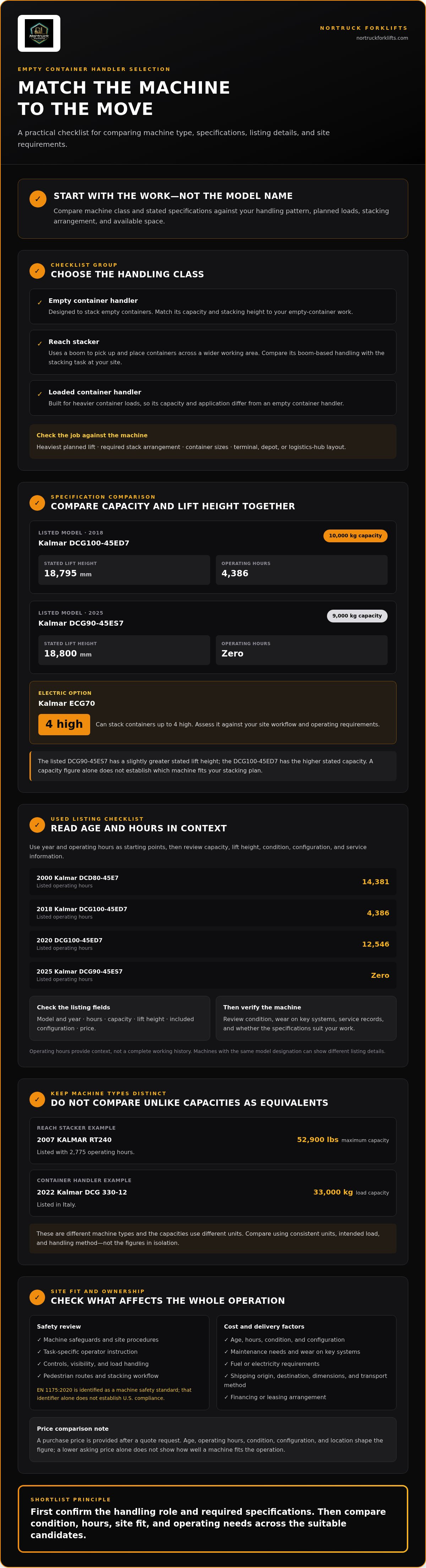
Compare rated lift capacity, stacking height, and the container sizes the machine can handle. Then match those figures to your heaviest planned lift, required stack arrangement, and site layout. A listed 2018 Kalmar DCG100-45ED7 has a capacity of 10,000 kg and lift height of 18,795 mm. The listed 2025 Kalmar DCG90-45ES7 has a capacity of 9,000 kg and lift height of 18,800 mm. Kalmar’s electric ECG70 can stack containers up to 4 high.
Model names can help identify equipment class, but compare specifications rather than assuming brands are interchangeable. Kalmar appears in listings for empty container handlers and reach stackers. Different manufacturers offer equipment across these categories, so read each listing’s stated capacity, lift height, attachment configuration, and operating hours together. A higher capacity alone doesn’t show whether a machine suits your stacking plan or the containers handled at your site.
For a direct comparison, a listed 2007 KALMAR RT240 reach stacker has a maximum capacity of 52,900 lbs and 2,775 operating hours. A 2022 Kalmar DCG 330-12 container handler listed in Italy has a load capacity of 33,000 kg. Those examples show why model type and intended load matter. Use the same units when comparing capacity, and assess the reach stacker’s boom-based handling against the container handler’s stacking role.
EN 1175:2020 is identified as a safety standard for machines; that identifier alone doesn’t establish U.S. compliance. For U.S. operation, include machine safeguards, site procedures, and task-specific operator instruction in your safety review. Training should address controls, visibility, load handling, pedestrian routes, and the site’s stacking workflow.
Ownership costs vary with condition, operating hours, maintenance needs, and the machine’s configuration. Compare service records and wear on key systems, then account for operating demands such as fuel or electricity. Financing and leasing are purchase arrangements; shipping is planned around the machine’s origin, destination, dimensions, and transport method. These terms shape the total acquisition plan alongside the asking price.
A Kalmar DCD200-12LB container handler listed in Spain has a load capacity of 20,000 kg. Treat this listing as a separate reference point, not as a substitute for checking the exact machine’s condition, configuration, and intended work. Confirm that its stated capacity aligns with the loads and stacking plan at your site, and review supporting service information before deciding whether it fits your operation.
For each candidate, consider how it will move through the work area, whether its handling method matches the task, and what support it will need after delivery. Comparing specifications, condition, and operating requirements helps narrow the choices without relying on model labels alone.
Empty container handler listings
Listings can differ in machine age, operating hours, and capacity. Compare those details against your operational needs rather than judging a machine by its model name alone.
Used Equipment Listings
Used listings can span machines from different years and with widely different hours. For example, a 2000 Kalmar DCD80-45E7 is listed with 14,381 hours; a 2018 Kalmar DCG100-45ED7 has 4,386 operating hours. A 2020 DCG100-45ED7 shows 12,546 operating hours, while a 2025 DCG90-45ES7 is listed with zero operating hours.
Use the year and hour reading as a starting point, then compare capacity and lift height. The 2018 DCG100-45ED7 has a stated capacity of 10,000 kg and lift height of 18,795 mm. The 2025 DCG90-45ES7 has a capacity of 9,000 kg and lift height of 18,800 mm. These examples help frame differences between listings, but don’t substitute for matching specifications to your work.
Listing Price Details
A purchase price depends on the individual machine and is given after a quote request; age, operating hours, condition, configuration, and location shape the figure. Compare listings on those factors before weighing their asking prices, since a lower figure alone doesn’t show how well a machine fits your operation.
Check that each listing clearly identifies the model, year, hours, capacity, lift height, and included configuration. A 2000 DCD80-45E7 and a 2025 DCG90-45ES7 represent different ages and specifications, so treat them as distinct options, not like-for-like substitutes. Listing details provide a first comparison, while the machine’s condition and intended use inform the purchase decision.
To assess a used machine, organize each listing’s details in one comparison sheet. Record the model and year, stated hours, capacity, lift height, and price. Then check whether the specifications suit the containers and stacking pattern at your site. This makes differences clear without relying on brand familiarity alone.
Operating hours are useful context, but they don’t describe the machine’s full working history. Consider hours alongside age, stated capacity, and the type of handling required. For example, the 2018 DCG100-45ED7 and 2020 DCG100-45ED7 share a model designation but show different operating-hour readings. The model name by itself doesn’t make their listing details equivalent.
For a practical shortlist, separate machines that meet your operational requirements from those that don’t. Compare capacity and lift height first, then review age and hours among the suitable candidates. If Kalmar equipment is part of your search, Kalmar heavy-lift equipment options offer a related category to consider.
Treat these details as separate comparison points: the asking price gives a basis for reviewing the older machine, and the hour reading describes the newer listing. Consider each alongside the specifications and requirements already identified, and verify that the particular machine suits the work before making a decision.
Electric empty container handler
The Kalmar ECG70 is an electric empty container handler that can stack containers up to 4 high. That gives buyers a concrete starting point for evaluating electric equipment: compare its stacking role with the height and container flow required at the site. The stated stacking capability is one specification, not a complete productivity assessment.
Before comparing electric models, map the work cycle. Record how containers move between receiving areas, storage rows, and dispatch, then identify where stacking takes place. Consider how the ECG70’s stated 4-high capability fits the planned arrangement. The operating pattern, travel distances, and availability of charging time all shape whether an electric machine fits daily operations.
Charging needs belong in the same assessment as handling requirements. Set out when the machine works, when it can pause, and where charging can take place. Compare that schedule with the shift pattern and expected workload. A site with continuous container movement has different planning needs from a depot with predictable gaps between tasks.
Productivity also depends on how an electric handler fits into the wider equipment mix. Map handoffs between the container handler and forklifts moving other loads around a logistics hub. Review traffic routes, working areas, and the order of each transfer. This can show whether the electric handler supports the flow or creates a bottleneck at a shared access point.
When reviewing an electric machine, compare its stated capacity and stacking capability with the containers and stack plan in use. Include site layout, charging arrangements, duty cycle, and operator workflow in the same review. An electric power source alone does not determine suitability or productivity. The operational fit depends on the whole task, from pickup through placement.
A practical evaluation can follow four steps: define the container moves, document the stack arrangement, map charging opportunities, and assess traffic flow. Apply each step to the ECG70 and the site’s actual work pattern. This creates a structured comparison with other equipment options, without relying on a single feature as a proxy for performance.
Choosing electric equipment also involves planning beyond the machine itself. Consider how charging will fit into site routines, how operators will incorporate it into their work, and whether the handling sequence supports the required container flow. Comparing these factors helps terminals, depots, and logistics hubs assess the electric option against their specific needs.
Asking prices
Prices for container handlers vary with age, condition, operating history, and configuration. Compare listings by aligning those details first, then assess capacity and lifting requirements. A price without specifications offers little basis for judging whether a machine fits terminal, depot, or logistics hub work.
Price depends on the individual machine. Age, operating hours, condition, capacity, and configuration all affect the assessment, while location and transport planning shape the acquisition decision. Treat price as one part of the comparison, not a complete measure of a machine’s value or suitability.
For a used listing, record the model year and operating hours beside its asking-price information. A 2000 Kalmar DCD80-45E7 is listed with 14,381 hours. A 2018 Kalmar DCG100-45ED7 has 4,386 operating hours, while a 2020 example has 12,546 operating hours. Those readings distinguish listings, but don’t explain condition by themselves.
Compare specifications that relate directly to lifting work. The 2018 DCG100-45ED7 has a stated capacity of 10,000 kg and lift height of 18,795 mm. A 2025 Kalmar DCG90-45ES7 is listed with a capacity of 9,000 kg and lift height of 18,800 mm. Different model years and specifications make direct price comparisons less useful unless the intended work is also considered.
A useful comparison process keeps each listing’s details together:
- Record the model, year, operating hours, and asking-price basis.
- Compare stated capacity and lift height with the required lifting tasks.
- Separate differences in age, configuration, and condition from differences in specifications.
- Consider transport and site requirements as part of the purchase decision.
The listed 2022 Kalmar DCG 330-12 in Italy has a load capacity of 33,000 kg. Its capacity places it in a different comparison context from empty-container models. A listed 2007 KALMAR RT240 reach stacker has a maximum capacity of 52,900 lbs and 2,775 operating hours. Because the machine type and stated capacity differ, its asking price should be assessed against its intended application.
Use price comparisons to identify questions about specifications and fit, not to assume similar model names mean equal value. Check whether each listing’s capacity and lift height suit the task, then weigh hours and age against the machine’s expected role. This helps you compare equipment on operational relevance rather than choosing solely because its price appears lower.
Empty container handler uses in terminals, depots, and logistics hubs
An empty container handler moves and stacks empty containers within a site’s storage flow. Its role depends on where containers arrive, wait, and leave. A marine terminal may need equipment to clear containers from a transfer area; a depot may prioritize organized storage and retrieval. A logistics hub may coordinate both tasks with other freight movements.
At a terminal, map the handoffs between quay-side activity, storage rows, and outbound transport. An empty handler can move containers between designated areas and build stacks to match the terminal’s retrieval sequence. That sequence matters: a container placed for convenient stacking may be harder to access later if dispatch priorities change. Plan equipment routes and stack locations together, rather than treating storage as a separate task.
A depot often receives returned containers that need sorting before reuse or onward movement. Identify where units are received, inspected, held, and selected for dispatch. The handler’s work fits into these defined zones. A clear route between them can reduce unnecessary repositioning and make container movements easier for operators coordinating yard activity.
At a logistics hub, container handling may share space with forklifts, trucks, and other equipment. Map the movement path for each task, including pickup, travel, placement, and removal. Note where routes cross and where stacks or parked vehicles may restrict visibility. These details help determine whether an empty handler can work within the existing flow or requires a revised layout.
Use a simple workflow review before selecting equipment:
- Trace each container’s arrival, storage, and departure route.
- Mark stack locations and identify the retrieval order.
- Separate container-handling paths from forklift and truck routes.
- Match the handler’s planned role to the site’s operating pattern.
A depot with frequent retrieval from mixed stacks, for example, may need a different setup from a terminal holding containers in planned groups. The relevant comparison is not simply the site name. Consider the handling sequence, available space, container flow, and interaction with other equipment. Reviewing these elements helps clarify which machine class and configuration suit the actual task.
Reach stackers serve a distinct role in port-terminal operations, particularly when the handling plan calls for boom-based container movement. An empty container handler and a reach stacker are not automatic substitutes. Compare how each fits the intended pickup points, placement locations, stack plan, and traffic flow. The right fit follows from the work pattern, not the site label.
For terminals, depots, and logistics hubs, start with the container route and work backward to the equipment decision. This gives you a practical basis for comparing handling methods and identifying changes the yard layout may require.
Nortruck Forklifts: Kalmar Heavy Lift Trucks
Nortruck Forklifts advises buyers on heavy lifting equipment and sources machinery suited to their operations. For container-handling work, Nortruck offers Kalmar Heavy Lift Trucks and reachstackers for port terminals. Discuss the required capacity, stacking tasks, site layout, and whether new or used machinery fits your plans. These details help focus the search on equipment suited to the job, rather than model names alone.
Nortruck Forklifts also offers Baumann Sideloaders and Combi-Lift 4-way Trucks for other material-handling requirements. Share the work your operation needs to carry out to explore a suitable equipment direction.
Visit Nortruck Forklifts online to discuss your equipment requirements.
Turn Your Equipment Review Into a Clear Next Step
Before choosing an empty container handler for sale, define the operational change you want the purchase to support. Is the priority smoother container flow, a better fit with the yard layout, or equipment suited to a planned change in handling? A clear objective gives your shortlist a practical test beyond specifications alone.
Bring that objective into a discussion about your operation. Explain how containers move through the site, where delays or constraints occur, and how the selected machine needs to work alongside your existing equipment. That context helps focus the search and keep the decision tied to real operational needs.
A considered purchase starts with the work the equipment must do. When you’re ready, discuss the options for your operation with Nortruck Forklifts.
A clear brief helps you move forward with purpose and confidence.
Frequently Asked Questions
What types and brands of empty container handlers are available for sale in the United States?
Options to compare include dedicated empty container handlers, electric models, reach stackers, and loaded container handlers. Kalmar is a relevant brand in this equipment category; Nortruck Forklifts offers Kalmar Heavy Lift Trucks and reachstackers for port terminals. For a U.S. purchase, compare the machine’s location and shipping arrangement as well as its type, since a listing’s advertised location affects the practical delivery plan.
Where can I find empty container handlers for sale near me in the United States?
Search listings by your state, port, or freight hub, then compare each machine’s location and delivery route to your site. Nortruck Forklifts provides sales and advisory services and sources machinery across Europe, with worldwide coverage. Share your location, handling needs, and preferred machine category to focus the search on equipment suited to your operation.
What maintenance, operating, and ownership costs should buyers expect?
Ownership costs vary with condition, operating hours, maintenance needs, and machine configuration. Compare service records and wear on key systems, and account for operating demands such as fuel or electricity.

Article by
Lars Gunnar Tärby
Disclaimer
1. General Information and No AdviceThe information, articles, product descriptions, and specifications provided on this website (www.nortruckforklifts.com) are for general informational and educational purposes only. While we strive to provide accurate and up-to-date content regarding new and used forklifts and heavy machinery, the material published does not constitute professional, technical, or legal advice.
2. Product Specifications and PricingNortruck Forklifts acts as a facilitator for the trade of new and used forklifts. All equipment details, including but not limited to year of manufacture, operating hours, lift capacity, dimensions, conditions, and pricing, are provided based on the information available to us at the time of publication. Specifications and availability are subject to change without prior notice.
3. "As Is" and VerificationAll articles and product listings are provided on an "as is" and "as available" basis without any warranties of any kind, either express or implied. Nortruck Forklifts does not guarantee that the descriptions are entirely error-free, complete, or reliable. Buyers and traders are strongly encouraged to independently verify all technical specifications, machine history, and equipment conditions directly with the seller or an authorized inspector before finalizing any purchase or transaction.
4. Limitation of LiabilityIn no event shall Nortruck Forklifts, its owners, or its contributors be held liable for any direct, indirect, incidental, consequential, or economic loss or damage arising out of the use of, or the inability to use, the information provided on this website, or any transactions facilitated through this platform. This includes, but is not limited to, damages caused by technical inaccuracies, typographical errors, or reliance on the content of our articles.
5. Third-Party LinksOur website may contain links to external websites, dealer networks, or third-party services that are not owned or controlled by Nortruck Forklifts. We have no control over, and assume no responsibility for, the content, privacy policies, or practices of any third-party websites.


