
A 45-ton rating is only the start of the lifting picture. A 45-ton reachstacker typically lifts 45 to 46 tons on the first row, while second-row capacity can range from 27 to 41 tons depending on the model. Effective 45 ton reachstacker sourcing means matching that capacity to the container weight, stacking plan and working reach your terminal needs.
Choosing the right machine takes more than comparing headline capacities. You need to consider where it will work, which containers it will handle, and how its specifications fit the yard’s layout and daily tasks. Those details shape whether a model suits port, terminal or intermodal operations.
This guide explains what a 45-tonne reachstacker can lift and where it is used, then compares the specifications and model types that matter. It also outlines the practical differences between renting and purchasing, so you can assess which route fits your operation and make a more informed equipment decision.
Key Takeaways
- Match rated lifting capacity to the container load, stacking row, and working reach, not just the headline tonnage.
- Assess whether the terminal’s layout and container-handling tasks suit a reachstacker or call for a different handling approach.
- Compare rental, purchase, and equipment-as-a-service by expected utilization, ownership responsibilities, and operating needs.
- When comparing models, focus on capacity charts, spreader compatibility, outreach, and lift height alongside engine, transmission, axle, and tire suitability.
- The U.S. Environmental Protection Agency’s Clean Ports Program allocates $3 billion for zero-emission port equipment; consider this funding context when evaluating equipment plans.
What Is a Reach Stacker (and What Can It Lift)?
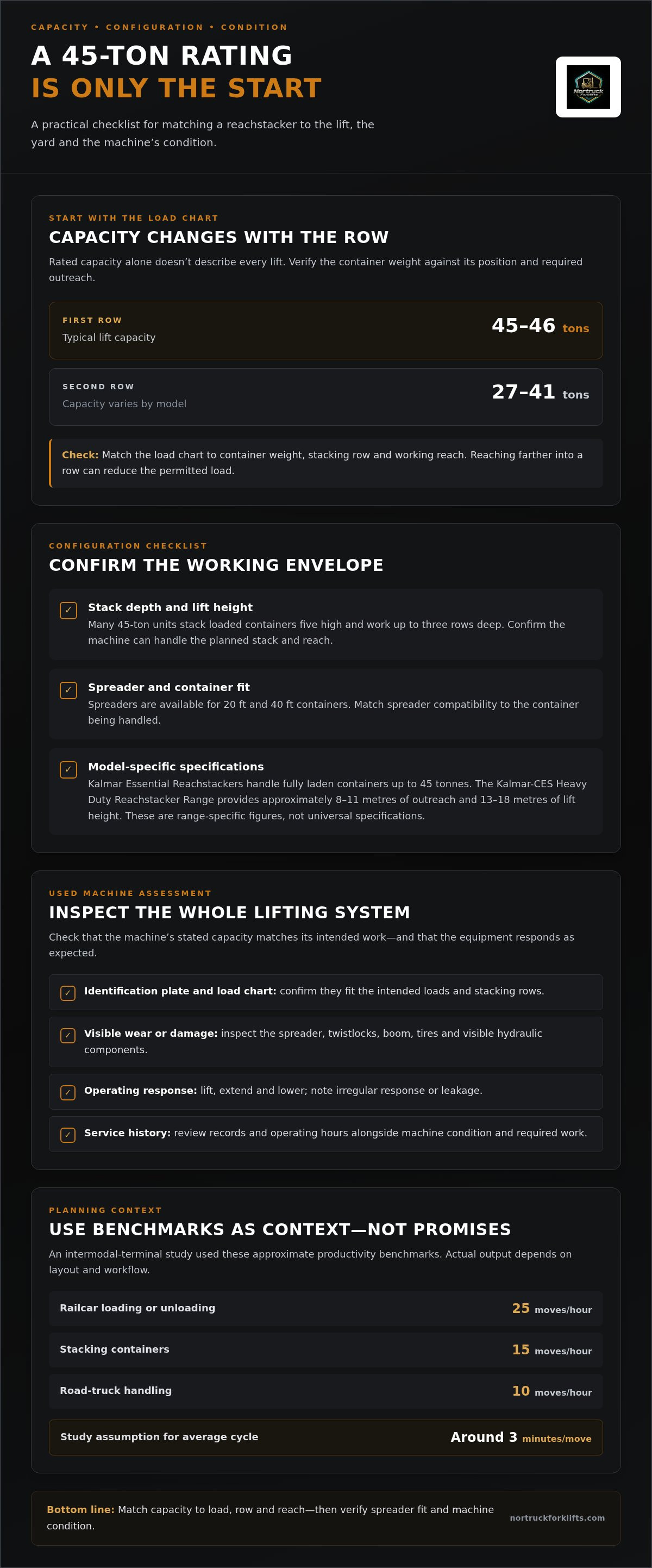
A reach stacker is mobile lifting equipment for loading, unloading, and moving containers around a terminal. A typical container model lifts 45 to 46 tons on the first row, while second-row capacity ranges from 27 to 41 tons, depending on the model. Many 45-ton units stack loaded containers five high and work up to three rows deep.
Capacity depends on the load’s position, so the rated capacity alone does not describe every lift. Check the machine’s load chart against the container weight, stacking row, and required outreach. A container close to the machine may be within its rated capacity, while reaching farther into a row can reduce the permitted load. Use the chart to match the machine’s working range to the moves it will perform.
Specifications also vary between machine types. Kalmar Essential Reachstackers handle fully laden containers weighing up to 45 tonnes. The Kalmar-CES Heavy Duty Reachstacker Range provides approximately 8-11 metres of outreach and 13-18 metres of lift height. These figures describe that range; they shouldn’t be treated as specifications for every 45-tonne machine.
Spreader fit matters, too. Reach stacker spreaders are available for 20 and 40 ft containers, and the correct setup must match the container being handled. Compare rated capacity with container size, lift height, outreach, and the planned stack depth. For example, a 40 ft container destined for a rear row needs suitable spreader compatibility and capacity at that reach.
Productivity benchmarks offer context for planning, not a guaranteed cycle rate. An intermodal-terminal study used 25 moves per hour as an approximate benchmark for railcar loading or unloading. The study used 15 moves per hour for stacking containers and 10 moves per hour for road-truck handling, with an average cycle assumption of around three minutes per move. Equipment layout and workflow affect actual output.
For U.S. operations, emissions requirements depend on the engine configuration, while import treatment depends on the machine’s classification and entry documentation. OSHA rules prohibit hoisting a container when its actual gross weight exceeds either its marked limit or the lifting appliance’s capacity.
Assess a used 45-ton reach stacker in a structured inspection:
- Match the identification plate and load chart to the machine’s intended loads and stacking rows.
- Inspect the spreader, twistlocks, boom, tires, and visible hydraulic components for wear or damage.
- Operate the machine through lifting, extending, and lowering movements, then note irregular response or leakage.
- Review service records and operating hours alongside the machine’s condition and the work it must perform.
These checks connect the stated capacity to the machine’s working condition. A sound assessment considers the whole handling system, from the spreader and load chart to the container’s position in the yard.
Ports, terminals, and intermodal applications
At a seaport, a reachstacker moves containers between quay-side transfer points, storage rows, and road vehicles. Its mobility suits changing yard layouts, and its reach over containers helps operators use space across rows and vertically. The right configuration depends on container flow, available ground space, and how often loads move between transport modes.
Intermodal yards connect rail, road, and sometimes inland waterway movements. A reach stacker can transfer containers between railcars and trucks, then place them in temporary storage while awaiting collection or onward transport. Intermodal yards represented approximately 28.2% of 45-ton reach stacker market revenue in 2025. For a terminal planner, that points to a key fit: matching lifting reach and stacking layout to the yard’s transfer pattern.
Space planning is especially important where land is constrained. Reach stackers can improve yard space utilization by up to 35% compared with alternative container handling methods. That advantage depends on how the yard arranges lanes, stacks, and vehicle access. A layout that prioritizes dense storage may slow access to individual containers, so operators need to balance stack depth against retrieval paths.
Support equipment can also influence throughput. In a modeled multipurpose-seaport scenario, adding a third supporting trailer while using one yard reach stacker raised container productivity from 10.6 to 14.5 lifts per hour. The example shows why a machine should be assessed as part of a handling system, not in isolation. Trailer availability, transfer distances, and coordination between operators all affect the sequence of moves.
Barge work requires a separate fit assessment. Compare quay height, water-level variation, barge dimensions, required negative lift, and container weight at the actual outreach. A standard 45-tonne toplift reachstacker isn’t automatically suitable for this task. Those conditions determine whether its geometry and working envelope align with the vessel and bank.
Reachstackers are also used at inland depots, distribution yards, and industrial sites handling containerized materials. They can stage containers outside warehouses, where access lanes and surface conditions affect safe movement. Heavy-industry tasks may involve bulky loads or specialized tooling, so select equipment to suit the intended load and attachment. A port machine is not automatically right for every industrial task.
For U.S. port projects, the U.S. Environmental Protection Agency’s Clean Ports Program allocates $3 billion for zero-emission port equipment. This funding context can inform terminal equipment planning alongside operational needs. For a port or intermodal operation comparing suitable machines, reachstackers for port terminals are a relevant equipment category to explore.
Rental, purchase, service, and equipment-as-a-service options
Choose how to acquire a machine by considering how often it will be used, your cash-flow preferences, and who will handle operating responsibilities. Then compare the reachstacker’s capacity and working position with the tasks that currently limit terminal throughput.
Rental, Purchase, and Service Options
Rental may suit a defined project or temporary capacity need, while purchase gives an operation direct control over a machine used regularly. Equipment-as-a-service combines equipment access with an agreed service arrangement, with scope set by contract. Before deciding, compare each option’s term, included support, usage conditions, and responsibility for downtime.
A 45-ton reachstacker differs from a 45-ton container handler or heavy forklift through its reach, stacking configuration, and intended container work. A forklift typically serves pallet or unit-load movements, while a reachstacker places containers across rows; compare each machine’s load chart at the actual operating position.
Start with the site requirements. Match container dimensions and loaded weights, yard surface, lane width, stack depth, and lift height to the machine’s capacity chart. Check attachment compatibility too: the spreader must suit the container type and handling task. A terminal moving containers between trucks and storage rows has different needs from a warehouse handling palletized goods.
Throughput bottlenecks can occur outside the lifting cycle. Map where trucks wait, where containers queue, and how far each move travels. If a reachstacker is waiting for trucks, adding lifting capacity alone may not improve flow. If container retrieval is slowed by the stack layout, changing the storage plan may address the constraint more directly.
Lead Times and Delivery Costs
Lead time depends on whether the machine is new or used, its configuration, and its preparation needs. Delivery timing also depends on the machine’s origin, transport route, and destination access. Plan the required arrival window around commissioning and workload, rather than treating dispatch as the only milestone.
Delivery costs depend on transport distance, machine dimensions, loading arrangements, and destination logistics. Purchase price depends on condition, configuration, and included equipment, and is provided after a quote request. To assess operating, maintenance, and parts costs, consider fuel use, operating hours, workload, wear, and parts requirements. A single typical figure would not reflect these differences.
Treat the initial purchase figure as a benchmark, not a complete ownership cost. Compare the quoted configuration and included equipment with the work planned for the yard. For rental or equipment-as-a-service, consider how the term, service coverage, usage conditions, and downtime responsibilities affect the total commitment. For any acquisition route, compare quotes using the same assumptions for operating hours, workload, delivery needs, and parts requirements. This clarifies the decision without making purchase price the only consideration.
45-Tonne reachstacker models
Model labels can conceal differences in hydraulic controls, capacity profiles, and load monitoring. For 45 ton reachstacker sourcing, compare the machine’s intended application and specifications rather than treating two 45-tonne models as equivalent.
Available Reachstacker Models
Kalmar container reachstackers are listed with capacities from 42 to 45 t, while the CHL 45 ton IC Reach stacker is identified as a 45-ton model. The CHL’s variable-pump hydraulic system uses flow sharing and load sensing. Its specifications also include a US Parker CAN-BUS electrical control system, an intelligent load safety system, and fault diagnosis.
Manufacturers Offering 45-Ton Reachstackers
Kalmar and CHL are identified with 45-tonne reachstacker options. Kalmar’s container models cover 42 to 45 t; CHL’s named example is the 45 ton IC Reach stacker. Compare each model’s documented configuration, lifting chart, and intended container work rather than relying on manufacturer name or capacity label alone.
The CHL model’s crane is an ELME 817-type design, made from high-quality steel with a single-tube structure. Its hydraulic flow sharing and load-sensing system describe how hydraulic oil flow responds to simultaneous operating demands. These details help frame a technical comparison, but they don’t replace reviewing the full machine configuration and lifting chart.
Kalmar’s Gloria range spans container and material handling through extra-heavy industrial loads, with lifting capacities from 45 tonnes to 130 tonnes. That wider range illustrates why a model family name doesn’t establish an individual machine’s capacity. Match the exact configuration to the load, attachment, and operating position required at the terminal.
Some Kalmar Gloria diesel, Eco, and ERG450 electric toplift configurations have an optional 50-tonne spreader. This is an attachment rating, not a blanket increase to the reachstacker’s capacity. For 45 ton reachstacker sourcing, compare the chosen spreader, machine, and lifting chart as one configuration before planning lifts.
Use a consistent comparison across models:
- Capacity: Read the model’s lifting chart at the required outreach and stacking position.
- Hydraulic system: Compare systems such as CHL’s variable-pump, load-sensing setup.
- Controls and monitoring: Note CHL’s CAN-BUS controls, load safety system, and fault diagnosis.
- Attachment: Check spreader type and rated capacity against the machine configuration.
This method separates headline capacity from features that determine suitability. For example, a CHL 45 ton IC and a Kalmar model may share a class label, yet differ in controls, hydraulic design, and available configuration. Compare the specification sheet for the exact unit, then assess its operating role and handling requirements.
Engine, transmission, axle, and tire specifications
Engine, transmission, axle, and tire choices affect how a mobile reachstacker travels, lifts, and works across a terminal. Compare the complete configuration with the yard’s routes, surfaces, operating cycle, and required capacity, rather than treating any single component as decisive.
Start with the engine specification and its emissions configuration. Diesel fuel typically represents 30-35% of total operating costs for reach stackers, so fuel use matters to a machine’s operating profile. Compare the engine’s documented output and fuel requirements with the work pattern, including loaded travel, idle periods, and repeated lifting. A duty cycle with frequent container moves differs from occasional material handling.
Assess the transmission as part of the travel system. Consider how the machine responds during loaded starts, direction changes, and travel along the terminal’s usual routes. A reachstacker moving repeatedly between container rows and truck lanes has different operating demands from one handling occasional transfers. Review the transmission type and operating controls against the planned work sequence.
Axles and tires transfer lifting loads to the ground. Their suitability depends on the machine configuration, load distribution, and surface conditions. Review axle details alongside rated capacity and tire specifications, then consider the actual route, whether it includes smooth paved lanes, uneven yard sections, or transitions between surfaces. For a used machine, inspect tire condition and visible axle components, and compare your findings with maintenance records.
Energy use depends on how the machine operates, not just its engine label. Repeated acceleration, extended idling, and long travel distances all affect its operating pattern. Record representative tasks, such as lifting a container from a truck, moving it across the yard, and placing it in a stack. This sequence gives you a practical basis for comparing engine and transmission configurations without assuming identical duty cycles.
During sourcing, assemble the specification details into one comparison:
- Engine: Record fuel type, emissions configuration, and documented output.
- Transmission: Compare type and controls against loaded travel and maneuvering needs.
- Axles: Review configuration alongside the expected loads and yard surface.
- Tires: Match specification and condition to the terminal’s routes.
- Monitoring: Review available load and system monitoring, including sensing functions.
A load-sensing hydraulic setup, such as the variable-pump system described for the CHL 45 ton IC Reach stacker, concerns hydraulic operation. It should not be mistaken for a complete engine, axle, or tire specification. Request the full configuration for the exact machine and compare its components against the tasks it must perform.
Also verify spreader twistlocks, engineered for about 80,000 lock cycles, against expected use. Special heavy reach stacker variants can lift 130 to 180 tons on a hook.
Nortruck Forklifts: Kalmar Heavy Lift Trucks
Nortruck Forklifts advises buyers and sources heavy lifting equipment to suit their operating requirements, including Kalmar Heavy Lift Trucks. Its advisory and sourcing service can help when you are comparing configurations, assessing a new or used reachstacker, or matching lifting capacity to container work.
A useful sourcing discussion starts with the tasks the machine must handle: container type, load, stacking arrangement, and working position. Those details help focus the comparison on relevant specifications rather than capacity labels alone. Nortruck Forklifts also offers Baumann Sideloaders and Combi-Lift 4-way Trucks for other material-handling needs.
Contact Nortruck Forklifts to discuss your operation’s equipment requirements.
Turn your equipment priorities into a sourcing plan
Turn your operational priorities into a decision brief that procurement and terminal teams can use together. Define the loads, movement patterns, site constraints, acquisition preference, and responsibilities that matter most. A shared brief makes it easier to compare proposals on the same basis, identify trade-offs early, and keep the selection focused on the work rather than a headline specification.
Approach 45 ton reachstacker sourcing as a planning decision, not simply a machine search. Bring the people responsible for yard flow, equipment operation, and purchasing into the same discussion. Their perspectives can clarify where flexibility matters, which operating requirements are fixed, and what a practical transition into service involves. That alignment gives your team a clear foundation for evaluating options.
A clear brief makes the next decision more focused. Align your team around the priorities, then use them to guide the selection.
Frequently Asked Questions
What is the price of a new 45-ton reachstacker in the United States?
There isn’t one standard price for a new 45-ton reachstacker; the price depends on the case and is provided after a quote request. Factors include the machine’s configuration, selected attachments, and delivery requirements. A useful comparison starts with the work the machine must perform, then considers which specifications are essential. This helps procurement teams compare suitable configurations rather than treating different equipment packages as equivalent.
What used 45-ton reachstackers are available for sale in the U.S.?
Used options include models sourced for specific requirements, rather than a fixed U.S. inventory list. Nortruck Forklifts sources used heavy lifting equipment across Europe. Listed reachstacker examples include the Kalmar DRF450, a 2008 model, and the SMV Reachstacker SC4537 TC5. For U.S. planning, compare the model and configuration with your operating needs, then account for transport and destination logistics when assessing a potential purchase.
What specifications and lifting capacities should buyers compare for 45-ton reachstackers?
Compare the exact machine configuration, not just its nominal capacity. Check the load chart, spreader compatibility, working outreach, lift height, and stacking arrangement against your planned moves. Review engine, transmission, axle, tire, and control-system details too. Keep units consistent across the machine plate, load chart, and container records. This gives procurement and operations teams a clearer basis for deciding whether a specific unit suits the work.
What U.S. emissions, safety, and import requirements apply to 45-ton reachstackers?
For U.S. operations, emissions requirements depend on engine configuration, and import treatment depends on the machine’s classification and entry documentation. OSHA prohibits hoisting a container when its actual gross weight exceeds its marked limit or the lifting appliance’s capacity.

Article by
Lars Gunnar Tärby
Disclaimer
1. General Information and No AdviceThe information, articles, product descriptions, and specifications provided on this website (www.nortruckforklifts.com) are for general informational and educational purposes only. While we strive to provide accurate and up-to-date content regarding new and used forklifts and heavy machinery, the material published does not constitute professional, technical, or legal advice.
2. Product Specifications and PricingNortruck Forklifts acts as a facilitator for the trade of new and used forklifts. All equipment details, including but not limited to year of manufacture, operating hours, lift capacity, dimensions, conditions, and pricing, are provided based on the information available to us at the time of publication. Specifications and availability are subject to change without prior notice.
3. "As Is" and VerificationAll articles and product listings are provided on an "as is" and "as available" basis without any warranties of any kind, either express or implied. Nortruck Forklifts does not guarantee that the descriptions are entirely error-free, complete, or reliable. Buyers and traders are strongly encouraged to independently verify all technical specifications, machine history, and equipment conditions directly with the seller or an authorized inspector before finalizing any purchase or transaction.
4. Limitation of LiabilityIn no event shall Nortruck Forklifts, its owners, or its contributors be held liable for any direct, indirect, incidental, consequential, or economic loss or damage arising out of the use of, or the inability to use, the information provided on this website, or any transactions facilitated through this platform. This includes, but is not limited to, damages caused by technical inaccuracies, typographical errors, or reliance on the content of our articles.
5. Third-Party LinksOur website may contain links to external websites, dealer networks, or third-party services that are not owned or controlled by Nortruck Forklifts. We have no control over, and assume no responsibility for, the content, privacy policies, or practices of any third-party websites.


