
The buying timeline can matter as much as the 20-ton heavy-duty forklift price. Supplier lead times range from a couple of weeks to a couple of months, depending on order volume and customization.
It’s understandable to want a clear budget and delivery window before committing to a machine of this size. Pricing depends on the specific configuration and is given after a quote request, with mast type, lift height and other specifications shaping the cost.
This guide explains how mast and lift-height choices affect the decision, reviews listed market prices, and outlines what to ask about lead time. You’ll also see which details to compare so you can assess options against your lifting requirements and delivery schedule.
Key Takeaways
- A two-stage mast is listed with a maximum lift height of 4,000 mm. Compare the required lift height with your available overhead clearance and handling layout.
- Price listings cover different machine types, including standard, heavy-duty and container-handling forklifts. Compare equivalent configurations rather than relying on the 20-ton label alone.
- Shipping requirements can affect how a forklift is prepared for transport, so confirm the loading configuration with the supplier.
- Build an operating-cost comparison around your work pattern, including fuel use, servicing needs and expected utilization, rather than focusing only on the purchase price.
- Use capacity, load centre, machine weight and dimensions to assess whether a listed forklift suits your loads and site layout.
Mast type and lift height
A two-stage mast on the standard 20-ton forklift has a maximum lifting height of 4,000 mm. That figure is a useful starting point, but it doesn’t tell you whether the machine suits your racks, loading points or building clearance. Match the lift height to the actual handling task, then compare the mast’s dimensions with the working environment. A higher reach requirement can call for a different configuration, which may affect the quoted price.
Start by measuring the highest point where a load must be placed. Include the load itself, not just the beam or storage level. For example, placing a tall load on an upper rack requires more clearance than lifting a compact load to the same level. Consider where the forklift will operate, too. Doorways, roof structures and overhead equipment can restrict mast movement even when the required lift height is within 4,000 mm.
Mast selection affects how a forklift moves around your site. A mast that reaches the required height must also suit the available aisle space and the route between storage and loading areas. Check the machine’s overall height both while travelling and while lifting. These dimensions serve different purposes: one determines clearance in motion, the other whether the machine can reach the work point.
- Record the lift task: note the maximum placement height and the load’s shape.
- Measure site clearance: include doorways, ceilings and overhead obstacles along the route.
- Compare mast requirements: match the needed reach with the available operating space.
- Request the configuration details: compare the quoted mast type and lift height with your measurements.
For pricing, compare like with like. A quote for a two-stage mast and 4,000 mm maximum lift height shouldn’t be treated as equivalent to a quote with a different mast arrangement or reach. Ask for the lift height and mast configuration to appear clearly in the specification. That makes it easier to identify whether a price difference reflects a different machine setup or other quoted equipment.
Consider the loads handled at full height, too. Maximum lifting height describes reach; it does not mean every load is suitable at that height. Load dimensions, attachments and operating conditions all matter. Share the load and site details alongside your required height when requesting a quote, rather than comparing machines by capacity alone. This helps you assess relevant options and avoid choosing a mast that reaches the target but does not suit the task.
Listed 20-ton forklift prices
Online listings for 20-ton forklifts don’t describe one uniform machine. They include standard diesel forklifts, heavy-duty configurations, container-handling models and CPCD200 forklifts. A listing for a forklift positioner is another category, not automatically a complete truck. Compare the machine type and included equipment before treating two advertised prices as directly comparable.
A headline capacity may describe a particular configuration, not every machine carrying the same capacity label. A container-handling forklift, for example, serves a different application from a standard diesel forklift. A listing that mentions a positioner may refer to an attachment or positioning equipment. Read each product description carefully to understand what the machine includes.
For a useful comparison, match each listing against the same practical criteria. Note the machine type, stated capacity, mast arrangement, lift height and engine options. The standard 20-ton forklift has Euro 5 and EPA 4 engines available as options. Those choices can change the specification being compared, so record them separately rather than assuming identical equipment.
- Separate machine categories: distinguish standard diesel, heavy-duty and container-handling forklifts.
- Check what the listing covers: identify whether it describes a complete truck or a positioner.
- Compare specifications: align capacity, mast, lift height and engine configuration.
- Review the offer scope: note which equipment and configuration the quoted amount includes.
Use the listed market examples as reference points, not as a single standard price for every 20-ton forklift. A listing’s category and configuration explain why advertised amounts can differ. A standard diesel model and a specialized container-handling model shouldn’t be compared as though they were identical. Likewise, a positioner listing shouldn’t be treated as a complete-truck offer without reading its description.
The price depends on the machine type, mast and lift-height requirements, engine options, condition and included equipment; the exact figure is provided in a quote for your case. Set your operating requirements first, then compare offers that describe the same equipment scope. This makes differences easier to interpret and helps you avoid basing a purchase decision on a category label alone.
For another equipment comparison, review heavy-duty industrial forklift options alongside the capacity and handling requirements of your operation with Nortruck Forklifts.
What are typical shipping, delivery, and import costs for a 20-ton forklift?
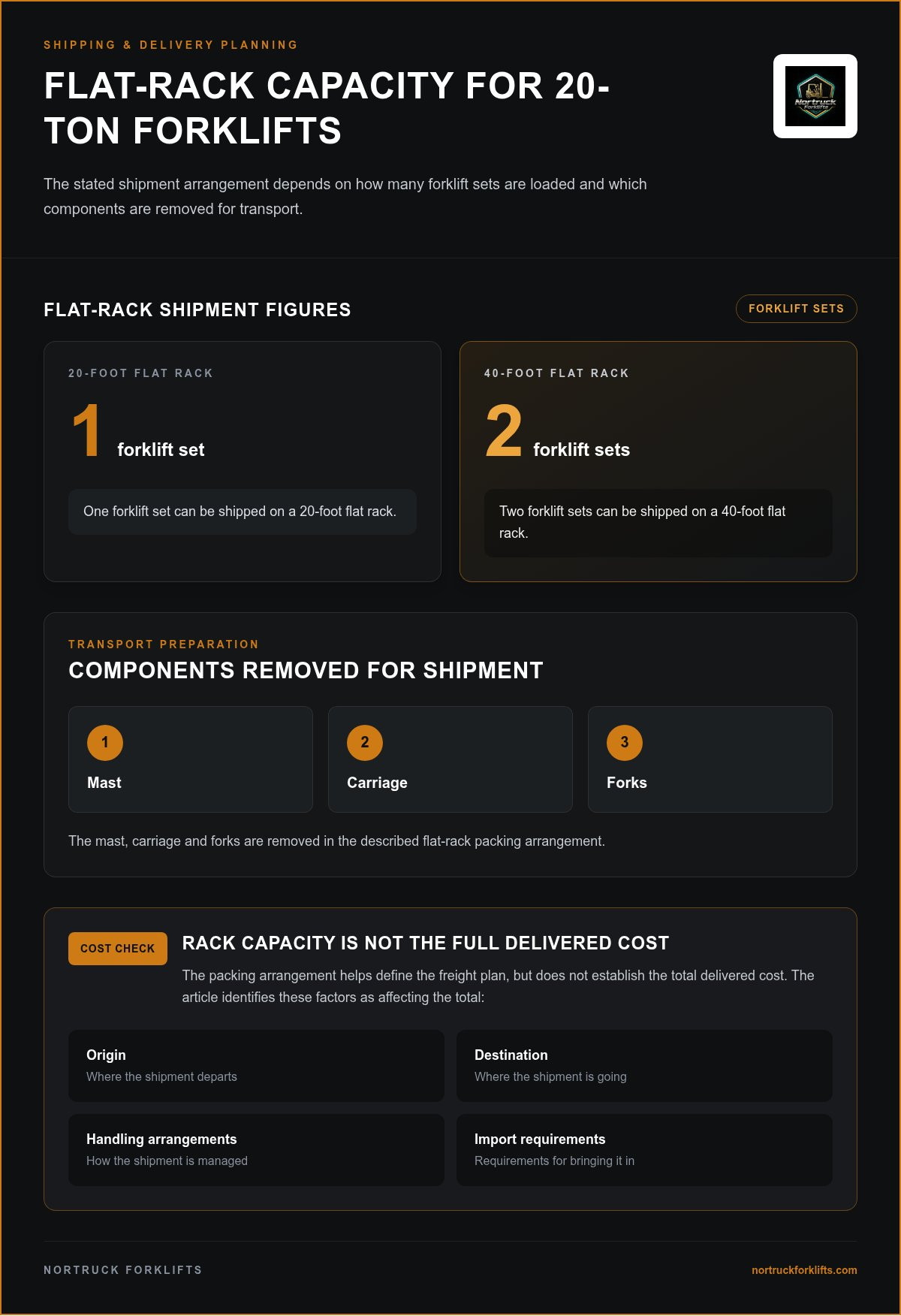
Transport planning begins with the forklift’s size and how it will be prepared for shipment. One forklift set can be shipped on a 20-foot flat rack, or two sets on a 40-foot flat rack, with the mast, carriage and forks removed. That packing arrangement helps define the freight plan, but it doesn’t establish the full delivered cost. The origin, destination, handling arrangements and import requirements all affect the total.
Separate transport costs into clear categories before comparing offers. Freight covers movement between departure and arrival points. Handling may include loading, unloading and moving the machine through terminals. Import-related charges depend on the destination and shipment details. Delivery to the final site is another part of the journey, particularly when access or unloading requires specific arrangements.
- Confirm the shipment configuration: identify whether the load is one set on a 20-foot flat rack or two sets on a 40-foot flat rack.
- Record what is removed: include the mast, carriage and forks in the packing plan.
- Map the route: provide the origin, destination and final delivery point for a comparable freight estimate.
- Clarify included services: distinguish freight from handling, import-related charges and final delivery.
Lead time also affects planning. Supplier lead times for a 20-ton forklift range from a couple of weeks to a couple of months, depending on order volume and customizations. Transport timing is a separate part of the schedule, so allow for the machine’s preparation, shipment and arrival arrangements. A customized order may require different preparation than a standard configuration.
For example, a buyer comparing one forklift set on a 20-foot flat rack with a two-set shipment on a 40-foot flat rack should compare the full shipment scope. Confirm that each estimate describes the same number of sets, removed components, route and delivery endpoint. Otherwise, one figure may cover terminal handling while another may cover only the main freight leg.
Ask for transport and import charges to be itemized, with the shipment configuration and delivery endpoint clearly stated. The total depends on the route, packing, handling, delivery arrangements and destination-specific import charges. This lets you compare the full delivery plan instead of focusing only on freight.
Prepare the receiving site before the forklift arrives. Confirm who will accept delivery, where unloading can take place and how the removed mast, carriage and forks will be handled. Matching these arrangements to the transport plan helps coordinate the journey through to final delivery.
What are the ongoing maintenance, fuel, and operating costs of a 20-ton forklift?
Purchase price is only one part of owning a 20-ton forklift. Fuel, planned maintenance, repairs and daily operating conditions shape the longer-term budget. The standard forklift’s listed Weichai engine rated output is 162 kW, but rated output alone doesn’t determine fuel use. Workload, engine hours, idle time, load weight and site conditions all influence consumption. Build estimates around the jobs the machine will actually perform.
Record operating hours and fuel use during representative shifts. Separate productive lifting from travel, waiting and idling. A machine moving heavy loads across a large yard, for example, may have a different duty cycle from one making short transfers between nearby work points. Track the work pattern alongside fuel records to compare operating scenarios, rather than treating engine output as a measure of fuel consumption.
Plan maintenance around the machine’s condition, working environment and use. Record inspections, servicing, repairs and replaced parts. Note recurring issues and the conditions in which they occur, such as dusty areas or frequent heavy-load handling. A clear maintenance history helps distinguish planned upkeep from unplanned downtime and gives used-equipment buyers useful context when assessing condition and operating needs.
- Track fuel: log fuel use alongside engine hours and the work performed.
- Record maintenance: keep service and repair history with the machine’s operating records.
- Review the duty cycle: compare heavy lifting, travel, idling and waiting in the actual work pattern.
- Assess options carefully: the standard 20-ton forklift has Euro 5 and EPA 4 engines available as options.
Warranty terms can also be part of an ownership comparison. The manufacturer offers standard one-year and two-year warranty options for its forklifts. Treat the stated term as one item in the specification, then read the warranty conditions alongside the machine’s planned use. Don’t assume a warranty removes routine operating expenses or covers every repair. Those costs still depend on the machine, its condition and the work it performs.
For a practical ownership estimate, combine the expected duty cycle, fuel records, maintenance history and warranty terms in one comparison. If two machines have different engine options, compare their configurations and intended work rather than assuming their operating costs match. A standard 162 kW rated output identifies engine power, not fuel use per hour. This distinction keeps the budget grounded in operational evidence instead of unsupported consumption assumptions.
Before choosing a 20-ton forklift, write down the work pattern, site conditions and maintenance records you need to evaluate. Use the same categories for each machine under consideration. That makes fuel and upkeep easier to compare, and shows which operating factors carry the greatest weight in your specific application.
Forklift truck
A 20-ton label is only one part of a forklift’s specification. The standard 20-ton diesel forklift is listed with a weight of 30,000 kg and dimensions of 6,300 × 2,930 × 3,920 mm. Those figures matter when matching the truck to site access, available working space and the loads it must handle. Review them alongside capacity before comparing machines, especially when operating areas have tight routes or limited room for manoeuvring.
The standard forklift has a 900 mm load centre. This measurement describes the distance from the fork face to the load’s centre of gravity, and it helps explain why load shape matters. A long or unevenly distributed load can place its centre farther forward than a compact load. The listed standard 20-ton diesel forklift is described as able to load and lift up to 24 tons, but that figure shouldn’t be treated as a promise for every load position or configuration.
Use a consistent specification checklist when reviewing a forklift listing:
- Capacity: compare the stated rating with the weight and shape of your typical loads.
- Load centre: note the 900 mm figure and consider where each load’s centre of gravity sits.
- Dimensions: compare the 6,300 × 2,930 × 3,920 mm measurements with routes and working areas.
- Machine weight: include the listed 30,000 kg when planning site movement and placement.
A bulky load may need closer assessment than a compact load of similar weight. Capacity alone does not describe the full handling task. Load dimensions, positioning and operating conditions affect whether a forklift suits the work. Document the heaviest and bulkiest loads separately, then compare the machine’s stated capacity and load-centre details with those examples.
Forklift listings also span different capacity classes. The market examples include 25-ton and 30-ton diesel forklifts, alongside 20-ton models. Compare the rated capacity and intended work rather than assuming a higher-capacity truck automatically fits your operation better. A larger machine’s dimensions and weight can influence whether it fits the site layout. A 20-ton model may suit one task, while a different capacity class may better match another.
Before shortlisting a truck, write down your typical load weight, load dimensions, handling points and site constraints. Then compare those details with the machine’s capacity, 900 mm load centre, 30,000 kg listed weight and overall dimensions. This process turns a broad capacity label into a practical specification comparison and helps keep the selected forklift aligned with the actual work.
Nortruck Forklifts: Kalmar Heavy Lift Trucks
Nortruck Forklifts advises buyers on Kalmar Heavy Lift Trucks and sources new and used heavy lifting equipment. Its advisory service can help when you’re comparing heavy-duty machinery, assessing equipment options or narrowing down a truck for a specific handling task. The right choice depends on the loads, operating environment and required configuration, not the capacity label alone.
Share your load profile, working conditions and key specification needs to support a focused discussion. Nortruck Forklifts can also advise on Baumann Sideloaders and Combi-Lift 4-way Trucks when those equipment types better match the handling application.
Contact Nortruck Forklifts to discuss your equipment requirements.
Move From Shortlist to a Clear Equipment Decision
Turn your shortlist into a practical purchase brief. Describe the loads, site conditions and operating priorities that matter most, then use those requirements to discuss the 20 ton heavy duty forklift price for your application. A clear brief helps keep the conversation focused on equipment suitability and the details that shape a quote.
Nortruck Forklifts offers Kalmar Heavy Lift Trucks, Baumann Sideloaders and Combi-Lift 4-way Trucks. If your handling needs span different load types or work areas, share that context when discussing your options. The right next step is a focused conversation about the equipment that fits your work, not a rushed decision based on a headline figure.
With your requirements clearly set out, you can move ahead with greater confidence and a more informed equipment decision.
Frequently Asked Questions
What is the typical lead time for suppliers' 20 ton forklift?
Lead times range from a couple of weeks to a couple of months, depending on order volume and customizations. The schedule can vary with the requested machine configuration and preparation. For planning, distinguish supplier lead time from the later transport and delivery stages. Provide the required specifications and destination when discussing timing, so the estimate reflects your intended order and receiving arrangements.
What is the price of a new 20-ton heavy-duty forklift in the United States?
The 20 ton heavy duty forklift price in the United States depends on the machine and its specification, rather than a single standard figure. Mast type, lift height, engine options and included equipment all shape the quote. Freight and delivery arrangements also affect the total budget. Define your operating requirements first, then compare quotes that cover the same configuration and delivery scope.
How much does a used 20-ton forklift cost in the U.S.?
The 20 ton heavy duty forklift price for a used machine depends on its condition, operating history, configuration and included equipment. Start by reviewing the machine’s records alongside its specification, rather than judging by capacity alone. For example, compare machines intended for the same work and with similar equipment. Include transport and delivery arrangements in your budget comparison to assess the full purchase decision.
Which brands sell 20-ton forklifts, and how do their prices compare?
Nortruck Forklifts offers Kalmar Heavy Lift Trucks, Linde Forklifts and Toyota Forklifts, among other equipment. Brand names alone do not make prices comparable. Align the intended task, capacity, configuration, condition and included equipment before assessing offers. Two listings may describe heavy-duty forklifts but still suit different handling applications.
What specifications affect the price of a 20-ton forklift?
Mast type, lift height, engine option, machine category and included equipment affect the specification being priced. The intended application also matters because general handling and container work call for different equipment requirements. Before requesting a quote, write down the loads, handling task and site constraints. Use those details to compare offers with matching specifications and identify what each quoted configuration includes.

Article by
Lars Gunnar Tärby
Disclaimer
1. General Information and No AdviceThe information, articles, product descriptions, and specifications provided on this website (www.nortruckforklifts.com) are for general informational and educational purposes only. While we strive to provide accurate and up-to-date content regarding new and used forklifts and heavy machinery, the material published does not constitute professional, technical, or legal advice.
2. Product Specifications and PricingNortruck Forklifts acts as a facilitator for the trade of new and used forklifts. All equipment details, including but not limited to year of manufacture, operating hours, lift capacity, dimensions, conditions, and pricing, are provided based on the information available to us at the time of publication. Specifications and availability are subject to change without prior notice.
3. "As Is" and VerificationAll articles and product listings are provided on an "as is" and "as available" basis without any warranties of any kind, either express or implied. Nortruck Forklifts does not guarantee that the descriptions are entirely error-free, complete, or reliable. Buyers and traders are strongly encouraged to independently verify all technical specifications, machine history, and equipment conditions directly with the seller or an authorized inspector before finalizing any purchase or transaction.
4. Limitation of LiabilityIn no event shall Nortruck Forklifts, its owners, or its contributors be held liable for any direct, indirect, incidental, consequential, or economic loss or damage arising out of the use of, or the inability to use, the information provided on this website, or any transactions facilitated through this platform. This includes, but is not limited to, damages caused by technical inaccuracies, typographical errors, or reliance on the content of our articles.
5. Third-Party LinksOur website may contain links to external websites, dealer networks, or third-party services that are not owned or controlled by Nortruck Forklifts. We have no control over, and assume no responsibility for, the content, privacy policies, or practices of any third-party websites.


