
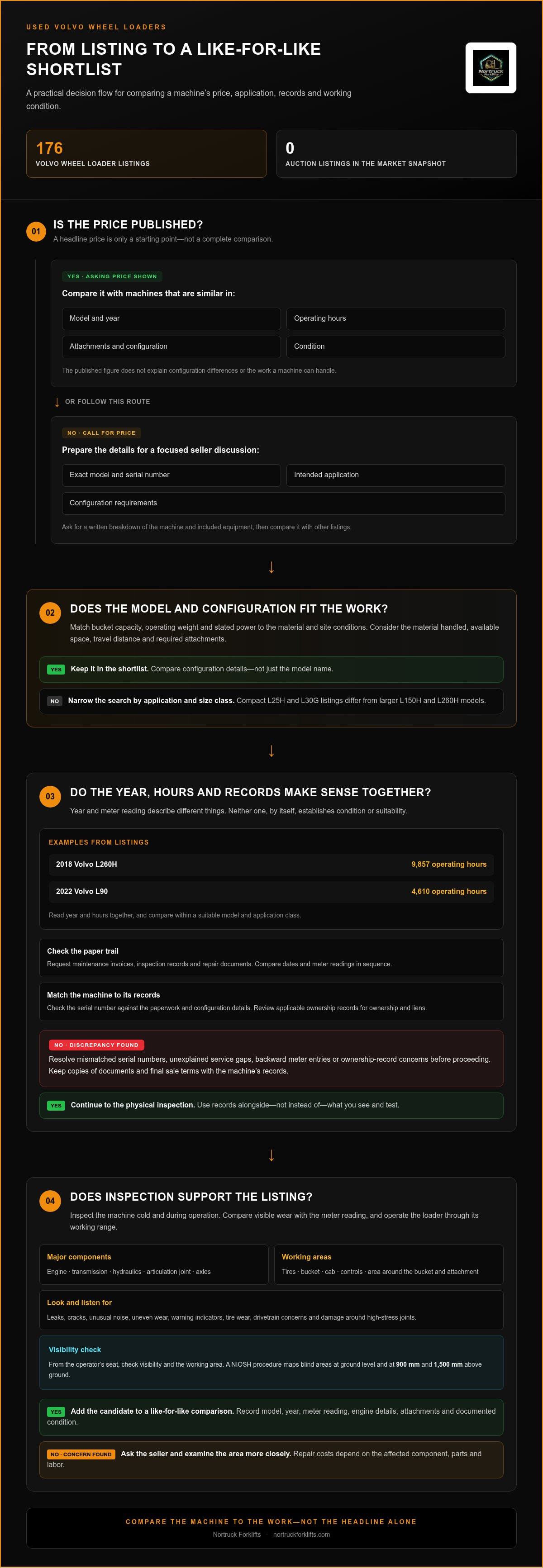
A low asking price doesn’t tell you whether a wheel loader suits the job. An October 2026 U.S. market snapshot shows 176 Volvo wheel loader listings, with no auction listings. The right machine depends on matching its model, year, hours, configuration and condition to the work it needs to do. Used Volvo wheel loader sourcing is more effective when the search starts with those operating requirements, not a listing headline.
Comparing machines by price and age is useful, but those details matter only in relation to the work the loader must do. This guide explains how to define your requirements, review listing details, compare purchase formats and understand sourcing costs. It also covers how to choose a sourcing partner and how expert advice can help identify a machine suited to your operation.
Key Takeaways
- Compare listings by configuration and working condition, not asking price alone, and assess visibility as part of the inspection.
- Use model year and operating hours together to build a more useful picture of a machine’s likely fit for the work.
- Interpret meter readings alongside operating history and machine condition rather than treating hours as a standalone measure.
- Understand how auction and fixed-price formats differ before deciding which buying route suits your requirements.
- Prepare the machine’s serial number, configuration details and intended application to make dealer discussions more focused.
Used Volvo wheel loader listings
A useful listing comparison starts with the loader’s model, configuration, condition and intended work. A market snapshot lists 176 Volvo wheel loader listings, with no auction listings.
For a practical inspection perspective, watch this used wheel loader appraisal walkthrough:
Available Loader Listings
Listings can span compact loaders such as the L25H and L30G, through larger models such as the L150H and L260H. Compare each machine’s bucket capacity, operating weight and stated power against the material and site conditions it must handle. Volvo, Caterpillar, John Deere and Komatsu loaders should be compared by application, configuration, condition and support needs, not brand name alone.
Check photographs for tire wear, leaks, structural damage and signs of repairs. The National Institute for Occupational Safety and Health describes a visibility procedure that maps blind areas at ground level and at 900 mm and 1,500 mm above ground, which can inform a used loader’s visibility inspection.
Asking Prices and Call-for-Price Listings
An asking price provides a published starting point, while a call-for-price listing requires a direct discussion with the seller. In either case, compare machines with similar models, years, hours, attachments and condition. A headline figure alone does not explain differences in configuration or the work a machine can handle.
For a call-for-price listing, prepare the exact model and serial number, intended application and configuration requirements. Ask for a written breakdown of the machine and included equipment, then compare it with other listings. This keeps the discussion focused on comparable machines rather than assumptions about value.
Pre-Purchase Inspection Checks
Inspect the engine, transmission, hydraulics, articulation joint, axles, tires, bucket, cab and controls. Look for leaks, cracks, unusual noise, uneven wear and warning indicators. Operate the loader through its working range and check its response. Common concerns include hydraulic leaks, worn tires, drivetrain issues and damage around high-stress joints. Repair costs depend on the affected component, parts and labor.
To assess a machine before purchase, inspect it cold and during operation, and compare visible wear with the meter reading. From the operator’s seat, check visibility and inspect the working area around the bucket and attachment.
Service History and Ownership Verification
Request maintenance invoices, inspection records and repair documents, then compare their dates and meter readings. Match the serial number on the loader to its paperwork and configuration details. To verify service history, hours, ownership and liens, review the seller’s records and the applicable ownership records for the machine’s jurisdiction.
Look for consistent ownership documents and evidence that any recorded security interests have been addressed before payment. Resolve discrepancies such as mismatched serial numbers, unexplained gaps in service records or meter entries that move backward before proceeding. Keep copies of the documents and final sale terms with the machine’s records.
Model, year, and operating hours
Model, production year and operating hours each describe a different aspect of a used Volvo loader. Review them together, then compare the machine’s configuration with the work it must perform. A newer year does not automatically mean less use, and a low meter reading alone does not establish condition. Records and physical inspection provide essential context.
Start with the model and application
Identify the exact model before comparing listings. A Volvo L90 and a Volvo L260H serve different equipment requirements, so compare machines within a suitable size and application class. Consider the material handled, space available, travel distance, and attachments required. These factors help narrow the search to machines that can perform the intended loading cycle.
Then compare configuration details rather than relying on the model name alone. For example, a listing for a 2014 Volvo L150H identifies a Volvo D13J turbocharged diesel engine and states 295 HP, with engine output also given as 220 kW. Such details help buyers distinguish a specific machine from a broad model comparison. Match listed specifications to the work, site conditions, and required attachment.
Put the year in context
The year helps establish a machine’s age, but it does not show how intensively it worked or how it was maintained. A listed 2018 Volvo L260H had 9,857 operating hours. A listed 2022 Volvo L90 had 4,610 operating hours. These examples show why year and hours should be read together, not used as competing shortcuts.
For each candidate, record its model and year, then compare the meter reading with available service records and visible wear. Check that the listing, identification plate, machine documents and inspection findings are consistent. Resolve any differences in the model or year across records before comparing the machine with other candidates.
Interpret operating hours carefully
Operating hours show accumulated use, but the reading alone cannot explain the work performed. Handling abrasive material, repeated short cycles and demanding site conditions can affect wear differently. Treat the meter reading as one part of your assessment, alongside maintenance history, component condition and operating behavior.
During inspection, compare the meter reading with wear on the controls, pedals, seat, tires, bucket and articulated joints. These observations do not replace records, but they can help identify questions for the seller and areas to examine more closely. Request dated maintenance documents and compare their recorded hours in sequence, looking for clear progression and unexplained gaps.
Build a like-for-like shortlist
Create a comparison table covering model, year, meter reading, engine details, attachments and documented condition. Compare machines with different configurations separately. This helps prevent a newer year or lower reading from outweighing a loader that better fits the application.
For a focused search, outline your required work and review relevant Volvo wheel loader sourcing guidance. A clear shortlist makes technical differences easier to discuss and helps keep the final choice grounded in operating requirements.
Operating meter readings
An hour-meter reading is a useful record of accumulated machine use, not a complete measure of condition. A Volvo L90H in Texas was listed with a meter reading of 17,630 hours. That figure gives buyers a starting point for examining the machine’s history, wear and maintenance records. It does not explain the type of work performed or how the loader was cared for.
Read the meter alongside evidence
Record the displayed hours during inspection and compare them with dated service invoices, inspection documents and earlier listing details. The sequence should make sense: later records should not show fewer hours than earlier ones. If an invoice records more hours than the current display, for example, resolve the discrepancy before relying on the meter reading.
Compare the meter reading with the machine’s visible condition. Check the operator controls, seat, pedals, tires, bucket edges and articulation area for wear consistent with documented use. A worn control surface alongside a very low reading merits closer review, as does a high reading paired with records of recent component work. Neither observation proves a fault, but both help focus the inspection.
Understand what hours can and cannot tell you
Two Volvo loaders showing the same hours can have different operating histories. Repetitive loading, material type, site conditions and maintenance practices affect component wear in different ways. The meter cannot reveal those conditions. Review the documented work history and inspect the engine, transmission, hydraulics and drivetrain instead of ranking candidates by hours alone.
Ask what the meter records and whether it has been replaced or repaired. If the seller explains a discrepancy, compare that explanation with invoices and service entries. Resolve unexplained gaps as a recordkeeping issue rather than adjusting the displayed figure yourself. Keep the reading, supporting documents and seller’s explanation together in the machine file.
Use a consistent comparison method
For each Volvo candidate, note the model, displayed hours, inspection date, service-record readings and observed wear. Apply the same checklist to every machine so that each receives a consistent assessment. Separate documented facts from observations, and record any differences clearly.
- Meter: Photograph the display and record the inspection date.
- Records: Arrange service entries by date and compare their hour readings.
- Condition: Match observed wear with the stated use and maintenance history.
- Follow-up: Resolve inconsistencies before relying on hours in your purchase decision.
This method makes the 17,630-hour Volvo L90H example easier to interpret: the reading is a relevant data point, but its meaning depends on records and physical evidence. For used Volvo wheel loader sourcing, a well-supported history gives the meter context and helps buyers compare machines on more than one figure.
Buying formats
Buying format affects how you compare offers, set a purchase budget and complete the transaction. A 2022 Volvo L220H in Poland was listed as a Buy Now machine, illustrating one fixed-price format alongside negotiated sales and auctions.
For a U.S. purchase, shipping, sales tax and registration or title costs depend on the machine’s location, destination, transport arrangements and applicable jurisdiction. Include these items in the landed-cost calculation, and establish which charges are covered by the seller’s terms and which are handled separately.
Fixed-price and negotiated purchases
A fixed-price listing states the purchase figure, while a negotiated sale involves discussing the machine and transaction terms directly. Neither format removes the need to compare model, configuration, condition and included attachments. Apply the same specification checklist to each candidate so you can assess price differences against equipment differences.
Before agreeing to a purchase, document the machine identity, included equipment, payment schedule, collection arrangements and any conditions attached to the sale. A Buy Now listing may let a buyer proceed on its stated terms, while a negotiated purchase allows discussion before agreement. Read the written terms carefully, because the listing format alone does not describe every transaction detail.
Auction purchases
An auction uses bidding rather than a conventional fixed asking price. Set a purchase limit based on the machine’s suitability and your total acquisition budget, including transport and applicable transaction charges. Keep that limit separate from any bid increment or auction fee stated in the sale conditions.
Review the auction rules before bidding. Confirm the closing process, payment timing, collection requirements and whether inspection access is available. Treat the final bid as one part of the total commitment. A machine far from its destination may need a different transport plan from one closer to the operating site.
Financing, warranty and returns
Financing, warranty coverage and return rights depend on the seller’s written terms and the transaction agreement. Do not assume a used loader includes financing, a warranty or a return period. Compare the actual terms for the machine, including coverage scope, exclusions, duration, payment obligations and the process for raising a concern.
Keep relevant documents in the purchase file, including the signed agreement, invoice, inspection records and any warranty or financing paperwork. If a term matters to your decision, make sure it is stated clearly in the agreement before payment. Written transaction terms are more reliable than verbal explanations.
Plan the delivered cost
Prepare a cost checklist before selecting a U.S. machine. Include the agreed purchase amount, transport route, loading and delivery arrangements, applicable sales or use taxes, and title or registration charges where required. Costs depend on the transaction, machine location and destination; confirm in writing how each item is handled.
For an international purchase, include the route and destination’s import and delivery requirements in your planning. Compare the complete delivered arrangement, not just the listing format. A clear breakdown helps you assess a fixed-price Volvo loader against an auction or negotiated alternative on consistent terms.
Contacting dealers
A focused first message helps a dealer understand which Volvo wheel loader suits your work. Include the machine type, application, operating environment, required configuration and destination. A loader for repetitive material handling, for example, may need a different setup from one used in a confined yard. Clear priorities make the initial discussion more useful.
Prepare the machine details
If you’re asking about a specific listing, include its model, year, serial number and advertised configuration. Reviewing the Volvo machine’s serial number and configuration details before quoting can help reduce fitment issues and sourcing delays. Name the attachment or configuration you need, and describe the work it must handle.
For a broader search, explain your essential operating requirements instead of requesting a model without context. Describe the material, site conditions, duty cycle and constraints that affect the machine choice. Separate required features from preferences to keep the shortlist relevant if a listing or configuration changes.
Make the request easy to answer
Organize your inquiry so each point is easy to address. Attach or reference the listing, then use a short checklist:
- Application: Describe the work and material handled.
- Machine: Give the Volvo model, year and serial number, if available.
- Configuration: Specify the required attachment and relevant setup.
- Destination: Identify where the loader needs to operate or be delivered.
- Decision criteria: Explain which requirements are essential and which are flexible.
This format helps keep the conversation specific. If you’re comparing a listed L90H with another candidate, identify both machines and the differences you need assessed. Avoid treating a model name as a complete specification; configuration details affect whether a machine suits your intended work.
Clarify the next steps
Ask for a written quote tied to the machine’s serial number and configuration. Compare the listed equipment, transaction terms and included attachments with your original requirements. If the proposed machine differs from your request, identify the difference before proceeding. Keep the quote and related correspondence together for a clear record.
For international sourcing, provide the destination early. Delivery location can shape the practical arrangements and keep discussions aligned with the intended purchase. When comparing offers, use the same specification and destination details for each inquiry so differences between proposals are easier to understand.
A prepared request gives the dealer a concrete starting point, whether you have a specific Volvo listing in mind or need help narrowing the search. Start with the application and configuration requirements, then discuss machine details and the quotation.
Nortruck Forklifts: Kalmar Heavy Lift Trucks
Nortruck Forklifts helps buyers source heavy lifting equipment and assess options against their operational requirements. Turn to the company when you need to compare equipment types or find a solution for demanding material-handling work.
Its range includes Kalmar Heavy Lift Trucks, Baumann Sideloaders, and Combi-Lift 4-way Trucks. Each serves a different handling need, so the right conversation starts with your materials, worksite and movement requirements. Share those priorities to focus the discussion on equipment suited to your operation, rather than choosing by name alone.
If your search includes a broader lifting requirement alongside a wheel loader, Nortruck Forklifts can help you consider relevant equipment options. Contact Nortruck Forklifts to discuss your requirements.
Put Your Equipment Decision Into Motion
Start by turning your operational priorities into a clear purchase brief. Identify the work the loader must handle, the conditions it will face and the requirements that matter most to your team. This gives your search practical direction and ties the final decision to day-to-day use.
Used Volvo wheel loader sourcing works best when it addresses a defined equipment need, rather than focusing on a particular machine alone. Share your priorities with Nortruck Forklifts to discuss the right direction for your operation. The specific machine and purchase circumstances will shape the final choice.
A considered equipment decision starts with the right questions. When you’re ready to move your search forward, contact Nortruck Forklifts to discuss your requirements.
Frequently Asked Questions
Where can I find used Volvo wheel loaders for sale in the United States?
Search U.S. dealer inventories, equipment marketplaces, and direct seller listings, then compare machines by location and configuration. A market snapshot recorded 176 Volvo wheel loader listings, with no auction listings in that snapshot. For used Volvo wheel loader sourcing, narrow the search by model, intended application, and delivery destination. Contact sellers with the listing details and serial number to discuss the specific machine.
What are the most popular used Volvo wheel loader models and their specifications?
Listing examples include compact models such as the L30GS and L35G, alongside larger loaders such as the L90H. A listed L30GS has a 1.2 cu yd bucket capacity; a listed L35G has 74 HP and a 1.6 cu yd bucket. A listed L90H has 184 HP and an operating weight of 31,968 - 38,140 lbs. Compare specifications with the material, site and loading task.
What is the typical price of a used Volvo wheel loader by model, year, and hours?
There is no single typical price across Volvo models, years and operating hours. The asking figure depends on condition, configuration, attachments, service record, location and sale format. Compare similar machines on these details, and include transport and transaction costs in your assessment. For a call-for-price listing, provide the model and configuration to support a specific quotation.
How can I source used Volvo wheel loaders from auctions, dealers, or international sellers safely?
Use a consistent process for auction, dealer and international purchases: identify the machine by serial number, review its documents, inspect its condition and read the transaction terms before committing. For an overseas machine, clarify the delivery route, included equipment, payment steps and responsibility for transport arrangements. Keep written records of the agreed machine, configuration, sale terms and delivery responsibilities.
What are common problems and repair costs for used Volvo wheel loaders?
Common concerns include hydraulic leaks, worn tires, drivetrain issues and damage around high-stress joints. Repair costs depend on the affected component, parts and labor.

Article by
Lars Gunnar Tärby
Disclaimer
1. General Information and No AdviceThe information, articles, product descriptions, and specifications provided on this website (www.nortruckforklifts.com) are for general informational and educational purposes only. While we strive to provide accurate and up-to-date content regarding new and used forklifts and heavy machinery, the material published does not constitute professional, technical, or legal advice.
2. Product Specifications and PricingNortruck Forklifts acts as a facilitator for the trade of new and used forklifts. All equipment details, including but not limited to year of manufacture, operating hours, lift capacity, dimensions, conditions, and pricing, are provided based on the information available to us at the time of publication. Specifications and availability are subject to change without prior notice.
3. "As Is" and VerificationAll articles and product listings are provided on an "as is" and "as available" basis without any warranties of any kind, either express or implied. Nortruck Forklifts does not guarantee that the descriptions are entirely error-free, complete, or reliable. Buyers and traders are strongly encouraged to independently verify all technical specifications, machine history, and equipment conditions directly with the seller or an authorized inspector before finalizing any purchase or transaction.
4. Limitation of LiabilityIn no event shall Nortruck Forklifts, its owners, or its contributors be held liable for any direct, indirect, incidental, consequential, or economic loss or damage arising out of the use of, or the inability to use, the information provided on this website, or any transactions facilitated through this platform. This includes, but is not limited to, damages caused by technical inaccuracies, typographical errors, or reliance on the content of our articles.
5. Third-Party LinksOur website may contain links to external websites, dealer networks, or third-party services that are not owned or controlled by Nortruck Forklifts. We have no control over, and assume no responsibility for, the content, privacy policies, or practices of any third-party websites.


