
Could a Baumann sideloader with the right headline capacity still be the wrong choice for your yard? When searching for a Baumann sideloader for sale, it’s easy to focus on the listing and overlook details that determine whether a machine suits your loads, routes and working environment.
Capacity alone doesn’t tell you whether the configuration fits your materials, travel routes or available space. For a used machine, you also need to review its condition and performance information before comparing it with a new option. This guide explains how to define your requirements, assess the information available for a specific machine and compare new and used sourcing options. Nortruck sources new and used equipment across Europe and can offer guidance based on your needs. With more than 40 years of lifting-equipment experience, Lars G Tarby can help you discuss the details to confirm before you commit, including model, year, capacity, configuration, condition and availability.
Key Takeaways
- Start with your load dimensions, handling route and working environment to assess whether a sideloader fits the job.
- Compare capacity at the stated load centre alongside lift height, mast configuration and the dimensions of the loads you handle.
- When evaluating a Baumann sideloader for sale, look beyond the listing headline and confirm the machine’s identity, specification and condition.
- Review documentation and arrange a hands-on inspection as separate steps before committing to a machine.
- Share your operating requirements with Nortruck to discuss sourcing suitable new or used options across Europe. Confirm each machine’s details and availability.
Is a Baumann sideloader the right choice for your material-handling operation?
Start with the work, not the listing. A Baumann sideloader may suit an operation that regularly moves long or awkward loads, but the right fit depends on how those loads travel through your site and on the confirmed specification of the individual machine.
A sideloader is a forklift designed to carry suitable long loads alongside its chassis, supporting transport and storage where handling them in front of the truck may be impractical. That makes it a candidate for some operations, not an automatic fit. In material handling, the route, storage method and movement of goods all affect equipment choice.
Which loads and working environments may suit a sideloader?
Long or bulky materials may suit this type of truck, subject to the machine’s verified capacity and configuration. Before assessing a Baumann sideloader for sale, record the load’s length, width, weight and centre of gravity, along with how often it needs to be moved. These details give you a practical basis for checking whether a candidate can handle the task.
Next, map the working environment. Note aisle width, floor condition, turning space, storage layout and whether the truck will operate indoors, outdoors or in both settings. A load may fall within the stated capacity and still be difficult to move through a confined route or position in a particular storage area. Check the application against machine-specific information rather than relying on a general listing description.
When should you compare other specialist forklift types?
Consider alternatives if your handling process requires movement in multiple directions, or if the loads and layout call for a different truck configuration. Compare options against the same loads, routes and storage tasks. Neither design is universally better. For a related option, see the Combi-Lift 4-way truck sourcing guide.
Treat each machine as a candidate until its details and fit are confirmed. Check the stated specifications against your loads and site, then verify current availability before making plans. Sharing your operating requirements with an experienced equipment adviser can help focus the comparison on suitable options, rather than on a model name or headline capacity alone.
Which Baumann sideloader specifications should you verify before buying?
Compare the specification of the individual machine, not a general description of the range. Capacity, dimensions and configuration can vary, so a listing headline alone doesn’t prove that the truck will handle your load. Ask for the capacity plate and manufacturer documentation for that specific machine, then compare the details with your operating plan. Equipment needs to fit the integrated flow of goods, not just one lift in isolation.
Rated capacity tells you what a truck can lift under its stated conditions. Check it against your load centre and the machine’s documented configuration.
How do load capacity and dimensions affect suitability?
Match the load’s weight and centre of gravity to the documented capacity at the relevant load centre. Don’t infer lifting ability from a model name or an advertised headline. Then check lift height and mast configuration against rack levels, doorways, overhead clearance and the space needed to position a load. If the documents don’t specify a detail, mark it for confirmation rather than treating it as known.
Which machine details should appear in a buyer comparison?
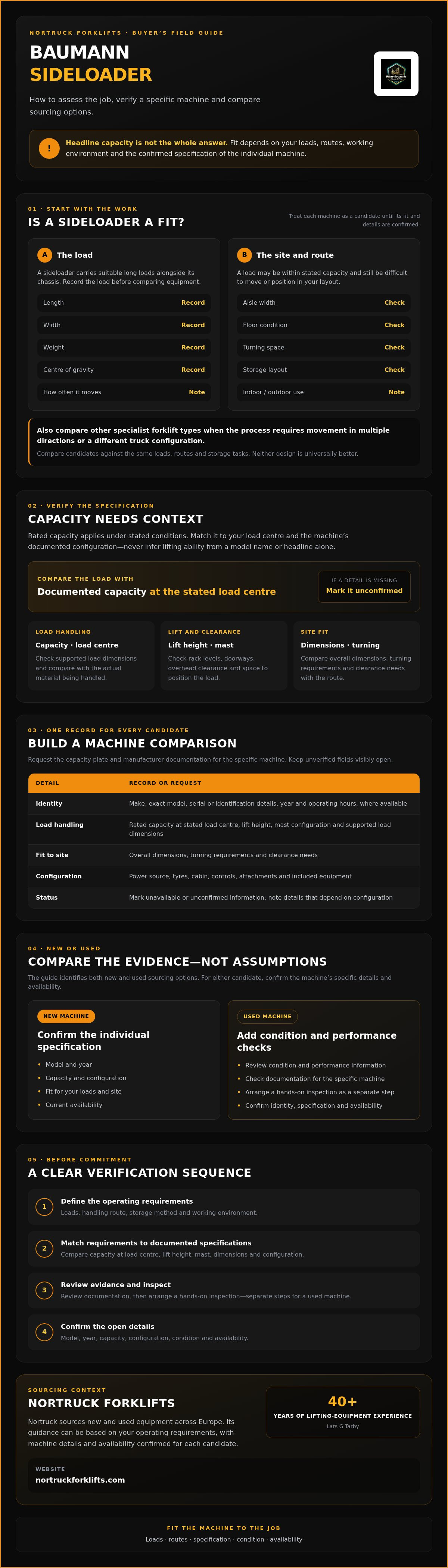
Use one consistent record for every candidate. Include the information below and leave unverified fields visibly open. This makes gaps clear and helps you ask focused questions before comparing machines.
| Detail to compare | What to record or request |
|---|---|
| Identity | Make, exact model, serial or identification details, year and operating hours, where available |
| Load handling | Rated capacity at stated load centre, lift height, mast configuration and supported load dimensions |
| Fit to site | Overall dimensions, turning requirements and clearance needs |
| Configuration | Power source, tyres, cabin, controls, attachments and included equipment |
| Status | Enter “unavailable” or “unconfirmed” wherever information hasn’t been verified. Note if it depends on configuration |
For each Baumann sideloader for sale, request evidence that connects the machine’s identity to its specification. Check that the identification plate corresponds with the supplied records, and ask for clarification if the capacity, load centre or configuration differs between documents. Record unknowns plainly. A blank field is more useful than an assumption.
Once you have a shortlist, use this comparison to discuss your load and site requirements with an equipment adviser. Nortruck provides sales and advisory support for sourcing new and used heavy equipment across Europe. You can discuss Baumann sideloader requirements, with each machine’s details and availability confirmed individually.
New or used Baumann sideloader: how to compare the sourcing options
Assess a new machine and a used one against the same operational requirements. Neither is automatically the better fit. Compare confirmed specifications, condition, supporting documentation and suitability for your handling task, rather than relying on listing phrases such as “ready to work” or “low hours.” Current new and used options depend on sourcing, so confirm each machine’s details and availability before making plans.
When comparing equipment sourced across Europe, apply the same questions to every candidate, whether it’s new or previously operated. Look at the evidence for each machine and note which details still need confirmation.
What should buyers establish when considering a used sideloader?
Ask for the machine’s identification details, maintenance records and inspection evidence where available. Compare reported operating hours with the service history, and arrange a physical or independent assessment where appropriate. Request written details of reported faults, repairs and included components. If records are missing or answers remain unclear, note the gap and consider how it affects your assessment instead of treating an assurance as verified evidence.
Condition and documentation help describe a machine’s history, but they don’t establish whether it suits your operation. Check the specification against your loads and site, and clarify any uncertainty before proceeding. If the truck will be used in the UK, consult the HSE’s lift truck safety guidance for information relevant to safe use and operator training.
How can you compare options without relying on headline claims?
Use one comparison sheet and separate evidence from claims. Label each item as confirmed, seller-stated or awaiting verification. That makes it easier to see where candidates differ and which questions still need answers.
- Specification: record the documented capacity, load centre, lift height and configuration.
- Condition and records: note inspection findings, service history, operating hours and documented faults or repairs.
- Practical fit: compare the machine with your load dimensions, route and working environment.
- Transaction details: record location and confirmed commercial terms, and identify anything still to be agreed.
A listing can introduce a candidate, but it can’t replace machine-specific checks. Ask how each option meets the task, then compare the answers on equal terms. Nortruck sources new and used equipment across Europe and provides sales and advisory support. Specific Baumann options, condition and availability need confirmation. A careful comparison helps you discuss a Baumann sideloader for sale using verified information, not headline claims.
What should you check before committing to a Baumann sideloader?
Use a two-part review before making a purchase decision. First check the documents, then assess the physical machine and its fit for your operation. Seller records are useful, but they don’t replace an inspection. Confirm findings and documentation for each candidate, since condition and configuration can differ from one machine to another.
Which documents and machine details should you request?
Gather the paperwork before arranging a final assessment. Work through this sequence:
- Request the machine records. Ask for the specification sheet, machine identification details, service history and any available inspection records.
- Match identity to evidence. Compare the machine’s identification plate with the supplied records. Check that the make, model and serial or identification details refer to the specific truck being offered.
- Confirm configuration. Check that the documented capacity, lift arrangement and other relevant specifications match the machine and your intended task.
- Clarify what’s included. Ask which attachments and components are part of the offer. Don’t assume equipment shown or mentioned in a description accompanies the truck.
- List missing information. Mark details that are unavailable or unconfirmed, and ask for answers before proceeding.
Keep seller statements distinct from information supported by documents. If records conflict, request clarification rather than choosing the more favourable figure.
How can you assess operational fit before purchase?
Document review tells you what the machine is reported to be. A hands-on review helps assess its current condition. Arrange a competent technical inspection appropriate to the machine and the environment where it will operate. Record the inspector’s findings and consider them alongside the seller’s documentation, not as a substitute for it.
- Check the route: compare access points, aisle clearances and turning space with the machine’s dimensions.
- Review the work area: consider floor conditions and the storage positions where loads will be picked up or placed.
- Ask for practical evidence: request a demonstration or additional evidence where practical and appropriate, especially if a key part of the intended task hasn’t been shown.
- Close out open questions: write down unresolved points and agree which must be confirmed before a decision.
A Baumann sideloader for sale should move forward for consideration only after its identity, documentation, inspection findings and operational fit have been reviewed together. If any material detail remains unclear, pause and seek confirmation specific to that machine.
How Nortruck can help source a Baumann sideloader for sale
Nortruck Forklifts provides sales and advisory support for sourcing new and used heavy lifting equipment, including Baumann sideloaders. Machinery is sourced across Europe, so a conversation can begin with your operating requirements and consider sourcing possibilities that may fit. Confirm a particular machine’s specification, condition, location, availability and terms individually. Discussing a requirement doesn’t mean a specific option is in stock.
Lars G Tarby has more than 40 years of lifting-equipment experience, which can provide a useful point of reference as you assess what your operation needs. That experience can inform a practical discussion, but the suitability of any candidate still depends on its verified details and your application.
What information should you prepare for a sourcing discussion?
A clear brief helps keep the conversation focused on the work the truck must do. You don’t need every answer settled before getting in touch, but sharing the details you know makes it easier to identify which specifications and sourcing questions need attention.
- Loads: note typical dimensions, weight and handling frequency, including any particularly demanding loads.
- Lifting task: describe the lift height and where loads are picked up, moved and placed.
- Site conditions: outline access routes, aisle and turning constraints, floor conditions, storage layout, and indoor or outdoor operation.
- Preferences: mention a preferred power source or any relevant machine configuration requirements.
- Sourcing: say whether you’re considering new, used or either, without assuming that a particular option is available.
What happens after you explain your requirements?
The next step is a discussion about suitable specifications and possible sourcing routes, guided by your loads and operating environment. If a candidate machine is identified, ask for its specific details and supporting information. Confirm its model, year, capacity, configuration, condition and availability rather than relying on general descriptions. Clarify any terms for that particular option before making a decision.
Use the conversation to identify what is established and what still needs checking. You can share your requirements and discuss Baumann sideloader requirements with Nortruck when you’re ready. There’s no need to commit before the relevant machine information has been confirmed.
Make your next sideloader decision with confidence
The right Baumann sideloader for sale is the one that matches your loads, site and handling requirements, not simply the listing headline. Confirm capacity against the load centre and configuration, then compare machine dimensions and lift details with your operating plan. For new or used options, check the specific machine’s documentation, identity, condition and availability before committing.
Nortruck offers Baumann sideloaders and sources new and used heavy equipment across Europe. Lars G Tarby brings more than 40 years of lifting-equipment experience to discussions about your requirements. Specific machines and their details still need to be confirmed individually, so a clear brief about your loads, site and preferences is a useful place to start.
With the right questions and verified information, you can make a considered choice that supports the work your operation needs to do.
Frequently Asked Questions
What is a Baumann sideloader used for?
A Baumann sideloader is used to move suitable long or awkward loads carried alongside the truck’s chassis. This arrangement may suit materials that are difficult to transport or position with a conventional forklift, depending on the load and site. Check the specific machine’s capacity and configuration against your materials, route and storage layout. The sideloader name alone doesn’t confirm that a particular machine is suitable for your operation.
How do I choose the right Baumann sideloader?
Choose by matching the machine’s verified specifications to your loads, travel routes and working environment. Record load dimensions, weight, centre of gravity and handling frequency, then consider lift height, aisle clearances, turning space, floor conditions and indoor or outdoor use. Compare candidate machines against these requirements, and confirm each one’s identity, configuration and availability. A listing headline is a starting point, not proof of fit.
What specifications should I check before buying a Baumann sideloader?
For a Baumann sideloader for sale, request the capacity plate and manufacturer documentation for the specific machine. Check rated capacity at the stated load centre, lift height, mast configuration and supported load dimensions. Also confirm overall dimensions, turning requirements, power source, tyres, cabin, controls, attachments and included components where relevant. Record missing or configuration-dependent details as unconfirmed, and compare the documented specification with your intended task.
Is a used Baumann sideloader worth considering?
A used Baumann sideloader may be worth considering if its confirmed specification, condition, documentation and commercial terms suit your requirements. Request machine identification, service history and available inspection records. Compare stated operating hours with the records, ask for faults, repairs and included components to be documented, and arrange a competent technical inspection appropriate to the machine and its intended environment. New equipment isn’t automatically a better fit, so assess each candidate individually.
How can I check whether a Baumann sideloader is available?
Ask the seller or sourcing adviser to confirm the status of the specific machine you’re considering. Nortruck Forklifts sources new and used heavy lifting equipment across Europe, but an individual machine’s availability, location, specification and condition must be confirmed. Share your load, site and configuration requirements to focus the search. Don’t assume a general listing or discussion of an option means that particular machine is currently available.
Should I compare a Baumann sideloader with a Combi-Lift truck?
Yes, if your handling tasks or site layout may call for a different specialist truck configuration. Compare each option against the same loads, routes, clearances and storage requirements, including any need to move loads in multiple directions. Neither type is the right choice for every operation. Confirm the specifications of individual candidate machines, then assess which documented configuration aligns best with your actual handling process.

Article by
Lars Gunnar Tärby
Disclaimer
1. General Information and No AdviceThe information, articles, product descriptions, and specifications provided on this website (www.nortruckforklifts.com) are for general informational and educational purposes only. While we strive to provide accurate and up-to-date content regarding new and used forklifts and heavy machinery, the material published does not constitute professional, technical, or legal advice.
2. Product Specifications and PricingNortruck Forklifts acts as a facilitator for the trade of new and used forklifts. All equipment details, including but not limited to year of manufacture, operating hours, lift capacity, dimensions, conditions, and pricing, are provided based on the information available to us at the time of publication. Specifications and availability are subject to change without prior notice.
3. "As Is" and VerificationAll articles and product listings are provided on an "as is" and "as available" basis without any warranties of any kind, either express or implied. Nortruck Forklifts does not guarantee that the descriptions are entirely error-free, complete, or reliable. Buyers and traders are strongly encouraged to independently verify all technical specifications, machine history, and equipment conditions directly with the seller or an authorized inspector before finalizing any purchase or transaction.
4. Limitation of LiabilityIn no event shall Nortruck Forklifts, its owners, or its contributors be held liable for any direct, indirect, incidental, consequential, or economic loss or damage arising out of the use of, or the inability to use, the information provided on this website, or any transactions facilitated through this platform. This includes, but is not limited to, damages caused by technical inaccuracies, typographical errors, or reliance on the content of our articles.
5. Third-Party LinksOur website may contain links to external websites, dealer networks, or third-party services that are not owned or controlled by Nortruck Forklifts. We have no control over, and assume no responsibility for, the content, privacy policies, or practices of any third-party websites.


