
What if the forklift with the highest rated capacity is still the wrong machine for your wind components? A heavy forklift for wind turbine component handling must be assessed against the load’s dimensions, centre of gravity, attachment, travel route, and operating conditions, not just the number on its capacity plate. Long blades and bulky tower sections can challenge visibility, stability, and maneuverability even when their weight appears manageable.
Wind components are heavy and awkward to handle, so a mismatch between equipment and site conditions can complicate every move. This guide explains how to assess tasks for a heavy forklift, which specifications to verify, and when another handling method may be more appropriate.
Start with component and site data, then identify practical machine requirements, including capacity at the actual load centre, attachment needs, clearances, route, and duty cycle. Nortruck Forklifts advises on and sources new and used equipment, with Kalmar Heavy Lift Trucks central to its offering. The right fit depends on verified specifications, so gather the details below before comparing machines.
Key Takeaways
- Break the job into individual lifts, transfers, and positioning tasks, then assess each component’s shape and handling needs.
- Judge a heavy forklift for wind turbine component handling by its capacity at the required load centre, with attachments and the applicable load chart considered.
- Compare forklifts with cranes, transporters, and other specialized equipment for each stage of the move.
- Build a supplier brief from component dimensions and weight, route measurements, ground conditions, clearances, and operating cycles.
- Use verified task data to compare proposed configurations and guide equipment sourcing, including consideration of Kalmar Heavy Lift Trucks.
When a heavy forklift makes sense for wind turbine component handling
Start with the move, not the machine. A project may involve unloading a component from a delivery vehicle, transferring it across a yard, staging it near an assembly area, and positioning it for the next operation. Assess each task separately because load orientation, travel path, and clearance needs can differ. A heavy forklift for wind turbine component handling may suit some controlled, ground-level moves, but that does not establish its suitability for every stage.
A forklift is a powered industrial truck, but the term covers different configurations. The key question is whether the proposed machine and load interface can perform the specific move within the equipment’s limits and the site’s constraints. Cranes or specialized transport may be more appropriate for other stages.
Which wind-turbine components might require heavy handling?
Component type is only a starting point. Tower sections are large cylindrical structures; nacelles are bulky assemblies; blades are long and slender; hubs and other components may have irregular shapes. Dimensions, centre of gravity, approved support points, and handling instructions vary by component. Obtain manufacturer-approved weight and dimensional data for each item. Long, irregular, or fragile loads warrant additional engineering review before selecting equipment or an attachment.
Which tasks can a heavy forklift perform?
Assess unloading, short-distance transfer, staging, and final positioning separately. A machine that suits one task may not suit the next, particularly if the route narrows, the surface changes, or accurate placement is required. Check access, ground or floor conditions, overhead and side clearances, turning space, and visibility before shortlisting equipment.
For example, moving a supported component from a vehicle to a nearby staging area differs from carrying it over a long route or positioning it at an installation point. The load’s length and balance affect maneuvering, while the surface and available working space may rule out a forklift before capacity is considered.
Use verified component and site data rather than a general label such as “heavy-duty.” Gather handling instructions, dimensions, and weight, then document the intended route and each lift or transfer. An equipment advisor can use that brief to assess whether a forklift configuration merits review or another method should be considered. Do not treat a machine as suitable until its specifications and proposed configuration have been checked against the task.
Match forklift capacity and configuration to the actual wind-component load
A forklift’s rated capacity does not, on its own, show whether it can handle a particular wind component. The rating applies under defined conditions, including a specified load centre and machine configuration. If a load extends well beyond the forks or sits farther from the mast than the rating assumes, the available capacity changes. Attachments and mast configuration matter too.
For a heavy forklift for wind turbine component handling, compare the component’s verified load data with the capacity shown for the proposed configuration. Ask for the supplier’s load chart covering the exact attachment and setup. Do not rely on a general product brochure or a capacity figure without its conditions. The Best Practice Guide from ESTA offers further guidance for planning wind-turbine transport and lifting operations.
What load data should buyers collect before comparing machines?
Build the comparison around documented facts, not estimates. Request manufacturer-approved component weight, dimensions, centre of gravity, approved support or lifting points, and handling instructions. Record attachment requirements and any restrictions on fork contact, support spacing, or load orientation. Resolve missing or unclear information before assessing a machine.
How do attachments and visibility affect suitability?
An attachment can change the load centre and reduce available capacity. It may also obstruct the operator’s sightline or change how the load is supported. Check fork length and spacing against the component’s approved support locations, then assess visibility along the travel and positioning path. A qualified professional should validate stability and the proposed handling method.
| Field to verify | What to confirm |
|---|---|
| Load | Approved weight, dimensions, centre of gravity, and support points |
| Attachment | Required type, configuration, and effect on load centre and capacity |
| Fork arrangement | Length and spacing matched to approved support locations |
| Machine setup | Mast configuration and relevant operating conditions |
| Capacity evidence | Configuration-specific load chart covering the intended lift |
| Operator view | Visibility of the load and travel path during the move |
Use the table to compare proposed configurations on the same basis, then have the technical evidence reviewed before acceptance. If you are preparing a specification, Nortruck Forklifts can discuss load and attachment details as part of its heavy lifting equipment sourcing advisory work.
Heavy forklift or another method: compare the handling task before deciding
Choose equipment for each stage of the move, not for the project label. A forklift, crane, or specialized transporter may each have a role, depending on the component, lift path, travel distance, and required placement accuracy. The U.S. Department of Energy outlines the scale of logistical handling for wind turbine components, including the challenges created by large towers and blades. That scale makes task-specific planning essential.
Greater nominal capacity does not automatically make a machine the safer choice. The machine must also suit the load’s geometry, support method, route, ground conditions, and positioning requirements. A machine that can lift a load in one configuration may still be unsuitable for transporting it along a particular route or placing it accurately in a restricted area.
When might a heavy forklift be a practical option?
A forklift may be worth assessing for repeatable unloading, transfer, staging, or positioning tasks where the route and work area can accommodate the machine and load. Check that the planned lift, travel, and placement sequence fits the proposed configuration. Suitability depends on verified load and site information, not the equipment category alone.
Compare each handling method against the same practical questions:
- Load: Does the component’s size, shape, and approved support method suit the equipment?
- Lift path: Can the equipment complete the required pick, travel, and placement within validated limits?
- Distance and route: Are the surface, gradients, turning space, and access suitable for the full move?
- Placement: Can the method deliver the required orientation and positioning accuracy?
A crane may suit lifting or placing a component, while a specialized transporter may be better for moving it along a longer route. Some projects use different methods at different stages. Treat a heavy forklift for wind turbine component handling as one possible part of the workflow, not as a universal substitute for cranes or transport equipment.
When should buyers assess alternatives?
Reconsider the method if load geometry, lift height, reach, or route conditions fall outside the equipment’s validated limits. The same applies when a component needs specialized support or controlled orientation that the proposed configuration cannot provide. For complex or high-consequence lifts, involve qualified professionals in reviewing the method and available technical information.
Ask for a documented handling plan that identifies the equipment proposed for each stage, the load and site assumptions, and how those assumptions will be verified. Resolve critical information gaps before selecting machinery. A clear comparison shows where a forklift may be appropriate, where another method may be preferable, and whether the sequence needs further technical review.
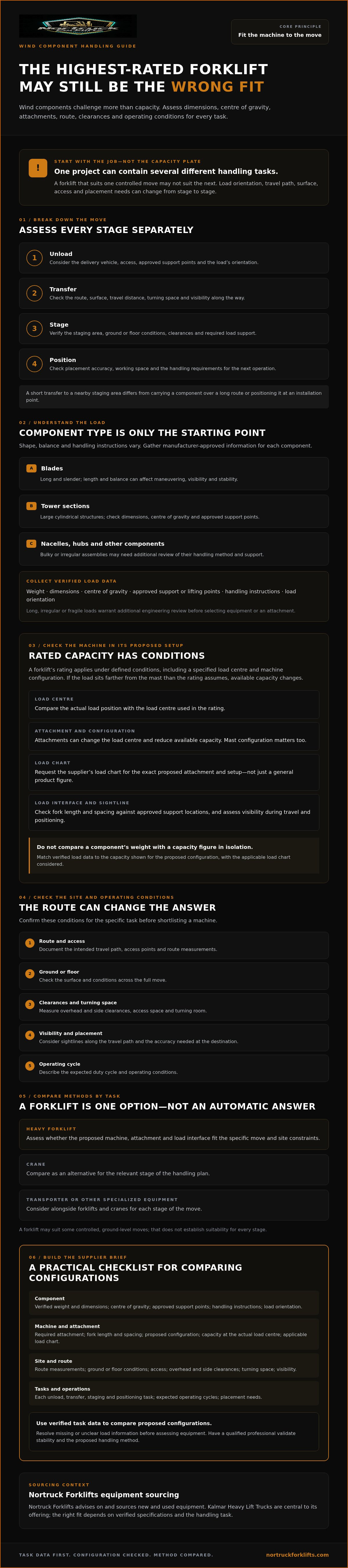
Build a wind-component forklift specification and supplier checklist
A precise brief makes supplier proposals easier to compare and gaps harder to miss. For a heavy forklift for wind turbine component handling, document the complete task, not only the component’s weight. Include load data, each stage of travel, site conditions, and the proposed machine configuration. This helps distinguish technical suitability from equipment condition, especially when comparing new and used machinery.
What should the machine specification include?
Work through the information in sequence. If a load detail or site measurement is unknown, mark it for confirmation rather than relying on an estimate.
- 1. Confirm the load: Record each component’s approved weight, overall dimensions, centre of gravity, support points, and handling restrictions.
- 2. Define the lift: State pickup and set-down locations, required lift height, load orientation, and positioning tolerances.
- 3. Map the route: Measure travel distance, turning space, access width, overhead and side clearances, and changes in surface or elevation.
- 4. Describe the site: Document floor or ground conditions, operating environment, staging space, and relevant site access limits.
- 5. Set operating needs: Estimate task frequency and operating cycle. Specify attachments, fork arrangement, and visibility requirements based on approved load support locations.
- 6. Request a proposed configuration: Ask the supplier to identify the machine setup, provide its configuration-specific load chart, and explain how it addresses the stated tasks and site conditions.
What should buyers verify before accepting a proposal?
Check that the load chart corresponds to the exact proposed machine and configuration, including its mast and attachment. Request machine records, configuration details, and known operating limitations. If the proposal relies on assumptions about the load, route, or ground, have those assumptions reviewed and validated before acceptance.
Keep condition checks separate from application approval. For used equipment, review its condition and available records with a qualified technical professional. For new equipment, confirm the supplied configuration and documentation. A machine’s condition does not prove it suits the task, and a suitable specification does not confirm the condition of a particular unit.
Ask the supplier to state in writing what the proposal includes, what it excludes, and which details still require site validation. Nortruck Forklifts advises on and sources new and used heavy lifting equipment, including Kalmar Heavy Lift Trucks. A complete brief gives an advisor a clearer basis for assessing options without assuming any model is suitable before its specifications are checked.
For equipment sourcing advice, you can discuss your forklift specification with Nortruck Forklifts.
Source a suitable heavy forklift for wind turbine component handling
Source equipment after defining the handling task, verifying load and site data, and assessing alternatives. This gives suppliers a useful basis for comparison and prevents a capacity label or general machine category from driving the decision. Check the final proposal against the actual component, route, operating cycle, and required configuration.
How can specialist sourcing support the equipment search?
An advisor can turn operational information into a clear machine brief: what must be moved, how it will be supported, where it will travel, and what the task requires at pickup and placement. That brief can guide a search across relevant equipment rather than relying on broad capacity or category descriptions. Nortruck Forklifts advises on and sources new and used heavy lifting equipment across Europe, with Kalmar Heavy Lift Trucks as a primary sourcing focus.
This focus does not guarantee that a particular Kalmar machine, or any specific configuration, will suit the application. Suitability depends on checking the proposed machine’s specifications against the handling task and site conditions. Ask for configuration data and technical documentation, and resolve assumptions before treating a proposal as acceptable.
What information should you bring to an initial discussion?
A well-prepared brief makes the conversation more productive. Gather documents and operating details that show both the load and the work it needs to perform:
- Component drawings, verified weights and dimensions, centre-of-gravity information, and manufacturer handling instructions.
- Approved support or lifting points, attachment requirements, and any handling restrictions.
- Site layout and travel route, including access, turning space, clearances, and ground or floor conditions.
- Expected work cycles, task frequency, required lift and placement details, and visibility or positioning needs.
If information is incomplete, identify what still needs confirmation rather than filling gaps with assumptions. With the brief in hand, you can discuss whether a forklift should remain under consideration, which machine details need verification, and whether another method may better fit a particular task stage. The goal is a considered equipment search, not a predetermined answer.
You can also discuss your wind-component handling requirements with Nortruck Forklifts as part of the sourcing process.
Move from handling requirements to a verified equipment choice
The right heavy forklift for wind turbine component handling depends on the specific lift and travel tasks, not capacity labels alone. Confirm component details, attachments, route conditions, and operating requirements, then compare the proposed configuration with its load chart. If a forklift does not suit a particular project stage, assess another handling method rather than forcing a mismatch.
A clear specification also makes sourcing more focused. Nortruck Forklifts provides heavy-equipment sales and sourcing advice, sourcing new and used machinery from manufacturers including Kalmar across Europe. Kalmar Heavy Lift Trucks are a key part of its offering, but verify any machine’s suitability against your application before proceeding.
Bring together load data, drawings, handling instructions, site layout, route information, and expected work cycles. These details create a practical starting point for a tailored discussion about equipment options.
With the right information and a careful verification process, you can approach the next sourcing step with greater clarity.
Frequently Asked Questions
Can a heavy forklift handle wind turbine blades?
Sometimes, but suitability depends on the blade’s dimensions, approved support points, machine configuration, and route. Do not select a heavy forklift for wind turbine component handling based on capacity alone. Obtain the blade manufacturer’s handling instructions and verified load data, then have a qualified professional assess the proposed attachment, stability, and movement path. A forklift may suit one handling stage, while another may require different equipment.
What capacity forklift is needed for wind turbine components?
There is no single capacity that suits every wind turbine component. Selection depends on confirmed load weight, load centre, attachment, lift height, and the exact machine configuration. Ask suppliers for a load chart matching the proposed setup, not just a headline capacity figure. Have the specifications and assumptions checked against the component documentation and actual site conditions before treating a machine as suitable.
How do you choose a forklift for a nacelle or tower section?
Start with the manufacturer-confirmed weight, dimensions, centre of gravity, approved handling points, and any restrictions. Then document the lift and placement, travel route, clearances, ground conditions, and positioning requirements. Compare this information with the proposed machine’s configuration-specific data and seek qualified technical review. A component label or general forklift capacity figure cannot establish suitability on its own.
Is a heavy forklift safer than a crane for wind turbine components?
Neither equipment type is automatically safer for every task. The appropriate method depends on the component, lift path, ground and site conditions, positioning needs, and approved handling instructions. Compare the complete task, including travel and placement, rather than choosing by equipment category. Have a competent professional assess complex or high-consequence moves, and do not operate a forklift outside its validated limits.
What should I check in a heavy forklift load chart?
Confirm that the load chart applies to the exact machine, mast, attachment, and configuration being proposed. Check capacity at the relevant load centre and lift conditions, and clarify any stated operating limitations. If the actual load or setup differs from the chart’s assumptions, do not extrapolate from a headline specification. Request technical review to establish whether the proposed configuration addresses the task.
Should I buy a new or used forklift for wind-component handling?
Define the handling specification first, then compare new and used candidates against it. For each machine, verify configuration-specific capacity information, condition, available records, and known limitations with appropriate technical support. A lower purchase price does not establish suitability, and a newer machine is not automatically the correct configuration. Base the decision on verified technical fit and the condition of the specific equipment being considered.
Can Nortruck source a forklift for wind turbine component handling?
Yes. Nortruck Forklifts provides sales and advisory services and sources new and used heavy lifting equipment, including Kalmar Heavy Lift Trucks, from across Europe. Share verified component details, site conditions, attachments, and the handling sequence so the requirements can be discussed before options are identified. Confirm suitability, configuration, and availability for each specific machine; do not assume a model fits before checking its specifications.
Discuss your wind-component handling requirements with Nortruck Forklifts.

Article by
Lars Gunnar Tärby
Disclaimer
1. General Information and No AdviceThe information, articles, product descriptions, and specifications provided on this website (www.nortruckforklifts.com) are for general informational and educational purposes only. While we strive to provide accurate and up-to-date content regarding new and used forklifts and heavy machinery, the material published does not constitute professional, technical, or legal advice.
2. Product Specifications and PricingNortruck Forklifts acts as a facilitator for the trade of new and used forklifts. All equipment details, including but not limited to year of manufacture, operating hours, lift capacity, dimensions, conditions, and pricing, are provided based on the information available to us at the time of publication. Specifications and availability are subject to change without prior notice.
3. "As Is" and VerificationAll articles and product listings are provided on an "as is" and "as available" basis without any warranties of any kind, either express or implied. Nortruck Forklifts does not guarantee that the descriptions are entirely error-free, complete, or reliable. Buyers and traders are strongly encouraged to independently verify all technical specifications, machine history, and equipment conditions directly with the seller or an authorized inspector before finalizing any purchase or transaction.
4. Limitation of LiabilityIn no event shall Nortruck Forklifts, its owners, or its contributors be held liable for any direct, indirect, incidental, consequential, or economic loss or damage arising out of the use of, or the inability to use, the information provided on this website, or any transactions facilitated through this platform. This includes, but is not limited to, damages caused by technical inaccuracies, typographical errors, or reliance on the content of our articles.
5. Third-Party LinksOur website may contain links to external websites, dealer networks, or third-party services that are not owned or controlled by Nortruck Forklifts. We have no control over, and assume no responsibility for, the content, privacy policies, or practices of any third-party websites.


