
What if used heavy lifting equipment that looks right on paper can’t handle the demands of your operation? A machine’s value depends on more than its stated capacity. Its condition, operating history, configuration, and fit for the work all matter, and those details can be difficult to compare across manufacturers.
Buying used can be a practical way to meet an equipment need, but uncertainty about a machine’s history or suitability shouldn’t be left to guesswork. Before comparing listings, define the tasks, loads, working conditions, and configuration your operation requires.
This guide explains how to turn those needs into clear equipment requirements, which records and checks to request, and how to assess a machine’s suitability. It also covers how a sourcing adviser can help narrow the search across manufacturers. Nortruck Forklifts advises on and sources new and used heavy lifting equipment from manufacturers across Europe, helping buyers connect operational needs with appropriate machinery.
Key Takeaways
- Start with the load, handling task, and working conditions to define what the equipment must do.
- Use seller descriptions as a starting point, then request identification details, specifications, service records, and operating history for used heavy lifting equipment.
- Compare machines by application fit, configuration, documented history, and unanswered questions, not purchase price alone.
- Follow a clear sequence: define requirements, shortlist candidates, review records, arrange an appropriate inspection, and confirm transaction details.
- Give a sourcing adviser a specific application brief to help focus the search across suitable manufacturers and machine types.
Used Heavy Lifting Equipment: Definition and Functions
Used heavy lifting equipment is pre-owned machinery designed to lift, carry, or position heavy loads in workplaces such as warehouses, industrial sites, and port terminals. The category includes heavy-capacity forklifts and other material-handling machines, but they are not interchangeable. A truck designed to carry a load through a warehouse serves a different purpose from equipment configured to handle long materials or containers.
Used status alone tells you little about a machine’s condition, history, or suitability. Begin with what your operation needs to move, the route it will travel, and how it must be handled. For a broader overview of equipment types, see Heavy equipment.
For a separate example of equipment walkaround tips, watch this excavator video:
Which types of heavy lifting equipment might suit the task?
Different machine configurations serve different handling needs. Heavy-capacity forklifts may suit jobs where loads need to be lifted and transported on forks. Sideloaders can be relevant when handling long loads, particularly where the way a load is carried matters. Four-way trucks may suit operations that need to move loads in more than one direction, while reachstackers are used in port-terminal settings to handle containers.
These categories are a starting point, not a substitute for checking the specific application. Nortruck Forklifts' confirmed offering categories include Kalmar Heavy Lift Trucks, Baumann Sideloaders, Combi-Lift 4-way Trucks, and reachstackers for port terminals. Match the machine category to the load, route, and site conditions before comparing individual listings.
What should a buyer define before searching?
Write down the work the machine must perform before comparing listings. Capture:
- Load type, maximum load, dimensions, and how often it must be handled.
- Required lift height and handling method, as well as aisle width, ground conditions, operating environment, and space for storage or manoeuvring.
- Shift patterns, operator requirements, and site-specific constraints that may need further review.
These details turn a broad search for used heavy lifting equipment into a focused brief. They also help distinguish a machine that appears capable from one whose configuration and documented condition warrant closer consideration.
How to evaluate used heavy lifting equipment before shortlisting it
Treat a seller’s description as a lead, not as proof that a machine is in suitable condition or configured for your site. Compare the stated capacity, dimensions, and configuration with your requirements. For a forklift, check that the available specifications relate to the intended load and lifting task, rather than relying on a headline capacity alone. If a key detail is missing or unclear, record it as an open question instead of making an assumption.
A desk review helps you decide whether a machine merits closer consideration. It cannot replace a qualified, machine-specific technical inspection. For general context on the distributor sector, the Associated Equipment Distributors is an international trade association representing equipment distributors.
Which records and machine details should buyers request?
Ask for information that identifies the exact machine and clarifies what is included in the offer. Request:
- Make and model, serial or other identification details, and photographs of the identification plate.
- Configuration details, available specification documents, and operator or maintenance manuals.
- Available maintenance records and operating history. Note missing periods or documents and ask whether further records exist, but do not assume why information is absent.
- A written list of attachments and components included in the specific offer.
Check that the documents refer to the same machine shown in the seller’s photographs. Where specifications or records conflict, ask for clarification before using them to judge suitability.
What can photographs and a remote review establish?
Request recent, clear images from multiple angles. Useful views may include the identification plate, tyres or wheels, forks or other load-handling components, controls, and areas showing wear or visible damage. Ask for close-ups of relevant areas where they can be photographed safely. Images can help you identify configuration details and prepare focused questions for an inspection.
Photographs have clear limits. They cannot verify internal condition, safe operation, or remaining service life. A remote review also cannot confirm how the machine performs under load or whether a visible issue affects its operation. Treat anything that cannot be established from records or images as an item for further checking, not as a confirmed fault or a clean bill of health.
Once a machine appears to match your requirements on paper, arrange for a qualified professional to assess that specific machine before committing. If you share your requirements with Nortruck, a concise application brief can help focus its equipment sourcing advice. You can explore equipment sourcing advice as part of your next steps.
How to compare used heavy lifting equipment with alternative options
Compare candidates against the work they must perform, not just against one another’s advertised capacity. A used machine, a new machine, and a different equipment category are meaningful alternatives only if they can handle the required load and suit the site. For wider sourcing context, see this European forklift market guide.
Use the same comparison criteria for each candidate, and mark missing information as unknown rather than treating it as confirmed.
| Comparison point | Questions to ask |
|---|---|
| Application fit | Can the machine handle the load and task in the intended environment? |
| Configuration | Does its setup suit the load dimensions, site layout, and handling route? |
| Documented history | What specifications, operating records, and maintenance information are available? |
| Information gaps | What still needs clarification or a machine-specific technical assessment? |
| New or used | Which option has the best-supported fit for the operation, based on the evidence available? |
When might a used machine be a suitable option?
A used machine may warrant consideration when its documented configuration appears to match the job and site requirements, and available records and inspection findings support further review. Weigh the evidence together: a suitable configuration does not establish condition, and a documented history does not by itself confirm that a machine is right for your operation. Compare what is known, what remains uncertain, and what a qualified inspection identifies before deciding.
Apply the same operational criteria to a new option. Do not assume used equipment is automatically cheaper or more reliable, or that new equipment is automatically the better fit. Base the decision on suitability and the strength of the information available for each candidate.
When should buyers widen the search beyond one machine type?
Revisit the shortlist if no candidate can meet the required load, dimensions, or site constraints. Consider other categories only where their functions align with the task. For example, a heavy forklift and a reachstacker could be compared for appropriate load-handling applications, but they are not interchangeable simply because both lift heavy loads.
If the requirement involves port-terminal handling, a used reachstacker sourcing guide offers relevant procurement context. Nortruck advises on and sources equipment across manufacturers, so a well-defined brief can help focus comparisons on technically relevant options.
What steps should buyers take before committing to used equipment?
A disciplined purchase process separates operational decisions from technical questions that need a qualified professional. Keep a written list of open questions and resolve them before agreeing to proceed. A missing record or unclear detail is not proof of a problem, but it is a reason to ask for clarification.
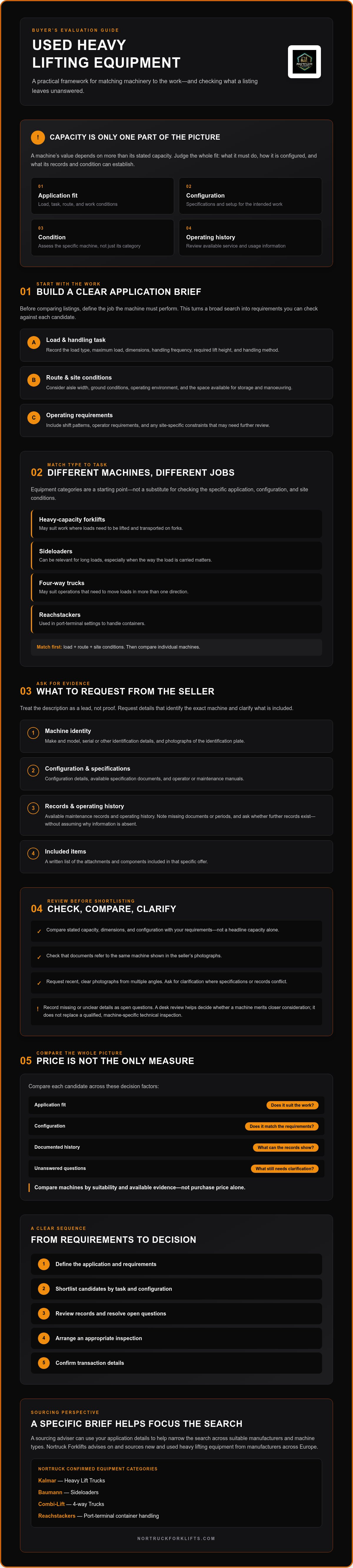
- Define the job. Confirm the load, handling task, working environment, and site constraints the machine must accommodate.
- Shortlist candidates. Compare each machine’s stated configuration with those requirements and remove options that do not appear to fit.
- Review available records. Match documents to the machine’s identification details and note any gaps or conflicting information.
- Arrange a machine-specific inspection. Share the application and machine details with a qualified technical professional, then review their findings and stated assessment limits.
- Confirm the transaction in writing. Make sure the exact machine, configuration, included items, and agreed arrangements are clear before proceeding.
This sequence keeps your decision grounded in the task and available evidence. You determine the operational requirements and whether outstanding questions have been resolved. A qualified professional assesses technical condition within the scope of the inspection. Neither a document review nor an inspection guarantees future performance.
How should a buyer prepare a machine-specific inspection?
Give the inspector the intended application, site requirements, machine model and identification details, configuration information, and any records already received. Ask for documented findings, including visible concerns, what could be assessed, and any limitations. Use the report to clarify uncertainties or request further review. An inspection provides evidence about the machine at the time and within the scope of the assessment, not certainty about every condition or future use.
Which transaction details need written confirmation?
Before committing to used heavy lifting equipment, check that the written offer identifies the specific machine and accurately describes its configuration and included attachments or components. Confirm delivery arrangements, who is responsible for transport, and what handover information or supporting documents will be provided. If the purchase involves cross-border delivery, clarify practical delivery and documentation arrangements with the relevant parties rather than assuming what applies.
Do not infer warranty coverage, return terms, or after-sales services from a verbal description or general expectation. If any such terms are offered, ask for them to be stated clearly in writing. Do the same for any unresolved point that could affect the machine’s suitability, handover, or delivery.
How can Nortruck help source suitable used heavy lifting equipment?
A focused sourcing search starts with the operation, not a make or model. Nortruck Forklifts advises buyers and sources new and used machinery from manufacturers across Europe, including Kalmar, Baumann, Combi-Lift, and Volvo. Sharing a clear application brief gives an adviser a practical basis for identifying relevant equipment categories and comparing options across manufacturers.
If high-capacity Kalmar equipment may suit the task, the Kalmar heavy lift truck sourcing guide provides additional context. A particular manufacturer can be a useful starting point, but each candidate still needs to be assessed against the load, site, and handling requirements.
What information should buyers share with a sourcing adviser?
Share the practical details that shape the search: load types and dimensions, maximum load, handling frequency, operating environment, and site limitations such as access or available space. Note any preferred machine types or manufacturers, but stay open to alternatives if another category appears more appropriate for the application.
You can also share budget parameters privately with the adviser so they understand the boundaries for the search. Avoid relying on assumed market prices. The relevant question is which suitable options can be identified and what information is available to assess them.
What can buyers expect from an initial sourcing conversation?
Expect a discussion focused on understanding the job, clarifying constraints, and considering which equipment categories may be relevant. The conversation can also identify what details to verify as potential machines are considered, including configuration, identification, available records, and included components. It is a starting point for a focused search, not confirmation of machine availability, condition, or suitability.
Nortruck's role is equipment sales, sourcing, and buyer advice. Describe the task and constraints as clearly as you can, then discuss which sourcing options may fit. This creates a practical basis for assessing next steps without assuming that a particular machine is right before its details are reviewed.
Make Your Next Equipment Search More Focused
The right used machine is one that fits the work and has enough supporting information for you to assess it carefully. Define the load and site requirements first, then compare each candidate’s configuration, documented history, and inspection findings. If a machine type does not suit the application, widen the search to technically appropriate alternatives rather than forcing a poor fit.
Nortruck Forklifts provides equipment sales, sourcing, and buyer advice, sourcing machinery from major manufacturers across Europe. Sharing a clear brief can help turn your operating needs into a focused search and identify which details need further verification.
With clear priorities and the right information, you can take the next step with greater confidence and identify equipment worth considering for your operation.
Frequently Asked Questions
What is considered heavy lifting equipment?
Heavy lifting equipment is machinery designed to lift, carry, or position substantial loads in work settings. The category includes heavy-capacity forklifts, sideloaders, four-way trucks, reachstackers, and other material-handling machines, each suited to different tasks and environments. A heavy forklift moves loads on forks, while a reachstacker is associated with port-terminal handling. Choose a category based on the load, handling route, and site requirements rather than the broad label alone.
Is used heavy lifting equipment worth considering?
Used heavy lifting equipment may be worth considering if its configuration suits the job and available records and inspection findings support further assessment. Used status alone does not establish condition, suitability, or value. Compare each candidate with relevant new alternatives using evidence such as machine identification, specifications, operating history, and technical inspection results. The right decision depends on the machine and your operation, not an assumption that used equipment is automatically cheaper or more reliable.
What should I check when buying used heavy lifting equipment?
Check that the machine’s identity, configuration, and specifications match the work it must perform. Request available manuals, service and operating records, and a clear list of included attachments or components. Compare its load-handling setup with your site conditions, and write down any missing or conflicting information. Photographs and documents help with an initial review, but arrange a qualified, machine-specific inspection to assess technical condition before committing.
Can a used forklift handle the same work as a new one?
It can, but age or newness alone does not establish whether a forklift is suitable. Compare the specific machine’s stated configuration and available technical information with the load, task, and operating environment. Review its history and have its condition assessed by a qualified professional. A used forklift that appears appropriate on paper still needs to be evaluated as an individual machine, and a new one also needs to meet the actual site requirements.
How do I choose between a heavy forklift and a reachstacker?
Start with the handling task and site. A heavy forklift may be relevant where loads need to be lifted and moved on forks, while a reachstacker is a distinct category associated with port-terminal container handling. Compare them only if both can perform the required job, then consider the load, dimensions, route, operating environment, and available space. Their shared ability to lift loads does not make them interchangeable.
What happens if the used machine has incomplete maintenance records?
Incomplete records leave questions to resolve, but they do not establish why information is missing or prove a fault. Ask whether additional service documents or operating history are available, and check that the records you receive correspond to the machine’s identification details. Note the gaps and share them with a qualified technical professional conducting a machine-specific inspection. Use the findings and remaining uncertainties when deciding whether to proceed.
Should I use an adviser to source used heavy lifting equipment?
An adviser can help translate your application into a focused search and compare potentially relevant machine categories and manufacturers. Share the load, dimensions, handling frequency, environment, site constraints, and any preferences. Nortruck Forklifts provides equipment sales, sourcing, and advisory services, sourcing machinery from major manufacturers across Europe. An adviser can help identify relevant options, but you should still verify each machine’s records, configuration, condition, and transaction details before proceeding.

Article by
Lars Gunnar Tärby
Disclaimer
1. General Information and No AdviceThe information, articles, product descriptions, and specifications provided on this website (www.nortruckforklifts.com) are for general informational and educational purposes only. While we strive to provide accurate and up-to-date content regarding new and used forklifts and heavy machinery, the material published does not constitute professional, technical, or legal advice.
2. Product Specifications and PricingNortruck Forklifts acts as a facilitator for the trade of new and used forklifts. All equipment details, including but not limited to year of manufacture, operating hours, lift capacity, dimensions, conditions, and pricing, are provided based on the information available to us at the time of publication. Specifications and availability are subject to change without prior notice.
3. "As Is" and VerificationAll articles and product listings are provided on an "as is" and "as available" basis without any warranties of any kind, either express or implied. Nortruck Forklifts does not guarantee that the descriptions are entirely error-free, complete, or reliable. Buyers and traders are strongly encouraged to independently verify all technical specifications, machine history, and equipment conditions directly with the seller or an authorized inspector before finalizing any purchase or transaction.
4. Limitation of LiabilityIn no event shall Nortruck Forklifts, its owners, or its contributors be held liable for any direct, indirect, incidental, consequential, or economic loss or damage arising out of the use of, or the inability to use, the information provided on this website, or any transactions facilitated through this platform. This includes, but is not limited to, damages caused by technical inaccuracies, typographical errors, or reliance on the content of our articles.
5. Third-Party LinksOur website may contain links to external websites, dealer networks, or third-party services that are not owned or controlled by Nortruck Forklifts. We have no control over, and assume no responsibility for, the content, privacy policies, or practices of any third-party websites.


