
Did you know that a mid-size Volvo wheel loader can retain over 53% of its original value after five years of heavy use? While that residual value is impressive, it only tells part of the story. You likely already feel the pressure of managing Volvo wheel loader operating costs when fuel consumption spikes during heavy-duty cycles or when an older machine triggers a series of unplanned repairs. It's frustrating to watch your operational margins shrink because of variables that often feel outside your control.
We've designed this 2026 TCO guide to help you move past the guesswork and take command of your fleet's financial performance. You'll learn how to leverage the latest OptiShift technology and ActiveCare Direct telematics to drive down expenses and eliminate downtime. We'll provide a clear framework for calculating total ownership costs, from energy consumption to sourcing reliable used units from European markets. By the end of this article, you'll have the confidence to build a fleet that holds its value and performs predictably on the balance sheet.
Key Takeaways
- Identify why the initial acquisition price represents only 25-30% of a machine's lifetime expense, allowing for more accurate long-term budgeting.
- Master the impact of OptiShift technology and telematics to lower your Volvo wheel loader operating costs by optimizing fuel consumption and cycle efficiency.
- Protect your margins by prioritizing genuine Volvo parts and structured maintenance intervals to prevent costly repairs and extend machine service life.
- Secure a higher residual value by understanding European market trends and sourcing high-spec loaders through an independent advisory model that bypasses broker markups.
Understanding the TCO Framework for Volvo Wheel Loaders
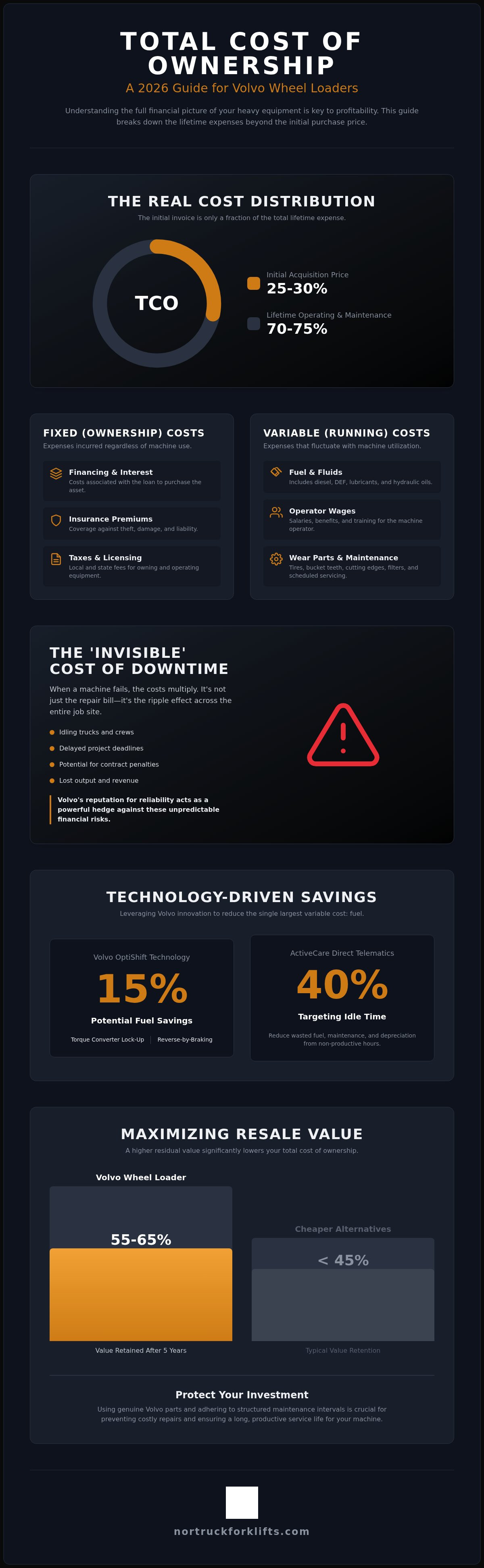
Financial clarity in heavy equipment procurement starts with looking far beyond the initial invoice. To truly understand Volvo wheel loader operating costs, you must adopt a Total Cost of Ownership (TCO) mindset. TCO is the cumulative sum of your acquisition, operating, and maintenance expenses, minus the machine's residual value when you eventually sell it. It's a common mistake to focus solely on the sticker price; however, that figure typically accounts for only 25% to 30% of what you'll spend over the machine's lifetime. The remaining 70% is consumed by fuel, tires, and the occasional unplanned repair. While a budget brand might look attractive on a spreadsheet today, the long-term efficiency of high-quality loader equipment from Volvo often proves more profitable because of its superior fuel economy and higher resale value.
Fixed vs. Variable Operating Costs
Effective management of Volvo wheel loader operating costs requires a clear distinction between fixed and variable expenses. Fixed costs are the "ownership" expenses that exist whether the machine is moving dirt or sitting in the yard. These include financing interest, insurance premiums, and local taxes. Variable costs, on the other hand, are the "running" expenses that fluctuate based on how hard the machine works. These include:
- Fuel and diesel exhaust fluid (DEF).
- Operator wages and benefits.
- Wear parts like bucket teeth, tires, and cutting edges.
- Preventative maintenance supplies like filters and lubricants.
Your machine utilization rate is the most critical factor in this equation. If you run a loader for 2,000 hours a year, your fixed costs are spread over a larger volume of work, reducing the cost per hour. Conversely, low utilization makes every hour of operation significantly more expensive. We often find that mid-size Volvo loaders, which retain 55% to 65% of their value after five years, allow owners to recoup a much larger portion of their fixed investment compared to cheaper alternatives.
The 'Invisible' Cost of Downtime
When a loader fails on a busy job site, the financial impact ripples through your entire operation. It's not just the mechanic's bill that hurts; it's the idling trucks, the delayed deadlines, and the potential for liquidated damages. Volvo's reputation for reliability acts as a hedge against these unpredictable financial risks. By investing in a machine with a proven track record, you're essentially buying insurance against site-wide stagnation. Downtime cost is the total financial loss incurred every hour a machine is unavailable, including lost output and the expense of idle labor. Because Volvo machines are engineered for high uptime, they help keep these "invisible" costs from eroding your project margins.
Fuel Efficiency: The Impact of Volvo OptiShift and Telematics
Fuel consumption is the single largest variable component of Volvo wheel loader operating costs. In 2026, Volvo's OptiShift technology remains a benchmark for efficiency, potentially reducing fuel burn by up to 15% in mid-size models like the L60, L70, and L90. This isn't just a marketing figure; it's the result of mechanical integration. By combining a torque converter lock-up with a unique "reverse-by-braking" function, the machine eliminates energy loss during direction changes. Instead of using the torque converter to slow the machine, it applies the service brakes automatically, which preserves the drivetrain and keeps more fuel in the tank.
When you consider that a diesel-powered L120H can consume between 18 and 22 liters per hour, a 15% saving translates to significant capital over a standard 2,000-hour work year. These gains are maximized when you move from simple operation to data-driven management. If you need help identifying which European models feature these specific efficiency packages, speaking with a specialized advisor can simplify your search.
Leveraging ActiveCare Direct for Cost Control
Telematics data is often underutilized, yet it's the most effective tool for curbing unnecessary spending. Volvo's ActiveCare Direct service provides a clear window into "idle time," which is often the silent killer of project margins. If a loader is idling for 40% of its shift, you're paying for fuel, maintenance, and depreciation without moving a single tonne of material. Telematics allows you to set fuel-consumption alerts that flag engine inefficiencies before they become catastrophic failures. Additionally, remote diagnostics allow technicians to identify issues before they arrive on-site, cutting down on travel expenses and billable hours.
Operator Influence on Fuel Costs
The person in the cab has more influence over your bottom line than any software update. An operator who understands how to use Eco-mode effectively can lower hourly fuel burn significantly compared to one who stays at high RPMs. Volvo’s onboard weighing system also plays a vital role here; it ensures every cycle is optimized. Under-loading leads to more trips, while over-loading causes excessive tire wear and strain. Investing in comprehensive operator training typically delivers a full return on investment within months through measurable fuel savings and reduced mechanical wear. Moving material efficiently isn't just about speed; it's about the precision of every bucket load.
Maintenance Cycles and the Longevity of Genuine Volvo Parts
Volvo machines are engineered for high-intensity work, but maintaining that performance requires a disciplined approach to service. A standard maintenance schedule for these loaders revolves around 500-hour and 1000-hour intervals. The 500-hour mark typically involves engine oil and filter changes, while the 1000-hour service expands to include transmission and hydraulic system checks. Adhering to these windows is a primary factor in controlling Volvo wheel loader operating costs. By catching minor wear early, you prevent the exponential costs associated with component failure later in the machine's life.
There's often a temptation to use aftermarket filters or seals to trim the budget. However, lower-cost filters frequently lack the micron-rating precision required for Volvo’s high-pressure systems. A small savings on a filter can lead to debris entering the fuel injectors or hydraulic pumps, resulting in repair bills that reach into the thousands. Volvo’s modular design also works in your favor; components are positioned for easy access, which significantly reduces the labor hours your mechanic bills for standard replacements. Even with perfect care, major components like engines and transmissions generally reach a point of scheduled overhaul around the 15,000-hour mark. Planning for this milestone prevents the machine from becoming a sudden financial liability.
Predictive vs. Reactive Maintenance Costs
Moving from a "fix it when it breaks" mentality to a predictive model is essential for protecting your margins. Regular oil analysis is a low-cost way to monitor the internal health of your hydraulics and engine. It's the difference between a planned seal replacement and a catastrophic cylinder failure that halts production for days. When you're in the process of sourcing a machine, you should always verify its service history against our Used Heavy Lifting Equipment Inspection Checklist to ensure you aren't inheriting someone else's neglected maintenance debt.
Tire Management and Ground Engagement Tools
Tires represent the second-highest variable cost after fuel. Choosing the right tread pattern, such as L3 for general purpose or L5 for rock-heavy applications, can extend tire life by hundreds of hours. Similarly, don't overlook your bucket teeth and cutting edges. Worn ground engagement tools increase resistance, which forces the engine to work harder and drives up fuel consumption. Keeping these components sharp and sized correctly ensures your cycle times remain fast and your Volvo wheel loader operating costs stay within a predictable range. It's these small, cumulative efficiencies that determine whether a project stays profitable.
Residual Value and Depreciation in the European Market
Residual value is the factor that often separates a profitable investment from a financial burden. When calculating Volvo wheel loader operating costs, the machine's ability to retain its value is a critical offset to your total expenditure. In the European used market, Volvo loaders consistently command a 10% to 20% premium over many competitors. This isn't just brand loyalty; it's a reflection of the machine's durability and the high global demand for its components. Even after reaching the 10,000-hour mark, these loaders possess significant "Second Life" potential, often being exported to emerging markets where their reliability remains a prized asset.
A documented service history from a reputable European dealer acts as a financial guarantee for the next owner. It proves that the 500-hour and 1000-hour intervals discussed earlier were strictly followed. For those looking to understand the broader landscape of equipment acquisition, our European forklift market guide provides essential context on sourcing high-spec machinery across the continent. Keeping your Volvo wheel loader operating costs low relies on picking the right point in the depreciation cycle and ensuring the unit has been treated with professional care.
Depreciation Curves: New vs. Used Sourcing
New equipment suffers its steepest depreciation in the first twelve months, sometimes losing nearly a third of its initial value the moment it leaves the lot. For many operations, sourcing a 3 to 5 year old Volvo loader represents the sweet spot for TCO. By this stage, the initial "sticker shock" has worn off, and the depreciation curve begins to flatten. While machine age is a factor for emissions compliance, the market primarily dictates value based on operating hours. A well-maintained unit with 4,000 hours often holds more value than a younger machine that has been worked double those hours in a harsh quarry environment.
Regional Market Variations
Geography plays a surprising role in machine condition. Loaders sourced from Northern Europe, particularly Scandinavia and Germany, often boast superior maintenance records and lower levels of corrosion compared to those from coastal or southern regions. Navigating the complexities of VAT and cross-border logistics requires specialized knowledge to avoid unexpected fees. With 40 years of industry experience, we specialize in identifying these "hidden gems" that offer the best balance of price and performance. We act as your bridge to the European supply, ensuring the machine you buy matches your specific operational goals.
Sourcing Strategy: Minimizing Costs via Expert Advisory
The traditional dealership model often creates a conflict of interest because the salesperson is incentivized to move whatever inventory is currently on the lot. To truly minimize Volvo wheel loader operating costs, you need a sourcing strategy that prioritizes your specific application over a dealer's stock levels. This is where the independent advisor model becomes a financial advantage. By acting as your advocate, we source machines based on your budget and technical requirements; this ensures you don't pay for features you don't need or end up with a loader that requires expensive retrofitting.
Bypassing the standard layer of intermediaries is another direct way to protect your margins. Every broker added to a transaction increases the "broker markup," which inflates your initial capital investment and skews your TCO calculations from the start. Our approach focuses on direct procurement through a verified European network. Before any purchase is finalized, a rigorous technical inspection by an expert like Lars G Tarby is essential. This vetting process identifies potential mechanical issues that could lead to the unplanned downtime we discussed in earlier sections, ensuring you aren't simply buying someone else's maintenance problem.
The Procurement Process: From Europe to Site
Successful procurement starts with a clearly defined scope that includes hour limits, age requirements, and specific attachments like high-lift arms or specialized buckets. Matching these specs at the point of purchase is far more cost-effective than attempting to modify a machine later. Once the right loader is identified, the logistics of heavy equipment transport become the next priority. Managing these timelines and costs requires a deep understanding of international shipping and customs. For a look at how we manage similar logistical challenges for other machinery, you can see our guide on Used Reachstacker Sourcing.
Why Experience Matters in Heavy Lifting
With 40 years of industry knowledge, we understand that heavy equipment acquisition is about finding long-term solutions, not just completing a transaction. This experience allows us to spot the subtle signs of machine stress that a less seasoned eye might miss. We prioritize transparency and direct communication, providing you with the technical depth needed to make an informed decision. By focusing on suitability and operational efficiency, we help you manage Volvo wheel loader operating costs from the first day of ownership.
Maximizing Your Fleet's Long-Term Profitability
Managing Volvo wheel loader operating costs isn't just about cutting expenses; it's about making strategic decisions that protect your margins over thousands of hours. Technologies like OptiShift and ActiveCare Direct provide a measurable edge in fuel economy and maintenance predictability. By focusing on the full Total Cost of Ownership framework, you shift from reactive spending to proactive wealth management.
The European market offers a unique opportunity to acquire high-spec machines that have been maintained to the highest standards. Leveraging 40 years of industry expertise ensures you bypass the markups of intermediaries and secure a loader that fits your specific operational needs. When you prioritize transparency and independent advisory, you build a fleet that retains its value and performs reliably under pressure.
We're here to act as your bridge to the best European supply, helping you handle the complexities of international procurement with confidence. Let's ensure your next acquisition is a step toward greater efficiency and lasting success.
Frequently Asked Questions
What is the average hourly fuel consumption of a Volvo L120H wheel loader?
A diesel-powered Volvo L120H typically consumes between 18 and 22 liters per operating hour. At current fuel prices, this results in an hourly cost ranging from $32 to $40. These figures fluctuate based on the intensity of the work cycle and the use of efficiency technologies like OptiShift. Monitoring these Volvo wheel loader operating costs through telematics allows you to identify if specific machines are exceeding these benchmarks.
How much does ActiveCare Direct cost and is it worth the investment?
Volvo ActiveCare Direct is provided free for the first year with a new machine purchase. Following this period, the annual subscription is $525.00. The investment is highly worthwhile because it provides a clear window into machine health and utilization. By identifying excessive idle time and flagging potential engine inefficiencies early, the system prevents the kind of catastrophic component failures that far exceed the annual cost of the subscription.
Which Volvo wheel loader model has the lowest operating cost for gravel pits?
For gravel pits, the mid-size L120H or L150H models often provide the best balance of productivity and low operating costs. In 2026, the inclusion of OptiShift technology in these models can reduce fuel consumption by up to 15%. If your operation requires higher capacity, the larger L350 with its D17 engine offers a 5% efficiency improvement over previous versions, making it a strong contender for high-volume material handling.
How do Volvo wheel loader operating costs compare to Caterpillar or Komatsu?
Volvo loaders generally offer lower fuel consumption and higher residual values than Caterpillar or Komatsu equivalents. While initial acquisition prices are competitive, Volvo’s focus on drivetrain integration and automatic braking technology lowers long-term mechanical wear. Data suggests that mainstream Volvo models in Europe retain between 55% and 65% of their value after five years, which is often a 10% to 20% premium over many competing brands in the used market.
What are the most common high-cost repairs on used Volvo loaders?
Major component overhauls, specifically the engine and transmission, are the most significant expenses, typically occurring around the 15,000-hour mark. On neglected used units, you may also face high costs for hydraulic pump replacements or catastrophic cylinder failures. These risks are why we emphasize regular oil analysis and a thorough technical inspection before purchase. Catching a failing seal early is significantly cheaper than replacing a complete hydraulic assembly later.
How does the European used market affect Volvo loader prices in 2026?
The 2026 European used market is currently facing some pricing pressure, which can create opportunities for savvy buyers to source high-spec machines at better values. Loaders from Northern Europe often command higher prices because they typically have more comprehensive service records and less corrosion. Understanding these regional variations is essential for accurate budgeting. We help you navigate these market shifts to ensure your procurement strategy remains aligned with your financial goals.
Can I reduce my loader's operating costs through operator training?
Yes, operator training is one of the fastest ways to lower Volvo wheel loader operating costs. An operator who effectively uses Eco-mode and the onboard weighing system can reduce fuel burn and tire wear significantly. Training helps prevent under-loading, which requires more cycles, and over-loading, which strains the drivetrain. Most businesses see a full return on the cost of training within months through measurable improvements in hourly efficiency and machine longevity.
What is the expected lifespan of a Volvo wheel loader engine before a major overhaul?
You can generally expect a Volvo wheel loader engine to operate for approximately 15,000 hours before requiring a major overhaul. This lifespan depends heavily on the use of genuine Volvo parts and adherence to 500-hour and 1,000-hour service intervals. Machines used in extreme environments or those with high idle times may require attention sooner. Consistent oil sampling is the best way to monitor internal wear and schedule the overhaul before a failure occurs.

Article by
Lars Gunnar Tärby
Disclaimer
1. General Information and No AdviceThe information, articles, product descriptions, and specifications provided on this website (www.nortruckforklifts.com) are for general informational and educational purposes only. While we strive to provide accurate and up-to-date content regarding new and used forklifts and heavy machinery, the material published does not constitute professional, technical, or legal advice.
2. Product Specifications and PricingNortruck Forklifts acts as a facilitator for the trade of new and used forklifts. All equipment details, including but not limited to year of manufacture, operating hours, lift capacity, dimensions, conditions, and pricing, are provided based on the information available to us at the time of publication. Specifications and availability are subject to change without prior notice.
3. "As Is" and VerificationAll articles and product listings are provided on an "as is" and "as available" basis without any warranties of any kind, either express or implied. Nortruck Forklifts does not guarantee that the descriptions are entirely error-free, complete, or reliable. Buyers and traders are strongly encouraged to independently verify all technical specifications, machine history, and equipment conditions directly with the seller or an authorized inspector before finalizing any purchase or transaction.
4. Limitation of LiabilityIn no event shall Nortruck Forklifts, its owners, or its contributors be held liable for any direct, indirect, incidental, consequential, or economic loss or damage arising out of the use of, or the inability to use, the information provided on this website, or any transactions facilitated through this platform. This includes, but is not limited to, damages caused by technical inaccuracies, typographical errors, or reliance on the content of our articles.
5. Third-Party LinksOur website may contain links to external websites, dealer networks, or third-party services that are not owned or controlled by Nortruck Forklifts. We have no control over, and assume no responsibility for, the content, privacy policies, or practices of any third-party websites.


