
What if the lowest quote for a heavy lift truck is actually the most expensive mistake your terminal makes this year? You're likely feeling the pressure of Stage V emission compliance and the rising costs of cross-border logistics. It's frustrating to wait months for machinery while your operational demands only grow. This European forklift market guide provides the expert clarity you need to bypass these delays and hidden expenses. We know that a successful acquisition depends on transparency and technical precision rather than marketing hype.
Securing the right equipment requires more than just a brochure. It's about understanding which manufacturer hubs offer the best value for your specific application. In this guide, we provide a clear framework for choosing between brands like Kalmar, Linde, and Toyota, while examining how 2026 regulations affect your fleet's future. You'll also discover a reliable method for sourcing high-quality used machinery that meets modern standards without the typical middleman markups. Let's look at the practical steps to modernize your fleet with confidence.
Key Takeaways
- Identify the critical 2026 regulatory shifts, including Stage V emission standards, that dictate which heavy-duty machinery is suitable for your specific site requirements.
- Gain a clear understanding of regional manufacturer hubs to determine whether German precision engineering or Scandinavian heavy-lifting technology best fits your operational needs.
- Learn how to calculate the true total cost of ownership by looking beyond the initial purchase price to fuel efficiency, maintenance, and projected residual value.
- Use this European forklift market guide to implement a rigorous inspection framework that secures high-quality machinery while avoiding the common pitfalls of cross-border logistics.
- Discover how an independent advisory model bypasses traditional markups and provides the technical vetting necessary for high-capacity equipment acquisition.
The State of the European Forklift Market in 2026
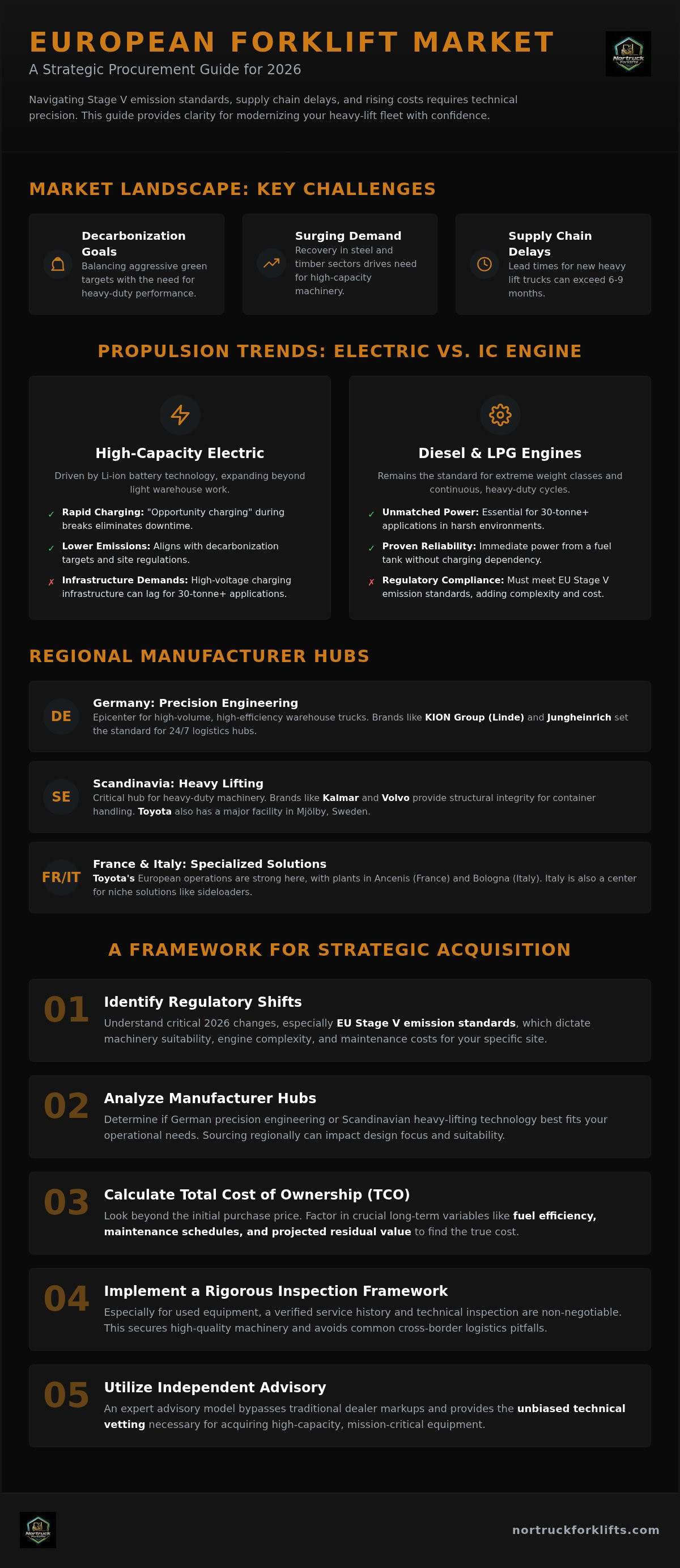
The European market is currently navigating a period of significant transition. Operators are forced to balance aggressive decarbonization targets with the non-negotiable need for heavy-duty performance. This European forklift market guide looks at how companies are managing this tension in 2026. While the rapid expansion of e-commerce has stabilized, the recovery of heavy industrial sectors like steel and timber has created a surge in demand for high-capacity machinery. Finding the right balance between "green" goals and operational reality is the primary challenge for procurement managers this year.
Regulatory compliance is a major driver of fleet renewal today. The EU Stage V emission standards are now fully implemented across all engine power bands. These rules require advanced filtration and exhaust after-treatment systems that have fundamentally changed the internal architecture of modern trucks. For a comprehensive overview of forklift technology and how these systems have evolved, looking at historical development helps explain why modern engines are more complex and costly to maintain than their predecessors. It's no longer just about lifting capacity; it's about managing a sophisticated mobile power plant.
Supply chain dynamics remain a critical factor in any procurement strategy. Lead times for new, custom-ordered heavy lift trucks can still exceed six to nine months depending on the manufacturer. Consequently, the market for high-quality used equipment has become exceptionally competitive. Many terminal managers now prioritize immediate availability over the "new machine" smell, provided the equipment comes with a verified service history and passes a rigorous technical inspection. This shift has made this European forklift market guide essential for those looking to source equipment without the long wait.
Propulsion Trends: Electric vs. IC Engine
Electric propulsion is no longer restricted to light warehouse work. High-capacity electric trucks are appearing in ports across the continent, driven by Li-ion battery tech that allows for rapid "opportunity charging" during shift breaks. This effectively eliminates the downtime associated with traditional lead-acid batteries. Despite this, diesel and LPG engines remain essential for 30-tonne+ applications. In these extreme weight classes, the infrastructure for high-voltage charging often lags behind the immediate reliability of a fuel tank. Diesel remains the standard for continuous, heavy-duty cycles in harsh environments.
Market Segmentation by Class and Load
Understanding the market requires a look at specific equipment classes. Class 1 through 3 are the standard warehouse tools where Linde and Toyota excel. However, the heavy-lifting landscape is defined by Class 4 and 5 machinery. This is where brands like Kalmar and Volvo provide the structural integrity needed for container handling and heavy industrial loads. For operations with unique spatial constraints, specialized equipment like Baumann sideloaders or Combi-Lift 4-way trucks offers solutions that standard counterbalance forklifts simply cannot match. Choosing the right class is the first step in avoiding the "under-specced" trap.
Regional Manufacturer Hubs: Where to Source What
Understanding the geography of manufacturing is a core component of any effective European forklift market guide. Where a machine is built often dictates its primary engineering focus and its suitability for specific operational environments. Germany remains the epicenter for precision engineering, with the KION Group (Linde) and Jungheinrich setting the standard for high-volume, high-efficiency warehouse trucks. These machines are designed for the rigorous demands of 24/7 logistics hubs where uptime is the only metric that matters. The "Made in Europe" stamp is more than just a label; it represents a commitment to the technical standards maintained by the European Materials Handling Federation. These standards ensure that equipment maintains a high resale value, making them sound long-term investments rather than mere expenses.
While Germany handles the high-precision sector, other regions have carved out vital niches. France and Sweden are critical hubs for Toyota's European operations, with major manufacturing facilities in Ancenis and Mjölby respectively. Italy has emerged as a specialist center, not only for Toyota's Bologna plant but also for niche material handling solutions like sideloaders. Sourcing from these established hubs ensures that you aren't just buying a piece of iron, but a legacy of engineering support and parts availability. If you're currently evaluating your fleet needs, speaking with a professional who understands these regional nuances can help you source the right machinery without the typical trial and error.
Heavy Lift Specialists: The Nordic Powerhouse
When your operations move beyond standard pallet dimensions and into the realm of 10 to 50-tonne loads, the search naturally shifts toward Scandinavia. This region is the global hub for heavy lifting technology. Kalmar remains the gold standard for port terminals and steel mills, offering the structural integrity required for continuous heavy-duty cycles. Similarly, Volvo wheel loaders provide the robust performance needed for industrial logistics and bulk handling. Finding verified Kalmar heavy lift trucks for sale requires a strategy that looks beyond local listings and into these specialized Nordic networks where the highest-spec machines are often traded.
Specialized Long-Load Solutions
Generic market guides often overlook the complexities of handling long, cumbersome loads like timber, plastics, or steel beams. This is where Italian and Irish engineering take the lead. Baumann sideloaders, manufactured in Italy, are the preferred choice for operations that require stable, lateral transport of long materials over distance. Conversely, Irish-built Combi-Lift trucks have revolutionized narrow-aisle storage by combining the features of a forklift, sideloader, and reach truck. Identifying a Combi-Lift 4-way truck for sale can be a game-changer for facilities looking to maximize storage density without expanding their physical footprint. These specialized machines solve specific problems that standard counterbalance trucks cannot address.
Strategic Procurement: Balancing Tonnage and Total Cost of Ownership
Procurement in the heavy machinery sector often falls into the "under-specced" trap. It's tempting to select a machine based on its maximum rated capacity, but this European forklift market guide emphasizes the importance of the load center. A truck rated for 15 tonnes at a 600mm load center won't perform the same if your actual load is bulky and shifts that center to 1200mm. Operating a machine at its absolute limit accelerates wear on hydraulic systems and decreases safety margins. We recommend speccing your equipment at 20% above your heaviest anticipated load to ensure longevity and operational safety.
Total Cost of Ownership (TCO) has become more complex in 2026. It's no longer just about fuel and filters. With direct sales to large fleet buyers accounting for 64.7% of the market in 2025, the industry is shifting toward data-driven decisions. As of January 7, 2026, all newly manufactured heavy vehicles must be fitted with Event Data Recorders (EDRs). This regulatory shift means that maintenance is now predictive rather than reactive. When you calculate TCO, you must factor in the residual value of premium brands. A well-maintained Linde or Toyota often retains 40% more value after five years compared to budget-tier alternatives, effectively lowering your long-term capital expenditure.
The "New vs. Used" debate often centers on immediate availability. A five-year-old Linde, built with superior metallurgy and hydraulic precision, frequently outperforms a brand-new budget machine in high-cycle environments. While new trucks from July 2026 must include Advanced Emergency Braking (AEB) systems, a high-spec used machine from a premium manufacturer remains a formidable asset. It's a matter of choosing between the latest digital features and proven mechanical reliability.
High-Capacity Selection Criteria
Selecting a machine in the 10-tonne to 50-tonne range requires a deep dive into facility constraints. Lift height is only one part of the equation; closed mast height determines whether your Kalmar can actually enter your warehouse or pass under existing infrastructure. Mast types, whether duplex or triplex, must be matched to your specific stacking needs. Additionally, consider attachment versatility. Using specialized spreaders or heavy-duty clamps can turn a standard counterbalance truck into a specialized tool for steel coils or paper rolls, increasing the machine's utility across different shifts.
The Value of Used Machinery
There are significant strategic benefits of sourcing used forklifts from Europe, particularly when targeting premium brands with shallow depreciation curves. Verifying the service history is the most critical step in this process. In 2026, we look for digital service logs that correlate with hour-meter readings to ensure transparency. An independent technical inspection is non-negotiable to verify that the hydraulic pressures and engine compression meet manufacturer specifications. This level of due diligence ensures that your "used" investment delivers "new" levels of uptime.
Navigating the Logistics of Cross-Border Sourcing
Finding the right machinery across national borders requires more than a casual scroll through online classifieds. Many listings for heavy equipment are outdated or fail to mention significant mechanical wear. This European forklift market guide treats the sourcing process as a technical mission. You need to move beyond high-resolution photos and into the realm of verified service records and direct seller vetting. Identifying a machine is only the first 20% of the puzzle. The remaining 80% involves the logistical and legal heavy lifting that ensures a 30-tonne truck actually arrives at your site in the condition promised.
Logistics for heavy lift trucks are specialized. You aren't just booking a standard freight carrier. Moving a high-capacity Kalmar or a large Volvo wheel loader from a hub in Germany to a terminal in Poland requires specialized low-loader transport and, often, oversized load permits. Commissioning is the final step. Once the machine arrives, a technical expert should be on-site to verify that the transport didn't impact the hydraulic seals or structural alignments. Proper planning prevents the hidden costs that often plague cross-border acquisitions.
Technical Inspection Checklist
A physical or third-party inspection is the only way to safeguard your investment. We prioritize three critical areas during every vetting process:
- Hydraulic Systems: We conduct pressure tests under load to identify internal bypass leaks that aren't visible at idle.
- Energy Diagnostics: For used electric units, a battery discharge test is mandatory to verify remaining life. For IC engines, we check for Stage V sensor health and exhaust after-treatment integrity.
- Structural Integrity: We inspect the carriage, mast pivots, and chassis for stress fractures or improper previous repairs that could compromise safety under load.
Legal and Financial Compliance
Navigating EU intra-community acquisitions involves strict documentation. You must ensure the machine carries a valid CE marking and an original Declaration of Conformity to meet safety regulations. Understanding Incoterms 2020 is equally vital. Whether you're buying Ex Works or Delivered at Place (DAP), the point of risk transfer must be clearly defined in the contract. To protect your capital, we always recommend using secure payment structures or escrow services when dealing with international sellers for the first time. It's about creating a paper trail that protects your business at every border crossing.
Expert Advisory: The Key to Industrial Forklift Sourcing in Europe
Market data provides a necessary foundation, but it's only 20% of the procurement puzzle. The remaining 80% is where many businesses face their biggest risks. This involves vetting a seller's reputation, verifying technical claims, and managing the delicate negotiation process. Relying solely on a European forklift market guide or an online listing leaves too much to chance. Real-world success in high-capacity equipment acquisition depends on an independent forklift advisor who understands the hidden nuances of the industry. This approach ensures you're getting a machine that's fit for purpose rather than just the one a dealer is eager to move off their lot.
Direct sourcing through established networks allows you to bypass the traditional middleman markups that often inflate prices. It also opens the door to customization. Whether you need specific hydraulic attachments or cabin modifications for extreme temperatures, an advisor can coordinate these changes before the machine leaves the hub. This level of oversight turns a standard purchase into a tailored operational solution that works from day one. Why settle for a generic machine when you can source one tailored to your specific site constraints?
The Nortruck Advantage
Nortruck Forklifts operates on a foundation of over 40 years of industry experience. Led by Lars G Tarby, we leverage a deep network of European contacts to find machinery that often never hits the public market. For example, we recently managed a project sourcing a specialized forklift for the concrete industry. This required a machine with specific dust-filtration systems and high-precision controls for handling heavy pre-cast elements. We handle the heavy lifting of logistics, technical vetting, and price negotiation so your team can stay focused on their core operations.
Getting Started with Your Sourcing Project
What are your non-negotiable operational requirements? Before starting a search, we define your specific tonnage, lift height, and environmental constraints. The typical timeline from initial inquiry to delivery varies based on the machine's location and required modifications, but our direct model is designed to be as efficient as possible. We invite you to reach out for a consultation to discuss your 2026 fleet goals. Let's work together to find the heavy lifting equipment your facility needs to maintain its competitive edge.
Secure Your Fleet's Future in the 2026 Market
Mastering the current landscape requires more than just checking spec sheets. It's about navigating Stage V regulations and choosing between premium regional hubs, whether you need the Nordic powerhouse for Kalmar or German precision for Linde. This European forklift market guide has highlighted the shift toward data-driven TCO and the necessity of rigorous technical vetting in cross-border logistics. Success depends on moving beyond online listings to find equipment that's truly fit for purpose.
With 40+ years of heavy lifting expertise, we provide direct access to major European manufacturers and specialized brands like Baumann and Combi-Lift. Don't let hidden logistics costs or technical uncertainties slow down your terminal operations. We're here to ensure your next acquisition is a transparent, high-performance investment. Let's start the conversation about your specific equipment needs today.
Frequently Asked Questions
What are the most reliable forklift brands in Europe for 2026?
Linde and Toyota remain the benchmarks for warehouse and light industrial applications due to their extensive service networks. For heavy-duty requirements, Kalmar and Volvo are the gold standards for structural integrity and high residual value. These brands are preferred because their engineering handles continuous, high-capacity cycles better than budget alternatives, ensuring lower downtime over the machine's lifespan.
How do I import a used forklift from one EU country to another?
Importing requires navigating EU intra-community acquisition rules. You must have a valid VAT number registered in the VIES system to facilitate a zero-rated transaction between member states. Key documentation includes the CMR transport document and a commercial invoice. It's also vital to arrange specialized low-loader transport, as high-capacity trucks often require oversized load permits for cross-border movement.
Is it better to buy a new electric forklift or a used diesel model for heavy lifting?
The choice depends on your site's charging infrastructure and the intensity of your shifts. A new electric truck offers a lower total cost of ownership through reduced fuel and maintenance expenses. However, a premium used diesel model provides immediate, high-torque power for 30-tonne plus applications where continuous operation is required. This European forklift market guide suggests evaluating your daily duty cycle before committing to a propulsion type.
What are the current lead times for Kalmar heavy lift trucks in Europe?
Lead times for new, factory-ordered Kalmar trucks currently range from six to nine months. This delay is driven by high demand for Stage V compliant engines and global component availability. If your facility requires immediate capacity, sourcing a technically vetted used unit from an established European network is the most effective way to bypass these long production schedules.
What documents are required for industrial forklift sourcing in Europe?
You must secure the original Declaration of Conformity and ensure the machine carries a valid CE marking. These documents prove the equipment meets essential EU safety and environmental standards. Additionally, you'll need the machine's service history logs and a CMR document for transport. Missing paperwork can lead to significant complications during safety audits or when trying to resell the equipment later.
How can I verify the condition of a used reachstacker located abroad?
Engaging an independent technician for a physical inspection is the only reliable verification method. They should perform hydraulic pressure tests under load and conduct engine diagnostics to check the health of the exhaust after-treatment system. For electric machinery, a battery discharge test is mandatory. These steps ensure that the machine's actual condition matches the seller's claims before capital is committed.
What is the difference between a forklift broker and a procurement consultant?
A broker typically acts as a traditional middleman, taking a percentage of the sale which can inflate the final price. A procurement consultant operates as an expert guide, providing transparent access to sourcing networks and vetting sellers on your behalf. This advisory model prioritizes technical suitability and direct negotiation, often bypassing the markups associated with standard brokerage transactions.
Are there specific EU subsidies for switching to electric heavy lifting equipment?
Subsidies for the "green transition" are primarily managed at the national level rather than through a single EU fund. Countries like Germany and France offer grants that cover a portion of the price gap between diesel and electric models. You should consult with a European forklift market guide specialist to identify current regional incentives that can offset the higher upfront cost of Li-ion powered machinery.

Article by
Lars Gunnar Tärby
Disclaimer
1. General Information and No AdviceThe information, articles, product descriptions, and specifications provided on this website (www.nortruckforklifts.com) are for general informational and educational purposes only. While we strive to provide accurate and up-to-date content regarding new and used forklifts and heavy machinery, the material published does not constitute professional, technical, or legal advice.
2. Product Specifications and PricingNortruck Forklifts acts as a facilitator for the trade of new and used forklifts. All equipment details, including but not limited to year of manufacture, operating hours, lift capacity, dimensions, conditions, and pricing, are provided based on the information available to us at the time of publication. Specifications and availability are subject to change without prior notice.
3. "As Is" and VerificationAll articles and product listings are provided on an "as is" and "as available" basis without any warranties of any kind, either express or implied. Nortruck Forklifts does not guarantee that the descriptions are entirely error-free, complete, or reliable. Buyers and traders are strongly encouraged to independently verify all technical specifications, machine history, and equipment conditions directly with the seller or an authorized inspector before finalizing any purchase or transaction.
4. Limitation of LiabilityIn no event shall Nortruck Forklifts, its owners, or its contributors be held liable for any direct, indirect, incidental, consequential, or economic loss or damage arising out of the use of, or the inability to use, the information provided on this website, or any transactions facilitated through this platform. This includes, but is not limited to, damages caused by technical inaccuracies, typographical errors, or reliance on the content of our articles.
5. Third-Party LinksOur website may contain links to external websites, dealer networks, or third-party services that are not owned or controlled by Nortruck Forklifts. We have no control over, and assume no responsibility for, the content, privacy policies, or practices of any third-party websites.


