
What if a forklift fits your aisle but can’t safely handle your heaviest load at the lift height you need? Choosing a compact heavy forklift for industrial facilities is a facility-fit decision, not simply a matter of capacity. Rated capacity and overall dimensions matter, but neither tells the whole story when aisle clearance, load shape, lift conditions, and daily routes all affect suitability.
This guide helps you define your facility and load requirements before comparing machines or choosing a sourcing route. You’ll learn how to assess working clearances and load conditions, distinguish heavy-duty compact trucks from conventional narrow-aisle forklifts, and build a shortlist around the work the equipment must do.
Nortruck Forklifts brings more than 40 years of lifting-equipment experience to sourcing new and used machinery across Europe. With access to manufacturers including Kalmar, Baumann, Combi-Lift, Linde, and Toyota, Nortruck can help frame a project-specific shortlist. Start with the operation, then compare suitable equipment against its requirements.
Key Takeaways
- Assess capacity, truck dimensions, turning space, and visibility together to judge whether a compact heavy forklift for industrial facilities suits the work area.
- Compare rated capacity with load center, lift height, and attachment needs before narrowing equipment options.
- Map routes, floor conditions, lifting points, and space constraints to build a useful site and load profile.
- Use consistent comparison criteria to create a practical shortlist rather than relying on “compact” or “narrow-aisle” labels alone.
- Consider new and used sourcing routes and a project-led review across European manufacturers to align candidates with your operating requirements.
When Does a Compact Heavy Forklift Make Sense in an Industrial Facility?
A compact heavy forklift for industrial facilities is worth considering when substantial loads must move through areas with limited clearance. The category combines those demands; it isn’t defined by one capacity rating or marketing label. A truck that can lift the load may still be unsuitable if it can’t turn along the route, clear an obstruction, or give the operator a useful view of the load.
Working definition: A compact heavy forklift combines load capacity suited to demanding industrial handling with dimensions and maneuverability suited to a constrained site. Whether it fits depends on the specific truck, load, and route considered together.
Compared with a conventional frontloader designed for more open travel, a compact heavy-duty truck may better suit restricted aisles, tight turning areas, or limited staging zones. But compact dimensions alone don’t make a truck suitable. A lower-capacity narrow-aisle truck may maneuver well in warehouse spaces yet fall short of the facility’s load demands. The general forklift category includes different configurations and capabilities, so compare the machine’s specifications with the job rather than relying on a broad label.
Compact heavy forklift versus narrow-aisle forklift
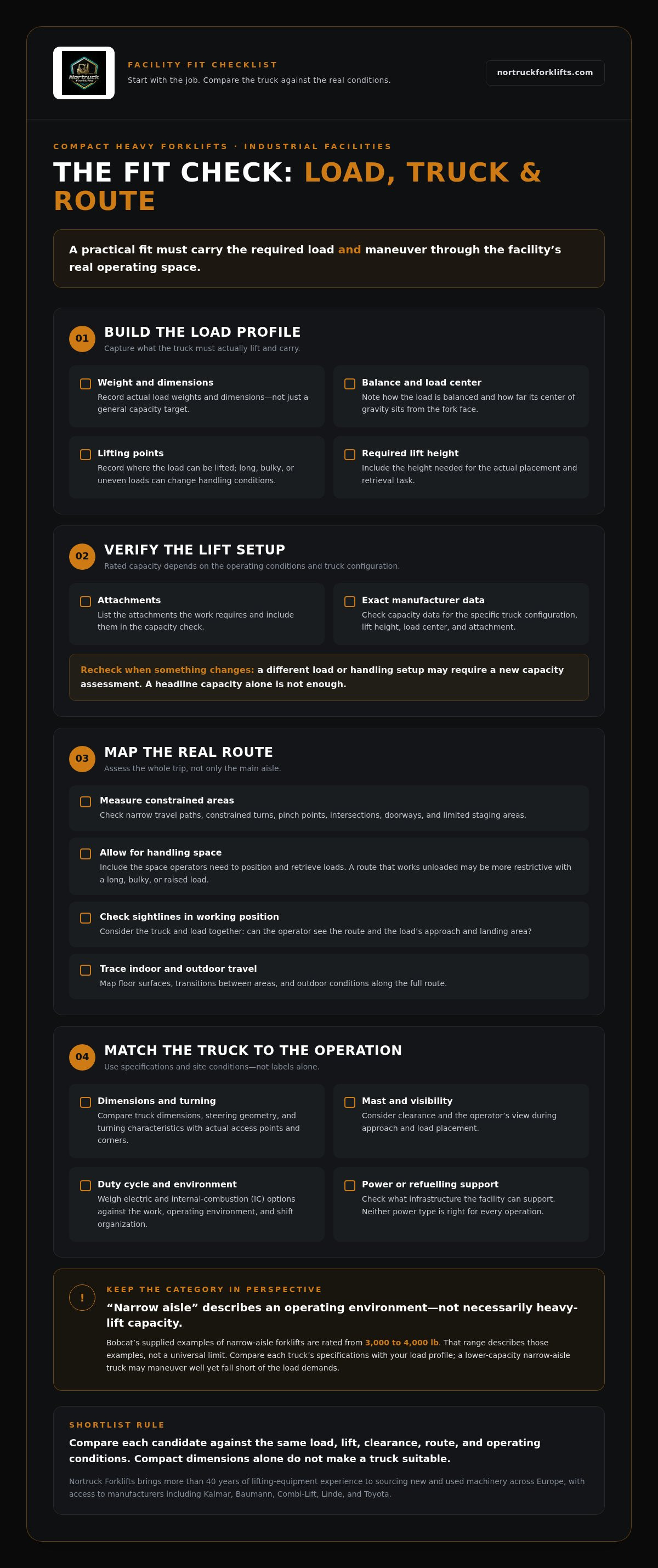
“Narrow aisle” describes an operating environment, not necessarily heavy-lift capacity. Bobcat’s supplied examples of narrow-aisle forklifts are rated from 3,000 to 4,000 lb. That range describes those examples, not a universal limit for narrow-aisle trucks. To judge suitability, compare the individual truck’s specifications with your load profile, including the weight and dimensions of the loads handled.
Facility conditions that make compact dimensions valuable
Check constrained turns, narrow travel paths, and limited staging areas. A route that works for an unloaded truck may become more restrictive with a long, bulky, or raised load. Measure pinch points, intersections, and doorways, and allow for the space operators need to position and retrieve loads. Check sightlines too: the truck and load should allow the operator to see the route and handling area.
Indoor and outdoor travel can change the decision. Floor surfaces, transitions between areas, and outdoor conditions affect tire and power requirements. Map the full route rather than assessing only the main aisle. A truck used across both environments needs to suit the conditions it will encounter along the way.
Evaluate footprint and rated capacity together: a truck is a practical fit only if it can carry the required load and maneuver through the facility’s real operating space. Use that as a starting point, then check the specific load and lift conditions before deciding whether a compact heavy-duty option is suitable.
How Compact Heavy Forklifts Handle Industrial Loads and Tight Spaces
A compact truck has to do more than fit through a restricted route. Its mast, steering, visibility, and load-handling setup affect how it works around structures, stored materials, and people. When assessing a compact heavy forklift for industrial facilities, consider these characteristics together. A small footprint is useful only if the truck can handle the required load and allow the operator to place it with a clear view of the work area.
Capacity, load center, and lift requirements
Rated capacity applies under specific operating conditions; it isn’t simply the weight printed on a load ticket. The load’s center of gravity and its distance from the fork face matter. A long or uneven load can place its center farther out than a compact, evenly distributed one. Lift height and attachments also affect the required setup, so a headline capacity doesn’t tell the whole story.
Review the manufacturer’s capacity data for the exact truck configuration, lift height, load center, and attachment. If the load or handling setup changes, revisit that data rather than assuming the original rating still applies. Specifications vary between machines and configurations, so use the documentation for the equipment being considered.
Steering, mast, visibility, and power choices
Steering geometry and turning characteristics determine how a truck moves through the facility’s actual corners and access points. Mast design affects clearance and the operator’s view during approach and placement. Check sightlines with the load positioned as it will be handled, including whether the operator can see the route and landing area. These practical checks complement the site’s operating procedures and relevant OSHA guidelines for powered industrial trucks.
Weigh electric and internal-combustion (IC) options against the duty cycle, operating environment, and available infrastructure. Consider where the truck will work, how shifts are organized, and what power or refuelling arrangements the site can support. Neither power type is right for every operation; the fit depends on the work and facility.
Separate confirmed requirements from early assumptions as you compare candidates. Record actual load weights and dimensions, required lift heights, attachments, and routes. Then match those details against the manufacturer’s specifications for each proposed setup. For example, a load handled close to the mast may require a different capacity assessment if its center of gravity sits farther forward. That assessment depends on the specific load and configuration, not on a general rule about compact trucks.
- Load: Weight, dimensions, balance, and lifting points.
- Truck: Capacity data for the relevant load center, lift height, and attachment.
- Route: Turning space, clearance, sightlines, and surface transitions.
Use these details to guide the equipment discussion instead of selecting a truck by label or a single rating. Nortruck Forklifts sources new and used heavy lifting equipment across Europe. Its project-led heavy equipment sourcing advice can help relate facility and load requirements to potential candidates.
How to Compare Compact Heavy Forklifts for Your Facility
Compare candidates against the same operating brief, not just advertised capacity or category. A consistent framework makes trade-offs easier to see: one truck may suit the load but require more turning space, while another may fit the route but need a different lifting configuration. For a compact heavy forklift for industrial facilities, build an evidence-based shortlist by measuring each candidate against the work it must perform.
Build a facility-fit comparison table
Use a table like this to organize project information before comparing makes and models. Add exact manufacturer specifications alongside your site findings. Don’t treat example figures or general category descriptions as machine data.
| Requirement | Evidence to gather | Implications for the shortlist |
|---|---|---|
| Loads and rated capacity | Load weights and dimensions, plus manufacturer capacity data for the proposed setup | Remove candidates that don’t meet the load requirements under the relevant operating conditions. |
| Load center and lifting points | Load balance, center of gravity, and fork or attachment position | Compare capacity against the actual load arrangement, not weight alone. |
| Lift height | Required placement heights and the manufacturer’s data for that lift configuration | Confirm candidates suit the intended lift, rather than relying on a base rating. |
| Travel routes and surfaces | Route widths, turning areas, floor conditions, and indoor-outdoor transitions | Assess dimensions, steering, tires, and power choices against the complete route. |
| Restricted spaces and visibility | Clearances, staging areas, sightlines, and operator access at work points | Prioritize configurations that can maneuver and support clear observation during placement. |
| Duty cycle and attachments | Operating hours and shifts, power infrastructure, and attachment requirements | Compare power sources and configurations against the work pattern and handling tasks. |
Use manufacturer documentation for exact capacity, dimensions, turning characteristics, lift data, and configuration details. Compare like with like: if the proposed setup includes an attachment or a different mast, use specifications for that configuration. Record gaps in the project information instead of filling them with assumptions.
Account for operation, safety, and ownership needs
A shortlist should reflect how operators approach loads, travel through the site, and maintain awareness around the truck. Consider sightlines with loads in place, access through work areas, and stability under the intended handling conditions. These are practical review points, not substitutes for the manufacturer’s operating guidance or applicable site procedures.
Assess new and used equipment by how closely the specifications match the brief and what machine information is available for evaluation. A used candidate still needs to suit the load, route, and duty cycle; a new candidate must meet those same requirements. Compare the documented configuration and condition with the operating brief before deciding which sourcing route merits consideration.
For a broader ownership-cost discussion, see Forklift Total Cost of Ownership: New vs Used. Keep that analysis distinct from facility fit: ownership considerations inform the decision, but they don’t replace matching equipment to the work.
How to Turn Site Requirements into a Compact Heavy Forklift Shortlist
A useful shortlist begins with an accurate equipment brief, not a preferred brand or headline capacity. Gather the details below, then use the same requirements to assess every candidate. This makes it easier to identify a compact heavy forklift for industrial facilities that fits both the loads and the working environment.
- Record the load profile. Note the heaviest loads and those handled most often, including dimensions, balance, lifting points, and handling frequency. The heaviest item sets an important capacity requirement, while common loads help describe the equipment’s regular work pattern.
- Map the facility and routes. Document aisle widths, turning areas, doorways, staging zones, gradients, and indoor-outdoor transitions. Include floor conditions and surface changes along the full route. A measured site sketch can reveal pinch points that a general aisle measurement might miss.
- Describe the lifting task. Specify required lift heights and any attachments needed to handle the load. Record operator sightlines and access requirements at pickup, during travel, and at placement. Include shift patterns, operating hours, and power infrastructure so candidates can be compared against the actual duty cycle.
- Separate essential constraints from preferences. Mark minimum capacity, required lift conditions, and route clearances as non-negotiable. List optional features separately. A candidate that misses a critical clearance or load requirement should not rank ahead of one that meets both simply because it offers a desirable extra.
- Review the shortlist against evidence. Compare each candidate’s manufacturer documentation with the brief, including capacity for the relevant configuration, overall dimensions, turning characteristics, lift height, and attachments. Keep assumptions visible and resolve missing project information before treating a candidate as a close fit.
Use the same evidence-led approach when weighing new and used equipment. Match both routes to the required configuration and operating conditions rather than comparing headline capacity alone. For used candidates, include available inspection and condition information alongside the machine’s specifications. The aim is to understand how well each option answers the brief, not to favor one sourcing route automatically.
For broader context on sourcing equipment across European markets, Industrial Forklift Sourcing Across Europe can complement this site-to-shortlist process. If heavy-lift capacity is central to the requirement, Sourcing Kalmar Heavy Lift Trucks for Sale: The Expert Guide to High-Capacity Logistics offers a related perspective. Lars G Tarby’s more than 40 years of lifting-equipment experience and Nortruck’s European sourcing network can support a project-led review of new and used candidates against the facility brief.
Use your site and load requirements to frame a focused equipment discussion.
Source a Compact Heavy Forklift with Nortruck’s Project-Led Advice
A shortlist becomes useful when each candidate is assessed against the same facility brief. Nortruck Forklifts starts with the work to be done: the loads, operating space, routes, and demands of the duty cycle. This keeps the sourcing discussion grounded in the project instead of starting with a model name or capacity figure in isolation.
For a compact heavy forklift for industrial facilities, details that may seem small can change which equipment merits consideration. A load’s dimensions and lifting points, a restricted turn, or a regular transition between indoor and outdoor areas can all affect the fit. Share these conditions early to give the equipment discussion a practical reference point.
What Nortruck brings to an equipment sourcing discussion
Lars G Tarby brings more than 40 years of lifting-equipment experience to sourcing advice. Nortruck sources machinery across Europe from manufacturers including Kalmar, Baumann, and Combi-Lift. This network supports a project-led search across manufacturers, with potential candidates assessed against the facility’s requirements rather than presented as a one-size-fits-all answer.
Nortruck’s advisory role connects sourcing research with the operating brief. The load profile and site conditions guide which equipment types and configurations warrant consideration, and candidate information is then related to the work the machine needs to perform. New and used heavy lifting equipment can both be considered, with the project requirements shaping the evaluation.
Prepare for a practical first conversation
You don’t need a perfect technical specification to begin. A clear account of the job is a strong starting point. Bring what you know about the loads and facility, and identify details that still need to be established. Useful information includes:
- Load weights, dimensions, lifting points, and how often different loads are handled.
- Facility measurements, including travel paths, doorways, turning areas, and restricted clearances.
- Routes and surfaces, including indoor-outdoor transitions and changes in floor conditions.
- Required lift heights, attachments, operator sightlines, shift patterns, and power arrangements.
These details frame the sourcing discussion and provide a consistent basis for reviewing candidates. Manufacturer specifications can be considered alongside the site brief, particularly when heavy-lift capacity is central to the project. For used equipment, available machine and condition information also forms part of the evaluation. The aim is a shortlist aligned with the operation, not a quick recommendation based on one headline figure.
Discuss your facility and load requirements with Nortruck to start a focused sourcing conversation.
Turn Your Equipment Brief into a Confident Decision
Make your equipment brief useful in a real sourcing conversation. Identify which operating constraints are fixed, which preferences can be adjusted, and where reliable information is still needed. That distinction keeps the search focused and helps you assess whether a proposed compact heavy forklift for industrial facilities fits the operation, not just the initial specification.
You don’t need every detail resolved before starting. A clear account of the work, the space, and the demands placed on the truck gives an experienced adviser a practical basis for discussing candidates and sourcing routes. Refine the shortlist from there using evidence and project priorities.
A considered decision starts with the right questions. Use your load and site brief to compare equipment against the operation it needs to serve.
Frequently Asked Questions
How is a compact heavy forklift different from a narrow-aisle forklift?
A compact heavy forklift combines substantial load-handling needs with a restricted operating footprint, while “narrow aisle” mainly describes where a truck operates. The labels can overlap, but they don’t guarantee the same capacity or configuration. A warehouse truck designed for close-rack work, for example, may not suit a bulky industrial component. Compare the machine’s load data and dimensions with the task rather than treating either label as a specification.
What does load center mean when selecting an industrial forklift?
Load center is the horizontal distance from the vertical face of the forks to the load’s center of gravity. If a load is longer, unevenly balanced, or positioned farther forward, its center of gravity may sit farther from the fork face. This affects how the truck’s capacity applies to that load. Use the load dimensions and placement details with the manufacturer’s capacity data for the proposed setup.
Can a compact heavy forklift be configured for electric operation?
Electric power is one option to consider when comparing forklift configurations. Its suitability depends on the specific machine and application. Consider shift patterns, expected operating time, charging arrangements, and whether the equipment will work indoors, outdoors, or in both environments. Compare manufacturer documentation with the facility’s duty cycle and infrastructure before adding a candidate to the shortlist.
What information should a buyer gather before requesting a forklift shortlist?
Prepare load weights, dimensions, lifting points, and handling frequency, along with required lift heights and any attachments. For a compact heavy forklift for industrial facilities, also note route widths, doorways, turning areas, surface conditions, and indoor-outdoor transitions. Include operating hours, shift patterns, power arrangements, and visibility or access concerns. Approximate measurements can frame an initial discussion, but accurate details are needed for final machine comparisons.
What documents help assess a used heavy forklift?
Start with the machine identification and specification information, including its data plate and manufacturer capacity documentation for the current configuration. Available inspection reports, condition records, and maintenance history can add useful context. Check that the documents refer to the same machine and attachments being considered. Treat incomplete records as an information gap in the evaluation rather than assuming the truck’s present condition or capacity.
Can one forklift handle both indoor and outdoor industrial work?
One truck can handle both if its specific configuration suits the environments and the full route. Review tire type, ground conditions, transitions, clearances, and power source in relation to the work pattern. A smooth indoor floor and an uneven outdoor approach create different operating demands. Map the route and identify where conditions change, then use manufacturer specifications to assess whether one truck can meet the full application.
How do attachments affect a forklift’s rated capacity?
An attachment can add weight and move the load farther from the truck, changing the capacity available for handling. The effect depends on the attachment, load position, lift height, and truck configuration, so there is no universal adjustment. Use capacity information for the specific attachment and setup, and confirm it corresponds to the machine being considered. A standard capacity rating alone may not describe the usable capacity for an attached application.
Ready to compare equipment against your facility’s loads and routes? Discuss your forklift requirements with Nortruck.

Article by
Lars Gunnar Tärby
Disclaimer
1. General Information and No AdviceThe information, articles, product descriptions, and specifications provided on this website (www.nortruckforklifts.com) are for general informational and educational purposes only. While we strive to provide accurate and up-to-date content regarding new and used forklifts and heavy machinery, the material published does not constitute professional, technical, or legal advice.
2. Product Specifications and PricingNortruck Forklifts acts as a facilitator for the trade of new and used forklifts. All equipment details, including but not limited to year of manufacture, operating hours, lift capacity, dimensions, conditions, and pricing, are provided based on the information available to us at the time of publication. Specifications and availability are subject to change without prior notice.
3. "As Is" and VerificationAll articles and product listings are provided on an "as is" and "as available" basis without any warranties of any kind, either express or implied. Nortruck Forklifts does not guarantee that the descriptions are entirely error-free, complete, or reliable. Buyers and traders are strongly encouraged to independently verify all technical specifications, machine history, and equipment conditions directly with the seller or an authorized inspector before finalizing any purchase or transaction.
4. Limitation of LiabilityIn no event shall Nortruck Forklifts, its owners, or its contributors be held liable for any direct, indirect, incidental, consequential, or economic loss or damage arising out of the use of, or the inability to use, the information provided on this website, or any transactions facilitated through this platform. This includes, but is not limited to, damages caused by technical inaccuracies, typographical errors, or reliance on the content of our articles.
5. Third-Party LinksOur website may contain links to external websites, dealer networks, or third-party services that are not owned or controlled by Nortruck Forklifts. We have no control over, and assume no responsibility for, the content, privacy policies, or practices of any third-party websites.


