
The best forklift for your operation may not be the one with the highest capacity rating or the most familiar badge. Successful industrial forklift sourcing Europe starts with the work the machine needs to do: the loads it will handle, the space it must operate in, and the demands of each shift. Focusing only on price or brand can lead to a mismatch in capacity or configuration that creates problems long after the purchase.
This guide shows you how to turn operating conditions into a clear equipment brief, compare new and used machinery using consistent criteria, and plan for cross-border transport and documentation. It also explains how to assess machine fit without relying on a manufacturer name alone. Nortruck Forklifts sources and advises on new and used lifting equipment from manufacturers including Kalmar, Baumann and Combi-Lift, giving you a broader basis for comparison. The goal is a procurement decision grounded in practical requirements, relevant evidence and experienced guidance.
Key Takeaways
- Build an equipment brief around the loads, work environment, duty cycle and workflow before narrowing down machine options.
- For industrial forklift sourcing Europe, assess capacity alongside load centre, attachments, lift height and the demands of the application.
- Compare new and used forklifts against the same operating requirements, using condition evidence and configuration as part of the decision.
- Plan procurement and delivery in sequence, accounting for the machine’s dimensions, configuration, route and destination.
- Use a multi-manufacturer sourcing perspective to explore options from Kalmar, Linde, Toyota, Baumann, Combi-Lift and Volvo.
Industrial forklift sourcing in Europe: define the requirement before the machine
Industrial forklift sourcing means finding equipment that fits a documented operating requirement, rather than choosing a machine from a catalogue and trying to make it work. For industrial forklift sourcing Europe, begin with the loads, work environment, duty cycle and workflow. These details define what the machine must handle and where it must operate. A brand name alone cannot show whether a specific configuration suits the job.
A useful brief gives sourcing discussions a practical basis across manufacturers. Record what the forklift will lift, how often it will operate and what the site allows. This guide helps you structure the decision and plan procurement. For a general overview of forklift design and operation, see these forklift basics.
For a visual look at technology in a European material-handling operation, watch this video:
Catalogue browsing can help identify equipment categories, but application-led sourcing makes comparisons more useful. For example, a buyer handling long materials in a constrained workspace should describe the loads and space limitations before comparing machine types or manufacturers. A broader manufacturer search can then identify relevant configurations without changing the operating brief to fit a listing.
What should an industrial forklift sourcing brief include?
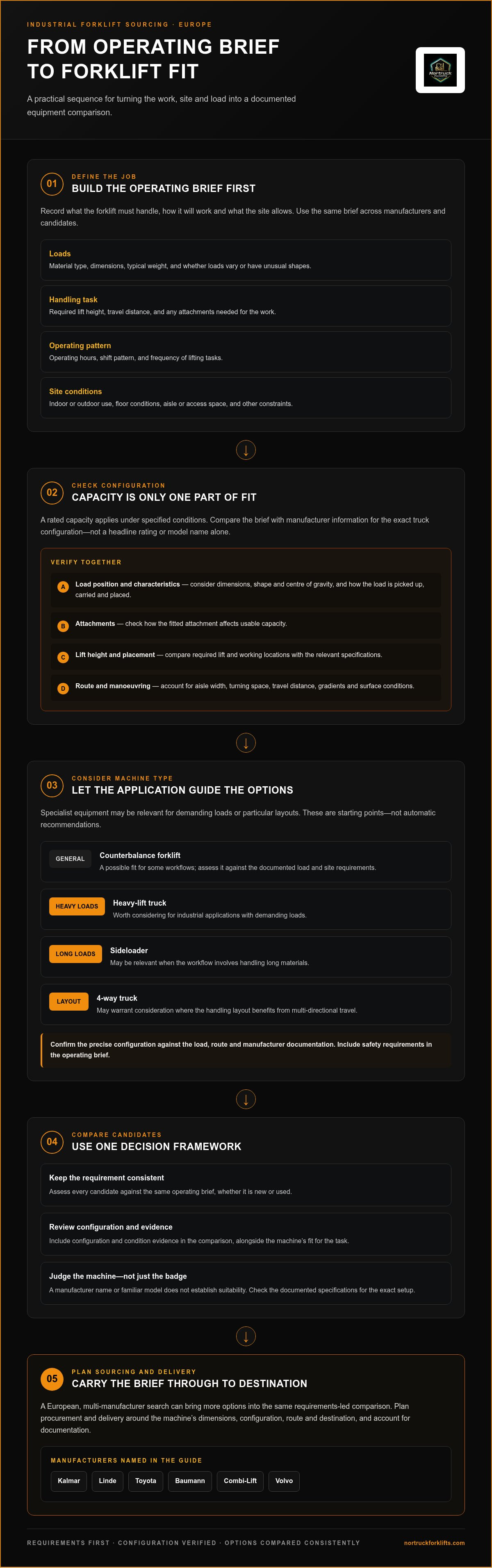
Make the brief specific enough to describe the work the machine will actually do. Include:
- Loads: material type, dimensions, typical weight and whether loads vary or have unusual shapes.
- Handling task: required lift height, travel distance and any attachments needed for the work.
- Operating pattern: operating hours, shift pattern and frequency of lifting tasks.
- Site conditions: indoor or outdoor use, floor conditions, aisle or access space and other constraints.
These details help clarify how to assess capacity and configuration when you compare suitable machines.
Why source industrial forklifts across Europe?
Looking across European sourcing options can broaden the search beyond a single local catalogue and bring different manufacturers into the same requirements-led discussion. Assess each option against the documented application, rather than assuming a particular machine is suitable. Nortruck sources new and used lifting equipment across Europe and offers a multi-manufacturer perspective. For wider market context, read the European forklift market guide.
Match forklift capacity and configuration to the industrial application
A forklift’s rated capacity is only one part of the selection. The rating applies under specified conditions, so load position, fitted attachments and required lift height can affect whether a machine is suitable for the task. For industrial forklift sourcing Europe, compare the operating brief with the manufacturer’s documentation for the exact configuration. Do not rely on a headline capacity or model name alone.
Start with the load. Consider its dimensions, shape and centre of gravity, then describe how it will be picked up, carried and placed. A compact, stable pallet presents a different handling task from an awkward or long load. Attachments matter too, as they can change the truck’s usable capacity. Check the manufacturer’s capacity information for the specified truck, attachment and lift conditions before comparing options.
Which operating details change the right forklift specification?
The site can rule a configuration in or out. Include aisle width and turning space, the distance and route travelled, gradients and surface conditions. A truck may be able to lift a load yet still be a poor operational fit if it cannot manoeuvre safely through the available space or work effectively on the site’s surfaces.
Lift height and load placement matter alongside travel conditions. Write down the required lift and working locations, then compare them with the relevant manufacturer specifications. Keep the brief consistent across options. This makes it easier to judge suitability for the task instead of treating a familiar brand as proof of fit.
When does specialist lifting equipment deserve consideration?
General counterbalance forklifts suit some workflows, but demanding loads or particular layouts may call for a specialist type. Heavy-lift trucks are worth considering for industrial applications with demanding loads. For long-load workflows, a sideloader may be relevant. Where the handling layout benefits from multi-directional travel, a 4-way truck may warrant consideration. These are starting points, not automatic recommendations. Confirm the precise machine configuration against the load, route and manufacturer documentation.
For a focused discussion of heavy-lift equipment, see the Kalmar heavy-lift sourcing guide. For UK workplace safety context, the HSE Approved Code of Practice for lift trucks covers operator training and safe use. Include safety requirements in the operating brief alongside equipment fit.
A clear specification brings these factors together: load characteristics, handling method, site constraints and relevant machine documentation. Nortruck’s experience across manufacturers can help turn that brief into a considered sourcing discussion. Explore Nortruck sourcing advice as you refine the equipment requirements for your operation.
Compare new and used industrial forklifts with the same decision framework
A fair comparison starts with the same operating requirement for every candidate. New equipment can be sourced to suit the application and specified configuration. For a used machine, buyers also need to assess its documented condition and history. Neither route should be judged by brand, age or asking price alone. In industrial forklift sourcing Europe, one consistent framework helps separate what the records show from what someone assumes.
Use a comparison table to make the differences visible. Record the evidence for each assessment, and mark information that is unavailable rather than treating it as fact.
| Comparison point | New equipment | Used equipment |
|---|---|---|
| Application fit | Compare the proposed specification with the documented operating brief. | Assess whether the machine’s documented specification suits the same brief. |
| Condition evidence | Review the specification and relevant machine documentation. | Review available machine records, service history and condition information. |
| Configuration | Check capacity, lift requirements and attachments against manufacturer documentation. | Check the machine’s actual configuration and applicable manufacturer information. |
| Procurement requirements | Record the agreed specification and requirements for procurement and delivery planning. | Record the same requirements, plus any relevant machine-specific documentation. |
How do new and used sourcing routes differ?
For new equipment, focus on how closely the proposed configuration matches the work described in the brief. For used equipment, application fit still comes first, but you also need to weigh available condition evidence and machine records. A machine is not necessarily suitable just because its category or brand looks right. Keep documented facts separate from gaps or unverified claims.
What belongs in a fair machine comparison?
Use manufacturer documentation to compare capacity and configuration on an equivalent basis. Different configurations can make headline figures misleading. Note the attachment, lift requirements and relevant operating conditions alongside the specification. For used options, record available service history, machine records and documented condition. Treat missing details as unknown, not as proof of either good or poor condition.
Then compare the full procurement requirement, including the documentation needed for the selected machine and the practical arrangements for moving it into operation. Avoid relying on assumed savings, expected residual value or unverified delivery estimates. The European Materials Handling Federation provides broader context on the industrial truck sector, while the machine’s own documentation remains central to an individual comparison.
Nortruck’s new and used sourcing advice uses your operating brief to frame options across manufacturers, including Kalmar, Linde, Toyota, Baumann and Combi-Lift. Explore Nortruck’s forklift sourcing to develop a comparison grounded in application fit and available evidence.
Plan European forklift procurement around logistics and documentation
A suitable machine still needs a clear route from agreed specification to receiving site. For industrial forklift sourcing Europe, treat procurement and delivery planning as part of the same project, not as a final step after selecting a forklift. The transport plan depends on the machine’s dimensions and configuration, collection location, route and destination. Attachments and other fitted equipment can affect transport requirements, so document the exact machine being sourced.
A practical sequence keeps the handover organised:
- Agree the specification: Record the selected machine configuration and the operating requirements it must meet.
- Identify collection and destination: Establish where the machine will be collected and delivered, including any route or access constraints.
- Prepare the receiving site: Confirm access, unloading arrangements and site readiness for the machine’s dimensions and configuration.
- Organise transaction records: Gather machine identification, specifications and relevant ownership or transaction documents.
- Review country-specific requirements: Check which tax, customs, registration and conformity requirements apply to the transaction and destination.
What should buyers coordinate before arranging transport?
Align the collection location and delivery destination with the machine’s actual configuration. Provide dimensions and relevant details for the truck and fitted equipment so transport planning reflects what will move, not a generic model description. Consider access routes at both ends, unloading arrangements and whether the receiving site is ready for the equipment. Transport timing and arrangements are project-specific, so base the plan on the agreed details rather than assuming a standard schedule.
Which documents and cross-border requirements need attention?
Keep the paperwork tied to the specific machine and transaction. A working file can include the machine’s identification details, manufacturer specifications and relevant ownership or transaction records. Depending on the countries and transaction, tax, customs, registration or conformity requirements may also apply. Requirements can vary, so verify the current rules for the route and destination. This checklist is a planning aid, not a definitive legal or customs determination.
Clear records connect the procurement decision to the machine being transported. They also give the buyer and sourcing partner a shared reference for coordinating collection, delivery and receipt. A change in configuration, route or destination may affect the plan, so keep those details aligned as the project progresses.
Source industrial forklifts in Europe with Nortruck’s experienced advice
A clear operating brief is the starting point. The next challenge is turning it into a focused sourcing decision across manufacturers and equipment types. Nortruck provides sales and advisory services for new and used lifting equipment sourced across Europe, helping buyers consider relevant options against the work the machine needs to do. This keeps the discussion centred on application fit, configuration and available evidence, rather than treating a familiar brand as the answer by itself.
What does an experienced sourcing adviser contribute?
An adviser can help shape operating details into a practical sourcing brief, then compare relevant equipment options against it. Depending on the application, the comparison may include Kalmar Heavy Lift Trucks, Linde and Toyota forklifts, Baumann sideloaders, Combi-Lift 4-way trucks and Volvo wheel loaders. Consider each option in context: the task, configuration and supporting specifications matter more than the name on the machine.
Good advice also makes trade-offs visible. A proposed option may fit one part of the operation while requiring a closer look at another, such as the handling layout or procurement requirements. Distinguishing documented facts from assumptions gives buyers a sounder basis for deciding which route to pursue. Nortruck’s multi-manufacturer sourcing perspective supports a broader discussion across new and used equipment.
How to start a Nortruck sourcing conversation
Bring the details that describe the real application. A concise brief makes the discussion more specific from the outset. Include:
- Load information: materials handled, typical dimensions and load characteristics.
- Operating conditions: indoor or outdoor use, work surfaces, space constraints and duty pattern.
- Handling requirements: lift needs, travel routes and any relevant attachments or configuration preferences.
- Procurement context: destination, new or used preference, and any transport or documentation considerations already identified.
Describe the central challenge in plain terms. Is the requirement focused on heavy lifting, long loads or a different industrial workflow? That context helps direct attention to relevant equipment categories without committing prematurely to a brand or machine type.
Nortruck’s sourcing and advisory approach connects application details with options from its manufacturer range. The brief guides the search, and evidence supports the comparison. If you’re ready to outline your application and procurement needs, start a conversation with Nortruck.
Move forward with a sourcing decision built around your operation
Strong industrial forklift sourcing Europe begins with a clear operating brief, not a preferred brand. Match capacity and configuration to the actual load, handling task and site conditions, then compare new and used options using equivalent specifications and documented evidence. Plan transport and paperwork around the selected machine, route and destination so procurement details support the decision from the outset.
Nortruck sources new and used lifting equipment across Europe from manufacturers including Kalmar, Linde, Toyota, Baumann, Combi-Lift and Volvo. Its advisory approach draws on Lars G Tarby’s more than 40 years of experience in lifting equipment. The focus is practical guidance that keeps machine fit at the centre of the conversation.
Have an application in mind? Share the key requirements and take the next step with a focused sourcing discussion.
A well-defined brief gives you a stronger foundation for a confident procurement decision.
Frequently Asked Questions
How do I source an industrial forklift in Europe?
Start by documenting the work the forklift must perform, then use that brief to guide the search. Record load dimensions and characteristics, required lift height, operating hours, shift pattern, site conditions and space constraints. Compare suitable machines against those requirements, using manufacturer specifications and relevant condition records for used equipment. For industrial forklift sourcing Europe, plan transport and documentation alongside machine selection, and account for destination-specific requirements before procurement proceeds.
Is it better to buy a new or used industrial forklift?
Neither option is automatically better. The right choice depends on how well the machine fits the application and what evidence is available. Compare new and used candidates against the same operating brief. For new equipment, focus on the proposed configuration and its documented specifications. For used equipment, also review available machine records, service history and condition information. Consider procurement and delivery requirements without relying on assumptions about savings or condition.
What information do I need before sourcing a forklift?
Prepare a practical description of the loads, handling task and operating environment. Include material type, typical load dimensions and characteristics, lift height, travel distance, operating hours and shift pattern. Note whether the work takes place indoors or outdoors, along with floor conditions, aisle width, turning space and other site constraints. Include any attachment or configuration requirements and the delivery destination. These details focus the search before you compare manufacturers or individual machines.
Can I source specialist forklifts from different manufacturers in Europe?
Yes. Nortruck sources new and used lifting equipment across Europe from multiple manufacturers. Its range includes Kalmar Heavy Lift Trucks, Baumann Sideloaders, Combi-Lift 4-way Trucks, Linde Forklifts and Toyota Forklifts, as well as Volvo Wheel Loaders and reachstackers for port terminals. The appropriate category depends on the handling application. Describe the loads, workflow and site layout first, then assess relevant options against the operating brief and manufacturer documentation.
What should I consider when transporting a forklift across European borders?
Coordinate the exact machine configuration, collection location, destination, route and receiving-site arrangements. Dimensions and fitted equipment inform transport planning, while access and unloading conditions affect site readiness. Prepare machine identification, specifications and relevant transaction or ownership records. Tax, customs, registration and conformity requirements can depend on the countries and transaction involved, so verify current rules for the route and destination. Keep transport arrangements project-specific rather than assuming a standard timing or process.
How can I compare industrial forklifts from different brands?
Compare each machine against the same documented operating requirement, not brand reputation or headline capacity alone. Check equivalent manufacturer specifications for capacity and configuration, including relevant attachments and lift conditions. Assess whether each option suits the loads, handling method and site constraints. For used machines, record available condition evidence, service history and operating context, distinguishing documented facts from unknowns. This creates a clearer comparison across manufacturers and helps reveal trade-offs relevant to the operation.
Does Nortruck source both new and used industrial forklifts?
Yes. Nortruck Forklifts provides sales and advisory services for new and used lifting equipment sourced across Europe. The sourcing discussion is guided by the application, configuration requirements and manufacturer documentation, rather than by brand alone. Nortruck works with manufacturers including Kalmar, Linde, Toyota, Baumann, Combi-Lift and Volvo. A brief covering loads, site conditions, duty pattern and destination gives the comparison a practical starting point.

Article by
Lars Gunnar Tärby
Disclaimer
1. General Information and No AdviceThe information, articles, product descriptions, and specifications provided on this website (www.nortruckforklifts.com) are for general informational and educational purposes only. While we strive to provide accurate and up-to-date content regarding new and used forklifts and heavy machinery, the material published does not constitute professional, technical, or legal advice.
2. Product Specifications and PricingNortruck Forklifts acts as a facilitator for the trade of new and used forklifts. All equipment details, including but not limited to year of manufacture, operating hours, lift capacity, dimensions, conditions, and pricing, are provided based on the information available to us at the time of publication. Specifications and availability are subject to change without prior notice.
3. "As Is" and VerificationAll articles and product listings are provided on an "as is" and "as available" basis without any warranties of any kind, either express or implied. Nortruck Forklifts does not guarantee that the descriptions are entirely error-free, complete, or reliable. Buyers and traders are strongly encouraged to independently verify all technical specifications, machine history, and equipment conditions directly with the seller or an authorized inspector before finalizing any purchase or transaction.
4. Limitation of LiabilityIn no event shall Nortruck Forklifts, its owners, or its contributors be held liable for any direct, indirect, incidental, consequential, or economic loss or damage arising out of the use of, or the inability to use, the information provided on this website, or any transactions facilitated through this platform. This includes, but is not limited to, damages caused by technical inaccuracies, typographical errors, or reliance on the content of our articles.
5. Third-Party LinksOur website may contain links to external websites, dealer networks, or third-party services that are not owned or controlled by Nortruck Forklifts. We have no control over, and assume no responsibility for, the content, privacy policies, or practices of any third-party websites.


