
Could a higher-capacity forklift still be the wrong choice for your smelter? Yes. Choosing a heavy forklift for aluminum smelting plant operations means looking beyond the capacity plate. Load centres, attachments, heat, dust, duty cycles, and travel routes all affect whether a machine suits the work. A general heavy forklift may not fit the demands of a specific task.
It’s understandable to focus first on the weight being moved, but rated capacity can change when a load sits further from the truck or an attachment is fitted. This guide explains how to define an equipment requirement, compare options against actual loads and plant conditions, and identify details that need technical review. If molten-metal handling is involved, it requires project-specific validation, not assumptions based on capacity alone.
We’ll look at load profiles, operating conditions, machine configuration, and site routes, then explain how an experienced sourcing adviser can help match those requirements to relevant new or used equipment. Nortruck draws on Lars G Tarby’s more than 40 years of lifting-equipment experience to support a considered heavy-lift selection.
Key Takeaways
- Assess a heavy forklift for aluminum smelting plant work by matching it to the task and environment, and distinguish routine handling from work near hot processes.
- Build a clear load profile that includes dimensions, load centre, and attachment requirements, not just weight.
- Map plant routes and operating conditions to decide whether a heavy forklift or an integrated handling system better fits the workflow.
- Use a consistent checklist to separate essential requirements from preferences, including exposure, utilization, visibility, and operator workflow.
- A precise plant brief helps Nortruck compare relevant heavy-lift options, with Kalmar Heavy Lift Trucks as its primary heavy-lift offering.
What Makes a Heavy Forklift Suitable for an Aluminum Smelting Plant?
A suitable heavy forklift is matched to the task, load, operating environment, and machine configuration. Look beyond the weight being lifted: load dimensions, how the load is carried, exposure to heat or dust, and the route all shape the equipment requirement.
A smelter-suitable heavy forklift is specified for the plant’s documented loads, handling tasks, routes, and exposure conditions. It is not a universal category or a guarantee that one truck can safely perform every job across the site.
Which materials and plant tasks will the forklift handle?
Start with the material, then describe how it moves. Ingots, billets, scrap, and production materials may need different handling arrangements depending on their dimensions, condition, and destination. Separate transport between work areas from stacking, feeding, and yard movements. Each task may involve a different load position, travel distance, or operating pattern.
Record whether material is cooled, warm, or exposed to radiant heat during handling. Moving cooled products is a different application from working close to hot processes. Molten-material handling requires project-specific engineering and validated equipment. Do not assume a forklift is suitable for that task based on its capacity or general heavy-duty designation.
Why does the smelter environment change the specification?
Map conditions along the actual operating route. Note heat exposure, dust, floor surfaces, visibility, and whether movements take place indoors, outdoors, or between both. Also document traffic interactions, pedestrian areas, turning space, and storage constraints. These details show where the truck must maneuver and what may affect the operator’s view or handling task.
Smelter processes and equipment vary by plant. A general overview of Aluminium Smelter Operations provides broader context, but the site’s own process areas and routes should guide the specification. Treat local safety procedures and exposure controls as plant-specific inputs, not assumptions about a standard layout or universal operating condition.
For a heavy forklift for aluminum smelting plant use, suitability depends on how these factors work together. A clear application brief gives equipment advisers a practical basis for comparing relevant heavy-lift options against the real job, rather than relying on a capacity figure alone.
How to Specify Load Capacity, Attachments, and Operating Conditions
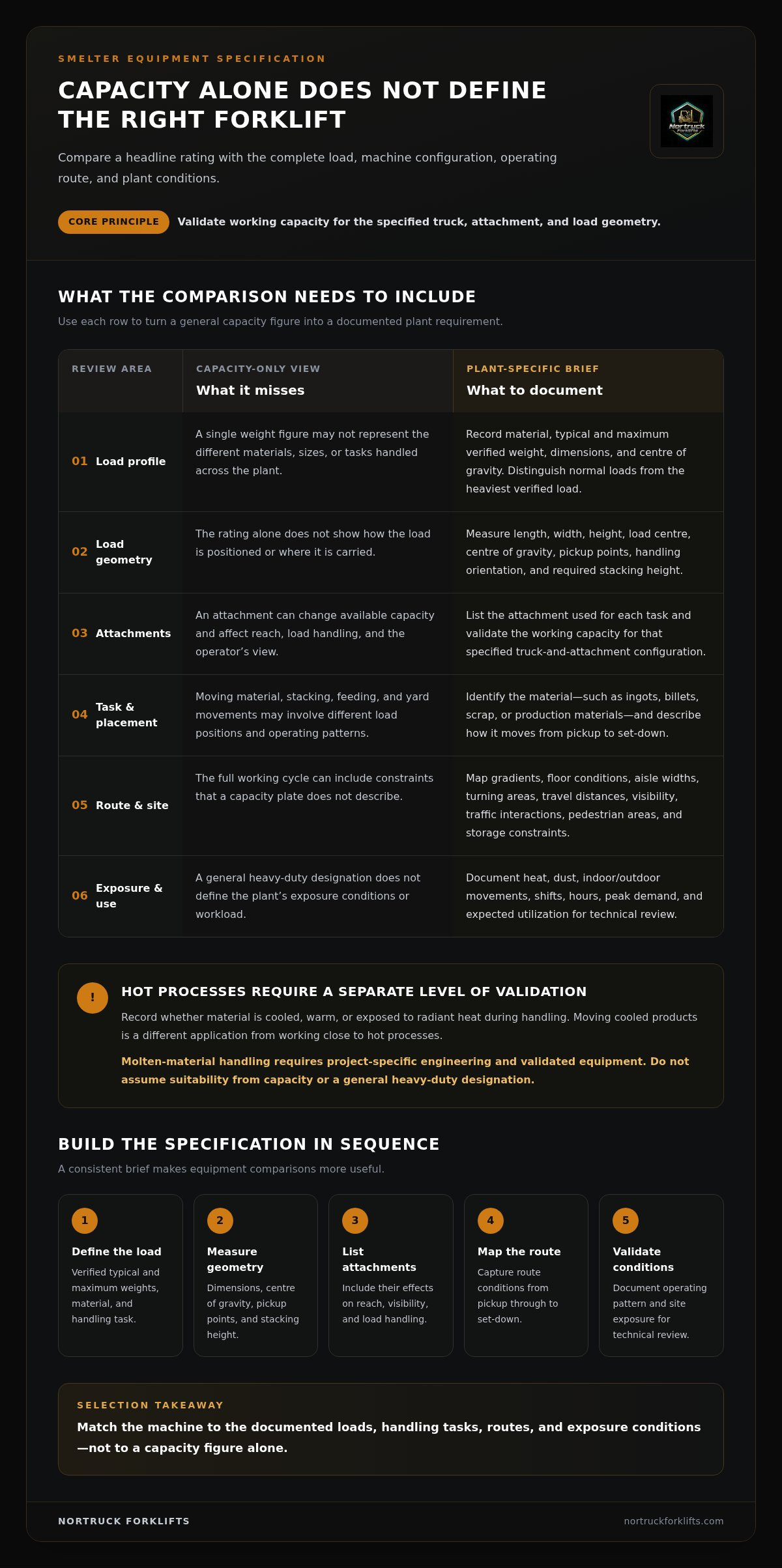
A forklift’s rated capacity is not a stand-alone answer to your load requirement. The load centre, attachment, and truck configuration affect the capacity available for the actual task. Validate working capacity for the specified truck, attachment, and load geometry. Do not infer it from the headline rating.
Build the specification in sequence so the information is useful when comparing equipment:
- Define the load. Record typical and maximum weights from verified operating data, and identify the material and how it is handled.
- Measure the geometry. Capture length, width, height, centre of gravity, pickup points, and required stacking height.
- Account for attachments. List each attachment used for the task. It can affect load handling, reach, and the operator’s view.
- Map the route. Note gradients, floor conditions, aisle widths, turning areas, and travel distances from pickup to set-down.
- Validate operating conditions. Document shifts, hours, peak demand, expected utilization, and exposure to heat, dust, or other site conditions for technical review.
What load data should buyers gather before sourcing?
Use measured values where available, and distinguish the normal operating load from the heaviest verified load. One example may not represent a plant that handles several materials or load sizes. Include attachment details for each task so equipment comparisons reflect the intended configuration.
| Procurement detail | What to record |
|---|---|
| Load | Material, typical and maximum verified weight, dimensions, and centre of gravity |
| Pickup and placement | Pickup points, handling orientation, and stacking height |
| Attachment | Attachment type and its effect on reach, visibility, and load handling |
| Route and use | Gradients, floor, aisle and turning space, travel distance, shifts, and peak demand |
| Exposure | Heat, dust, and other conditions relevant to technical review |
How should plant conditions shape the machine specification?
Describe the full working cycle, not just the lift. A tight turn, a gradient, or restricted visibility can change what the operation requires. Expected hours and peak demand also help distinguish occasional handling from sustained use. Include the site’s safety requirements in the brief. For US operations, the OSHA Standards for Powered Industrial Trucks are a relevant reference.
A well-documented brief gives an adviser a sound basis for comparing machinery against the actual work. If you’re developing a heavy forklift for aluminum smelting plant specification, Nortruck’s heavy-lift equipment sourcing advice can help connect the recorded load and operating profile to relevant options.
Heavy Forklift or Integrated Handling System: Which Fits the Plant?
Neither a heavy forklift nor an integrated handling system is automatically the better choice. The fit depends on how materials move through the plant: whether tasks and routes change, how closely handling must align with production, and whether equipment needs to serve several work areas or a dedicated process.
A heavy forklift may suit varied duties, particularly when loads move between locations or handling needs change across shifts. Shared use can make one truck useful across several tasks, but it can also create scheduling conflicts when production areas need it at the same time. Consider maneuverability, operator visibility, and the time and effort involved in changing attachments within the actual workflow.
When should buyers assess a process-specific handling system?
Assess a dedicated or integrated approach when handling is closely tied to a production sequence, requires automation, or involves repeated movements along a defined process. Compare the full sequence, from pickup through transfer and placement, rather than judging equipment by a single lift. Resources such as Aluminum Material Handling Solutions illustrate the range of equipment used in aluminum processing. Hot-material and molten-metal duties need specialist engineering assessment and validated equipment.
| Decision factor | Questions to consider | Information to supply |
|---|---|---|
| Task flexibility | Will the truck serve several duties, or repeat one defined task? | Handling tasks, loads, and how often each occurs |
| Process integration | Must material move in step with production or automation? | Handoffs, process stages, and any required timing or interfaces |
| Route and access | Do loads travel through changing routes or a dedicated path? | Route layouts, turning areas, access restrictions, and set-down points |
| Operating profile | Will equipment be shared, or is continuous task availability important? | Shift patterns, demand peaks, and potential conflicts between work areas |
| Specialist exposure | Does the task involve hot materials or molten metal? | Process details and exposure conditions for engineering review |
Use this comparison to establish which approach fits the workflow before narrowing equipment choices. Buyers assessing a heavy forklift for aluminum smelting plant operation can also consult Nortruck’s Kalmar heavy-lift sourcing guide for broader context on high-capacity procurement. A documented task and route profile makes the comparison more precise.
A Smelter-Specific Procurement Checklist for Comparing Forklifts
A consistent checklist turns a plant brief into a fair comparison. Use the same load cases and site conditions for every candidate, and separate mandatory requirements from preferences. This shows whether a machine meets the operating need or only appears suitable based on its headline capacity.
How can buyers compare candidate machines consistently?
Record the evidence behind each assessment, along with assumptions and open technical questions. Compare documented machine and attachment configurations against the same tasks, routes, and exposure conditions. Keep unknown details open for technical review rather than treating an assumption as a specification.
- Load data: typical and maximum verified weights, dimensions, centre of gravity, pickup points, and stacking needs.
- Attachment: required attachment and its effect on capacity, reach, visibility, and load handling.
- Route: gradients, floor conditions, aisle widths, turning areas, travel distances, and set-down points.
- Exposure: heat, dust, and other conditions that need technical assessment for the task.
- Utilization: shifts, operating hours, peak demand, and whether equipment is shared across work areas.
- Visibility and workflow: sightlines, operator movements, pedestrian interactions, and handoffs in the process.
For each item, mark it as required or preferred, then note the supporting document or remaining question. This is especially useful when comparing a heavy forklift for aluminum smelting plant operation, where apparent fit needs to be weighed against the complete application.
What should a complete sourcing brief include?
Bring the comparison together in one brief: summarize the loads, tasks, working environment, routes, and utilization. Add site drawings, photographs, and relevant equipment-interface details where available. State timing requirements and procurement preferences, but keep the brief focused on the operating need rather than prescribing a fixed solution before options are assessed.
Nortruck uses a clear plant specification to advise on relevant new and used heavy-lift equipment. For broader context on sourcing across Europe, see the European forklift market guide. A complete brief keeps equipment comparisons grounded in the buyer’s documented operating profile.
Source a Heavy Forklift for Your Aluminum Smelting Plant with Nortruck
Once your plant requirements are documented, compare them with relevant heavy-lift options. Nortruck provides sourcing and advisory services for new and used heavy lifting equipment sourced across Europe. Kalmar Heavy Lift Trucks are its primary heavy-lift offering. A sound recommendation is grounded in your documented loads, attachments, routes, and operating profile, not a general capacity category.
How does Nortruck support a project-specific sourcing decision?
The discussion starts with the work the equipment needs to do. Your task and operating profile provide a basis for identifying and comparing relevant machinery, including new and used options against your project priorities. Nortruck’s advice draws on Lars G Tarby’s more than 40 years of lifting-equipment experience.
Recommendations should explain which requirements a candidate addresses, what configuration details inform the comparison, and where technical questions remain open. For a heavy forklift for aluminum smelting plant application, that distinction matters. A general heavy-lift designation alone does not establish suitability for a particular load, attachment, route, or exposure. Molten-material handling requires project-specific technical validation, not an assumption based on a broad product category.
What should buyers prepare for an initial discussion?
A focused brief keeps the conversation practical. Bring information that describes the actual job, including:
- Verified typical and maximum load weights, dimensions, and pickup points.
- Attachment details and the tasks each attachment must support.
- Routes, turning areas, surfaces, and operating locations.
- Utilization, shift patterns, and periods of peak demand.
- Relevant environmental exposures and process constraints, including any work near hot materials.
Site drawings, photographs, and details about interfaces with other equipment can add useful context. If information is not yet available, identify it as an open question rather than filling the gap with an estimate. This distinguishes verified requirements from preferences and details needing further review.
With a well-defined brief, Nortruck can help compare equipment options against your plant’s priorities and explain the basis for the recommendation. Have a project in mind? Discuss your heavy-lift requirement with Nortruck and share your loads, routes, and operating requirements.
Make Your Next Heavy-Lift Decision with Confidence
Choose a suitable heavy forklift for aluminum smelting plant operations by matching the machine to actual loads, attachments, routes, and exposure conditions, not by capacity alone. A clear plant brief also helps buyers compare a forklift with an integrated handling system based on workflow and operating priorities.
For demanding or heat-exposed tasks, document the conditions and ensure the proposed equipment is assessed for the specific application. Molten-material handling requires project-specific technical validation. Nortruck can help you evaluate relevant new and used heavy-lift options sourced across Europe, with Kalmar Heavy Lift Trucks as its primary heavy-lift offering. This advice draws on Lars G Tarby’s more than 40 years of lifting-equipment experience.
Bring your load data, route details, and operating requirements to the discussion. A well-defined brief is a practical first step toward identifying equipment that fits your plant’s work.
With clear requirements and experienced sourcing advice, you can make a more considered equipment decision.
Frequently Asked Questions
What type of forklift is used in an aluminum smelting plant?
The right type depends on the loads, tasks, routes, and operating conditions in the plant. Heavy-lift trucks may suit demanding loads, while sideloaders or four-way trucks may fit particular load shapes or travel constraints. Distinguish routine movement of cooled products from work near hot processes. Choose by matching the machine and its configuration to documented duties, rather than by equipment category alone.
How do I calculate the capacity needed for a smelter forklift?
Start with verified load weights, dimensions, and centre of gravity, then account for the attachment and how the load is carried. These factors affect the working capacity available in the specified configuration, so a headline rating alone is not enough. Include pickup points and stacking height in the load brief, then have the proposed configuration assessed against each task. Do not estimate capacity from weight alone or apply one load case to every duty.
Can a standard heavy forklift handle hot aluminum?
Not safely by assumption. A general heavy-duty rating does not establish suitability for hot-material handling. Document whether material is cooled, warm, or exposed to radiant heat, and describe the task and surrounding conditions for project-specific technical review. Molten-metal handling requires specialist engineering and validated equipment. Treat it as a separate application from routine transport of cooled products, and do not select a truck for it based only on rated capacity.
What should I include in a forklift specification for an aluminum smelter?
Include load weights and dimensions, centre of gravity, pickup points, stacking height, and any attachments. Describe each task, including transport, stacking, feeding, or yard movements, then map routes, gradients, floor conditions, aisle widths, and turning areas. Add operating hours, shifts, expected utilization, visibility needs, and exposures such as heat and dust. Separate mandatory requirements from preferences, and record unanswered technical questions instead of filling gaps with assumptions.
Is a heavy forklift or an integrated handling system better for a smelting plant?
Neither is always better; the workflow determines the fit. A heavy forklift may suit varied tasks and changing routes, while a process-specific system may be worth assessing when handling is dedicated, automated, or closely integrated with production. Compare the full material-handling sequence, not just one lift. Consider equipment sharing, possible conflicts between production demands, route access, operator visibility, and process interfaces before choosing an approach.
Should I buy a new or used heavy forklift for an aluminum smelting plant?
Compare new and used options against the same documented requirements and project priorities. For either option, focus on whether the proposed machine and configuration fit the loads, attachments, routes, operating profile, and site conditions. Base the purchase decision on relevant equipment details, not age or category alone. Nortruck sources new and used heavy lifting equipment across Europe and can advise on options against the buyer’s operating brief.
What information should I send when sourcing a smelter forklift?
Send verified typical and maximum load weights, dimensions, pickup points, attachment details, and a description of each handling task. Add site routes, turning areas, floor conditions, operating environment, shifts, utilization, and process constraints, including any heat exposure. Drawings and photographs can provide useful context. Nortruck uses a clear plant brief to advise on relevant heavy-lift options, including Kalmar Heavy Lift Trucks, its primary heavy-lift offering.

Article by
Lars Gunnar Tärby
Disclaimer
1. General Information and No AdviceThe information, articles, product descriptions, and specifications provided on this website (www.nortruckforklifts.com) are for general informational and educational purposes only. While we strive to provide accurate and up-to-date content regarding new and used forklifts and heavy machinery, the material published does not constitute professional, technical, or legal advice.
2. Product Specifications and PricingNortruck Forklifts acts as a facilitator for the trade of new and used forklifts. All equipment details, including but not limited to year of manufacture, operating hours, lift capacity, dimensions, conditions, and pricing, are provided based on the information available to us at the time of publication. Specifications and availability are subject to change without prior notice.
3. "As Is" and VerificationAll articles and product listings are provided on an "as is" and "as available" basis without any warranties of any kind, either express or implied. Nortruck Forklifts does not guarantee that the descriptions are entirely error-free, complete, or reliable. Buyers and traders are strongly encouraged to independently verify all technical specifications, machine history, and equipment conditions directly with the seller or an authorized inspector before finalizing any purchase or transaction.
4. Limitation of LiabilityIn no event shall Nortruck Forklifts, its owners, or its contributors be held liable for any direct, indirect, incidental, consequential, or economic loss or damage arising out of the use of, or the inability to use, the information provided on this website, or any transactions facilitated through this platform. This includes, but is not limited to, damages caused by technical inaccuracies, typographical errors, or reliance on the content of our articles.
5. Third-Party LinksOur website may contain links to external websites, dealer networks, or third-party services that are not owned or controlled by Nortruck Forklifts. We have no control over, and assume no responsibility for, the content, privacy policies, or practices of any third-party websites.


