
The right electric counterbalance forklift isn’t necessarily the newest model. It’s the one that fits your loads, work schedule and charging routine. To judge whether electric power can support your operation, look beyond battery features and consider how the truck will work across a typical shift.
Battery options, charging flexibility, connected fleet data and electric capability for demanding applications all influence equipment decisions. But a technology trend alone can’t tell you whether a truck suits your site. Shift patterns, load weights, travel distances, floor and site conditions, and time available for charging all matter.
This article covers the developments worth understanding, the operating conditions that affect suitability, and the information to gather before defining equipment requirements. It also explains how battery choice and charging plans shape day-to-day use. With more than 40 years of lifting-equipment experience, Lars G Tarby of Nortruck Forklifts helps businesses relate equipment choices and sourcing requirements to the realities of their operations.
Key Takeaways
- Understand how an electric counterbalance forklift differs from other truck categories and which operating needs can make it worth considering.
- Compare battery options by looking at charging windows, shift patterns and the electrical capacity available at your site.
- Assess electric and combustion trucks against your actual duty cycle, including emissions at point of use, noise, and charging or refuelling needs.
- Build a practical suitability profile by recording loads, lift heights, attachments, routes, surfaces, indoor and outdoor transitions, and downtime.
- Use those operating details to focus a sourcing discussion with Lars G Tarby, who has more than 40 years of lifting-equipment experience.
Why electric counterbalance forklifts are gaining attention in material handling
An electric counterbalance forklift uses electric power for travel and lifting. A counterweight at the rear balances a load carried on the front forks. This layout is commonly used to move pallets and other loads between vehicles, storage areas and production points. Unlike some warehouse trucks, such as reach trucks or pallet trucks, it does not rely on front support legs or a different load-handling arrangement. A general overview of the history and types of forklifts places this configuration in the wider equipment category.
The counterbalance design is familiar, but the operating context is changing. When reviewing a fleet, consider not only lifting capacity but also where trucks work, operator exposure and how power is supplied across a shift. These factors help explain interest in electric options, but they do not make electric the automatic choice for every site.
What makes a counterbalance forklift different?
The rear counterweight offsets the load’s forward force, allowing the truck to carry loads without the projecting support legs used on some other truck types. This layout is useful for picking loads up from the floor, loading or unloading at a dock, and moving materials through production areas. It can also suit mixed indoor and outdoor routes, depending on the truck configuration and site conditions.
There is no universal setup. Mast height, tyres, load dimensions and weight, attachments, floor condition and route layout all affect suitability. A truck that handles a pallet on a level production floor may need a different configuration for uneven surfaces or regular transitions between indoor and outdoor work. Compare the full route and load requirements, not just the truck’s rated capacity.
Which pressures are shaping the shift to electric?
Electric trucks produce no exhaust emissions at the point of use. This can matter in enclosed work areas where air quality and ventilation are operational concerns. They may also operate with less noise than combustion trucks, although overall sound levels depend on the truck, its task and the working environment. These are practical considerations, not requirements that apply equally to every site.
Sustainability goals can lead businesses to examine emissions across their equipment fleets. Energy management adds another consideration: charging affects truck availability and may require planning around work schedules and site electrical capacity. Fleet electrification is therefore an operational decision as well as an equipment choice.
The useful question is not simply whether electric counterbalance forklifts are attracting attention. It is whether the truck’s layout and power source suit the loads, routes and working environment. Start by documenting daily handling tasks, then compare options against that profile. This also helps distinguish established features, such as the counterweight design, from newer developments and claims that need to be assessed for the specific application.
How batteries, charging and controls are changing electric counterbalance forklifts
Battery choice affects more than how a truck is powered. It influences charging routines, maintenance tasks, equipment availability and shift planning. Lithium-ion batteries and connected fleet systems are useful trends to understand, but neither determines whether a particular setup suits your operation. Market trends and technological advancements in electric forklifts offer broader context; the practical decision still depends on the truck and its working conditions.
Battery choices and their operational trade-offs
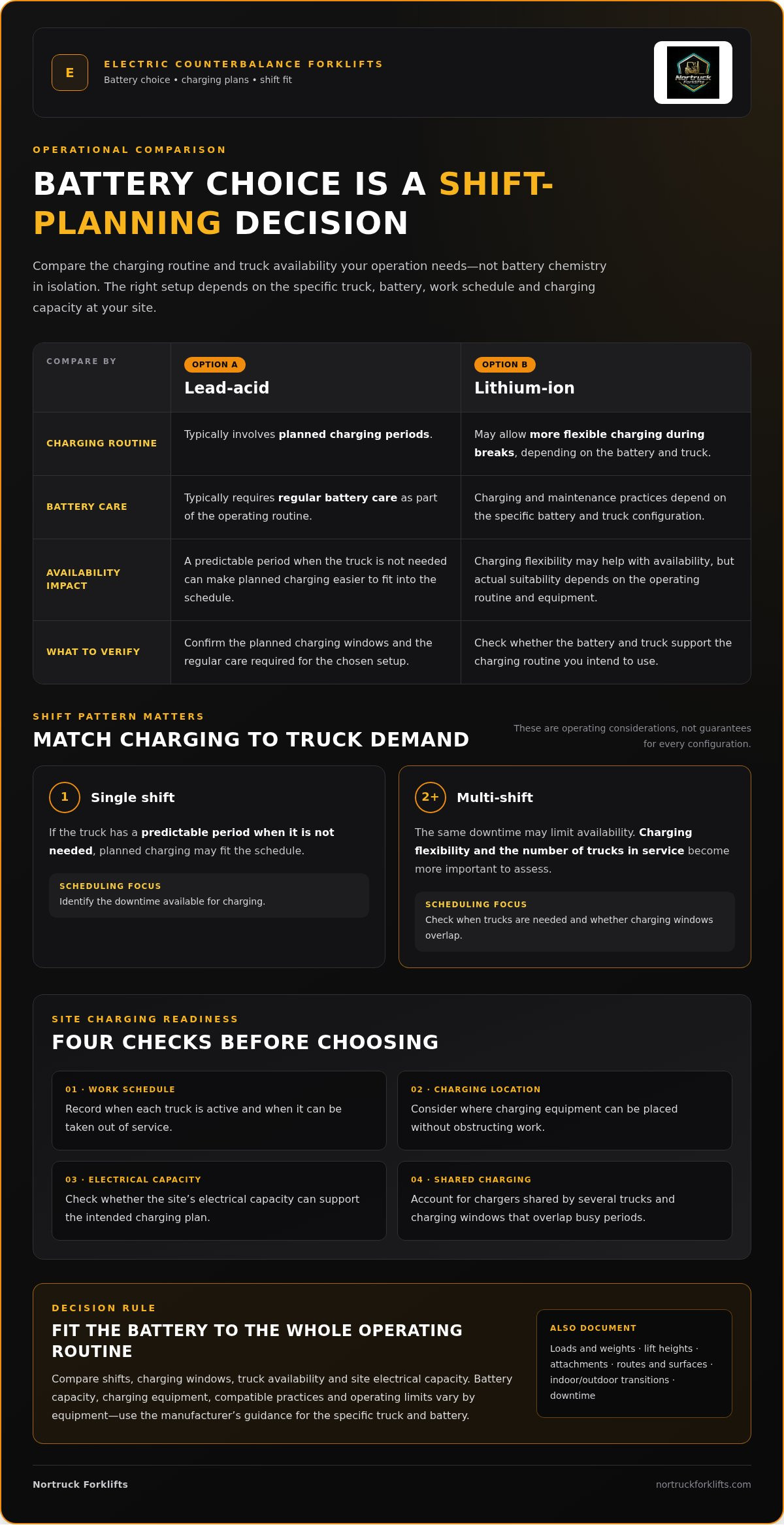
Lead-acid and lithium-ion batteries can involve different charging and maintenance practices. Lead-acid arrangements typically require planned charging periods and regular battery care. Lithium-ion systems may allow more flexible charging during breaks, depending on the battery and truck. These are general characteristics, not guarantees for every configuration.
For a single-shift operation with a predictable period when the truck is not needed, planned charging may fit the schedule. In a multi-shift operation, the same downtime could limit availability, making charging flexibility and the number of trucks in service more important. Compare the complete operating routine, including when trucks are needed, rather than choosing by battery chemistry alone.
Choose a battery setup that matches the truck’s requirements, the shifts it must cover and the charging routine your site can support.
Battery capacity, charging equipment, compatible charging practices and operating limits vary by equipment. Use the manufacturer’s guidance for the specific truck and battery, especially when comparing charging routines or planning opportunity charging.
Charging, energy management and fleet visibility
Begin with the work schedule. Record when each truck is active, when it can be taken out of service, and where charging equipment could be placed without obstructing work. Then consider whether the site’s electrical capacity can support the intended charging plan. A charging window that looks sufficient on paper may overlap with a busy period or be shared by several trucks.
Connected controls and telematics can help managers understand equipment use. Depending on the system, data may include utilisation, battery status, charging patterns or operator activity. Use it to investigate specific questions: do trucks sit idle while connected to a charger, or does charging demand cluster at shift change? Data alone does not resolve these issues or guarantee higher productivity. Interpret it alongside work schedules and site routines.
- Record shift start and finish times, planned breaks and likely charging windows.
- Map charging locations and note any electrical-capacity constraints.
- Compare available fleet data with actual work patterns and the operating plan.
With those details in hand, a discussion about an electric counterbalance forklift can focus on practical fit rather than general battery claims. Nortruck’s forklift sourcing advice connects operating requirements with equipment options, drawing on Lars G Tarby’s more than 40 years of lifting-equipment experience.
Electric counterbalance forklifts versus combustion trucks: assess the real trade-offs
Choosing between electric and combustion power is not a simple comparison of energy sources. The right fit depends on what the truck handles, where it travels, how long it works between breaks and what the site can support. Use the comparison below as a starting point, then weigh each factor against the actual operating routine.
| Consideration | Electric truck | Combustion truck |
|---|---|---|
| Emissions at point of use | No exhaust emissions from the truck during operation. | Produces exhaust during operation, making ventilation and work location relevant. |
| Noise | Can be quieter in operation, though tyres, handling and the work environment still contribute to noise. | Engine noise adds to the overall sound of the work area. |
| Energy supply | Needs a charging plan, suitable charging access and time for charging. | Needs fuel access and a refuelling routine; refuelling may be easier to schedule where charging windows are limited. |
| Duty-cycle demands | Fit depends on battery capacity, workload, shifts and opportunities to recharge. | Fit depends on truck capability, fuel planning, site conditions and the demands of the work. |
Where electric power can fit well
For indoor tasks, the absence of exhaust emissions at the point of use may be an important consideration, particularly where several trucks operate in enclosed areas. Noise may also matter near workstations or where equipment operates alongside other activities. These features can support a site’s priorities, but they do not remove the need to assess ventilation, handling demands and the surrounding work.
A predictable route and known breaks can make it easier to plan charging. For example, a truck that returns to the same staging area during a scheduled pause may have a clearer charging opportunity than one moving continuously between distant work zones. Check the truck’s capabilities and charging arrangements against the actual schedule.
Where the duty cycle needs closer assessment
Review operations carefully when they involve long shifts, limited downtime, heavy or frequent handling, or outdoor work on demanding surfaces. Gradients, travel distance, load weight, ambient conditions and transitions between indoor and outdoor areas can all affect energy use and truck performance. The powertrain alone does not show whether a truck can sustain the required work.
Site infrastructure matters too. An electric truck may suit the handling task but be difficult to schedule if charging access is constrained. A combustion truck may raise other concerns around exhaust, noise or fuel logistics. Compare the complete operating context, including work patterns and energy access, rather than assuming one power source is always superior. For operations with distinct tasks, different equipment or a mixed fleet may be worth considering.
How to assess whether an electric counterbalance forklift suits your site
Start with the work the truck must do, not a headline battery feature. Build a site profile, then use it to assess truck specifications, charging arrangements and operational constraints. A clear profile makes comparisons more specific and helps uncover requirements that can be missed when reviewing equipment in isolation.
Build a clear duty-cycle profile
Work through the handling task in order. Record typical and maximum loads, lift heights, attachments, and how often loads are picked up, moved and set down. Attachments can change a truck’s effective capacity, so include the equipment the operation actually uses rather than assuming every load is handled with standard forks.
- Define the loads and lifts. Note load dimensions and weights, lift heights, handling frequency and any attachments used.
- Map the routes. Record travel distances, gradients, turning points, floor surfaces and areas where the truck moves between indoor and outdoor work. Note exposure to weather or temperature conditions that may affect equipment use.
- Describe the shifts. Document operating hours, breaks, handovers, periods of peak demand and downtime. Identify when a truck can realistically be taken out of service without disrupting material flow.
- Compare the profile with the work. Decide whether the truck must handle the full range of loads and routes throughout a shift, or whether separate tasks create distinct demands.
Record exceptions as well as the usual routine. A route that is mostly level but includes a steep ramp, or a typical pallet load alongside occasional heavier items, can change the equipment comparison.
Check infrastructure and operational constraints
Mark potential charging locations and the times each truck could use them. Consider whether several trucks share a charging area, whether access is blocked during busy periods, and how charging fits around shift changes. Have the relevant facilities or electrical specialist assess site infrastructure for the intended charging plan. This helps identify practical constraints without assuming a particular installation is suitable.
Bring the duty-cycle profile and site notes together before reviewing specifications. Wider sourcing context can also help frame equipment decisions; the European forklift market guide discusses sourcing and heavy-lifting considerations.
Before comparing an electric counterbalance forklift, gather load weights and dimensions, lift heights, attachments, routes, surfaces, shift patterns, downtime, charging access and site-infrastructure constraints. These details give equipment discussions a practical foundation. Nortruck Forklifts provides sales and sourcing advice informed by Lars G Tarby’s more than 40 years of lifting-equipment experience.
From electric forklift trends to a well-matched sourcing decision
Technology matters when it addresses an operational need. Before comparing equipment, bring together the job demands, battery and charging plan, and site constraints. This turns interest in an electric counterbalance forklift into a sourcing brief based on how the truck will work, rather than on a trend or a single specification.
Turn operating requirements into a sourcing brief
Start with the essential requirements: load weights and dimensions, required lift heights and handling attachments. Then describe the operating pattern, including shifts, breaks, route distances, gradients, surfaces and indoor-outdoor transitions. Add the charging locations and windows available to the fleet. Together, these details show whether a proposed configuration can meet the work without creating a mismatch between truck capability and the site routine.
Separate essential requirements from preferences. A maximum load or a route condition may be critical to safe, reliable handling, while a preferred feature may offer flexibility rather than determine suitability. This distinction keeps comparisons focused and gives an adviser a clearer basis for discussing equipment. If an operation has several distinct tasks, specify which ones the truck must cover and which are occasional exceptions.
What an experienced sourcing discussion can clarify
Nortruck Forklifts provides sales and sourcing advice for forklift and heavy-lifting requirements. Lars G Tarby brings more than 40 years of lifting-equipment experience, helping relate the details in a sourcing brief to the practical demands of the operation. The discussion can consider how load handling, duty cycle, power choice and site constraints interact, rather than treating each specification as an isolated feature.
Nortruck sources new and used machinery across Europe, matching equipment to the specific needs of each application rather than assuming one model or configuration suits every site. Sourcing starts with the stated requirements to ensure long-term reliability and performance.
A practical brief gives an adviser enough detail to narrow the discussion and identify questions to resolve before comparing options. Include required capacity and lift height, attachments, shift pattern, route and surface conditions, charging access, and site constraints. If some information is still being gathered, state what is known and what remains uncertain. Clear inputs keep the sourcing conversation grounded in operational fit.
With those requirements in hand, Nortruck can discuss sourcing options in light of the work your operation needs to get done. Share your priorities and operating conditions to begin a practical conversation about equipment fit.
Make your next equipment decision with confidence
Use your site requirements as a decision tool, not just a list to hand over. Mark which conditions are essential for work to continue smoothly and where alternatives are possible. This keeps the search focused if a preferred configuration does not align with the operation’s charging arrangements, routes or handling demands.
Before discussing an electric counterbalance forklift, involve the people who understand the loads, daily workflow and site constraints. Their input can reveal overlooked tasks and clarify which trade-offs are acceptable. Keep the agreed priorities visible as options are considered, so the decision reflects operational needs rather than a feature that looks compelling in isolation.
A measured sourcing discussion can turn those priorities into a practical path forward. Nortruck’s advice draws on lifting-equipment experience and focuses on matching requirements with suitable sourcing options.
With a clear brief and the right questions, you can move toward an equipment decision that supports the work ahead.
Frequently Asked Questions
What is an electric counterbalance forklift?
An electric counterbalance forklift uses an electric system for power and a rear counterweight to balance loads carried on front forks. Unlike a reach truck, it does not extend its forks into racking from behind support legs; it approaches and lifts the load from the front. Rated capacity and suitable tasks depend on the truck’s configuration, load centre, attachment and working conditions, so headline capacity alone does not establish fit.
Are electric counterbalance forklifts suitable for outdoor use?
Some are suitable for outdoor work, depending on the truck and the conditions it will encounter. Occasional travel across a smooth yard differs from continuous operation on rough ground, steep gradients or in weather exposure. Tyre choice, surface quality and handling tasks all matter. Compare the manufacturer’s specifications with the actual route, including transitions between indoor floors and outdoor areas.
How long can an electric counterbalance forklift operate on one charge?
There is no single runtime figure that applies to every truck. Battery type and capacity are only part of the picture: frequent lifting, long travel distances, heavy loads, temperature and operator practices can all affect energy use. A truck moving intermittently on short routes may have a different profile from one working continuously. Use observed duty-cycle data alongside the manufacturer’s published specifications to plan charging windows and shifts.
Is lithium-ion always better than lead-acid for an electric forklift?
No. The better choice depends on the operation and the equipment. Compare how each battery option fits the site’s charging routine, maintenance practices, shift pattern and available infrastructure, then check compatibility with the truck. A predictable single-shift schedule may create different priorities from a busy operation with limited downtime. Use current manufacturer information for the specific truck and battery rather than choosing based on one headline feature.
Can an electric counterbalance forklift handle multiple shifts?
It can if the truck and battery specifications, level of use and charging plan support the work across those shifts. Map when trucks are needed, when they can be taken out of service and whether charging access is shared. A schedule with short handovers and little downtime may require a different fleet plan from one with longer breaks. Compare actual shift demands with documented equipment requirements rather than assuming continuous availability.
What should I check before sourcing an electric counterbalance forklift?
Prepare a clear record of the loads, lift heights and attachments the truck must handle, along with routes, floor surfaces, shift patterns and charging access. Include unusual tasks, such as moving long or awkward loads, rather than relying only on typical pallet weights. These details make specification comparisons more meaningful than headline capacity alone. A sourcing discussion can then focus on equipment suited to the brief without presuming a particular model is right.
Do electric counterbalance forklifts require different site planning?
Yes. Charging locations, available charging windows and electrical infrastructure become part of the operating plan. Requirements vary with the truck and battery specifications, site electrical capacity and equipment use. Note where trucks could charge and whether several units may need access at the same time. For infrastructure questions, involve the appropriate facilities or electrical specialist; general equipment guidance is not a site-specific assessment.

Article by
Lars Gunnar Tärby
Disclaimer
1. General Information and No AdviceThe information, articles, product descriptions, and specifications provided on this website (www.nortruckforklifts.com) are for general informational and educational purposes only. While we strive to provide accurate and up-to-date content regarding new and used forklifts and heavy machinery, the material published does not constitute professional, technical, or legal advice.
2. Product Specifications and PricingNortruck Forklifts acts as a facilitator for the trade of new and used forklifts. All equipment details, including but not limited to year of manufacture, operating hours, lift capacity, dimensions, conditions, and pricing, are provided based on the information available to us at the time of publication. Specifications and availability are subject to change without prior notice.
3. "As Is" and VerificationAll articles and product listings are provided on an "as is" and "as available" basis without any warranties of any kind, either express or implied. Nortruck Forklifts does not guarantee that the descriptions are entirely error-free, complete, or reliable. Buyers and traders are strongly encouraged to independently verify all technical specifications, machine history, and equipment conditions directly with the seller or an authorized inspector before finalizing any purchase or transaction.
4. Limitation of LiabilityIn no event shall Nortruck Forklifts, its owners, or its contributors be held liable for any direct, indirect, incidental, consequential, or economic loss or damage arising out of the use of, or the inability to use, the information provided on this website, or any transactions facilitated through this platform. This includes, but is not limited to, damages caused by technical inaccuracies, typographical errors, or reliance on the content of our articles.
5. Third-Party LinksOur website may contain links to external websites, dealer networks, or third-party services that are not owned or controlled by Nortruck Forklifts. We have no control over, and assume no responsibility for, the content, privacy policies, or practices of any third-party websites.


