
A forklift’s age is only a starting point for estimating resale value. For a heavy forklift residual value advisory, useful planning estimates are 50-65% of value at 3-5 years, 30-45% at 6-10 years, and 15-25% beyond 10 years. Operating hours, maintenance history, condition, and buyer demand can shift the estimate substantially.
It’s natural to expect older equipment to be worth less, but two forklifts of the same age can have very different residual values. A hard-working machine with gaps in its service records may compare poorly with one that has been well maintained and suits current buyer needs.
This article explains how useful life, depreciation, ownership costs, and leasing shape residual value, then shows how to build a practical resale estimate. It also covers why repairs, equipment configuration, and the route to market matter when deciding whether to sell, retain, or replace a heavy forklift.
Key Takeaways
- Use age as a starting point, not a complete valuation: operating hours, maintenance history, condition, and application all shape a forklift’s remaining useful life and resale appeal.
- Compare estimated residual-value ranges by age, then adjust the assessment for the machine’s actual wear and configuration.
- Weigh expected resale value alongside maintenance and other ownership costs when deciding whether to keep, replace, or lease equipment.
- Documented service records and a realistic assessment of repairs can help you judge whether further investment is likely to support resale value.
- Choose a remarketing route that fits the forklift and its likely buyers, since direct sales, trade-ins, marketplaces, and auctions can lead to different outcomes.
Fleet depreciation and ownership costs
Depreciation reduces a forklift’s recorded value over its ownership period, but resale value follows the market. For planning, forklifts aged 3-5 years are estimated to retain 50-65% of value. That range is a starting point, not a substitute for assessing operating hours, condition, and service records.
Ownership costs also shape replacement decisions. When comparing two machines, consider purchase or lease payments, maintenance, energy, labor, and expected resale proceeds. A lower purchase cost may still mean higher total costs if upkeep increases or the machine’s residual value falls.
For a visual look at how brand reputation can shape demand for used equipment, watch Midwestern Equipment’s video:
In the US, distinguish a forklift’s estimated market residual value from its tax depreciation and financial-accounting treatment. Tax basis and recorded book value can differ, so a disposal calculation should use the applicable records and rules, not the resale estimate alone. Keep the valuation, depreciation schedule, and sale documentation separate.
Total cost of ownership (TCO) brings these factors together over a chosen operating period. Track acquisition or lease costs, energy, labor, maintenance, major component work, downtime, and estimated resale proceeds. An inspection can identify wear that affects future operating costs and buyer appeal. Repair trends matter too: repeated component work may make replacement more economical than continued ownership.
These figures use European fleet and labor-market data, with depreciation treated under HGB accounting standards. They illustrate cost categories rather than US fleet budgets.
Three-year ownership residual values need careful interpretation. J.D. Power’s U.S. ALG Residual Values Awards recognize vehicle models projected to retain the highest percentage of MSRP after three years. Those awards cover vehicles, not forklifts. Forklift estimates instead depend on equipment condition, operating history, and market demand.
Maintenance and sale timing can also influence recovery value. Regular maintenance can extend a forklift’s life by up to 30%, while the right targeted repair may make it more marketable. But additional investment does not always make financial sense. Compare the repair’s likely effect on condition and buyer confidence against the remaining ownership costs before committing.
Market trends can shift the calculation: used forklift prices surged during 2021-2022 amid OEM backlogs. That exceptional period shows why an old purchase price or straight-line depreciation schedule cannot alone predict current resale proceeds. A useful fleet estimate pairs recorded depreciation with a current condition inspection and a realistic view of buyer demand.
How does forklift leasing affect residual value?
Leasing changes who carries the resale-value risk at replacement. When you own the forklift, you sell it and bear the difference between expected and actual proceeds. A lease can set an exit point, but return conditions and the equipment’s condition still affect the final economics.
The TUM study describes the optimal replacement point as the moment rising maintenance costs and declining residual value make continued operation more expensive than exchanging the fleet. Its models compare service lives of 8, 10, and 12 years across single- and double-shift operations. Leasing provides a way to exit at that cycle without absorbing the residual-value loss associated with ownership.
Age alone doesn’t tell the whole story. Hour-meter readings, maintenance history, manufacturer tier, and application all contribute to pricing. Forklifts can last 10,000 to 20,000 operating hours with proper maintenance, while another estimate places typical operation at roughly 10,000 to 14,000 hours before major powertrain overhauls or structural rebuilds. Treat those as planning ranges, not a single fixed lifespan.
A forklift with 10,000 operating hours remaining may sell for 40-60% of its original price, depending on the builder and condition. A well-maintained used heavy forklift from Nortruck Forklifts can exceed 20,000 operating hours. These examples show why the model year alone can misrepresent remaining service potential: a machine’s application and documented upkeep may tell a different story.
Attachments, mast type, tires, and emissions tier affect resale through buyer fit, condition, and configuration. A 4-stage high-lift mast can suit a different job than a standard 2-stage or 3-stage mast, while worn tires or specialized attachments may narrow the buyer pool. The right configuration supports demand when it matches a buyer’s operating requirements.
Severe wear, poor maintenance records, and demanding operating environments can weaken buyer confidence or increase expected costs. Reduce uncertainty by recording operating hours and service work, maintaining the equipment consistently, and timing replacement around rising maintenance needs.
Operating environment matters because dust, moisture, uneven surfaces, and intensive shifts can change wear on components. Record the application alongside hours; two models with similar meter readings may have different condition histories. For electric forklifts, battery life is typically 5-7 years, so battery condition can be an important part of a used-equipment assessment.
Assess operating costs alongside maintenance trends and replacement timing. A lease may simplify the exit decision, while ownership gives you more control over sale timing and remarketing. Before choosing, compare the contract’s return requirements with the machine’s hours, attachments, and inspection findings.
How do I know my forklift’s resale value?
Start with comparable equipment, then adjust for the forklift’s hours, condition, configuration, and brand. Demand varies by brand and fuel type, so machines of the same age can have different resale values.
Resale Value by Fuel Type
Fuel type shapes which buyers can use a forklift and what condition they assess. Electric, diesel, and LPG models don’t have a universal resale-value ranking; demand depends on the application, local operating needs, and equipment condition. For used electric forklifts, battery condition matters, since battery life is typically 5-7 years. Compare each machine with similar fuel-type models and account for its operating history.
Valuation Guides and Comparable Sales
Valuation guides and comparable sales are reference points for estimating a machine’s likely market position. In the US, review auction results, equipment listings, and recorded sales for forklifts with similar capacity, fuel type, mast configuration, hours, and condition. Auction estimates suggest different sale channels can return different shares of resale value: direct-to-buyer sales, 80-100%; online marketplaces, 70-90%; dealer trade-ins, 60-80%; and auctions, 50-70%. Compare like with like.
These percentages describe sale routes, not a guaranteed price for a particular forklift. An auction result for a high-hour machine is a weak comparison for a lower-hour model with documented maintenance. Record the sale date and equipment details for each comparable, and use several relevant results rather than relying on one listing.
Appraisal Inspections and Documentation
An appraisal inspection records the forklift’s condition and identifies factors that may affect buyer interest. Review the tires, mast, hydraulics, drivetrain, battery, attachments, and overall appearance. Compare the findings with the hour-meter reading, maintenance logs, service history, and original manuals. These records help explain how the equipment was used and maintained.
Brand reputation also affects demand because buyers weigh expected service life and operating history. Toyota is one example: a well-maintained used Toyota forklift can exceed 20,000 operating hours. That example doesn’t set the value of every Toyota or other brand; model, hours, condition, and maintenance records still matter.
For a practical estimate, group comparable machines by brand tier and model, then compare their hours and inspection results. Adjust for differences in mast height, capacity, attachments, and configuration, since these can expand or narrow the potential buyer pool. A clean appearance may help marketability, while dents, rust, torn seats, or damaged forks can reduce value by 10-20%.
Distinguish a guide value from likely proceeds. Direct sales, trade-ins, online listings, and auctions can produce different outcomes because each reaches buyers through a different channel. Use comparable sales as a reference, then adjust for documented condition and your intended sales route.
Forklift depreciation and resale value estimates
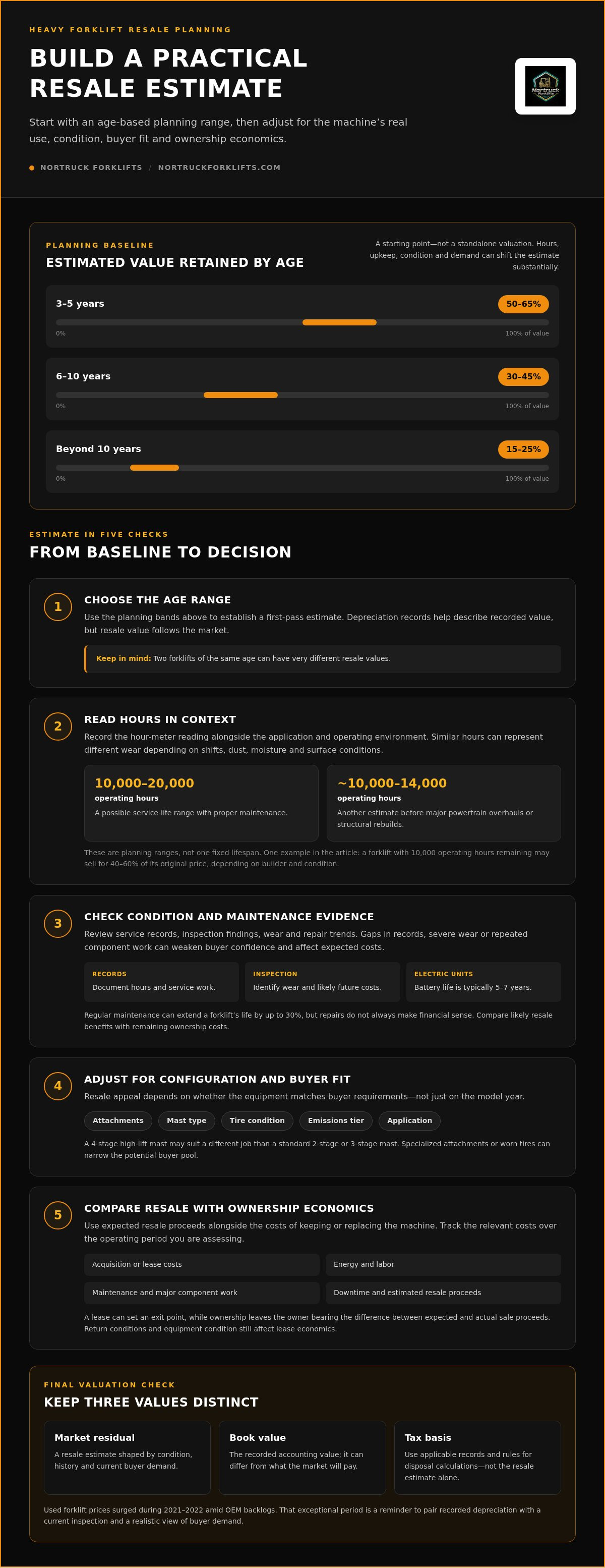
Depreciation provides a planning baseline, while resale value reflects the machine’s age, condition, use, and buyer demand. Estimate both before setting a lease assumption or fleet replacement target.
Residual Value Retention Over Time
Residual value retention is the share of a forklift’s original value it may retain at a given age. Forklifts aged 3-5 years are estimated to retain 50-65% of value; those aged 6-10 years, 30-45%; and those over 10 years, 15-25%. These ranges help frame replacement planning, but they don’t replace an equipment-specific assessment.
Age bands leave room for meaningful differences. A forklift with high operating hours, visible wear, or incomplete maintenance records may attract less interest than a comparable machine with documented upkeep. A market estimate should reflect the actual condition and configuration, not simply apply an age percentage without adjustment.
Forklifts typically depreciate by 15-20% annually, while models less than 2 years old are estimated to retain 70-85% of value. These figures are broad benchmarks rather than a guaranteed year-by-year schedule. Depreciation may not follow a straight line because demand, condition, and market trends change over time.
Residual Value Calculation for Planning
A residual value calculation estimates expected resale proceeds at a planned lease end or replacement date. Start with the original value and apply an age-based retention range, then adjust for operating hours, service history, condition, configuration, and likely sales channel. For a lease or fleet plan, this makes the assumption clear and easier to compare across models.
Use the same method across the fleet. Record each forklift’s model, age, meter reading, maintenance history, and inspection findings. Compare similar equipment, then choose a reasonable retention estimate within the relevant age range. Keep this estimate separate from book depreciation, which serves an accounting purpose rather than predicting the sale price.
Condition adjustments should have clear evidence. Tires, mast, hydraulics, drivetrain, battery, attachments, and appearance can affect marketability. Dents, rust, torn seats, and damaged forks can reduce value by 10-20%. Telematics or operator safety systems can increase resale value by up to 10%, where buyers value those features.
For example, a Toyota forklift with 50% of its lifespan remaining can still command a significant resale price compared with less reliable brands. Treat this as a reminder to include brand and remaining service life, not as a fixed Toyota premium. Buyer demand, equipment condition, and documented maintenance still shape the estimate.
A heavy forklift residual value advisory can help align a lease-end assumption with a fleet replacement plan. Review the estimate when operating hours, repair needs, or market demand change. If a targeted repair affects inspection findings or buyer confidence, update the condition assessment before relying on an earlier resale estimate.
What residual value percentages do heavy forklifts retain after 3, 5, and 10 years?
Age-based estimates give fleet planners a useful starting point, but they don’t produce a precise sale price. Use the ranges below to frame a replacement decision, then assess the specific forklift’s hours, condition, and likely buyer demand.
- At 3 years: forklifts aged 3-5 years are estimated to retain 50-65% of their value.
- At 5 years: the same 3-5-year range applies, so five-year equipment falls within the 50-65% estimate.
- At 10 years: forklifts aged 6-10 years are estimated to retain 30-45% of value.
- Beyond 10 years: forklifts more than 10 years old are estimated to retain 15-25%.
These bands don’t assign a separate percentage to every year. A three-year-old machine and a five-year-old machine both sit within the 3-5-year range, but their estimates can differ with operating hours, history, and condition. Likewise, ten years belongs in the 6-10-year band; the over-10-year range applies once the forklift is older than ten years.
Apply the percentage consistently to the relevant value basis. If you are planning against the original purchase value, use that same basis across the fleet and record the estimated retained share. Don’t treat the midpoint of a range as a guaranteed outcome. A useful replacement plan shows the full range and explains why a particular machine sits toward its lower or upper end.
For example, a forklift with complete maintenance records and moderate use may warrant a different estimate from a same-age unit with heavy use and visible damage. A range narrows the discussion, but inspection findings and equipment history determine the machine-specific position. Keep the estimate separate from accounting depreciation: book value and likely resale value answer different questions.
Age is only one input. Operating hours and application history show how much work the forklift has performed, while condition affects the repairs a buyer may anticipate. Configuration matters too: capacity, mast height, fuel type, and attachments can expand or narrow the potential buyer pool. A machine suited to a specific application may attract a different level of demand from one with a less suitable configuration.
Use these percentages as planning benchmarks, not automatic discounts or fixed resale prices. For a lease-end estimate, match the age band to the expected return date. For a fleet replacement plan, compare expected resale proceeds with ongoing ownership costs and the equipment’s remaining usefulness. Revisiting estimates as hours and condition change keeps decisions grounded in the actual fleet.
Nortruck Forklifts: Kalmar Heavy Lift Trucks
Nortruck Forklifts can help connect your fleet requirements with suitable heavy lifting equipment, including Kalmar Heavy Lift Trucks. If your residual-value assessment points toward replacement, its equipment range also includes Baumann Sideloaders, Combi-Lift 4-way Trucks, and Linde Forklifts. The right choice depends on the work, operating environment, capacity needs, and configuration that fit your operation. Nortruck Forklifts provides sales and advisory services, helping you consider machinery options in the context of your equipment needs. Use your estimated resale value, inspection findings, and replacement priorities to guide that conversation. Contact Nortruck Forklifts to discuss your equipment requirements.
Make Your Next Fleet Decision Deliberately
Turn the resale estimate into a decision that supports your next operating cycle. Define the replacement’s job, the loads it must handle, and the conditions it will work in. Then compare suitable equipment against those requirements instead of choosing on resale value alone. A focused heavy forklift residual value advisory can connect the current asset decision to the next machine’s role in your fleet.
For heavy-load handling, consider whether Kalmar Heavy Lift Trucks fit the application. Baumann Sideloaders and Combi-Lift 4-way Trucks may suit operations with specific load-handling needs. Bringing those operational requirements into the equipment discussion gives your replacement decision a practical starting point.
Contact Nortruck Forklifts to discuss your equipment requirements and next steps.
A clear plan puts your next equipment decision on firmer ground.
Frequently Asked Questions
How Does the Lifespan Impact the Value of Used Forklifts?
Useful life affects resale because buyers pay for remaining productive work, not just calendar age. A forklift nearing a major overhaul can lose appeal even if it still runs reliably; a lower-hour machine with wear from severe duty may face similar scrutiny. Compare the intended task with the truck’s remaining capability and condition. This helps explain why age-based guide ranges need a machine-specific interpretation.
Is it better to sell or trade in my forklift?
Selling directly may suit owners prepared to manage buyer inquiries, inspections, negotiations, and transfer arrangements. A trade-in can be practical when replacing equipment, since the existing forklift’s value can be considered alongside the replacement transaction. Compare expected proceeds after preparation and sale logistics, not just the initial offer. Choose the route that best fits your priorities, whether that means more control over the sale or a simpler replacement process.
What is the optimal forklift replacement cycle?
The right replacement point is when retaining the forklift no longer supports your operating and financial priorities as well as replacing it would. Compare its expected workload, upcoming maintenance needs, productivity, and resale prospects with the requirements of the next operating period. A machine may still function but no longer suit the loads or work pattern. Set a review point around changes in operating needs rather than relying on age alone.
What factors determine the residual value of a heavy forklift?
Residual value reflects how useful and marketable the forklift is to its next owner. Capacity, mast configuration, fuel type, attachments, brand, and condition affect which buyers may consider it. Location matters too: the strongest market may be somewhere other than where the forklift is being sold. A specialized configuration may suit a narrower buyer group, while a machine that matches common applications can appeal to more potential purchasers.
How do forklift hours, maintenance records, and condition affect resale value?
Hours indicate use, while maintenance records and condition help explain what those hours mean for future operation. Present the hour-meter reading alongside dated service entries and application history so a buyer can follow the machine’s working record. Clearly note major repairs and component changes. Visible wear or damage may prompt closer assessment during an inspection; consistent documentation helps distinguish ordinary use from unresolved concerns.

Article by
Lars Gunnar Tärby
Disclaimer
1. General Information and No AdviceThe information, articles, product descriptions, and specifications provided on this website (www.nortruckforklifts.com) are for general informational and educational purposes only. While we strive to provide accurate and up-to-date content regarding new and used forklifts and heavy machinery, the material published does not constitute professional, technical, or legal advice.
2. Product Specifications and PricingNortruck Forklifts acts as a facilitator for the trade of new and used forklifts. All equipment details, including but not limited to year of manufacture, operating hours, lift capacity, dimensions, conditions, and pricing, are provided based on the information available to us at the time of publication. Specifications and availability are subject to change without prior notice.
3. "As Is" and VerificationAll articles and product listings are provided on an "as is" and "as available" basis without any warranties of any kind, either express or implied. Nortruck Forklifts does not guarantee that the descriptions are entirely error-free, complete, or reliable. Buyers and traders are strongly encouraged to independently verify all technical specifications, machine history, and equipment conditions directly with the seller or an authorized inspector before finalizing any purchase or transaction.
4. Limitation of LiabilityIn no event shall Nortruck Forklifts, its owners, or its contributors be held liable for any direct, indirect, incidental, consequential, or economic loss or damage arising out of the use of, or the inability to use, the information provided on this website, or any transactions facilitated through this platform. This includes, but is not limited to, damages caused by technical inaccuracies, typographical errors, or reliance on the content of our articles.
5. Third-Party LinksOur website may contain links to external websites, dealer networks, or third-party services that are not owned or controlled by Nortruck Forklifts. We have no control over, and assume no responsibility for, the content, privacy policies, or practices of any third-party websites.


