
What if the biggest obstacle to modernizing your fleet isn't the technology itself, but the lingering myth that electric power can't handle a grueling double shift? It's a common concern for operations managers who oversee high-intensity environments. You've likely looked at a heavy duty electric forklift for warehouse applications and hesitated because of the upfront price tag or the nightmare scenario of a machine dying mid-task. Transitioning away from internal combustion feels like a gamble when your throughput depends on raw, uncompromising strength.
We understand that reliability is your primary metric. This guide provides a strategic roadmap to help you transition your heavy lifting operations to electric power without sacrificing performance or your bottom line. We'll validate how modern 120V systems handle demanding cycles and explain why the total cost of ownership often favors electric despite the initial investment. From assessing your grid capacity to navigating the European sourcing market, you'll gain the clarity needed to make an informed, brand-independent decision for your facility.
Key Takeaways
- Understand how electric technology has evolved to handle heavy lifting capacities up to 33 tonnes without compromising on performance.
- Discover why Lithium-ion batteries and opportunity charging are the preferred choices for maintaining continuous, multi-shift operations.
- Learn how to evaluate the total cost of ownership for a heavy duty electric forklift for warehouse use by analyzing the shift from fuel to electricity costs.
- Identify the essential facility requirements, including power grid capacity and floor loading, necessary to support high-capacity electric infrastructure.
- Explore the strategic advantages of sourcing specialized equipment from the European market with the guidance of an independent advisor.
The Evolution of the Heavy Duty Electric Forklift for Warehouse Use
For decades, electric machines were confined to light-duty pallet moving and narrow aisles. That's no longer the case. The industry has moved beyond the five-tonne barrier, with manufacturers like Kalmar and Linde now producing units capable of 18 to 33-tonne capacities. This shift marks a significant milestone in The Evolution of the Forklift, where battery power is no longer a compromise but a competitive advantage. By 2026, several factors have converged to make this the tipping point for the heavy duty electric forklift for warehouse fleets, including stricter emissions regulations and the rising volatility of diesel prices.
The operational shift is profound. We're seeing heavy-duty units move from being "indoor only" niche tools to becoming the primary workhorses for high-intensity, multi-shift operations. This isn't just about swapping a fuel tank for a battery. It's a fundamental change in how heavy lifting is managed. Because the technology landscape is moving so quickly, the role of an independent advisor has become vital. You need someone who understands the nuances of different brands to ensure the machine you choose actually matches your specific infrastructure and throughput requirements.
Drivers Behind the Electric Transition
Operational environments are changing rapidly. Zero-emission mandates, particularly new regulations starting in 2026, have made indoor combustion engines a significant liability. Insurance providers often look more favorably on facilities that eliminate the fire risks and air quality issues associated with liquid fuels. Beyond compliance, the human factor is substantial. Reducing noise levels improves operator awareness and allows for clearer communication on the warehouse floor, which is a direct win for safety. Most importantly, the long-term ROI is becoming undeniable. Removing diesel fuel costs and the complex maintenance of internal combustion engines directly strengthens your balance sheet.
Breaking the Power Myth: Can Electric Handle 25 Tonnes?
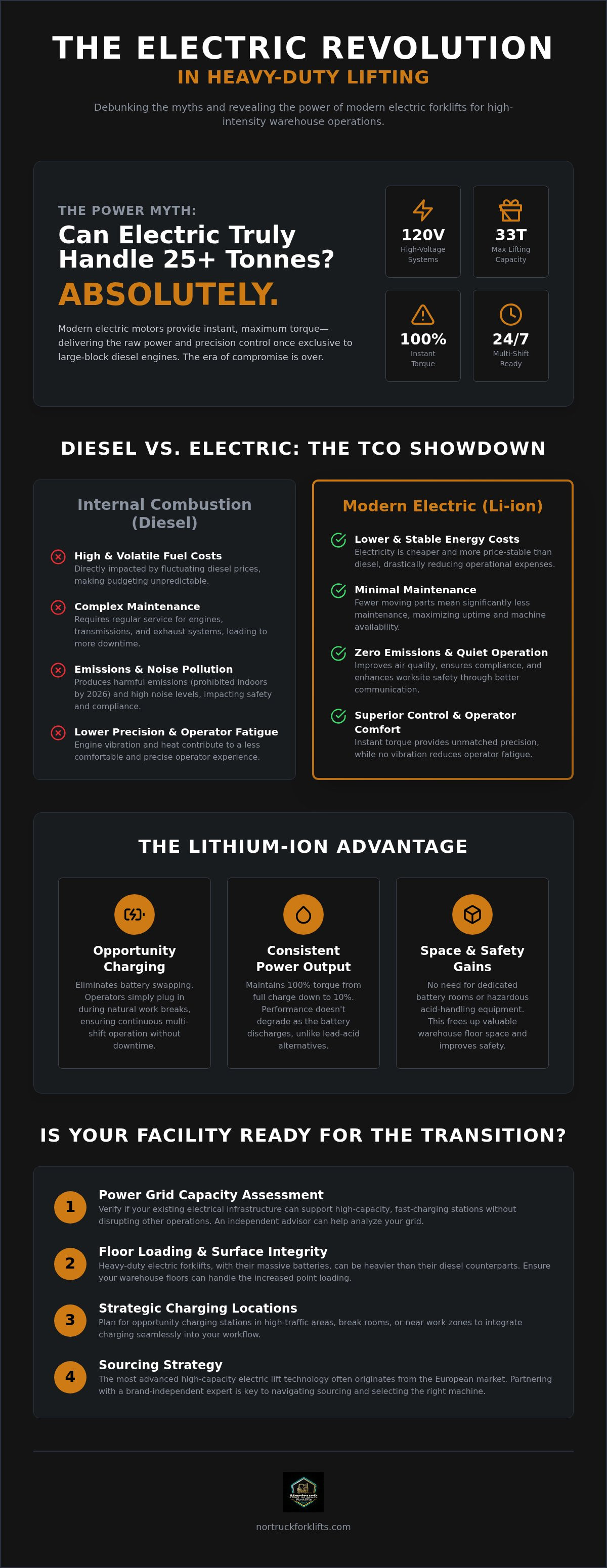
One of the most persistent misconceptions is that electric motors lack the "grunt" for extreme loads. In reality, electric motors provide maximum torque instantly. This is ideal for the precision required in heavy lifting. Modern 80V and 120V systems deliver the sustained power once reserved for large-block diesel engines. These high-voltage architectures minimize heat buildup, allowing for the high-intensity work cycles common in port terminals and heavy manufacturing. High-capacity electric power is now the global benchmark for warehouse torque and lifting precision.
Choosing a heavy duty electric forklift for warehouse applications requires looking past the spec sheet. It involves understanding how that power is delivered over a full shift. When you remove the vibration and heat of a diesel engine, you don't just gain efficiency; you gain a more reliable, precise machine for your most demanding tasks.
Key Battery Technologies Powering High-Capacity Lifting
The energy source in a heavy duty electric forklift for warehouse use is the single most critical factor in determining its operational success. In the high-capacity segment, typically spanning 8 to 25 tonnes, the battery is no longer just a component; it is a complex power plant. While smaller forklifts have long used various electric sources, the heavy-duty sector has historically been held back by the sheer amount of energy required to move massive loads. Modern advancements have changed this reality.
Lithium-Ion (Li-ion) has rapidly become the standard for heavy-duty applications. Unlike lead-acid counterparts, Li-ion batteries maintain a consistent voltage throughout the entire discharge cycle. This means your 15-tonne lift has the same torque at 10% charge as it does at 100%. Thermal management is equally vital. High-capacity cells generate significant heat during intensive shifts. Manufacturers now integrate sophisticated cooling systems to ensure the battery remains within safe temperature ranges, preventing degradation and maintaining performance during peak summer months.
The Lithium-Ion Advantage for Heavy Cycles
Li-ion technology eliminates the logistical burden of traditional electric fleets. You don't need dedicated battery rooms or specialized acid-handling equipment. This saves valuable floor space. The primary benefit for high-intensity warehouses is opportunity charging. Rather than swapping batteries, which is a dangerous and time-consuming process for 25-tonne machines, operators simply plug in during breaks. A quick 20-minute charge provides enough energy to sustain the next several hours of work. If you're managing a 24/7 operation, this technology is essentially mandatory for maintaining productivity.
Lead-Acid: When Does it Still Make Sense?
Lead-acid batteries remain a viable choice for specific, lower-intensity scenarios. If your heavy lifting is confined to a single shift with significant downtime between tasks, the lower initial cost of lead-acid might be attractive. However, the maintenance burden is real. These batteries require regular watering, equalizing charges, and strict adherence to OSHA safety standards for powered industrial trucks, particularly regarding ventilation for charging areas. When sourcing used equipment, always evaluate the remaining life of the battery. Replacing a high-capacity lead-acid pack can be a significant unbudgeted expense. If you need help vetting the battery health of a potential purchase, consulting an independent advisor for heavy equipment can save you from an expensive mistake.
Evaluating the Total Cost of Ownership (TCO) for Heavy Warehouse Lifts
When you analyze the price tag of a heavy duty electric forklift for warehouse operations, the initial capital expenditure (CapEx) is undeniably higher than diesel. But focusing only on the purchase price ignores the strategic nature of the investment. The total cost of ownership (TCO) is where the electric advantage becomes clear, especially in high-capacity lifting. In the 10 to 30-tonne category, the "fuel vs. electricity" delta is massive. Large diesel engines are inherently inefficient at these scales, losing significant energy to heat and friction. Electric motors convert energy with far greater precision, resulting in a lower cost per tonne moved.
Maintenance savings provide another significant boost to your ROI. By transitioning to electric power, you effectively remove the most common failure points in heavy lifting equipment. There are no complex transmissions to fail, no radiators to clog, and no oil filters to change every few hundred hours. This reduction in moving parts doesn't just lower your parts bill; it increases your uptime. Recent industry analysis on forklift electrification confirms that these reliability gains are a primary driver for fleet managers moving toward lithium-ion technology as their new default.
The "Invisible" Savings of Electric Power
Operational savings often extend beyond the machine's spec sheet. Because heavy electric units produce zero exhaust and minimal ambient heat, your facility's ventilation and HVAC requirements are greatly reduced. This is a direct, recurring saving on your utility bill that many managers overlook during the procurement phase. Additionally, the lack of engine vibration leads to a longer lifespan for sensitive electronic components and hydraulic seals. It also significantly reduces operator fatigue, which can lead to better safety outcomes and higher productivity over a long shift. For a deeper financial breakdown of these variables, you can read our guide on New vs Used Heavy Forklift ROI.
Strategic Procurement: Sourcing New vs. Used
Deciding between new and used equipment requires a clear understanding of your duty cycle. Investing in new Kalmar electric technology gives you access to the most advanced battery management systems and the security of a full manufacturer warranty. However, the European market for used heavy electrics is becoming increasingly sophisticated. When vetting a used heavy duty electric forklift for warehouse use, the inspection process shifts. Instead of checking engine compression, we focus on battery cycle counts and motor insulation resistance. Resale values for these machines remain high in Europe due to the growing demand for zero-emission equipment. As an independent advisor, Nortruck Forklifts helps you navigate these options across all major brands, ensuring you find the machine that delivers the best long-term value for your specific application.
How to Implement Heavy Duty Electric Sourcing: A Step-by-Step Facility Audit
Transitioning to a heavy duty electric forklift for warehouse operations isn't a simple swap. It's an infrastructure project. Unlike smaller units, high-capacity electric trucks demand significant power and physical space. Before you sign a purchase agreement, you must ensure your facility can support the machine's operational needs. A systematic audit prevents expensive retrofitting costs and ensures your ROI stays on track from day one. This process moves beyond the machine's spec sheet to look at your entire warehouse ecosystem.
- Step 1: Power Grid Capacity Audit. Verify if your local transformer can handle the load of 100kW+ rapid chargers.
- Step 2: Floor Loading and Infrastructure. High-capacity batteries add substantial weight. You need to confirm your warehouse floor can handle the increased point-loading of a 25-tonne machine plus its battery pack.
- Step 3: Defining the Duty Cycle. Map your shift patterns to identify natural windows for opportunity charging.
- Step 4: Selecting the Right Attachment. Every kilogram of an attachment reduces battery efficiency. Balance your need for specialized handling with the energy draw it requires.
- Step 5: Engaging an Independent Advisor. Use an expert to source the specific machine you need across the European market, ensuring you don't settle for what's merely available locally.
Step 1: The Electrical Infrastructure Audit
Charging a large fleet of heavy electrics requires a massive amount of "juice." You'll likely need to work with your local utility provider to ensure you have sufficient kVA for heavy-duty rapid chargers. A standard three-phase charger for a 15-tonne electric lift typically draws between 120 and 160 amps to maintain rapid charging speeds. Smart charging software is essential here. It allows you to stagger charging times, preventing peak demand surcharges that can quickly erode your operational savings.
Step 3: Duty Cycle Mapping for Success
Don't rely on guesswork for your charging schedule. Telematics data is your best tool for tracking "actual" lift times versus idle times. This data often reveals that a machine isn't working as hard as you think, which opens up "natural" charging breaks in the warehouse workflow. If you plan for seasonal peaks, you can determine exactly how many chargers you need without over-investing in infrastructure. This data-driven approach ensures your heavy duty electric forklift for warehouse use is always ready when the next container arrives.
Success in electrification depends on getting the details right before the equipment arrives. By following these steps, you eliminate the technical surprises that often derail large-scale procurement. Once your facility is ready, the focus shifts to finding the right brand and model to fill that newly prepared space.
Expert Sourcing: Navigating the European Market for Heavy Electric Lifts
Finding a heavy duty electric forklift for warehouse operations often requires looking beyond your immediate geographic area. Local dealers are typically restricted by franchise agreements and regional stock, which limits your choices to what's currently on the lot. In contrast, the broader European market offers a far deeper inventory of high-capacity machines from manufacturers like Kalmar and Linde. These units are often better maintained and more precisely suited for specialized requirements than the limited selections available locally.
Cross-border sourcing for 20+ tonne units involves complex logistics and rigorous vetting. It requires a thorough inspection process to ensure the machine meets the technical specifications discussed earlier, particularly regarding battery health and motor insulation. Moving these massive machines across Europe isn't just a transport task; it's a specialized operation that requires an advocate who understands the nuances of international heavy equipment trade. This level of oversight ensures that your investment arrives ready for immediate operation.
Brand Neutrality: Kalmar, Toyota, or Linde?
Every brand has its strengths, and our independent advisory ensures you aren't pushed toward a single manufacturer. Kalmar is often the benchmark for extreme capacities in the 18 to 33-tonne range, while Linde and Toyota offer robust portfolios for the 8 to 15-tonne segment. We match the machine's specifications to your specialized needs, whether you're handling steel, concrete, or heavy manufacturing components. For example, if you're managing long loads in tight spaces, a standard counterbalance machine might not be the most efficient choice. In these cases, a Combi-Lift 4-way truck might be better for narrow-aisle heavy storage. We analyze your facility's layout to ensure the machine you source is the most precise tool for the job.
The Sourcing Process with Nortruck Forklifts
Our process begins with a deep dive into your operational requirements to find a long-term solution rather than just a machine. Lars G Tarby leverages 40 years of industry experience to act as your advocate in the European market. This involves vetting potential machinery, verifying maintenance records, and coordinating the logistics of delivery. We maintain direct communication without unnecessary intermediaries, ensuring total transparency in every transaction. This insider perspective is crucial when evaluating a used heavy duty electric forklift for warehouse use, as it allows us to identify potential issues that a generalist broker might miss. Nortruck Forklifts focuses on building a partnership that prioritizes suitability and operational efficiency.
Future-Proof Your Warehouse with Strategic Electrification
Transitioning to electric power is no longer a speculative choice for heavy lifting. It's a strategic move toward operational efficiency and long-term cost stability. By understanding the shift toward high-capacity lithium-ion technology and conducting a thorough facility audit, you remove the technical barriers that often stall electrification projects. The decision to source a heavy duty electric forklift for warehouse applications requires looking beyond local availability to find the most suitable machine for your specific duty cycle.
We focus on delivering value through an independent advisory process that prioritizes your total cost of ownership. With over 40 years of industry expertise, we provide direct access to premium European stock from manufacturers like Kalmar, Linde, and Toyota. This brand-neutral approach ensures you receive a machine that matches your throughput needs without the bias of a single-brand dealership.
Building a cleaner, quieter, and more efficient warehouse is a significant undertaking, but you don't have to navigate the European market alone. With the right guidance and a methodical sourcing strategy, your transition to electric power will be a seamless success.
Frequently Asked Questions
Can a heavy duty electric forklift work as hard as a diesel one?
Yes, a heavy duty electric forklift for warehouse use provides instant torque that often surpasses diesel performance in precision tasks. Modern high-voltage systems are engineered for the same 18 to 33-tonne capacities found in port terminals. Unlike internal combustion engines that need to rev up to reach peak power, electric motors deliver maximum lifting force immediately. This makes them exceptionally effective for the heavy, repetitive cycles common in high-intensity industrial environments.
How long does it take to charge a 12,000 lb capacity electric forklift?
Charging time depends heavily on your battery technology and charger output. A lithium-ion unit of this capacity can typically reach a full charge in one to two hours using a high-output rapid charger. Lead-acid batteries generally require eight hours to charge followed by an eight-hour cooling period. For multi-shift operations, lithium-ion is the practical choice because it supports opportunity charging during short operator breaks without damaging the battery cells.
What is the lifespan of a lithium-ion battery in a heavy-duty forklift?
You can expect a high-quality lithium-ion battery to last between 3,000 and 5,000 charge cycles. In a typical heavy-duty warehouse environment, this translates to approximately seven to ten years of operational life. Unlike lead-acid batteries, which degrade quickly if not maintained, lithium-ion units retain their capacity much longer. Many of these cells eventually find a second life in stationary energy storage after they're retired from forklift service.
Do I need a special charging room for heavy-duty electric forklifts?
No, you don't need a specialized charging room if you use lithium-ion technology. These batteries don't produce explosive gases during the charging process, so expensive ventilation systems aren't required. You can place chargers in convenient locations throughout your facility to facilitate opportunity charging. However, if you're using lead-acid batteries, you must still provide a dedicated area with proper airflow and acid-neutralizing equipment to comply with safety regulations.
Are electric forklifts safe for use in wet or outdoor warehouse areas?
Yes, many modern electric units are specifically designed for all-weather use in outdoor warehouse yards and port terminals. Manufacturers like Kalmar and Linde build these trucks with high Ingress Protection (IP) ratings to shield sensitive electrical components from rain and dust. While older electric models were strictly for indoor use, today's high-capacity machines are built to withstand the same environmental rigors as their diesel counterparts without compromising on safety or reliability.
Is it better to buy a new or used heavy-duty electric forklift?
The choice depends on your duty cycle and budget. Investing in a new heavy duty electric forklift for warehouse use ensures you have the latest battery management systems and a full manufacturer warranty. However, the European used market is an excellent source for high-capacity machines that have been well-maintained. If you choose a used unit, it's vital to have an independent advisor vet the battery health and motor insulation before finalizing the purchase.
How much does it cost to install a heavy-duty forklift charging station?
Installation costs vary significantly based on your facility's existing electrical capacity. If your warehouse already has sufficient power, you'll mainly pay for the charger and basic electrical work. However, if you need to upgrade your local transformer or install 100kW+ infrastructure, costs will be higher. Some utilities offer rebates for make-ready electrical work, so you should check local programs like those offered by the Tennessee Valley Authority or similar regional providers.
Can I use my existing attachments on a new electric heavy-duty truck?
Yes, you can typically use your existing hydraulic attachments on a new electric truck. Most manufacturers use standardized mounting interfaces and hydraulic connections. You should verify that the attachment's weight doesn't negatively impact the forklift's rated capacity or energy efficiency. High-consumption attachments like large paper roll clamps may drain the battery faster, so it's best to consult your equipment advisor to ensure the battery capacity is sized correctly for the task.

Article by
Lars Gunnar Tärby
Disclaimer
1. General Information and No AdviceThe information, articles, product descriptions, and specifications provided on this website (www.nortruckforklifts.com) are for general informational and educational purposes only. While we strive to provide accurate and up-to-date content regarding new and used forklifts and heavy machinery, the material published does not constitute professional, technical, or legal advice.
2. Product Specifications and PricingNortruck Forklifts acts as a facilitator for the trade of new and used forklifts. All equipment details, including but not limited to year of manufacture, operating hours, lift capacity, dimensions, conditions, and pricing, are provided based on the information available to us at the time of publication. Specifications and availability are subject to change without prior notice.
3. "As Is" and VerificationAll articles and product listings are provided on an "as is" and "as available" basis without any warranties of any kind, either express or implied. Nortruck Forklifts does not guarantee that the descriptions are entirely error-free, complete, or reliable. Buyers and traders are strongly encouraged to independently verify all technical specifications, machine history, and equipment conditions directly with the seller or an authorized inspector before finalizing any purchase or transaction.
4. Limitation of LiabilityIn no event shall Nortruck Forklifts, its owners, or its contributors be held liable for any direct, indirect, incidental, consequential, or economic loss or damage arising out of the use of, or the inability to use, the information provided on this website, or any transactions facilitated through this platform. This includes, but is not limited to, damages caused by technical inaccuracies, typographical errors, or reliance on the content of our articles.
5. Third-Party LinksOur website may contain links to external websites, dealer networks, or third-party services that are not owned or controlled by Nortruck Forklifts. We have no control over, and assume no responsibility for, the content, privacy policies, or practices of any third-party websites.


