
In the concrete sector, the environment is a machine killer, and standard material handling equipment often fails within the first year of heavy-duty service. You likely know the frustration of watching abrasive dust eat through hydraulic seals or seeing a traditional counterbalance truck struggle with the irregular dimensions of a precast beam. Finding the right forklift for concrete industry operations isn't just about raw lifting power; it's about matching machine geometry to the unique physics of your inventory.
We understand that your goal is to eliminate inefficient double-handling while protecting your products from transport damage. This article explains how to navigate these complexities with specialized machinery and expert sourcing strategies that prioritize operational durability. We'll examine why certain brands like Kalmar and Baumann excel in rough terrain, how to mitigate the costs of abrasive wear, and the most efficient way to source high-capacity equipment through the European market. By the end, you'll have a clear roadmap for securing a machine that survives your yard's specific challenges.
Key Takeaways
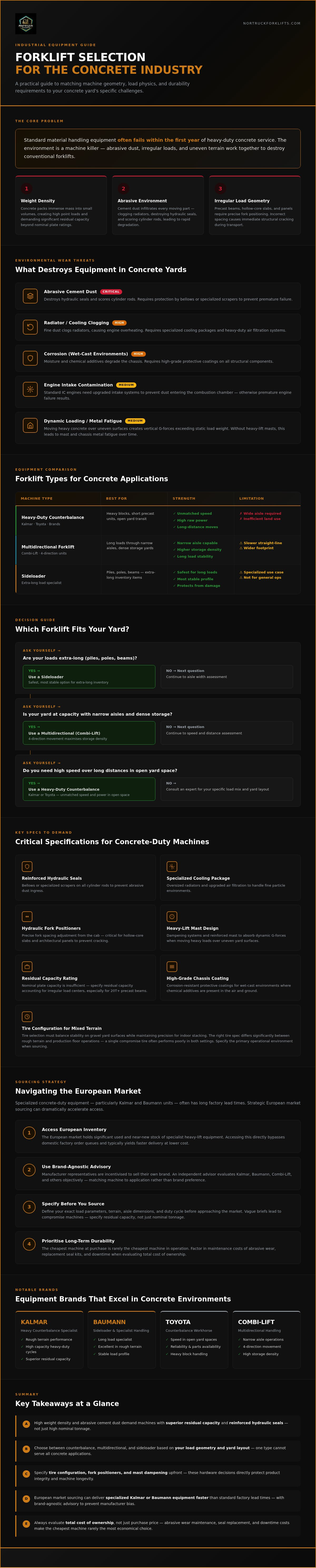
- Understand how high weight density and abrasive cement dust dictate the need for machines with superior residual capacity and reinforced hydraulic seals.
- Compare the operational benefits of heavy-duty counterbalance trucks against multidirectional units to determine the best forklift for concrete industry yard layouts.
- Evaluate critical hardware specifications such as tire stability on uneven terrain and the use of specialized hydraulic fork positioners for irregular loads.
- Explore strategic sourcing methods to access European inventory, allowing you to secure specialized Kalmar or Baumann equipment faster than standard factory lead times.
- Learn how independent, brand-agnostic advisory helps you avoid manufacturer bias and focuses on the long-term durability of your material handling fleet.
The Unique Challenges of the Concrete Industry
Concrete handling is an unforgiving discipline. Unlike standard logistics, the materials are heavy, abrasive, and often fragile despite their appearance. Selecting a forklift for concrete industry use requires an understanding of how these variables interact with machine physics. It isn't just about the nominal lift capacity on the data plate; it's about how that machine performs when the load center shifts or the environment turns hostile. How do you ensure your equipment survives these conditions without constant downtime?
Weight density is the primary hurdle. Concrete packs immense mass into small volumes, which creates high point loads and demands significant residual capacity. If you're moving 20-tonne precast beams, a standard industrial truck will likely reach its limit long before the physical weight is met because the center of gravity is often irregular. You need a machine designed for heavy-duty cycles that can handle the transition from smooth production floors to the unpaved, uneven terrain of a storage yard without compromising stability. This requires a chassis and tire configuration that provides stability on gravel while maintaining the precision needed for indoor stacking.
Load Dynamics: Precast vs. Block Handling
Standard pallets are rare in this sector. You're often dealing with hollow-core slabs or architectural panels that require precise fork positioning to avoid structural cracking. If the forks aren't spaced correctly, the internal tension of the concrete can cause immediate failure during transport. Dynamic loading refers to the increased stress placed on the forklift's mast and chassis when heavy concrete units are moved over uneven yard surfaces, creating vertical G-forces that can exceed the static weight of the load. Without the right dampening systems or heavy-lift masts, these forces can lead to metal fatigue and catastrophic failure over time.
Environmental Wear and Tear
The environment is the second major challenge. Cement dust acts as a fine abrasive, infiltrating every moving part. It's a silent killer of cooling systems, often clogging radiators and leading to engine overheating. Choosing a forklift for concrete industry applications means looking for specialized cooling packages and heavy-duty air filtration. Consider these specific risks:
- Abrasive dust: Destroys hydraulic seals and scores cylinder rods if not protected by bellows or specialized scrapers.
- Corrosion: In wet-cast environments, moisture and chemical additives can degrade the chassis if the machine doesn't have high-grade protective coatings.
- Filtration: Standard IC engines require upgraded intake systems to prevent dust from entering the combustion chamber, which can lead to premature engine failure.
By addressing these environmental factors early in the sourcing process, you can avoid the high maintenance costs that typically plague standard equipment in this sector.
Comparing Forklift Types for Concrete Applications
Selecting the right forklift for concrete industry tasks depends largely on the geometry of your loads and the layout of your yard. While a standard heavy-duty counterbalance truck is the workhorse of many facilities, it isn't always the most efficient choice for specialized precast components. You must balance raw lifting capacity with the physical constraints of your storage environment and the safety requirements of transporting irregular shapes. One size rarely fits all in this sector.
Multidirectional vs. Traditional Counterbalance
Traditional counterbalance trucks from brands like Kalmar or Toyota are unmatched for speed and power in open spaces. They're ideal for moving heavy blocks or short precast units over long distances. However, they require significant aisle widths to turn, which can lead to inefficient land use. If your yard is reaching capacity, transitioning to a multidirectional machine like a Combi-Lift can be a game-changer. These units move in four directions, allowing you to carry long loads through narrow aisles and doorways that would be impossible for a standard truck. While they might be slightly slower in straight-line transit, the gains in storage density often outweigh the loss in travel speed. The wider footprint of these machines also provides a different stability profile that's often better suited for long, thin loads.
The Role of Sideloaders in Concrete Logistics
When your inventory consists of extra-long piles, poles, or beams, a sideloader becomes the safest and most stable option. Unlike a front-loading truck where the load is balanced on the forks, a sideloader carries the weight on its internal bed. This configuration eliminates the pendulum effect, where a long load swings dangerously during transport, potentially causing product damage or tipping. We often recommend Baumann units for these applications because of their specialized suspension systems and durability in abrasive environments. For a deeper look at these machines, see our Baumann Sideloader Sourcing and Selection Guide.
Straddle Carriers for Infrastructure Projects
For the largest precast components, such as bridge girders or massive tunnel segments, straddle carriers offer the highest capacity. These machines straddle the load entirely, lifting it from above. They provide exceptional stability for loads that exceed 40 or 50 tonnes and are frequently used in large-scale civil engineering yards. If you're managing "impossible" loads that standard trucks can't touch, talking to an independent advisor can help you source these specialized units from the European market without the usual manufacturer delays. This approach ensures you get the right machine geometry for your specific infrastructure project.
Critical Specifications for Concrete Handling Machinery
Once you've determined the right machine type, the technical specifications will dictate your long-term total cost of ownership. In a forklift for concrete industry application, standard factory settings rarely suffice. The abrasive nature of the work and the extreme weight of the loads mean that small hardware choices can lead to massive differences in uptime. You aren't just buying a lift; you're investing in a system that must withstand constant vibration and particulate infiltration.
Tire selection is the first major decision. While pneumatic tires offer the best suspension for uneven gravel yards, they're susceptible to punctures from rebar and debris. Many operators prefer "pneumatic-shaped solids," which provide the puncture-proof reliability of a solid tire with a profile that can still handle rough terrain. This choice directly impacts stability. When you're lifting a high-value precast panel, any tire deflection can cause the load to sway, risking both the product and the safety of your ground crew. Similarly, cabin ergonomics shouldn't be viewed as a luxury. High-visibility masts and 360-degree cameras are essential when handling oversized loads that naturally create large blind spots.
Mast and Hydraulic Considerations
Concrete handling involves high-frequency vibrations that can cause standard masts to develop stress fractures. Look for reinforced masts with heavy-duty rollers designed for high-capacity cycles. Precision is equally vital; you need fine "inching" control to place heavy components onto trailers or into storage racks without jarring the material. Load-sensing hydraulics are critical for fuel efficiency in 10-tonne+ operations because they only deliver oil flow when the load demands it, reducing heat build-up and engine strain. This precision prevents the "bouncing" effect often seen in lower-quality hydraulic systems when moving heavy concrete units.
Dust Protection and Cooling
Standard maintenance schedules fail in the concrete industry. While a manufacturer might suggest a 500-hour service interval, a cement-heavy environment often requires air filter checks every 250 hours or even daily. To combat this, specialized cooling packages are a necessity. Reversible fans are an excellent investment; they periodically reverse the airflow to blow out cement dust from the radiator, preventing the engine from overheating during long shifts. We also recommend sealed electronics and high-IP-rated connectors to prevent fine particulate matter from causing short-circuits. These specs might increase the initial purchase price, but they significantly reduce the frequency of "impossible" repairs that sideline your fleet during peak production periods.
For those operating in mixed environments, Stage V engines are now the standard for hybrid indoor/outdoor use. These engines provide the power needed for heavy yard work while meeting the strict emissions requirements for indoor production halls. If you're unsure which engine or mast configuration fits your specific yard layout, reaching out for an independent advisory session can help you avoid over-specifying or under-powering your fleet.
Strategic Sourcing: Navigating the European Market
Sourcing a forklift for concrete industry operations has become increasingly difficult due to global supply chain pressures. New machinery orders from major manufacturers now frequently carry lead times exceeding 12 months. For a growing precast facility, waiting a year for equipment isn't just an inconvenience; it's a lost opportunity. This reality has shifted the focus toward strategic sourcing, where accessing a wider, more diverse inventory becomes the only way to maintain operational momentum.
The European market offers a distinct advantage for heavy material handling. Because Europe is a hub for manufacturers like Kalmar and Linde, the volume of specialized heavy lift trucks is significantly higher than in other regions. This allows you to find configurations that are rare in local markets, such as machines with factory-fitted dust protection packages or high-capacity masts designed for the civil engineering sector. By looking beyond local borders, you can often secure a machine that fits your specific load requirements in weeks rather than months.
The Benefits of Sourcing from Europe
Nortruck facilitates these cross-border transactions by acting as an independent advisor, removing the unnecessary intermediaries that often inflate prices. We focus on transparency, providing direct access to European inventories where specialized machinery is more abundant. This approach allows you to find the exact specifications required for heavy concrete loads without being limited by what a local dealer happens to have on the lot. To understand how to navigate this landscape, read our European Forklift Market Guide 2026.
Evaluating Used Heavy Lifting Equipment
A five-year-old heavy lift truck often provides a better return on investment than a new unit, provided the inspection is rigorous. When we evaluate a forklift for concrete industry use, we prioritize the application environment over the total hours worked. A machine used in a clean port environment is a different asset than one that has spent its life in a dusty cement yard. Critical inspection points include:
- Mast Integrity: We check for hairline stress fractures in the mast channels and carriage, which are common in high-vibration concrete environments.
- Hydraulic Condition: We look for scoring on the lift cylinders, a clear sign that abrasive dust has bypassed the seals.
- Cooling System History: We verify if the radiators were regularly cleared, as overheating is the leading cause of engine failure in this sector.
The Nortruck Advantage: Expert Advisory for Concrete Logistics
Choosing a forklift for concrete industry operations shouldn't be a gamble based on a sales brochure. When you're dealing with 20-tonne precast beams and abrasive dust, you need more than just a machine. You need an advocate who understands the internal nuances of your yard. Lars G. Tarby brings over 40 years of specialist experience to every consultation, operating as an independent advisor rather than a captive dealer. This independence is your greatest asset. It allows us to compare Kalmar, Baumann, and Combi-Lift objectively, ensuring the equipment matches your specific geometry instead of a manufacturer's sales quota.
We prioritize transparency and direct communication. By eliminating unnecessary intermediaries, we remove the hidden broker markups that often inflate the cost of heavy machinery. You get the expert guidance of a seasoned veteran who values long-term operational efficiency over a quick transaction. Our focus is on finding a durable machine that survives rough terrain while reducing the double-handling of materials.
From Consultation to Delivery
Our advisory process starts with a deep dive into your yard layout and load cycles. We don't just look at the weight of your heaviest unit. We analyze how often you move it, the surface conditions it travels over, and the height it needs to reach. This data-driven approach allows us to identify the machine that fits your exact needs. Leveraging 40 years of industry connections, we often find "hidden" inventory across Europe that isn't listed on public portals. This direct access allows us to bypass the 12-month lead times currently plaguing the new equipment market.
Case Study: Heavy Lift Solutions
We've successfully sourced high-capacity Kalmar units for concrete manufacturers who struggled with standard equipment failure. In one instance, a client experienced constant hydraulic issues due to cement dust infiltration. By specifying a machine with upgraded filtration and a reversible cooling fan, we significantly reduced their total cost of ownership. This level of expert selection ensures your investment survives the harsh reality of the concrete yard. For more details on choosing the right specs, explore our Heavy Duty Forklifts for Concrete: 2026 Procurement Guide.
Securing Your Heavy Lifting Strategy
Choosing the right forklift for concrete industry operations requires balancing extreme lift capacity with the specialized protection needed for abrasive environments. You've seen how matching machine geometry to your specific precast loads reduces double-handling and product damage. Whether you need the raw power of a Kalmar or the narrow-aisle precision of a Combi-Lift, the technical specifications must be tailored to your yard's unique terrain and dust levels.
Navigating the current lead time crisis involves looking beyond local inventory. By leveraging direct access to the European market, you can find high-quality used or new machinery without the typical broker markups or manufacturer delays. Lars G. Tarby provides the independent, brand-agnostic advice you need to make a confident investment based on 40 years of industry experience.
Your facility deserves a fleet that works as hard as you do. We're here to help you find the machine that transforms your logistics from a bottleneck into a competitive advantage.
Frequently Asked Questions
What is the best forklift for moving precast concrete beams?
Sideloaders from brands like Baumann are often the superior choice for long precast beams because they carry the load on a stable side platform rather than balancing it on front forks. This configuration eliminates the dangerous pendulum effect during transport. If you're managing exceptionally heavy or wide girders, a high-capacity Kalmar counterbalance truck or a specialized straddle carrier provides the necessary stability. The best machine depends on your specific beam dimensions and yard aisle widths.
How much lift capacity do I need for a concrete block plant?
Most block plants require a forklift for concrete industry applications with a capacity between 5 and 10 tonnes. While a single cube of blocks might weigh 1.5 to 2 tonnes, operators frequently use double-pallet handlers to increase efficiency. You must account for the weight of the attachment and the shift in the load center. Choosing a machine with a higher residual capacity ensures safety during high-frequency cycles and reduces wear on the hydraulic system.
Are electric forklifts suitable for the concrete industry?
Electric forklifts are increasingly viable for concrete handling, especially for indoor production floors where emissions must be eliminated. Modern high-capacity electric units from Linde or Kalmar now offer the same lifting power as their diesel counterparts. However, you must ensure the battery technology, such as Lithium-ion, can handle the high-duty cycles and abrasive environment. For purely outdoor work on rough gravel, heavy-duty internal combustion engines still remain the industry standard for durability.
Why should I buy a used Kalmar forklift for concrete handling?
Buying a used Kalmar is a strategic move to bypass the 12-month lead times currently affecting new machinery orders. These trucks are engineered for the world's toughest environments, meaning a well-maintained five-year-old unit still possesses immense operational life. Since Kalmar machines hold their residual value exceptionally well, your total cost of ownership is often lower than buying a less durable new brand that might struggle with heavy concrete loads.
How does concrete dust affect forklift maintenance?
Concrete dust acts as a fine abrasive that can destroy a machine's cooling system and hydraulic seals. It clogs radiators, leading to engine overheating, and scores cylinder rods if they aren't protected. In these environments, you should implement daily air filter checks and use reversible cooling fans to blow out particulate matter. Standard maintenance intervals are usually insufficient; we recommend shortening service cycles to prevent the abrasive dust from causing catastrophic component failure.
What attachments are necessary for handling concrete pipes?
Handling concrete pipes requires specialized attachments like hydraulic pipe clamps or internal boom rams. These tools prevent the product from rolling or cracking during transit. A hydraulic fork positioner is also essential, as it allows the operator to adjust the forks from the cabin to fit different pipe diameters safely. Using the correct attachment ensures the center of gravity remains stable, which is critical when navigating the uneven surfaces of a storage yard.
Can a Combilift handle rough terrain in a concrete yard?
Yes, multidirectional trucks like the Combi-Lift are available in rough terrain configurations specifically designed for gravel yards. These models feature larger tires and higher ground clearance to manage the transition from indoor production to outdoor storage. While they offer exceptional space-saving benefits in narrow aisles, you should verify that the specific model's tire and suspension setup can handle the high vertical G-forces generated when moving heavy precast units over unpaved ground.
How do I source a specialized forklift from Europe?
Sourcing a specialized forklift for concrete industry needs from Europe is most efficient through an independent advisor like Nortruck. We provide direct access to a wider inventory of Kalmar, Baumann, and Linde machines that aren't available locally. By working directly with Lars G. Tarby, you eliminate broker markups and receive an expert evaluation of the machine's history. This ensures you get a unit with the exact specifications required for your specific precast or block handling geometry.

Article by
Lars Gunnar Tärby
Disclaimer
1. General Information and No AdviceThe information, articles, product descriptions, and specifications provided on this website (www.nortruckforklifts.com) are for general informational and educational purposes only. While we strive to provide accurate and up-to-date content regarding new and used forklifts and heavy machinery, the material published does not constitute professional, technical, or legal advice.
2. Product Specifications and PricingNortruck Forklifts acts as a facilitator for the trade of new and used forklifts. All equipment details, including but not limited to year of manufacture, operating hours, lift capacity, dimensions, conditions, and pricing, are provided based on the information available to us at the time of publication. Specifications and availability are subject to change without prior notice.
3. "As Is" and VerificationAll articles and product listings are provided on an "as is" and "as available" basis without any warranties of any kind, either express or implied. Nortruck Forklifts does not guarantee that the descriptions are entirely error-free, complete, or reliable. Buyers and traders are strongly encouraged to independently verify all technical specifications, machine history, and equipment conditions directly with the seller or an authorized inspector before finalizing any purchase or transaction.
4. Limitation of LiabilityIn no event shall Nortruck Forklifts, its owners, or its contributors be held liable for any direct, indirect, incidental, consequential, or economic loss or damage arising out of the use of, or the inability to use, the information provided on this website, or any transactions facilitated through this platform. This includes, but is not limited to, damages caused by technical inaccuracies, typographical errors, or reliance on the content of our articles.
5. Third-Party LinksOur website may contain links to external websites, dealer networks, or third-party services that are not owned or controlled by Nortruck Forklifts. We have no control over, and assume no responsibility for, the content, privacy policies, or practices of any third-party websites.


