
The most expensive heavy lift truck you can buy isn't always the one with the highest sticker price; it's often the new machine that loses 25% of its value before it even completes its first year of service. When you're managing high-capacity operations, the choice regarding new vs used heavy forklift ROI isn't just about the initial check you write. It's about predicting residual value and managing the rising maintenance costs that can quietly erode your operational budget. You likely want the reliability and robust performance associated with leading equipment providers without the steep depreciation curve of a factory-fresh asset.
We understand the pressure to maintain a high-performing fleet while keeping the Total Cost of Ownership (TCO) under control. This 2026 strategic guide provides a clear framework for comparing asset lifecycles and understanding the latest EU machinery regulations. You'll learn how to identify high-value "hidden gems" in the European market that offer the best value-to-age ratio. By mastering these financial variables, you can minimize hidden ownership costs and secure a fleet that supports your long-term growth without unnecessary financial risk.
Key Takeaways
- Understand why the initial purchase price represents only 20-30% of a heavy truck's lifetime cost, shifting your focus to long-term operational variables.
- Discover how to maximize your new vs used heavy forklift ROI by targeting the "sweet spot" of 3-5 year old machines that have already cleared the steepest depreciation hurdles.
- Learn to navigate the "bathtub curve" of reliability to prevent rising maintenance costs from eroding your fleet's profitability over a 10-year cycle.
- Evaluate how application-specific choices, such as multidirectional Combi-Lift trucks, can deliver higher ROI through space optimization compared to standard models.
- Gain insights into using independent technical advisory to bypass manufacturer bias and source high-value Kalmar or Linde assets from the European secondary market.
Defining ROI for Heavy Lifting: Beyond the Initial Sticker Price
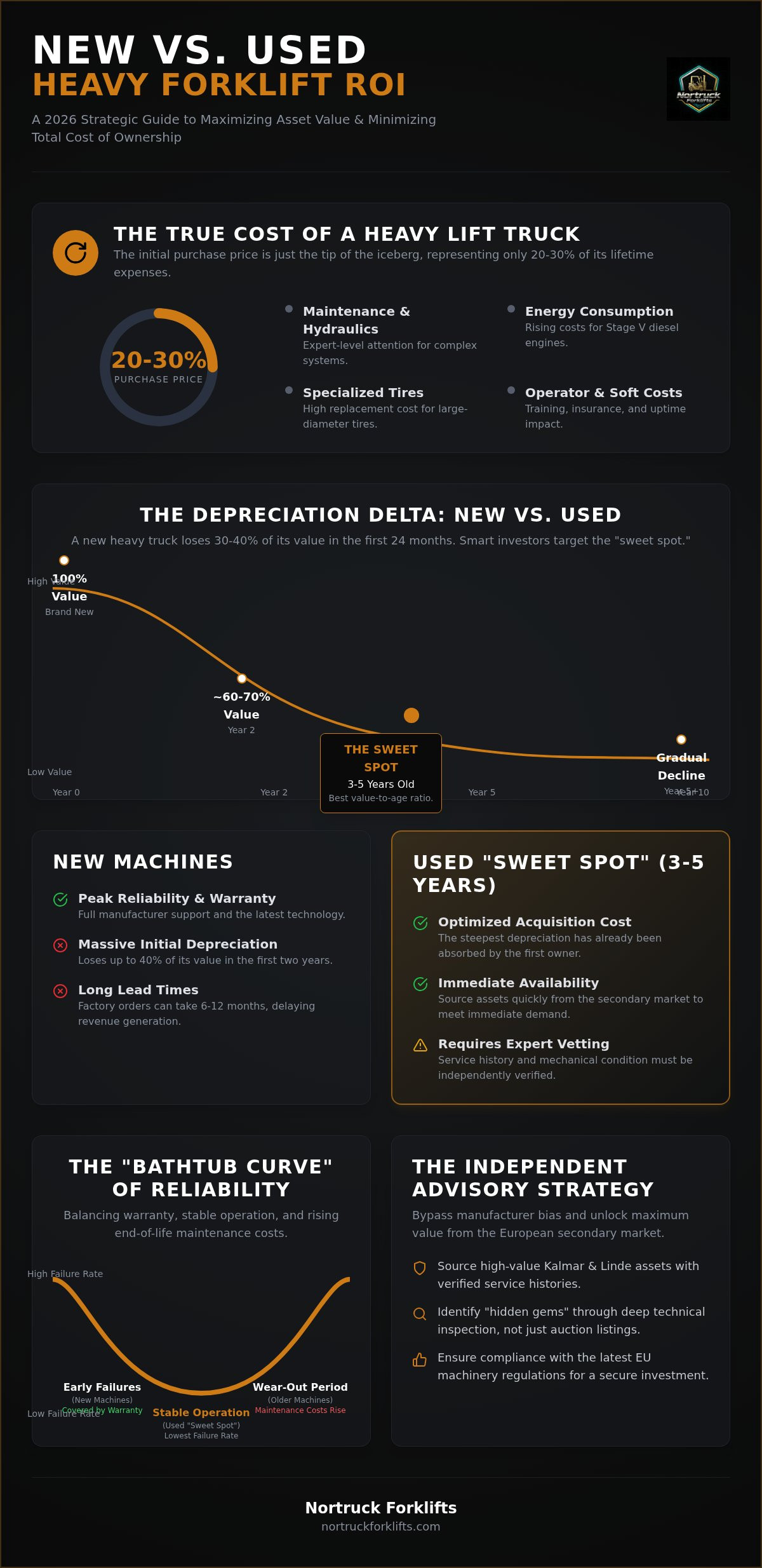
Many procurement managers focus solely on the capital expenditure of a new unit. However, when evaluating new vs used heavy forklift ROI, the initial purchase price usually represents only 20% to 30% of the machine's total lifetime cost. In high-capacity environments, the financial impact of your choice extends far beyond the dealership invoice. It encompasses energy consumption, specialized maintenance, and the eventual resale value. Heavy forklift ROI is the net operational profit generated per asset over its entire service life, minus all TCO pillars.
By 2026, the variables affecting these calculations have become more complex. Rising energy costs for Stage V diesel engines and the high price of specialized, large-diameter tires are significant factors. Beyond procurement, managing the disposal of industrial rubber is part of a complete lifecycle strategy—learn more about Tired Tyres for specialized waste management services. Additionally, hydraulic systems in heavy lift trucks require more frequent, expert-level attention than standard warehouse equipment. If you don't account for these recurring expenses, your ROI projections will be fundamentally flawed. A machine that seems like a bargain at auction can quickly become a liability if its hydraulic seals or transmission components are nearing the end of their service life.
The 30-Tonne Variance
Standard ROI models for a 2-tonne warehouse Forklift don't scale linearly to a 30-tonne Kalmar reachstacker. High-capacity assets involve massive specialized transport fees and complex on-site commissioning that can cost thousands before the machine lifts its first load. Component longevity is also tied to duty cycles; a truck working 20 hours a day in a steel mill faces a much steeper depreciation curve than one used intermittently in a timber yard. When you're dealing with high-capacity equipment, you need to look at the "value-to-age" ratio rather than just the year of manufacture.
Soft Costs and Operational Uptime
Uptime is the most critical driver of ROI in heavy industry. When a reachstacker goes down in a port terminal, the "cost of a down machine" isn't just the repair bill; it's the ripple effect of stalled logistics and missed shipping windows. You must also factor in soft costs like specialized operator training and increased insurance premiums for high-value industrial assets. These "hidden" pillars of TCO determine whether a used machine with a lower entry price actually yields a better return than a new model with a full warranty. Reliability isn't just a technical metric; it's a financial safeguard for your entire operation.
New vs Used: The Depreciation and Acquisition Delta
Acquisition strategy is where your procurement spreadsheet meets the reality of the terminal yard. For high-capacity equipment, the depreciation delta is the most significant factor in new vs used heavy forklift ROI. A new 40-tonne reachstacker can lose between 30% and 40% of its market value in just the first 24 months. While a new machine offers the comfort of a factory warranty, you're essentially paying a massive premium for the privilege of absorbing that initial valuation crash. For many operations, that capital is better deployed elsewhere.
Availability is another critical factor that often overrides price. In 2026, factory lead times for specialized heavy trucks often stretch from 6 to 12 months. If your new contract starts next month, a factory order isn't a viable solution. Used sourcing provides nearly immediate access to assets, allowing you to begin generating revenue without the long wait. From a CapEx perspective, used assets allow for a lower entry point. This can be particularly advantageous for tax strategies focused on immediate operational expansion rather than long-term amortization of a high-interest loan.
The Secondary Market "Sweet Spot"
The most intelligent investments in the heavy sector typically target machines in the 3-5 year age bracket. These units are often ex-leasing fleet machines that come with fully documented service histories. The key is verifying the recorded hours against the actual mechanical condition. An advisor with deep technical knowledge can spot a well-maintained "hidden gem" that a standard auction listing might overlook. For example, when searching for a Linde forklift for sale, you should prioritize high-spec models that were part of a manufacturer-maintained service contract. This approach ensures you're getting a machine that has already cleared its steepest depreciation hurdle but still possesses the majority of its working life.
Residual Value: The Exit Strategy
Your exit strategy is just as important as your initial purchase. Brands like Kalmar, Toyota, and Volvo consistently hold their value better in the secondary market because of their reputation for long-term durability. Determining the economic life of an asset requires looking toward the 10-year mark. Will the machine still have significant resale value, or will it be worth only its weight in scrap? Detailed maintenance records are the single biggest factor in protecting that final ROI. If you're unsure how to evaluate a specific machine's history, it's often wise to consult an independent expert who understands the nuances of the European secondary market.
Maintenance and Reliability: The Hidden ROI Killers
Reliability in heavy lifting follows the "bathtub curve," where failure rates are higher during the initial "break-in" period and again as the machine reaches its wear-out phase. When calculating new vs used heavy forklift ROI, you must account for where an asset sits on this curve. A brand-new machine might come with a warranty, but infant mortality failures can still lead to unexpected downtime. Conversely, an older machine requires a sophisticated approach to its total cost of ownership to ensure that maintenance costs don't eclipse its operational value.
For heavy lifts, a proactive maintenance schedule typically yields a 4:1 ROI by preventing catastrophic hydraulic or engine failure. It's much cheaper to replace a seal during a scheduled inspection than to repair a blown cylinder in the middle of a shift. In 2026, telematics play a pivotal role in this strategy. Modern sensors provide real-time data on oil temperature, vibration, and fuel consumption, allowing managers to fix minor issues before they become terminal. This data-driven approach turns maintenance from a "necessary evil" into a strategic tool for maximizing asset life.
Preventive vs. Reactive Maintenance Math
Budgeting for a major overhaul at the 10,000-hour mark is non-negotiable for high-capacity trucks. You should prioritize machines with high parts commonality across Europe to ensure that replacements are easy to find and affordable. An independent advisor is essential for this process, helping you verify the maintenance history of a used reachstacker for port use. They can identify if previous owners followed the manufacturer's intervals or if the machine was "run to fail," which significantly impacts its long-term financial performance.
Specialized Sourcing for Uptime
Reducing downtime requires more than just a local mechanic. You can often bypass local dealership bottlenecks by utilizing an international network to source rare heavy-lift components directly from European suppliers. This specialized sourcing ensures that your maintenance budget stays on track while meeting strict 2026 compliance and safety standards. By sourcing high-quality parts outside the standard OEM channels, you can maintain the reliability of your Kalmar or Linde fleet without the "brand tax" often associated with local dealers. Uptime is the ultimate goal, and having a diverse supply chain is the best way to protect it.
Application-Specific ROI: Sideloaders and Multidirectional Trucks
Buying the wrong equipment is the fastest way to sabotage your new vs used heavy forklift ROI. It doesn't matter if you saved 50% on a used Kalmar if that machine requires 12-meter aisles in a facility designed for six. In the heavy lift sector, the physical footprint of the machine often dictates the profitability of the entire operation. If the equipment can't handle long loads safely or requires excessive maneuvering space, you're losing money on every cycle through wasted time and increased fuel consumption.
For long-load handling in timber or steel yards, the Baumann sideloader remains the industry benchmark for efficiency. These machines are engineered to transport heavy materials parallel to the direction of travel, which eliminates the need for wide turning circles. Similarly, sourcing a Combi-Lift 4-way truck for sale can transform your storage density. When compared to traditional reach trucks, as explored in our multidirectional forklift vs reach truck analysis, these multidirectional units allow for significantly narrower aisles. This effectively increases your warehouse capacity without the need for a costly building expansion.
Space Optimization as an ROI Driver
Real estate is often your second largest expense after labor. In high-density storage, calculating the cost-per-pallet-position is essential for a true ROI analysis. Specialized multidirectional assets reduce the risk of product and rack damage because they don't have to "swing" loads into place. This precision preserves the lifecycle value of the asset and protects your warehouse infrastructure. In specialized manufacturing, the ability to move a 20-tonne component through a standard doorway is a massive operational advantage that standard forklifts simply can't match.
Energy Efficiency: Diesel vs. Electric ROI in 2026
By 2026, the energy profile of your fleet has become a major ROI pivot point. Electric heavy lifts now account for over 70% of new sales in Europe, driven by maintenance costs that often sit below $1.00 per hour. However, you must calculate the TCO of the charging infrastructure and comply with new standards like EN 17329:2026 for lithium-ion safety. While Stage V diesel engines are highly efficient for 30-tonne reachstackers in intensive shifts, rising carbon taxes can quickly tilt the math in favor of electric power. You've got to weigh the higher acquisition cost of electric units against the long-term fuel savings and lower mechanical complexity.
The Independent Advisory Strategy: Minimizing TCO across Europe
When you walk into a manufacturer's dealership, their primary objective is to move new inventory to meet quarterly factory quotas. This inherent bias often clouds the objective analysis of your new vs used heavy forklift ROI. An independent advisor, however, operates with a different set of priorities. Our goal is to ensure the asset you acquire provides the highest possible return, whether that's a factory-fresh unit or a five-year-old machine sourced from a port terminal in Northern Europe. Transparency is the foundation of a successful procurement strategy.
With over 40 years of technical experience, we've seen which models stand the test of time and which ones become "lemons" after the first 5,000 hours. We identify these problematic series before they ever reach your yard, saving you from expensive hydraulic failures or electronic glitches. Sourcing a Kalmar heavy lift truck for sale through an independent channel allows you to tap into the entire European secondary market. This breadth of choice ensures you aren't limited to what's currently sitting on a local lot, but can instead find the specific configuration that matches your operational needs.
Eliminating the Middleman in Procurement
Direct European sourcing significantly reduces the hidden brokerage fees and dealership markups that often inflate the price of heavy machinery. By bypassing these intermediaries, you retain more capital for your operational budget. We prioritize independent pre-purchase inspections for every heavy asset to verify technical integrity. This approach allows us to build a multi-brand fleet strategy based on technical merit and parts availability rather than marketing loyalty. Does your current fleet reflect the best technology available, or just the best deal your local dealer could offer at the time?
Developing a 10-Year Asset Roadmap
True ROI isn't achieved through reactive buying when a machine finally breaks down. It requires moving toward strategic lifecycle management with a clear 10-year roadmap. As we navigate the 2026 market fluctuations, having an expert guide helps you time your acquisitions and disposals to maximize residual value. We invite you to a professional consultation to audit your current fleet's TCO and ROI projections. Let's look at the data together to see where we can minimize your hidden ownership costs and improve your operational efficiency.
Ready to optimize your heavy lifting operations? Book a consultation with Lars G Tarby to discuss your 2026 procurement strategy and secure the high-value assets your business deserves.
Securing Your Fleet's Financial Future in 2026
Maximizing your operational profit in the heavy lift sector requires a shift from reactive procurement to strategic lifecycle management. As we've explored, the real value isn't found in the lowest sticker price but in the machines that offer the best balance of acquisition cost, uptime, and residual value. By targeting high-spec assets like Kalmar or Linde trucks in the secondary market, you can avoid the heavy depreciation hit of new equipment while still ensuring your fleet meets the latest 2026 safety and energy standards.
Mastering new vs used heavy forklift ROI is ultimately about transparency and technical insight. With 40+ years of industrial lifting expertise and an independent sourcing network across the entire European market, we specialize in finding the "hidden gems" that protect your bottom line. Whether you're looking for Baumann sideloaders or high-capacity reachstackers, our goal is to provide the honest guidance you need to build a resilient, high-performing fleet without unnecessary manufacturer bias.
We're ready to help you audit your current TCO and find the best path forward for your terminal or warehouse operations. Let's start a conversation about your long-term goals and secure the high-value assets that will drive your business forward.
Frequently Asked Questions
What is the most significant hidden cost in heavy forklift ROI?
The most significant hidden cost is often the secondary loss of revenue caused by unexpected downtime. In heavy lift operations, a single hour of a machine being out of service can halt entire logistics chains. Beyond parts, the specialized labor rates for high-capacity mechanics can quickly erode your budget if the machine hasn't been properly vetted for hydraulic or transmission wear before purchase.
How many hours are too many when buying a used 30-tonne reachstacker?
For a 30-tonne reachstacker, 10,000 to 12,000 operational hours usually signal the need for a major component overhaul. While these machines are built for extreme durability, reaching this threshold without a documented history of preventive maintenance increases the risk of catastrophic failure. If a machine has exceeded 15,000 hours, its financial viability relies heavily on whether the engine and hydraulics were already refurbished by a qualified technician.
Does sourcing a heavy forklift from Europe really save money after transport costs?
Sourcing from the European market often yields a better new vs used heavy forklift ROI because the sheer volume of available assets keeps prices competitive. Even after factoring in specialized transport and commissioning, the value-to-age ratio in Europe is typically superior to smaller local markets. This is especially true for premium brands like Linde or Kalmar, where the technical condition of ex-leasing fleets is often meticulously documented.
How does the resale value of Kalmar compare to other heavy lift brands?
Kalmar assets generally command a premium on the secondary market compared to many other heavy lift brands. This high residual value is a key pillar of their long-term financial performance. Buyers trust the structural integrity and parts availability of Kalmar units, making them easier to liquidate or trade in when it's time to refresh your fleet. This brand recognition helps protect your capital investment over a 10-year cycle.
At what age does a heavy forklift typically lose its ROI efficiency?
Heavy forklifts typically see a decline in operational efficiency between year 7 and year 10 of their service life. At this stage, the frequency of reactive repairs usually begins to outpace the machine's generated value. If annual maintenance costs approach 20% of the truck's current market value, it's a clear signal that the asset has reached the end of its most profitable lifecycle and should be replaced.
Is electric heavy lifting equipment more cost-effective than diesel in 2026?
In 2026, electric heavy equipment is often more cost-effective for single-shift operations due to maintenance costs staying under $1.00 per hour. However, for intensive, multi-shift port operations, Stage V diesel reachstackers remain a strong choice for maximizing new vs used heavy forklift ROI. The decision depends on your existing charging infrastructure and the impact of local carbon taxes on your total operating budget.
How much does a preventive maintenance plan affect the total ROI?
A structured preventive maintenance plan can deliver a 4:1 return on investment by preventing major component failures. Skipping just one 250-hour service interval can increase the likelihood of a major breakdown by 40%. By spending a predictable amount on inspections and fluid changes, you avoid the significantly higher costs and logistical delays associated with reactive, emergency repairs during peak operations.
Why should I use an independent advisor instead of a local dealer for heavy lifts?
An independent advisor provides access to the entire European market rather than just the inventory sitting on a local lot. Unlike dealers who are incentivized to sell specific new models, an advisor focuses on your specific TCO goals and operational requirements. This perspective is vital for identifying high-value used assets and avoiding models with known technical flaws, ensuring your capital is invested in the machine that best fits your reality.

Article by
Lars Gunnar Tärby
Disclaimer
1. General Information and No AdviceThe information, articles, product descriptions, and specifications provided on this website (www.nortruckforklifts.com) are for general informational and educational purposes only. While we strive to provide accurate and up-to-date content regarding new and used forklifts and heavy machinery, the material published does not constitute professional, technical, or legal advice.
2. Product Specifications and PricingNortruck Forklifts acts as a facilitator for the trade of new and used forklifts. All equipment details, including but not limited to year of manufacture, operating hours, lift capacity, dimensions, conditions, and pricing, are provided based on the information available to us at the time of publication. Specifications and availability are subject to change without prior notice.
3. "As Is" and VerificationAll articles and product listings are provided on an "as is" and "as available" basis without any warranties of any kind, either express or implied. Nortruck Forklifts does not guarantee that the descriptions are entirely error-free, complete, or reliable. Buyers and traders are strongly encouraged to independently verify all technical specifications, machine history, and equipment conditions directly with the seller or an authorized inspector before finalizing any purchase or transaction.
4. Limitation of LiabilityIn no event shall Nortruck Forklifts, its owners, or its contributors be held liable for any direct, indirect, incidental, consequential, or economic loss or damage arising out of the use of, or the inability to use, the information provided on this website, or any transactions facilitated through this platform. This includes, but is not limited to, damages caused by technical inaccuracies, typographical errors, or reliance on the content of our articles.
5. Third-Party LinksOur website may contain links to external websites, dealer networks, or third-party services that are not owned or controlled by Nortruck Forklifts. We have no control over, and assume no responsibility for, the content, privacy policies, or practices of any third-party websites.


