
The highest-capacity machine isn’t automatically the right choice for a rail terminal. Selecting material handling equipment for rail freight terminals by lift rating alone can overlook cargo type, handling sequence, available space and how equipment moves through the site.
Containers, palletised freight and long loads may call for different handling approaches, while the terminal’s layout and workflow limit which configurations make practical sense. This guide offers a task-based way to compare equipment categories and build a sourcing brief around your operating requirements.
We’ll look at handling tasks and terminal constraints alongside heavy lift trucks, sideloaders, four-way trucks, forklifts and reachstackers. These are categories to assess against your operation, not universal recommendations. Lars G Tarby of Nortruck Forklifts brings more than 40 years of lifting-equipment experience to discussions about requirements for new or used machinery sourced across Europe.
Key Takeaways
- Start with the freight profile and handling sequence to identify which equipment categories to compare.
- Assess machine fit against load dimensions, centre of gravity, attachments and available manoeuvring space.
- Build a sourcing brief that separates essential operating requirements from preferences.
- Evaluate material handling equipment for rail freight terminals by task, not rated capacity alone.
- Compare new and used machinery against the brief, with experienced guidance to help assess suitable options.
What material handling equipment does a rail freight terminal need?
Material handling equipment for rail freight terminals is mobile machinery used to transfer, position, stack or stage freight as it moves between railcars and other parts of the terminal. The suitable equipment category depends on the cargo, the task and the site layout.
This equipment is distinct from track infrastructure, such as rails and switches, and from fixed process systems. The focus here is on machines that handle freight and how they move through the terminal. Defining those tasks is more useful than choosing a machine by capacity alone.
The video below shows one example of equipment used in a rail freight unloading context:
Which cargo and handling tasks shape equipment requirements?
Start by grouping freight into practical workflows. Intermodal containers move between rail and road or storage areas; intermodal freight transport describes the use of standardized containers across modes. Palletised freight may need to be unloaded, transferred and staged. Long loads such as timber or steel call for an approach suited to their length and support points. Other cargo can bring different load shapes and handling needs.
Map the full task: loading or unloading a railcar, transferring freight across the terminal, stacking it, or moving it to a staging area. Forklifts, heavy lift trucks, sideloaders, multidirectional trucks and reachstackers are distinct categories to assess against those tasks. Don’t assume one machine will handle every cargo type or movement equally well.
How do rail-terminal workflows differ from port handling?
Rail terminals have their own interfaces and transfer points. Equipment must work around railcars, access routes, storage areas and the space available to manoeuvre. Transferring a container between rail and truck differs from moving palletised or long freight from a railcar to a staging area. The workflow helps define which machine is relevant.
Port-terminal reachstacker applications offer useful context for container handling, but a port setup isn’t automatically right for a rail site. For port-specific procurement considerations, see this port reachstacker sourcing guide. At a rail terminal, start with the cargo path, transfer points and available operating space.
Compare equipment categories for rail freight terminal handling
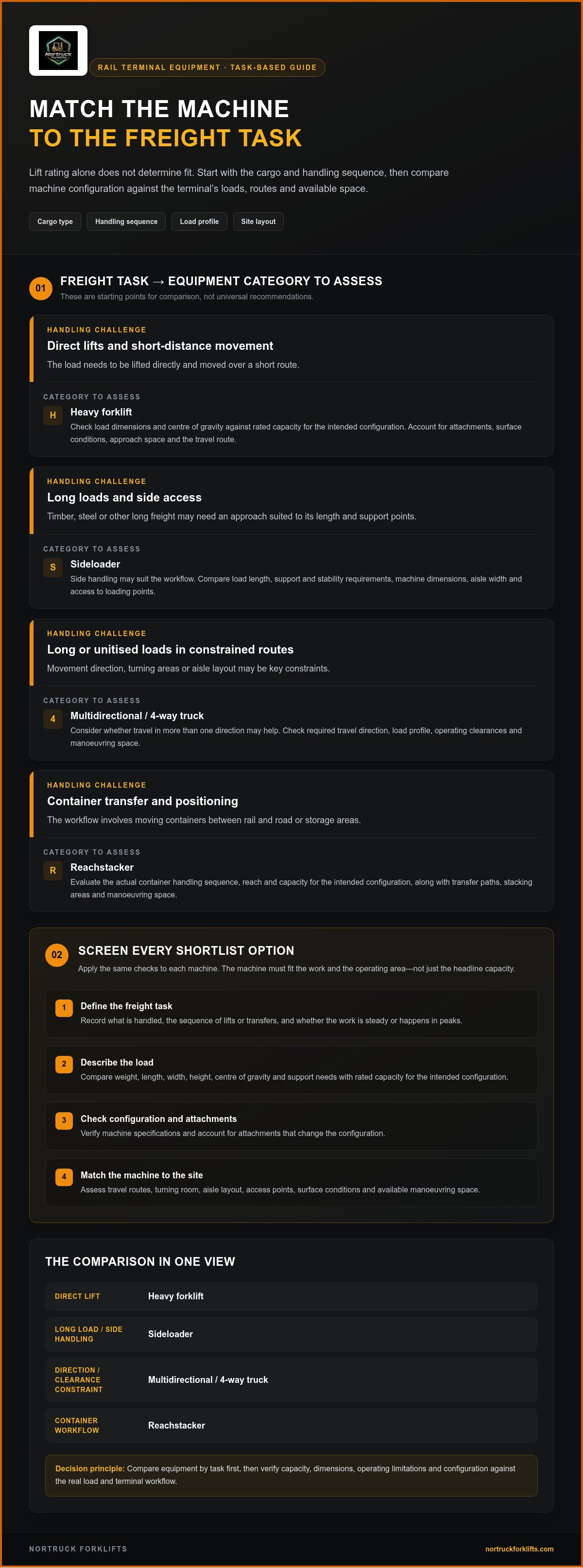
Equipment categories suit different handling patterns. Use this comparison to narrow the shortlist, then check each machine’s verified specifications against your loads and workflow. These categories are starting points, not guarantees of suitability for a particular rail application.
| Equipment category | Cargo and handling task | Operating space to consider | Typical decision factors |
|---|---|---|---|
| Heavy forklift | Loads that need direct lifting and short-distance movement | Travel routes, turning room and space to approach the load | Load dimensions, centre of gravity, attachments and surface conditions |
| Sideloaders | Long loads that may be handled from the side | Long-load routes, aisle width and access to loading points | Load length, support and stability requirements, machine dimensions |
| Multidirectional or 4-way trucks | Long or unitised loads where movement in more than one direction may help | Constrained routes, turning areas and aisle layout | Required travel direction, load profile and operating clearances |
| Reachstackers | Container-handling workflows involving lifting and positioning containers | Container transfer paths, stacking areas and manoeuvring space | Handling sequence, reach and capacity for the intended configuration |
When might a heavy forklift suit terminal freight handling?
Consider a heavy forklift when the task involves lifting a load directly and moving it over a short route. Compare the load’s dimensions and centre of gravity with the machine’s rated capacity, and account for any attachment that changes the configuration. The surface and route matter too: the machine must be able to approach, lift and travel through the operating area. For high-capacity procurement context, see this Kalmar heavy lift truck sourcing guide.
When should buyers assess sideloaders, 4-way trucks or reachstackers?
Assess a sideloader for long-load workflows where side handling may suit the route, subject to the machine’s specifications and site conditions. A multidirectional truck may be worth considering when layout makes travel direction or manoeuvring space a key constraint. For containers, evaluate a reachstacker against the actual transfer and positioning tasks. It isn’t a default choice for every terminal.
Compare material handling equipment for rail freight terminals by task first, then check the verified capacity, dimensions, operating limitations and configuration needed. Nortruck’s equipment advisers can help frame that comparison around a defined handling requirement. Discuss your equipment requirements with an experienced adviser.
How to compare rail terminal equipment against real operating requirements
A useful comparison starts with the work the machine must perform, not a headline capacity or preferred equipment type. Apply the same screening steps to each option:
- Define the freight task. Record what is being handled, the sequence of lifts or transfers, and whether the work is steady or happens in peaks.
- Describe the loads. Note weight, length, width, height, centre of gravity and any features that affect how the load can be supported. Compare these details with rated capacity for the intended configuration.
- Account for attachments. Identify whether the task needs an attachment, then assess how it changes the machine configuration and handling requirements.
- Map the route and work area. Document travel distances, aisle and turning space, clearances, ground conditions, staging areas and access to railcars and transfer points. Include interactions with other terminal traffic.
- Review ongoing use. Compare expected utilisation and operator requirements, then consider service planning and lifecycle needs alongside task fit. Don’t assume capacity alone establishes suitability.
Which technical and site details belong in the comparison?
Use consistent information for every candidate: load weights and dimensions, handling frequency, lift or stacking requirements, route lengths, aisle widths and surface conditions. Add clearances, railcar access, transfer locations and nearby staging areas. These details help show whether a machine can reach the work area and move through the workflow, not just meet a load rating on paper.
How should buyers weigh productivity against flexibility?
Compare options against both typical activity and peak periods. A configuration suited to one frequent load may be less adaptable if freight profiles vary. In a constrained layout, a flexible movement pattern may matter more. For multidirectional movement as a sourcing consideration, see this Combi-Lift 4-way truck guide.
Keep the comparison grounded in verified machine specifications and project conditions. Capacity, dimensions, reach and operating limitations can vary by configuration, so assess them against the documented task and site. Nortruck’s equipment advisers can help frame a sourcing discussion around those requirements. Discuss your terminal equipment needs.
What should a rail freight terminal equipment brief include?
A practical brief turns the handling need into criteria that can be compared across equipment categories. It also helps an adviser focus sourcing on machines that fit the cargo, workflow and site, rather than starting with a model or capacity in isolation.
What information helps define the machine requirement?
Build the brief in sequence, separating must-haves from preferences:
- Describe the freight. List cargo types, load weights and dimensions, including the range of load profiles the machine may need to handle.
- Map the handling pattern. Record loading, unloading, transfer, stacking and staging tasks, along with handling frequency and shifts. Note lift heights or stacking requirements where relevant.
- Set out the site conditions. Describe the terminal layout, railcar access, transfer points, travel routes, available clearances, ground conditions and staging areas.
- Define the operating setup. Include operator requirements, potential attachment needs, where equipment will be stored and relevant interaction with the existing fleet.
- Prioritise requirements. Mark specifications essential for safe, workable operation separately from preferences that could be flexible.
This gives a sourcing adviser a clear basis for identifying relevant categories of material handling equipment for rail freight terminals. It also makes trade-offs visible: a preferred configuration can be considered without confusing it with a site or load requirement the machine must meet.
How can buyers make sourcing discussions more productive?
Share the intended application, must-have specifications and priorities behind the purchase. State whether you prefer new or used machinery, while keeping both options open if the project allows. Include acceptable alternatives, such as flexibility in configuration or equipment category, when they still meet the operating need. Clear constraints focus the search, while realistic alternatives can widen the relevant options.
Nortruck sources new and used machinery from manufacturers across Europe and advises buyers on matching equipment to defined handling requirements. For broader procurement context, see the European forklift sourcing guide. A concise brief gives the discussion a useful starting point and keeps comparisons tied to the project.
Source rail freight terminal equipment with experienced guidance
A sourcing discussion is most productive when it starts with the handling requirement, not a predetermined machine. For material handling equipment for rail freight terminals, bring together the freight profile, handling sequence, operating conditions and essential specifications. This gives an adviser a practical basis for narrowing the search to relevant equipment categories and configurations.
How does an equipment sourcing discussion move forward?
Nortruck’s advisory work begins with the buyer’s application. What cargo needs moving? Where will the equipment work, and how will freight travel between the rail interface, transfer points and staging areas? Which load dimensions, attachments, operating clearances or other requirements are essential? Clear answers help shape the search and keep potential options tied to the terminal’s workflow.
New and used machinery can then be considered against the same brief. Neither is automatically the better fit; the right sourcing route depends on the project’s requirements and priorities. Nortruck sources machinery from manufacturers across Europe, including Kalmar Heavy Lift Trucks and Baumann Sideloaders. These are examples to assess against the intended task, not assumptions about what every rail terminal needs. Evaluate capacity, dimensions and operating limitations for the specific machine and configuration.
Lars G Tarby brings more than 40 years of lifting-equipment experience to these discussions. His experience supports a considered conversation about how the stated requirements relate to equipment categories and sourcing options, rather than treating a single specification as the whole decision.
What is a useful next step for terminal buyers?
Share your equipment brief and procurement priorities, including the cargo, tasks, operating environment, must-have specifications and acceptable alternatives. If you’re open to both new and used machinery, say so. If a requirement is fixed, make that clear. This keeps the discussion focused while allowing options to be assessed against the project, not a generic checklist.
Have a defined handling need or an early-stage brief? A conversation can help clarify which equipment categories and specifications are relevant to your terminal.
Turn your equipment brief into a practical next step
Choosing material handling equipment for rail freight terminals starts with the work itself: the cargo, handling sequence and space available. Compare equipment categories against operating conditions, then check load dimensions, centre of gravity, attachments and machine specifications before narrowing your options.
A focused brief also makes sourcing discussions more useful. Separate essential requirements from preferences, and consider whether new or used machinery fits your procurement priorities. Nortruck sources new and used heavy lifting equipment across Europe, with Lars G Tarby bringing more than 40 years of lifting-equipment experience to the advisory process.
Whether you’re refining an early requirement or ready to compare suitable options, a clear conversation can bring the key decisions into focus.
Start with the handling task to build a stronger foundation for choosing equipment that fits your operation.
Frequently Asked Questions
What equipment is used in a rail freight terminal?
Rail freight terminals may use forklifts, sideloaders, multidirectional trucks or reachstackers, depending on the freight and handling tasks. A forklift may be assessed for direct lifting and short-distance movement, while a sideloader may suit some long-load workflows. Reachstackers may be considered for container handling. Compare each category with load dimensions, rail access, available space and handling frequency. No category is a universal solution for every terminal.
How do I choose material handling equipment for a rail freight terminal?
Start by documenting cargo types, load weights and dimensions, handling frequency, travel routes and available space. Then compare equipment categories with the required lifting, movement and staging tasks. Include operator needs, attachment requirements and site conditions in the brief. For material handling equipment for rail freight terminals, use verified, machine-specific specifications to assess fit. Headline capacity alone won’t show whether equipment suits the complete workflow.
Can a reachstacker be used at a rail freight terminal?
A reachstacker may be considered if container handling is part of the terminal workflow. Its suitability depends on the container task, operating pattern, available space and the specific machine’s verified specifications. Compare it with other relevant categories against the site layout and transfer requirements. A reachstacker used in a port context isn’t automatically the right choice for a rail terminal, so assess the application and operating conditions.
What is the difference between a heavy forklift and a reachstacker?
A heavy forklift and a reachstacker are different equipment categories, and their suitability depends on the load and task. Compare how each could perform the required lifting, movement and staging work, then account for site dimensions and operating conditions. Review specifications for the specific machine and configuration. Rated capacity matters, but it shouldn’t be the only selection factor; load profile and the full workflow also affect fit.
What information should I provide when sourcing terminal equipment?
Share the cargo profile, load weights and dimensions, handling frequency, lift requirements and terminal layout. Include rail access, travel distances, surface conditions, shift patterns, and any attachment or operator considerations. Separate essential requirements from preferences, and state whether you’re considering new or used machinery. This gives an adviser a clearer basis for narrowing equipment categories and comparing sourcing options against the terminal’s requirements.
Should a rail terminal buy new or used handling equipment?
The right choice depends on the project brief, operating requirements and procurement priorities. Compare candidate machines using verified specifications, condition, expected use and lifecycle considerations. New equipment isn’t automatically the best fit, and used equipment isn’t automatically the better value. Define essential requirements first, then assess suitable options against them. Nortruck sources new and used heavy lifting equipment from manufacturers across Europe to support different procurement briefs.
How can terminal operators compare equipment productivity?
Compare equipment against the complete handling sequence, including load type, travel distance, transfer points, staging and frequency. Assess typical and peak workflows, site constraints and interaction with other terminal traffic. Use relevant machine specifications to understand how an option fits those conditions. Avoid relying on unsupported throughput promises: productivity depends on the equipment’s role in the overall operation, not on one capacity or performance figure.

Article by
Lars Gunnar Tärby
Disclaimer
1. General Information and No AdviceThe information, articles, product descriptions, and specifications provided on this website (www.nortruckforklifts.com) are for general informational and educational purposes only. While we strive to provide accurate and up-to-date content regarding new and used forklifts and heavy machinery, the material published does not constitute professional, technical, or legal advice.
2. Product Specifications and PricingNortruck Forklifts acts as a facilitator for the trade of new and used forklifts. All equipment details, including but not limited to year of manufacture, operating hours, lift capacity, dimensions, conditions, and pricing, are provided based on the information available to us at the time of publication. Specifications and availability are subject to change without prior notice.
3. "As Is" and VerificationAll articles and product listings are provided on an "as is" and "as available" basis without any warranties of any kind, either express or implied. Nortruck Forklifts does not guarantee that the descriptions are entirely error-free, complete, or reliable. Buyers and traders are strongly encouraged to independently verify all technical specifications, machine history, and equipment conditions directly with the seller or an authorized inspector before finalizing any purchase or transaction.
4. Limitation of LiabilityIn no event shall Nortruck Forklifts, its owners, or its contributors be held liable for any direct, indirect, incidental, consequential, or economic loss or damage arising out of the use of, or the inability to use, the information provided on this website, or any transactions facilitated through this platform. This includes, but is not limited to, damages caused by technical inaccuracies, typographical errors, or reliance on the content of our articles.
5. Third-Party LinksOur website may contain links to external websites, dealer networks, or third-party services that are not owned or controlled by Nortruck Forklifts. We have no control over, and assume no responsibility for, the content, privacy policies, or practices of any third-party websites.


