
The highest-capacity truck on paper may still be the wrong choice for your coils. A heavy lift truck for coil handling must suit the load’s dimensions and engagement method, as well as its weight. Capacity matters, but so does confirming how the truck’s rating changes with the intended attachment and handling setup.
To choose confidently, match the truck and attachment to the actual coil, route, and placement task. A specialist coil handler isn’t automatically a better fit than a conventional heavy lift truck. This guide explains how to compare the options and what specifications and procurement details to verify before purchase. Nortruck Forklifts advises on and sources new and used heavy lifting equipment, with Kalmar Heavy Lift Trucks as its primary offering. The aim is to assess candidate machines against your application, not to choose on capacity alone.
Key Takeaways
- Choose a heavy lift truck for coil handling by assessing the full task, not load mass alone.
- Compare fork-based and core-engaging methods against coil orientation, dimensions, surface protection, and process needs.
- Check how lift height, travel distance, visibility, turning space, floor conditions, and duty cycle affect truck suitability.
- Before purchase, document the load and task, confirm attachment compatibility, and request capacity information for the exact configuration.
- Nortruck advises on sourcing new and used heavy lifting equipment, including Kalmar Heavy Lift Trucks. Confirm coil-specific suitability and availability for each requirement.
What a Heavy Lift Truck for Coil Handling Must Do
Coil handling means transporting and positioning a cylindrical load with an engagement method suited to the load and task. A steel coil, a paper roll, and another cylindrical product may look similar, but their mass, surface protection, core dimensions, and permitted contact points can differ. Treating them as interchangeable can lead to a handling setup that doesn’t suit the load.
Definition: A heavy lift truck is suitable for coil handling only when the load, attachment, truck configuration, and worksite are compatible.
A forklift is a type of powered industrial truck, but the equipment category alone doesn’t establish whether a particular machine can perform a coil-handling task. Define the application before comparing candidate trucks.
Which coil details should buyers record first?
Start with the heaviest coil the truck may need to handle, as well as a typical coil. Record the outside diameter, width, and core dimensions for each load. Then note whether the coil travels eye-horizontal, eye-vertical, or in more than one orientation. Together, these details help determine how the load can be engaged, carried, and positioned.
Document packaging, surface sensitivity, and acceptable contact points, too. Confirm contact limits with the load owner rather than assuming the core or outer surface can be touched. Steel coils and rolls made from other materials may need different handling considerations because their weight and susceptibility to surface damage vary.
Why does coil handling need more than a capacity check?
A truck’s rated capacity isn’t a standalone measure of what it can lift in every configuration. An attachment adds weight and can change the load centre, affecting the capacity available for the coil. Ask for capacity information for the exact truck and attachment combination, and have the manufacturer verify the applicable ratings and operating limits.
Capacity is only one part of the operating picture. The operator needs to see the load and travel path, maintain stability, and place the coil accurately. A long travel route, restricted turning space, uneven floors, or a precise placement task can all affect which machine and configuration suit the work.
Record the route and destination as well as the load. A machine that can lift a coil in one set of conditions may not suit every movement or placement in the work cycle. A clear application profile gives buyers and equipment advisers a more reliable basis for evaluating options.
How Coil Engagement Methods Affect Heavy Lift Truck Selection
The attachment determines how the coil is supported, where force is applied, and how the truck carries the load. A core-engaging ram and fork-based support suit different load geometries and processes. Neither method is universally preferable. The right choice depends on coil orientation, dimensions, surface protection requirements, and how the coil must be moved and placed.
| Engagement approach | Potential application fit | Questions to verify |
|---|---|---|
| Core-engaging ram or mandrel | May suit a coil whose core and orientation allow secure engagement through the eye. | Do the core dimensions, coil balance, truck and attachment configuration meet manufacturer requirements? |
| Forks or coil-specific fork attachment | May suit loads supported beneath the coil, with fork shape or an approved attachment selected for the profile. | Will the contact points protect the surface, and do coil dimensions and placement needs match the setup? |
When might a coil ram or mandrel be considered?
A ram or mandrel engages the coil through its core, so it may be an option when the core dimensions and orientation allow that method. Before selecting one, confirm the core size, load balance, and intended travel and placement process. The manufacturer must verify that the specific truck and attachment combination is approved for the application and provides the required capacity.
When might forks or coil-specific fork attachments be considered?
Forks support the load from beneath. An approved, coil-specific attachment may change the supporting shape to suit a particular profile. Suitability depends on where the load can safely be contacted. Confirm acceptable contact points and surface protection with the load owner, then check the coil diameter, width, and placement clearances against the proposed setup.
Compare the methods against the actual task, not just the attachment name. A coil that can be engaged in one orientation may need a different approach if the process requires another orientation or precise placement. Since an attachment changes the truck’s configuration, confirm compatibility and request the approved capacity for the truck and attachment together. Don’t assume the truck’s rating applies unchanged after an attachment is fitted.
Include the operator’s view of the load and the handling procedure in the assessment. For U.S. operations, OSHA provides guidance on training and operating powered industrial trucks. If you’re comparing candidate machines, sharing coil and process details with Nortruck’s heavy equipment sourcing adviser can help focus the discussion on your application.
How to Compare Heavy Lift Trucks for Your Coil Operation
Compare candidates against the same task profile, not just their headline capacity or equipment category. For each heavy lift truck for coil handling, check the maximum coil mass, dimensions and orientation, required lift height, and travel distance. Then assess attachment compatibility, operator visibility with the load in place, turning space, floor conditions, and expected duty cycle. A truck that fits one part of the task may not suit the entire route and work cycle.
Which operating conditions change the comparison?
Record aisle widths, surface quality, gradients, and whether work takes place indoors, outdoors, or in both settings. Note the distance between pickup and set-down points. OSHA’s guidance on safe operating conditions for powered industrial trucks can help frame checks of surfaces and workplace obstructions. Add the shift pattern, handling frequency, and peak workload. Include heat or dust only if those conditions apply at your site.
Keep the comparison evidence-based. Separate manufacturer documentation for the exact truck and attachment from seller descriptions, estimates, or assumptions. Mark unconfirmed details clearly instead of treating them as specifications.
Candidate A: Record the configuration and source of specifications, evidence received, unknowns, fit with the load, route, and work cycle, and any trade-offs to resolve.
Candidate B: Record the same fields. Using identical criteria makes differences easier to identify and follow up.
How should buyers compare new and used candidates?
Assess new and used machines against the documented configuration and your application, not age or advertised capacity alone. For a used candidate, request service history, inspection evidence, and clear photographs. Check whether the records identify the machine and attachment being offered, and note any gaps that need clarification. This used heavy lifting equipment inspection checklist can help organize the review.
Before short-listing, separate confirmed fit from unresolved questions. A candidate may appear suitable by capacity but still have an unverified attachment match or a visibility limitation. Resolve these points using manufacturer documentation and an assessment of the actual operating conditions. The result is a practical comparison with clear trade-offs and next steps, rather than a ranking based on one headline figure.
What to Verify Before Buying a Coil Handling Truck
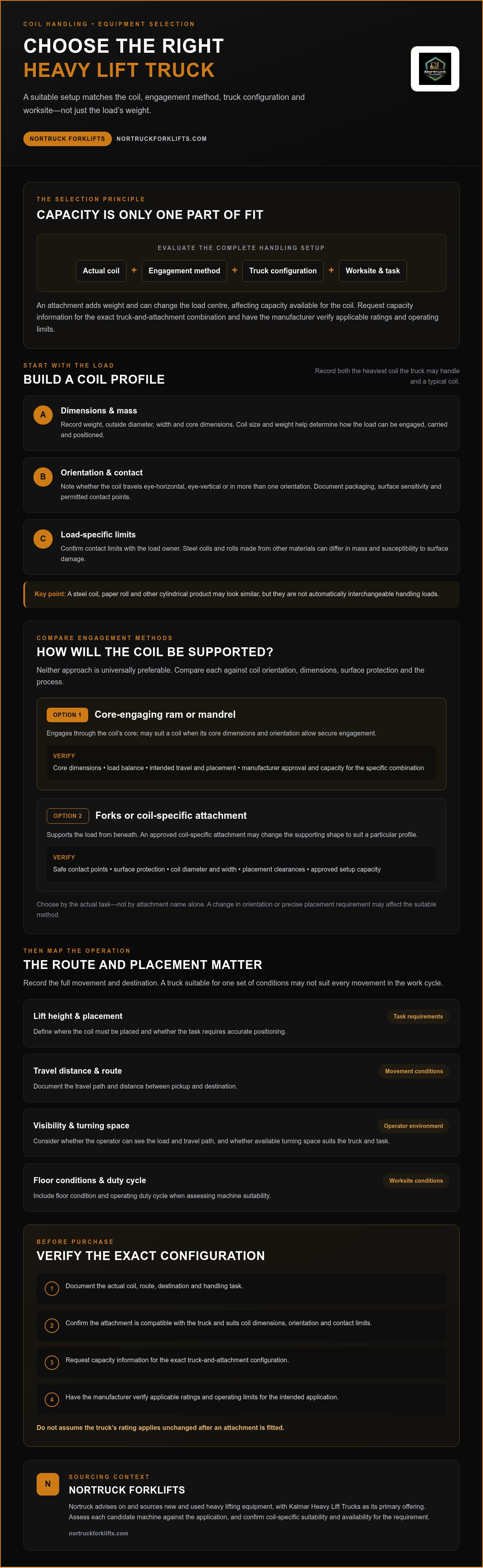
Use a consistent validation sequence before committing to a heavy lift truck for coil handling. First confirm the load and work cycle, then check the proposed configuration and the machine’s condition. A record of what’s verified, what’s missing, and who needs to confirm it helps prevent assumptions from becoming purchase decisions.
- Document the load. Record the maximum and typical coil mass, dimensions, core data, orientation, packaging, and handling frequency.
- Define the task and site. Describe pickup and set-down points, the travel route, floor conditions, lift height, working space, and expected work pattern.
- Verify the configuration. Request capacity information for the exact truck and attachment combination. Confirm the documents match the proposed make, configuration, and attachment.
- Assess the machine. Review available records and arrange a qualified inspection and application review before deciding to buy.
What information should a supplier receive?
Share the load range, outside dimensions, core measurements, coil orientation, and how often the machine will handle coils. Include site details such as travel distance, floor conditions, lift height, and space for turning and placement. State whether you’re considering a new or used machine, and explain any timing constraints so the search can be assessed against your requirement.
How can buyers validate a candidate machine?
Check that each document refers to the machine being offered, including its make, configuration, attachment, and serial number. Ask for the relevant capacity information and clarify gaps rather than relying on a general specification or seller description. For a used truck, request inspection evidence and available operating records, then arrange an assessment by qualified professionals familiar with the machine and application.
Inspection, operator requirements, and applicable compliance obligations vary by location and operation. Confirm them with qualified local professionals before purchase. For wider context on assessing a Kalmar candidate and the sourcing process, see the Kalmar heavy lift truck sourcing guide. Nortruck advises on sourcing new and used heavy lifting equipment. Coil-specific configurations and availability need to be confirmed against each requirement.
Sourcing a Heavy Lift Truck for Coil Handling with Nortruck
Finding a suitable machine involves more than locating a truck with a high enough headline capacity. Nortruck advises on and sources new and used heavy lifting equipment from manufacturers across Europe. Kalmar Heavy Lift Trucks are among Nortruck’s offerings, but don’t assume a particular model, coil attachment, specification, or machine is available. Each requirement needs to be checked individually.
An equipment sourcing adviser can help turn your load and site information into a clear brief for supplier discussions. That brief gives candidate machines a consistent basis for comparison: do their documented configurations align with the coil, handling method, and worksite requirements? Experience can help focus the search and identify questions to resolve, but it doesn’t replace manufacturer verification or confirm that a particular machine will be available or suitable.
What can an equipment sourcing adviser help clarify?
A well-defined application helps narrow the conversation from general equipment categories to specific requirements. An adviser can help organize the details you provide, compare candidate machines against those requirements, and flag where documentation or technical confirmation is still needed. Keep confirmed specifications separate from assumptions, especially for capacity and attachment compatibility.
What should you include in an initial enquiry?
Share enough information to make the sourcing discussion practical. Include:
- Coil weights, dimensions, core data, orientation, and handling frequency.
- Site conditions, travel routes, required lift height, and available working space.
- Whether you’re open to new or used equipment, and when you need the machine.
An early estimate is useful if you label it as unconfirmed. As specifications become clearer, refine the brief and assess candidate equipment against the same operating requirements. This keeps the discussion focused without treating an initial option as a confirmed match.
For a coil-handling requirement, the useful next step is a sourcing discussion based on the application, not an assumption that a particular truck or attachment will fit. Share your load and site details to discuss a coil handling requirement with Nortruck.
Make Your Next Coil-Handling Decision with Confidence
A suitable heavy lift truck for coil handling matches the load, engagement method, truck configuration, and worksite. Capacity alone isn’t enough. Confirm the rating for the exact truck and attachment, then compare visibility, access, travel conditions, and placement needs against the real work cycle.
Before purchase, document coil weights and dimensions, orientation, handling frequency, and site conditions. Use those details to compare candidates, identify missing evidence, and resolve open questions about specifications or machine condition. A structured review keeps the decision grounded in your operation rather than a headline figure.
Nortruck provides equipment sales and advisory services, including Kalmar Heavy Lift Trucks, and sources new and used heavy lifting equipment across Europe. The suitability, attachment compatibility, specifications, and availability of any coil-handling configuration need to be confirmed for your individual requirement.
With a clear application brief and the right technical checks, you can move forward with a more informed sourcing discussion and a solution better aligned with your work.
Frequently Asked Questions
Is a standard heavy lift truck suitable for handling steel coils?
It may be suitable, but only if the truck, attachment, and operating setup are approved for the specific coil and task. Rated capacity alone doesn’t establish whether a heavy lift truck for coil handling is a good fit. Compare the coil’s dimensions and orientation with the engagement method, travel route, and lift requirements. Before selecting equipment, request documentation for the proposed configuration and arrange a qualified application review.
How do I choose the right capacity for a coil handling truck?
Start with the heaviest coil and its dimensions, then account for the attachment and exact handling configuration. Request capacity information for the specific truck and attachment combination rather than relying on a headline rating. Include required lift height, load centre, and operating conditions in the assessment. Have the manufacturer or a qualified adviser verify that the proposed setup is suitable for the task.
Can a forklift handle a coil through its core?
Some coil-handling setups use a core-engaging ram or similar attachment, but this method isn’t suitable for every coil or operation. Check the core dimensions, coil orientation, load balance, and attachment design against the proposed truck configuration. The full setup must be documented for the intended task. Don’t assume that a core-engaging method is appropriate simply because the attachment can physically enter the coil’s core.
What information should I provide when sourcing a heavy lift truck for coils?
Provide the maximum and typical coil weight, outside diameter, width, core dimensions, and handling orientation. Add the required lift height, travel distance, floor conditions, operating frequency, and working-space limits. Note whether you’re open to new or used equipment and when you need it. These details help an adviser compare candidate machines with the real application and identify specifications or site requirements that still need confirmation.
Should I buy a new or used coil handling truck?
The right choice depends on your application, machine availability and condition, documentation, and operating requirements. For a used candidate, request its configuration details, service history, inspection evidence, and records needed to check suitability. Compare the evidence for each machine rather than judging by age alone. A qualified inspection and application review can help identify unanswered questions before you decide whether a candidate meets your needs.
Does Nortruck sell a specific Kalmar truck for coil handling?
Nortruck sells Kalmar Heavy Lift Trucks and provides sales and advisory services for heavy lifting equipment, but a specific coil-handling Kalmar model, attachment, or current availability isn’t confirmed here. Nortruck sources new and used machinery across Europe. Share your coil dimensions, operating conditions, and timing so the team can assess whether a suitable candidate may be sourced. Confirm any proposed configuration and specifications for your application.

Article by
Lars Gunnar Tärby
Disclaimer
1. General Information and No AdviceThe information, articles, product descriptions, and specifications provided on this website (www.nortruckforklifts.com) are for general informational and educational purposes only. While we strive to provide accurate and up-to-date content regarding new and used forklifts and heavy machinery, the material published does not constitute professional, technical, or legal advice.
2. Product Specifications and PricingNortruck Forklifts acts as a facilitator for the trade of new and used forklifts. All equipment details, including but not limited to year of manufacture, operating hours, lift capacity, dimensions, conditions, and pricing, are provided based on the information available to us at the time of publication. Specifications and availability are subject to change without prior notice.
3. "As Is" and VerificationAll articles and product listings are provided on an "as is" and "as available" basis without any warranties of any kind, either express or implied. Nortruck Forklifts does not guarantee that the descriptions are entirely error-free, complete, or reliable. Buyers and traders are strongly encouraged to independently verify all technical specifications, machine history, and equipment conditions directly with the seller or an authorized inspector before finalizing any purchase or transaction.
4. Limitation of LiabilityIn no event shall Nortruck Forklifts, its owners, or its contributors be held liable for any direct, indirect, incidental, consequential, or economic loss or damage arising out of the use of, or the inability to use, the information provided on this website, or any transactions facilitated through this platform. This includes, but is not limited to, damages caused by technical inaccuracies, typographical errors, or reliance on the content of our articles.
5. Third-Party LinksOur website may contain links to external websites, dealer networks, or third-party services that are not owned or controlled by Nortruck Forklifts. We have no control over, and assume no responsibility for, the content, privacy policies, or practices of any third-party websites.


