
Could a forklift rated for your heaviest load still be the wrong choice? Yes. Rated capacity alone doesn’t tell you how a truck will handle your loads at the required lift height, with attachments fitted, or across your site conditions. Choosing a Linde heavy diesel forklift 10 to 18 ton means matching the machine to the work, not simply selecting a number on a specification sheet.
That’s a practical concern when comparing trucks for demanding operations. A truck in the 10 to 18 tonne class needs to suit more than the headline rating. Assess load dimensions, handling conditions, duty cycle and the trade-offs between diesel and electric power before narrowing your options.
This guide outlines the operating requirements to assess and the questions to resolve before requesting a suitable machine. Nortruck Forklifts founders each bring more than 40 years of experience in heavy lifting equipment sales and advisory, and the company sources machinery through a Europe-wide network. Start with what your operation needs from a heavy forklift, then compare specific machines against that brief.
Key Takeaways
- Assess load dimensions, centre of gravity, lift height and attachment needs alongside load weight to define your handling requirements.
- Compare diesel and electric options against your site conditions, duty pattern, emissions constraints and refuelling or charging arrangements.
- Use a practical checklist to separate essential requirements from preferences before narrowing your Linde heavy diesel forklift 10 to 18 ton shortlist.
- Review machine-specific documentation against your operating brief before making a sourcing decision.
- Discuss your application with Nortruck for experienced advice and sourcing support through its Europe-wide network.
What a 10-18-Tonne Linde Diesel Forklift Is Designed to Handle
A forklift in the 10 to 18 tonne class is a heavy-duty counterbalance truck intended to lift and transport substantial loads carried in front of the vehicle. The capacity range gives you a starting point, not a complete answer. Suitability for a particular task depends on the load, how it is carried, the required lift and the machine’s configuration.
A capacity class describes a truck’s rated lifting range; application fit depends on whether the configured machine can handle your actual load, height and site conditions. A compact, dense load and a long load of the same weight can create different handling demands. Lift height, load centre and attachments can also affect capacity. Use the specific machine’s current manufacturer documentation and capacity information rather than relying on the class name alone.
Forklifts are designed for lifting and moving loads, but their types and operating contexts vary. For a broader introduction to their operation and categories, see Understanding Forklifts. For a heavy-duty selection, translate your work into clear requirements before comparing machines.
Which operations may need a heavy-duty diesel forklift?
Heavy-duty forklifts may be considered for operations involving substantial loads, such as steel handling, port logistics or paper production. Those examples don’t mean every operation in these industries needs a 10 to 18 tonne truck. The relevant question is whether the actual loads and handling conditions call for this capacity class.
Map the work, not just the industry. Note the heaviest loads routinely handled, how often they’re moved, where they’re picked up and set down, and whether space or ground conditions constrain manoeuvring. These details help distinguish a genuine heavy-lift requirement from a general assumption based on the sector.
What do H100-H180 D and HT100-HT180 D mean?
Product designations alone don’t tell you whether a particular truck or configuration is right for your operation. When assessing a Linde truck, use the documentation for the individual machine to establish its capacity, configuration and operating details. Don’t infer a complete specification from a series label or model name.
Before narrowing a shortlist, describe the handling task in practical terms:
- Load: Record weight, dimensions and how the load is supported or positioned.
- Lift: Identify the required pickup and placement heights, including any constraints along the route.
- Equipment: Note attachment needs, since fitted equipment can change the truck’s capacity and suitability.
- Environment: Describe indoor or outdoor use, available working space, ground conditions and the handling pattern.
This brief gives an advisor a more useful starting point than a capacity figure on its own. If you’re considering a Linde heavy diesel forklift 10 to 18 ton, assess the specific machine’s manufacturer documentation against the task before treating its rated class as proof of suitability.
How Load, Load Centre, and Duty Cycle Shape Forklift Selection
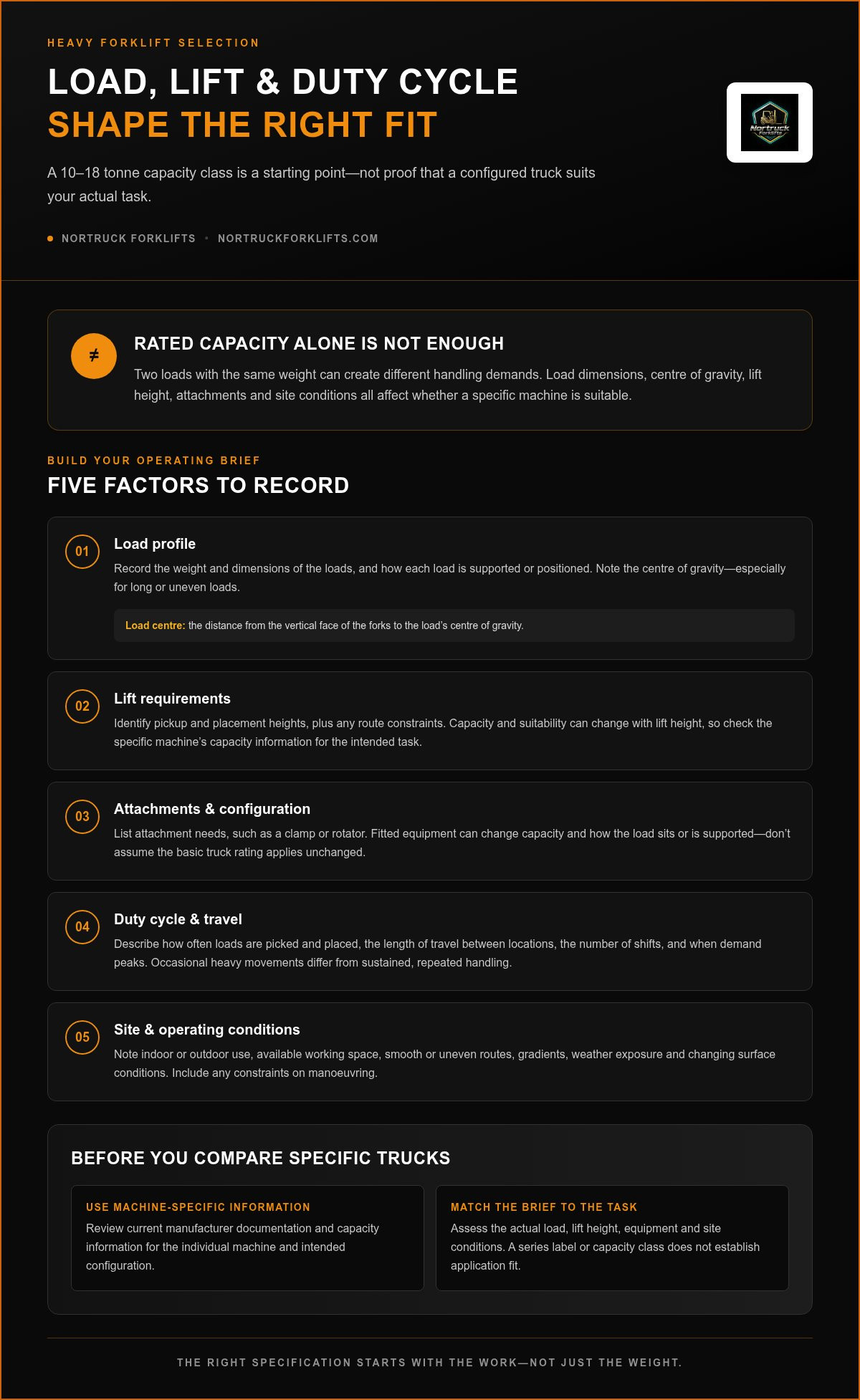
Two loads with the same weight can place different demands on a forklift. A long or uneven load may shift its centre of gravity, while lifting it higher or using an attachment changes the handling setup. That’s why load weight is only one part of the selection brief. Buyers need a clear picture of what the truck will lift, how it will carry it and how often the task occurs.
Before comparing trucks, record each load’s weight, dimensions and centre of gravity, the required lift height, attachment needs, handling frequency, shifts, travel distance and site conditions. This gives an advisor the operating facts needed to discuss a suitable configuration rather than relying on a headline capacity.
How load centre and attachments affect the decision
Load centre is the distance from the vertical face of the forks to the load’s centre of gravity. If a load is longer or positioned farther forward, its centre of gravity may sit farther from the forks. This changes the leverage acting on the truck, so load weight alone can’t establish whether a particular configuration is suitable.
Attachments also affect a truck’s capacity and operating configuration. A clamp, rotator or other attachment can change how far the load sits from the fork face and how it is supported. Don’t assume the truck’s basic rating applies unchanged once equipment is fitted. Use the specific machine’s capacity information for the intended setup, load and lift height.
How the work pattern changes the required configuration
Intermittent handling has a different rhythm from sustained, repeated work or operation across multiple shifts. Record how often loads are picked and placed, the length of travel between locations, and when demand peaks. A truck used for occasional heavy movements may face different operational demands from one expected to handle a steady flow of loads throughout the working day.
Site conditions matter too. Note whether routes are smooth or uneven, whether they include gradients, and whether the truck will work indoors, outdoors or between both. Describe exposure to weather and any changes in surface conditions. These details help frame a discussion about the machine configuration and its intended working environment.
For safe operations, build site procedures around applicable local requirements and actual workplace risks. OSHA provides US workplace safety resources at OSHA Safety Standards for Heavy Equipment; buyers operating elsewhere should use the rules relevant to their location.
Bring the completed operating brief to an experienced forklift advisor. Nortruck’s founders each have more than 40 years of experience in heavy lifting equipment sales and advisory, and can discuss your application directly. If you’re assessing a Linde heavy diesel forklift 10 to 18 ton, discuss your forklift application with Nortruck before narrowing the shortlist.
Diesel or Electric: Compare the 10-18-Tonne Options by Site Conditions
A heavy load doesn’t automatically point to diesel. The right power type depends on the site, the work pattern and the practical arrangements needed to operate the truck. Compare both options against the same operating brief, including where the forklift will work, how often it will be used, what restrictions apply and how refuelling or charging fits into the schedule.
The right power type depends on the site and work pattern, not the load rating alone. Use the comparison below to identify where each option needs closer assessment, rather than treating either as a default choice.
Operating factor | Diesel: assess | Electric: assess
Environment | Outdoor routes, changing surfaces and the demands of the work area. | Indoor or mixed-area use, site restrictions and access to suitable charging locations.
Duty pattern | Handling frequency, shift pattern, travel distances and periods of peak demand. | The same work pattern, with attention to how charging can be fitted around operating hours.
Emissions constraints | Applicable emissions requirements and any indoor-air or workplace rules at the site. | Site-specific restrictions and the operation’s environmental requirements.
Energy arrangements | Refuelling access and how it fits into the work schedule. | Charging access, available facilities and when the truck can be charged.
When does a diesel forklift fit the operating environment?
Diesel may merit consideration for outdoor work or demanding handling, but those conditions alone don’t establish that a particular truck is suitable. Map routes, surfaces and work areas, then account for the site’s operating requirements. Check applicable indoor-air, emissions and workplace rules for the location and intended use. Avoid assuming compliance or suitability from the power type; the relevant requirements depend on the site.
When should buyers compare an electric alternative?
Include electric in the assessment if the truck will work indoors, the site has restrictions relevant to diesel operation, or charging can be built into the schedule. Consider where charging would take place and how the operating pattern affects access to the truck. Nortruck offers Linde forklifts, including the Linde E25 electric truck, listed with a 2 to 5 tonne capacity. For a heavy-lift requirement, compare the specifications of each candidate against the actual application rather than assuming a smaller electric model or a particular power type will fit.
For broader fleet context, Nortruck’s Linde forklift sourcing guide covers procurement considerations beyond this power-type comparison. Industry resources from Material Handling Industry Insights can also support wider research into material handling practices.
Before requesting a Linde heavy diesel forklift 10 to 18 ton, put diesel and electric through the same site-specific comparison. A clear view of operating hours, work areas, restrictions and energy arrangements makes a discussion with an experienced forklift advisor more focused.
A Practical Checklist for Evaluating a 10-18-Tonne Linde Diesel Forklift
A useful shortlist starts with the job, then tests each candidate against the same requirements. Keep essential operating needs separate from preferences. That makes it easier to identify a workable machine without letting optional features distract from capacity, configuration or site fit.
What information should buyers prepare first?
Build an operational brief before comparing individual trucks. Record the loads the forklift handles in normal work and the heaviest loads it must manage. Include load dimensions, the required handling height and any attachment requirements. Describe the work pattern and site too, since these determine how the machine will be used, not just what it must lift.
- Define must-haves: Document typical and maximum loads, their dimensions, required handling height and the attachments needed for the task.
- Describe the duty: Note shifts, handling frequency, travel routes, distances, surfaces and gradients. Specify whether work takes place indoors, outdoors or in both settings.
- Record site constraints: Identify access routes, available storage and operator visibility requirements that affect the work area or handling task.
- Separate preferences: List desirable features apart from requirements the operation can’t compromise on. Keep preferences from obscuring a shortfall in a must-have.
Be specific about the task. For example, “move loads through a restricted access route and place them at a defined height” gives a clearer basis for assessment than “handle heavy materials.” Use the same brief for every candidate so the comparison remains consistent.
What should the machine documentation clarify?
Once the operational brief is clear, assess the documentation for the particular truck. Match its capacity information to the intended load, lift height and configuration, including any attachment. Don’t assume every truck in a series shares the same specification. For a Linde heavy diesel forklift 10 to 18 ton, the individual machine’s current manufacturer documentation is the reference point for its stated capacity and setup.
For a used unit, review its machine identity, available service history and condition information. Keep this step focused on records and the unit’s stated condition rather than treating a model name or series description as proof of its history. If you need a broader used-equipment review, use Nortruck’s used heavy lifting equipment inspection checklist.
Before requesting a machine, prepare a concise brief with must-haves at the top, preferences clearly marked and documentation needs listed separately. That gives an experienced advisor a practical basis for discussing the application and sourcing a suitable forklift through Nortruck’s Europe-wide network.
Source a Linde Heavy Diesel Forklift with Nortruck’s Advisory Support
Sourcing a heavy forklift is more than locating a truck with a matching capacity label. The machine has to suit the loads, work pattern, site and priorities you’ve defined. Nortruck provides sales and advisory services for forklifts and heavy lifting equipment, including Linde forklifts. The discussion starts with your operation, then focuses on identifying a suitable machine and sourcing route.
Nortruck sources new and used machinery through a Europe-wide partner network that includes Denmark, Sweden, Germany, France, Spain and Poland. Its founders each bring more than 40 years of experience in heavy lifting equipment sales and advisory. That direct advisory service, without middlemen, keeps the discussion centred on your requirements and the information needed to assess a potential match.
How Nortruck helps match a truck to the operation
An advisory conversation begins with the work the forklift must do. Bring the load details and handling requirements, then describe shift patterns, site conditions and your operating priorities. If you’re considering a Linde heavy diesel forklift 10 to 18 ton, this application-led approach helps frame the search around the truck’s intended role rather than assuming that the capacity class alone settles the decision.
From there, Nortruck uses its European partner network to source machinery in line with the brief. The sourcing process is guided by the fit between the operation and a candidate machine, with the machine’s own information forming part of the assessment. Nortruck also offers heavy-lift options from manufacturers such as Kalmar, so you can discuss the wider requirements of your operation as part of the sourcing conversation.
What to include in a sourcing enquiry
A concise brief helps make the first discussion practical. Include the details that affect the truck’s suitability and your priorities for sourcing:
- Loads: Typical and maximum weights, dimensions and how loads are handled.
- Work pattern: Shifts, handling frequency, travel distances and periods of peak demand.
- Environment: Indoor or outdoor use, route surfaces, gradients, site access and other operating constraints.
- Preferences: Preferred power type, new or used preference, and any priorities that are flexible rather than essential.
- Documentation: The machine-specific capacity and configuration information you need to assess, plus any records relevant to a used unit.
You don’t need to turn the enquiry into a lengthy technical report. Clear, honest operating details give Nortruck a sound basis for discussing the application and sourcing a route. If some requirements are still being defined, describe what you know and where you need guidance. The aim is a considered conversation about the right truck for your business, grounded in the work the machine needs to do.
Turn Your Operating Brief Into a Confident Sourcing Decision
The next step is to turn your requirements into a clear sourcing brief. Bring together the loads the truck must handle, the conditions it will work in and the priorities that matter most to your operation. This gives the discussion a practical focus: not simply whether a truck falls into the right class, but whether a specific machine’s documented configuration fits the job.
If you’re considering a Linde heavy diesel forklift 10 to 18 ton, you don’t need to settle every detail before starting the conversation. Share what you know, flag the questions still open and use experienced advice to shape the way forward. A thoughtful sourcing process helps you assess options based on their relevance to your work, rather than making a decision from a model name alone.
A clear brief is a strong starting point. Discuss your forklift requirements with Nortruck to get experienced advice and sourcing support for your operation.
Frequently Asked Questions
Does Linde make diesel forklifts with 10-18-tonne capacities?
Nortruck offers Linde forklifts, including the Linde E25 electric truck, listed with a 2 to 5 tonne capacity. For a 10 to 18 tonne requirement, focus on the individual machine’s specifications and whether its configuration suits the load, attachment and lift requirements. Nortruck also sources heavy lifting equipment from manufacturers such as Kalmar and can advise on the right sourcing approach for your application.
How do I choose the right capacity within the 10-18-tonne range?
Start with the demands of the actual task, not the largest load you can recall. Compare routine loads with the heaviest loads the truck must handle, and consider whether their shape or position changes how they’re carried. Then use the capacity information for the specific machine and configuration. If the work varies, give an advisor examples of both typical and demanding tasks before narrowing the shortlist.
Is a diesel forklift suitable for indoor use?
It depends on the building, ventilation, workplace rules and how the truck will be used. A truck that operates outdoors isn’t automatically suitable for an enclosed work area. Identify any indoor-air or emissions restrictions that apply at your site, and consider how long or how often the machine will work indoors. Compare power types against those conditions and the relevant local requirements before choosing.
What is the difference between H100-H180 D and HT100-HT180 D?
Don’t rely on a product designation alone to establish a truck’s technical specification or suitability. Compare current manufacturer documentation for each specific machine, focusing on its configuration, stated capacity and intended application. This makes the comparison relevant to the work you need the forklift to do.
What information should I prepare before requesting a forklift recommendation?
Prepare a short brief that describes the job from pickup to placement. Include typical and maximum loads, their dimensions, required lift, attachments, shift pattern and travel routes. Add site access, surfaces, indoor or outdoor use, and any visibility or operating constraints. If you have machine documentation requirements or a preferred power type, include those too. Specific examples of the work help make the sourcing discussion more useful.
Can Nortruck help source a Linde heavy diesel forklift in Europe?
Nortruck advises businesses sourcing Linde forklifts and uses its Europe-wide partner network to source machinery. Share your operating brief, preferred power type and relevant site constraints so the discussion can focus on your application. Nortruck also sources heavy lifting equipment from manufacturers such as Kalmar, giving you a chance to discuss the appropriate options for your lifting requirements.
Should I choose a new or used heavy-duty forklift?
There isn’t one right answer for every operation. Base the decision on the job requirements and the evidence available for the individual machine. For a used forklift, compare its identity, condition information and service records with the role you need it to perform. Don’t use age or a familiar series name as a substitute for that review. The relevant question is whether the particular unit’s information supports your intended use.

Article by
Lars Gunnar Tärby
Disclaimer
1. General Information and No AdviceThe information, articles, product descriptions, and specifications provided on this website (www.nortruckforklifts.com) are for general informational and educational purposes only. While we strive to provide accurate and up-to-date content regarding new and used forklifts and heavy machinery, the material published does not constitute professional, technical, or legal advice.
2. Product Specifications and PricingNortruck Forklifts acts as a facilitator for the trade of new and used forklifts. All equipment details, including but not limited to year of manufacture, operating hours, lift capacity, dimensions, conditions, and pricing, are provided based on the information available to us at the time of publication. Specifications and availability are subject to change without prior notice.
3. "As Is" and VerificationAll articles and product listings are provided on an "as is" and "as available" basis without any warranties of any kind, either express or implied. Nortruck Forklifts does not guarantee that the descriptions are entirely error-free, complete, or reliable. Buyers and traders are strongly encouraged to independently verify all technical specifications, machine history, and equipment conditions directly with the seller or an authorized inspector before finalizing any purchase or transaction.
4. Limitation of LiabilityIn no event shall Nortruck Forklifts, its owners, or its contributors be held liable for any direct, indirect, incidental, consequential, or economic loss or damage arising out of the use of, or the inability to use, the information provided on this website, or any transactions facilitated through this platform. This includes, but is not limited to, damages caused by technical inaccuracies, typographical errors, or reliance on the content of our articles.
5. Third-Party LinksOur website may contain links to external websites, dealer networks, or third-party services that are not owned or controlled by Nortruck Forklifts. We have no control over, and assume no responsibility for, the content, privacy policies, or practices of any third-party websites.


