
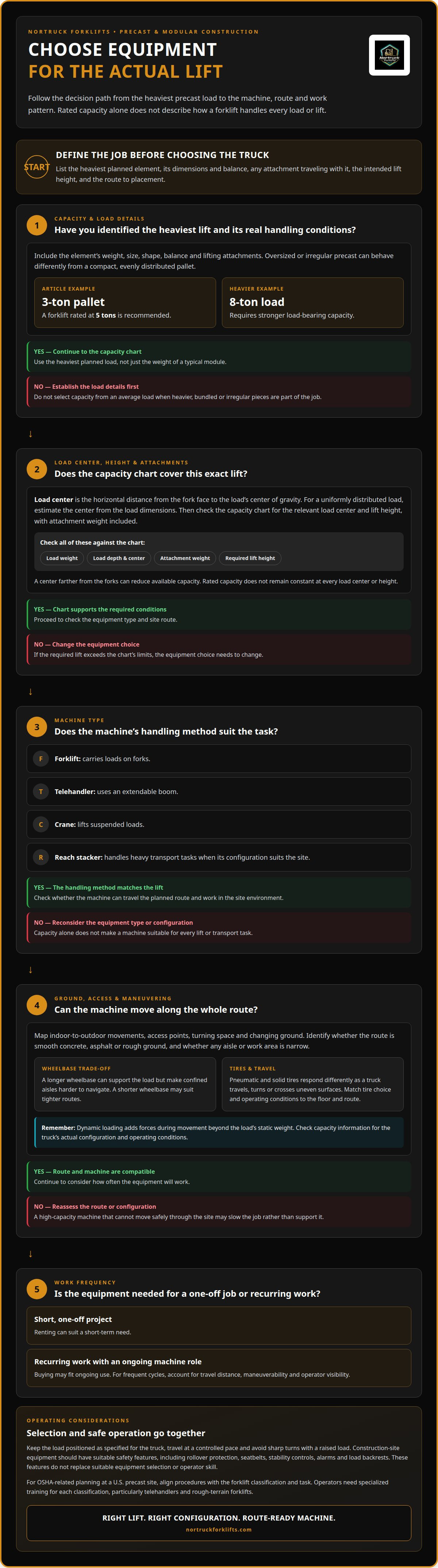
A forklift’s rated capacity should exceed the project’s maximum load requirement: for example, a 3-ton pallet calls for a forklift rated at 5 tons, while an 8-ton load requires stronger capacity. Selecting a heavy forklift for precast modular construction means matching that capacity to the actual lift, not just the weight of a typical module.
That’s only part of the decision. Precast elements can be oversized or awkward to handle, so the machine must suit the ground, lift height and route between indoor and outdoor work areas. A high-capacity forklift that cannot move safely through the site may slow the job instead of supporting it.
This guide explains how to assess load weight and handling needs, match equipment to terrain and lift height, and plan movement between work areas. You’ll learn which trade-offs matter when choosing heavy-duty equipment for precast concrete and modular construction, so the machine is suited to the work it will actually do.
Key Takeaways
- Match rated capacity to the heaviest load and account for how its size and shape affect handling.
- Choose equipment around the site’s terrain, work frequency, and operating environment, not capacity alone.
- Plan indoor-to-outdoor module movements around access routes, maneuvering space, and changing ground conditions.
- Compare required lift height with the placement task, including elevated positions and obstacles.
- Explore how heavy-duty equipment and suitable load-handling arrangements can support oversized precast components.
What forklift capacity is required for precast concrete and concrete product handling?
Choose capacity for the heaviest planned load, then account for its dimensions, attachments and required lift height. Forklifts carry loads on forks, telehandlers use an extendable boom, cranes lift suspended loads, and reach stackers handle heavy transport tasks when their configuration suits the site.
Capacity for Precast Loads
Start with the actual weight of each precast element, including any lifting attachments that travel with it. For a 3-ton pallet, a 5-ton-rated forklift is recommended; an 8-ton load requires stronger load-bearing capacity. These examples show why selection should reflect the heaviest lift, not the average piece handled during the operation.
Renting can suit a short, one-off project, while buying may fit recurring work where the machine has an ongoing role. In either case, compare the loads and applications across the project, including bundled products and irregular shapes, before choosing capacity.
Wheelbase affects the balance between load support and maneuverability. A longer wheelbase can make operation in confined aisles more difficult, while a shorter one may suit tighter routes. Assess the route, turning space and load dimensions together. Rated capacity alone does not show how easily a machine can transport a long precast unit across the site.
Load Center and Lift Height
Load center is the horizontal distance from the fork face to the load’s center of gravity. For a uniformly distributed load, estimate that center from the load’s dimensions, then use the forklift’s capacity chart for the relevant load center and lift height. Oversized precast pieces can place the center farther from the forks, reducing the capacity available for the lift.
To assess a lift, identify the load’s weight, depth, center of gravity, attachment weight and intended lift height. Then compare those conditions with the machine’s capacity chart. A forklift’s rated capacity does not remain constant at every load center or height. If the required lift exceeds the chart’s limits, the equipment choice needs to change.
Capacity, Stability, and Project Requirements
Assess capacity and stability together. A heavy load positioned farther forward creates a different balance condition from the same weight close to the fork face. Attachments also affect the handling setup, so include them when checking the chart and planning loading, transport and placement.
Match the selection to the heaviest element, its shape, lifting height, and travel route. For example, a forklift handling an 8-ton precast component needs stronger capacity than one selected for 3-ton pallets, and its wheelbase and maneuvering area must suit the site. This step-by-step assessment helps define a machine for the project’s actual lifts.
Choosing equipment based on load, environment, and frequency of use
Equipment selection starts with the work pattern, not a single capacity figure. Assess the materials’ weight and shape, the route, the operating environment and how often the machine will work. A forklift handling bundled precast elements on a smooth indoor floor faces different demands from one crossing uneven outdoor ground throughout a shift.
Use these factors to define the application:
- Load: Account for the material’s weight, dimensions, and balance. An irregular precast element can behave differently from a compact, evenly distributed pallet.
- Environment: Identify whether the route is smooth concrete, asphalt, or rough ground, and whether space is narrow.
- Frequency: Consider whether lifting is occasional or central to continuous site operation. Repeated cycles make travel distance, maneuverability, and operator visibility important selection criteria.
- Load variation: Include the heaviest and least regular loads, not only the most common item.
Tire type affects how a truck responds to dynamic loading. Pneumatic and solid tires behave differently as a forklift travels, turns or crosses uneven surfaces. The dynamic load factor accounts for forces added during movement, beyond the load’s static weight. Match tire choice and operating conditions to the floor and route, then use the truck’s capacity information for its actual configuration. A smooth indoor floor and an uneven outdoor route are different applications.
Stability depends on the load, the truck and how the operator moves. Keep the load positioned as specified for the truck, travel at a controlled pace and avoid sharp turns with a raised load. Construction-site equipment should have suitable safety features, including rollover protection, seatbelts, stability controls, alarms and load backrests. These features support safe operation but do not replace suitable equipment selection or operator skill.
For OSHA-related planning at a U.S. precast site, align operating procedures with the forklift classification and task. Operators need specialized training for each forklift classification, particularly telehandlers and rough-terrain forklifts. This distinction matters because equipment designed for a smooth warehouse aisle handles differently from a machine operating on rugged ground.
A narrow aisle can favor a machine that maneuvers in restricted space, while outdoor routes require attention to tires, ground conditions and stability. Frequent movement between loading and placement areas also makes route length and turning points important. For example, a load moved repeatedly around a confined indoor work zone may call for a different configuration from occasional transport across an open, stable surface.
To align machine type with the operating environment, review Nortruck Forklifts options as part of the equipment-selection process.
Moving modules between indoor and outdoor areas
A module’s route may run from a smooth indoor floor to an outdoor surface, so equipment must suit both parts of the move. The Combi-SC is designed to maneuver modular buildings between indoor and outdoor areas. For other equipment choices, compare access dimensions, turning space, floor conditions and the handling method at each end.
Map the transfer as a sequence rather than treating the doorway as the only constraint:
- Inside: Identify the pickup point, available turning space, floor surface, and route to the exit.
- Transition: Consider doorway clearance, changes in floor level, and how the machine approaches the opening.
- Outside: Assess the travel surface, route width, and final placement area.
- Placement: Confirm that the equipment can approach the set-down point and release the module as planned.
These steps reveal conflicts early. For example, a module may fit through an indoor opening but leave too little room for the machine to turn after passing through. A planned, straight route can reduce repeated repositioning, while a tight corner may require a different handling arrangement. Consider the dimensions of the loaded machine and module together, not the module alone.
Fuel and power choices also shape indoor and outdoor use. LPG forklifts can be used in both indoor and outdoor applications, making them one option for work that crosses between spaces. Electric forklifts produce zero emissions and less noise than other forklift options, which may make them preferable for indoor or environmentally sensitive sites. Choose according to the work environment and operating pattern, not just the first pickup location.
Charging needs affect scheduling. Recharging an electric forklift might take several hours, so plan when charging can happen without interrupting module movements. If the machine moves modules continuously between indoor and outdoor areas, include charging periods in the work sequence. If activity is intermittent, planned breaks may provide a suitable charging window.
Productivity depends on how well the equipment, route and handling plan work together. A forklift used indoors and outdoors must suit both environments; a machine suited to one surface may not suit the other. Check where the module will be picked up, transported and set down, then decide whether one machine can complete the full transfer or whether the workflow needs separate handling stages.
For a modular unit moving from an indoor work area to an outdoor staging space, plan the route first, then match the equipment and power source to the full journey. This connects equipment selection to the actual handling sequence, access spaces and operating rhythm.
Terrain compatibility and lift height
Match the truck to the ground, then confirm that it can place the load at the required height. These decisions affect travel, vertical storage and access around precast work areas.
Terrain Compatibility
Rough-terrain forklifts are designed for unpaved, rugged construction sites. Their rugged tires and high ground clearance support operation over uneven ground. By contrast, counterbalance forklifts suit stable surfaces and truck loading, where routes are relatively flat.
Assess the full travel path, not just the pickup point. A site with firm indoor floors and rough outdoor access may need equipment suited to both environments. All-terrain forklifts can move between job sites and roads while handling medium loads, so consider whether that role matches the project’s transport pattern.
Ground conditions also affect stability and control. Puncture-proof flotation tires on the Combi-SC reduce ground pressure and support operation on poor or semi-rough terrain. This can matter when modules must cross surfaces less consistent than a finished concrete floor. Compare the terrain, load distribution and machine’s intended application before choosing.
Mast Types and Lifting Height
A forklift’s lift height is the maximum vertical distance it can raise a load. Mast configuration affects how the truck reaches that point and the overhead clearance it needs while moving or lifting. Check both the placement height and the clearance beneath doorways, beams and other obstructions.
For concrete handling, Combilift C-Series forklifts have stated lift heights from 4040 mm to 12 m. That range illustrates why the required height should come from the task, such as stacking products or reaching an elevated storage position, rather than choosing maximum reach without a use case.
Vertical storage introduces another constraint: the load must pass through the available space before reaching its final position. A machine that can raise a module high enough may still be unsuitable if its mast cannot pass beneath an indoor doorway or structure. Plan the lift path from floor to destination, including the approach angle and space for the load.
Telehandlers offer another way to reach elevated positions. Their extendable boom can place materials at upper levels or reach over obstacles, while rough-terrain forklifts suit uneven outdoor ground. On stable surfaces, counterbalance or industrial forklifts may better suit the task. The engine, controls, tire setup and lift geometry should all fit the route and placement sequence.
Before settling on a configuration, map each pickup and set-down point, then identify the tightest clearance and highest placement. For example, a module destined for double stacking in a narrow aisle requires suitable lift height and enough room to position the machine. Treat terrain and vertical reach as connected parts of one handling plan.
Heavy-duty forklifts for precast concrete and oversized construction materials
Precast components can be heavy, wide, or awkward to support with standard forks. Heavy-duty forklifts handling loads exceeding 10 tons can suit major construction tasks, but capacity alone doesn’t settle the choice. The load’s dimensions, balance, lifting points, ground conditions, and final placement all affect the handling arrangement.
Start by defining how each component will travel from pickup to set-down. A forklift operating on stable concrete or asphalt suits industrial handling on those surfaces. For an oversized element, fork positioners or side shifters can help adjust fork spacing and place irregular loads more precisely. The attachment must match the load and the machine’s capacity chart.
- Load shape: Identify whether the component is compact, long, or unevenly distributed. A long precast beam creates different positioning needs from a compact block.
- Lifting points: Plan where supports, forks, or lifting attachments will contact the component. Suitable contact points help maintain controlled handling during travel.
- Travel route: Map the route from the warehouse or casting area to the installation point. Turns, surface changes, and indoor and outdoor transitions affect the equipment choice.
- Placement: Establish whether the forklift can approach the set-down point directly or must reposition the component.
Some modular lifting tasks need coordinated support rather than ordinary pallet handling. A multi-lifting-point attachment can lift a modular building from ground level to a trailer. A beam with adjustable anchoring positions can accommodate different module arrangements. Cradling a module with chains and slings attached at its top and bottom can support gentler lifting and more even weight distribution.
Diesel forklifts suit heavy-duty outdoor tasks and can handle large materials over long distances. An electric forklift may suit warehouse work when its operating characteristics fit the site, but equipment choice should follow the full route and load-handling plan. For a transfer between indoor and outdoor work areas, consider whether one machine can handle each surface and placement stage.
In the United States, local equipment dealers and rental companies are potential channels for sourcing heavy forklifts for precast projects. A dealer can support a purchase for ongoing operations, while rental companies serve projects needing temporary equipment access.
The practical takeaway is to specify the heaviest component, handling points, route, surface and placement method before selecting a heavy-duty machine. This turns “oversized” into clear operating requirements and helps narrow the equipment configuration to the lifting work at hand.
Nortruck Forklifts: Kalmar Heavy Lift Trucks
Nortruck Forklifts helps match heavy lifting equipment to the load, route and placement demands of precast work. For demanding heavy-load applications, Kalmar Heavy Lift Trucks are an option to consider. The right fit depends on component weight, handling method, ground conditions and required lift height.
Share the project’s heaviest loads, movement path and indoor or outdoor conditions to focus equipment selection on the work ahead. Nortruck Forklifts also offers Linde Forklifts, Toyota Forklifts and Volvo Wheel Loaders for other material-handling requirements.
Contact Nortruck Forklifts to discuss equipment for your precast construction project.
Turn the lifting plan into your next equipment decision
Before the next project begins, turn the planned lifts into a clear equipment brief. Record the components to move, where each move starts and ends, and how the equipment fits into the site sequence. This gives the selection process a practical reference beyond a single machine specification.
A heavy forklift for precast modular construction should fit the work as it will actually be performed, including unusual lifts and changing site conditions. Nortruck Forklifts offers Kalmar Heavy Lift Trucks, Baumann Sideloaders, and Combi-Lift 4-way Trucks to address different material-handling needs. The right conversation starts with the project’s lifting plan and the role each machine must play.
Bring your upcoming project requirements to Nortruck Forklifts to discuss suitable equipment options. A focused equipment decision can help your team plan the next stage of precast handling with greater clarity.
Take the next step with a plan grounded in the work ahead.
Frequently Asked Questions
How do you select the right forklift for a construction site?
Select equipment by mapping the heaviest lift, its pickup and set-down points, and the full travel route. Then account for the load’s dimensions, handling method, ground conditions and how often the machine will operate. For example, a long panel moving through a restricted passage needs different maneuvering characteristics from a compact unit traveling across an open yard. A heavy forklift for precast modular construction should suit the complete task, not just one lift.
What lift heights are available for concrete storage and handling?
Available lift height depends on the equipment configuration and the placement task. Combilift C-Series forklifts for concrete handling have stated lift heights from 4040 mm to 12 m. For a storage plan, consider the highest placement point alongside clearances along the approach. A module may need to pass through a doorway before rising, so both travel clearance and final elevation matter when choosing a configuration.
What safety features matter when handling concrete products?
Construction-site forklifts should have appropriate safety features such as rollover protection, seatbelts, stability controls, alarms and load backrests. These features support safe operation, while the handling plan should also account for visibility, travel paths and load position. For example, a wide precast panel can obstruct the operator’s view, so the route and maneuvering procedure must reflect the actual load, not an unloaded truck.
What forklift capacity and lift height are needed for precast concrete modules?
Choose capacity and height from the module’s weight, dimensions, handling arrangement, and set-down location. A 3-ton pallet is an example for which a 5-ton-rated forklift is recommended; an 8-ton load needs stronger load-bearing capacity. Lift height should match the actual placement point and available clearance. For modules, include any lifting attachment in the handling plan and assess how it affects the usable capacity shown for the truck.
Which forklift types suit precast panels and modular units?
The right type depends on how the unit is carried and where it travels. A counterbalance forklift can suit stable surfaces, while a rough-terrain forklift is designed for rugged, unpaved sites. Side loaders can carry long materials sideways through narrow spaces. For modules that need reach or placement over an obstacle, a telehandler’s extendable boom can help. The route and lifting method distinguish these applications more clearly than the machine category alone.
Which manufacturers and models make heavy forklifts for precast construction?
Nortruck Forklifts offers equipment from Kalmar, Linde, Toyota, Baumann, and Combi-Lift. Its listed heavy equipment includes Kalmar DCG 150 with a stated capacity range of 15 to 38 tonnes, and Kalmar DCF 90 at 9 to 16 tonnes. These examples show different capacity ranges, not a universal recommendation. Match any model to the load, lift conditions, and site route before selecting it for a project.
What attachments help lift precast concrete safely?
Attachments should suit the component’s shape, contact points and handling method. Fork positioners and side shifters can help position irregularly sized loads. For modular buildings, a multi-lifting-point attachment can support lifting from ground level to a trailer. Chains and slings connected at the module’s top and bottom can cradle it and distribute weight more evenly. Include the attachment in the load assessment and handling configuration.
Which site conditions and surfaces affect heavy forklift use?
Surface stability, uneven ground, aisle width, doorway clearance and transitions between indoor and outdoor areas all affect equipment suitability. Industrial forklifts suit stable surfaces such as concrete or asphalt, while rough-terrain forklifts are designed for rugged, unpaved sites. A route crossing both a warehouse floor and an outdoor staging area needs planning for each section, including turns and the final approach to the placement point.

Article by
Lars Gunnar Tärby
Disclaimer
1. General Information and No AdviceThe information, articles, product descriptions, and specifications provided on this website (www.nortruckforklifts.com) are for general informational and educational purposes only. While we strive to provide accurate and up-to-date content regarding new and used forklifts and heavy machinery, the material published does not constitute professional, technical, or legal advice.
2. Product Specifications and PricingNortruck Forklifts acts as a facilitator for the trade of new and used forklifts. All equipment details, including but not limited to year of manufacture, operating hours, lift capacity, dimensions, conditions, and pricing, are provided based on the information available to us at the time of publication. Specifications and availability are subject to change without prior notice.
3. "As Is" and VerificationAll articles and product listings are provided on an "as is" and "as available" basis without any warranties of any kind, either express or implied. Nortruck Forklifts does not guarantee that the descriptions are entirely error-free, complete, or reliable. Buyers and traders are strongly encouraged to independently verify all technical specifications, machine history, and equipment conditions directly with the seller or an authorized inspector before finalizing any purchase or transaction.
4. Limitation of LiabilityIn no event shall Nortruck Forklifts, its owners, or its contributors be held liable for any direct, indirect, incidental, consequential, or economic loss or damage arising out of the use of, or the inability to use, the information provided on this website, or any transactions facilitated through this platform. This includes, but is not limited to, damages caused by technical inaccuracies, typographical errors, or reliance on the content of our articles.
5. Third-Party LinksOur website may contain links to external websites, dealer networks, or third-party services that are not owned or controlled by Nortruck Forklifts. We have no control over, and assume no responsibility for, the content, privacy policies, or practices of any third-party websites.


