
A laden container handler lifts fully loaded 20 ft and 40 ft ISO containers. Standard loaded handlers typically have a capacity of 41 to 46 tons, but the right choice depends on the loads, stacking height and yard layout the machine must handle. That’s why laden container handler procurement starts with the work the equipment needs to do, not just its headline capacity.
Capacity is a natural starting point, but it is only part of the decision. Reach, stacking arrangement, container types, and safety features all affect whether a machine suits your operation.
This guide explains how laden container handlers differ from other container-handling equipment, what lifting and stacking capabilities mean in practice, and which container types they can handle. A side-by-side comparison and practical decision guide will help you narrow the options to your site’s workload and priorities.
Key Takeaways
- Match rated lifting capacity to the containers’ gross loads and the lifting position, not just the machine’s maximum figure.
- Compare handlers by stacking height, reach, and yard layout to see which operating role fits your site.
- Identify the container lengths and types in your workflow, then align the equipment and spreader configuration with those requirements.
- Include safety features and operating conditions in your selection criteria alongside throughput and total ownership costs.
- Use a clear procurement specification to distinguish equipment for full-container handling from machines intended for mixed duties.
Laden container handler lifting capacity
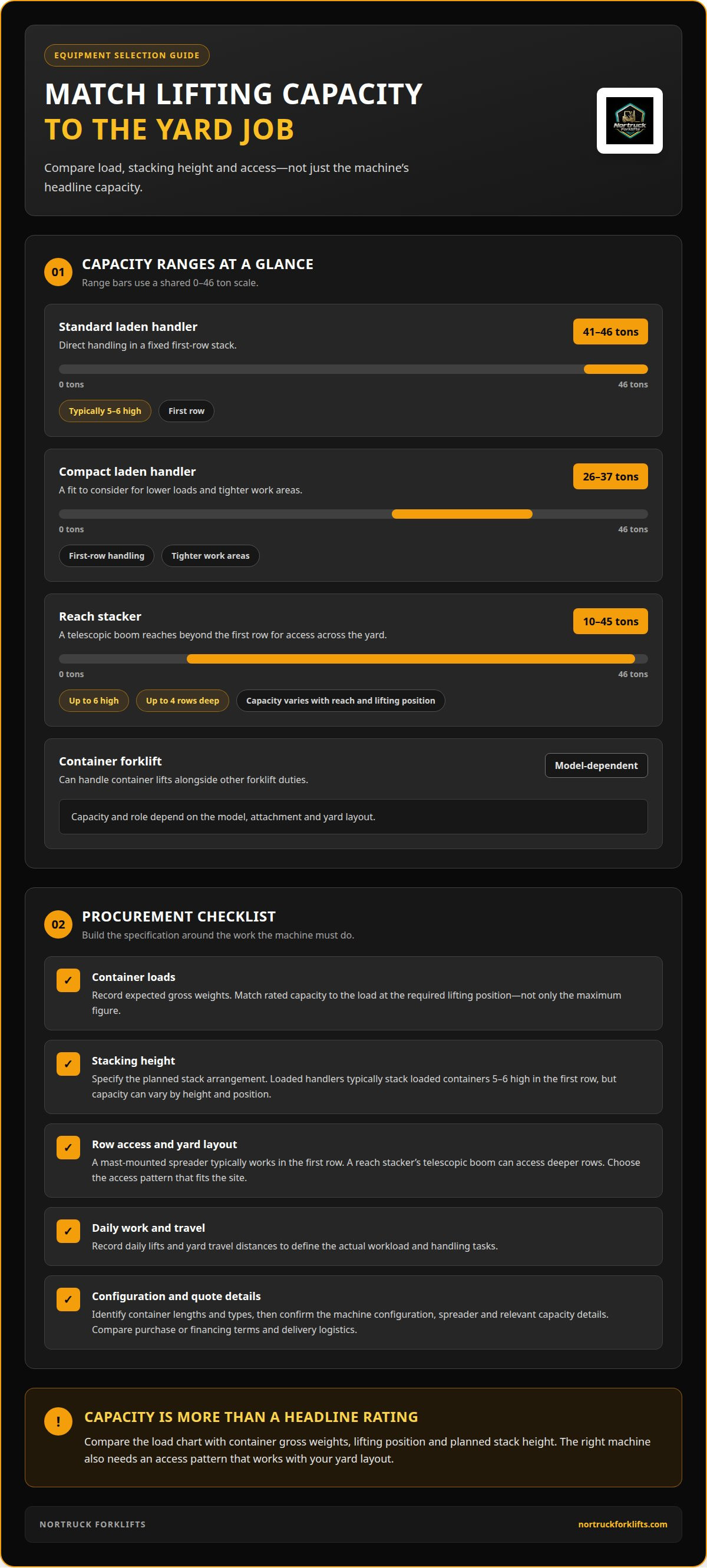
Capacity describes the load a machine can lift under defined operating conditions. Standard laden container handlers typically have a capacity of 41 to 46 tons, while compact models typically handle 26 to 37 tons. These categories help narrow equipment choices, but the load chart and lifting position matter more than a headline rating.
Stacking height affects the capacity you need in practice. Loaded handlers typically stack loaded containers five to six high in the first row, but a machine lifting near its rated limit may not retain that capacity at every height or position. Compare the machine’s rated capacity with container gross weights and your planned stack arrangement.
Reach stackers offer a different balance of capacity and access. Kalmar reach stackers can lift containers weighing between 10 and 45 tons, stack up to six high, and manage loading or unloading up to four rows deep. Their telescopic boom reaches beyond the first row, which can suit intermodal terminals where access to several rows is useful. Actual capacity depends on reach and lifting position.
| Equipment option | Typical capacity | Stacking and access | Best-fit consideration |
|---|---|---|---|
| Standard laden handler | 41 to 46 tons | Five to six high, first row | Direct handling in a fixed first-row stack |
| Compact laden handler | 26 to 37 tons | First-row handling | Lower loads and tighter work areas |
| Reach stacker | 10 to 45 tons | Up to six high and four rows deep | Flexible access across yard rows |
| Container forklift | Model and configuration dependent | Depends on attachment and layout | Container lifts alongside other forklift duties |
Choose a machine with capacity for your container weights at the required height and reach, and an access pattern that suits your yard layout.
How do laden container handlers compare with reach stackers and container forklifts? A laden handler typically uses a mast-mounted spreader and works in the first row. A reach stacker uses a telescopic boom to access deeper rows. Container forklifts use forks or a suitable attachment, so their capacity and role depend on the model and configuration.
For laden container handler procurement, define the job before comparing quotes. Record expected container gross weights, stack height, row access, daily lifts, and yard travel distances. Ask for a quote that specifies the machine configuration and relevant capacity details. Compare purchase and financing terms, plan delivery logistics, and account for the route and site needed to receive the machine.
Which U.S. dealers, auctions, and marketplaces sell laden container handlers? Buyers can find equipment through heavy-equipment dealers, industrial machinery auctions, and online equipment marketplaces. Listings vary in machine condition, configuration, and delivery arrangements, so compare those details against your requirements.
What Is a Loaded Container Handler?
A loaded container handler is a heavy machine built to lift fully loaded 20 ft and 40 ft ISO containers. Its spreader attaches to the container’s top corner fittings and hangs from a mast. That mast-mounted design means a conventional loaded handler works in the first row, rather than reaching across several rows. In an intermodal terminal, it can move a container between a vehicle, a ground position, and a stack.
A laden handler has a different role from equipment designed mainly for empty containers. It must manage the container and its cargo as one load, so capacity and lifting position determine how the machine can be used. For example, a distribution yard receiving loaded containers needs to plan where trucks can approach and where the handler can set down each load. These details affect traffic flow, stack access, and the handoff between transport and storage.
Cycle time also affects daily operations. Reach stackers typically complete standard pick-and-place operations in container yards in 90 to 120 seconds. The actual pace depends on the route, positioning, visibility, and operator familiarity with the machine. Experienced operators can achieve cycles 20 to 30 percent faster than novice operators. That difference makes operator experience relevant to workload planning, but it doesn’t replace matching equipment to the yard’s layout and handling tasks.
Electric equipment changes the operating-cost calculation. Modern battery technology enables electric container-handling equipment to operate for 40-50 hours on a single charge. For a terminal assessing electric and diesel options, compare expected operating hours and charging needs with the work schedule. The useful question is how each system fits the site’s duty cycle, not simply whether it uses a battery.
Weigh capital, fuel, and maintenance against projected throughput. A lower purchase outlay may not suit a demanding duty cycle, while a higher-capacity option may add capability you rarely use. Compare equipment against the actual tasks in the quote: loaded-container moves, stack locations, yard travel, and expected daily lifts. Budget for equipment-specific operator training and certification, so operators can learn the controls, load handling, and site procedures before routine shifts. This aligns machine selection, safe operation, and distribution schedules.
Container types and sizes handled
Container fit depends on length, height, type, and spreader configuration. The Kalmar DRG100-140 handles standard ISO containers from 20 ft to 40 ft. It can also pick up 45 ft to 56 ft containers in the 40 ft position. That distinction matters: a longer container may be handled using a designated pickup position, not its full length setting.
Height limits affect clearance inside terminals and beneath stacked loads. The DRG100-140 handles standard ISO container heights from 4 ft to 9 ft 6 in. It can handle special containers measuring 10 ft 6 in. Account for those dimensions when planning overhead clearance, stack positions, and routes through the yard. An equipment fit assessment should include the container’s actual height, not only its nominal length.
Container type also shapes the handling plan. For example, the DRG100-140 can handle reefers measuring 20 ft to 40 ft, with 45 ft reefers picked up in the 40 ft position. It can handle tank containers measuring 20 ft to 30 ft, and flat racks measuring 20 ft to 40 ft. These ranges give buyers a practical starting point for matching recurring container flows to equipment capability.
- Standard ISO: 20 ft to 40 ft, with 45 ft to 56 ft containers picked up in the 40 ft position.
- Reefer: 20 ft to 40 ft, with 45 ft units picked up in the 40 ft position.
- Tank: 20 ft to 30 ft.
- Flat rack: 20 ft to 40 ft.
Assess container compatibility in a clear sequence: list the types handled, record each length and height, then match those dimensions to the machine’s spreader positions. Include unusual loads in the review. The spreader must connect appropriately with the container, and the route and placement area must accommodate its size. At terminals with mixed traffic, distinguish routine container dimensions from occasional outliers in the operating plan.
An empty container handler serves a different workload from a laden handler. Empty-handler capacities typically range from 8 to 11 tons, and these machines can stack empty containers up to 8 high. That makes load type a key distinction when comparing equipment. Electric power is another separate selection consideration; it doesn’t change the container’s length or height, but the chosen machine still needs to match the same container and spreader requirements.
Visibility matters during alignment, especially with taller or less common formats such as 10 ft 6 in special containers. Include the operator’s approach path and placement area in the fit review, alongside the container dimensions. Matching container type, spreader, and clear operating space helps prevent choosing equipment around a standard container while overlooking the less frequent loads that also pass through the terminal.
Laden container handlers as a product segment
Laden container handlers are a distinct equipment segment because their primary work is moving loaded containers. The segment held 42.5% of the container handling forklift truck market. Its market value was $7.74 billion. Those figures show the scale of demand, but they don’t establish which machine suits a particular operation. Procurement specifications should state whether the machine will primarily handle full containers or perform mixed duties.
That distinction shapes the specification. For a dedicated full-container role, document load types, handling frequency, and placement patterns. Mixed duties add other tasks to the machine’s work plan. For example, a terminal handling full containers alongside general material loads should define both tasks before evaluating equipment. This prevents the purchase specification from covering only the most visible job.
Weight matters when choosing an equipment segment, but task mix and site conditions matter too. Map the machine’s intended work to yard traffic routes, ground conditions, and storage arrangements. List routine tasks first, then identify less frequent duties that could affect attachments or operating configuration. This gives suppliers a consistent basis for discussing equipment options.
- Primary duty: State whether full-container handling or mixed work is the main requirement.
- Load profile: Describe the container types and expected gross weights.
- Work pattern: Record where containers are received, moved, and placed.
- Operating environment: Include yard layout, travel routes, and ground conditions.
Emissions and energy use belong in the same product comparison. Hybrid reach stackers can reduce fuel consumption by 20 to 30 percent. That figure is relevant when comparing powertrain approaches, but the operational case depends on duty cycle and work pattern. An automated feature set may also affect how equipment fits into terminal processes. Assess it against actual site tasks rather than treating automation as a benefit by itself.
To optimize a purchase, compare like with like: specify the same duties, load profile, and operating conditions for each option. Then weigh projected throughput against capital, fuel, and maintenance considerations. This prevents a broad market category from standing in for a practical equipment decision. The key takeaway is simple: define the job before selecting the segment’s machine, and make the full-container or mixed-duty role explicit in the specification.
What is a laden container handler and what container sizes and loads can it handle?
A laden container handler moves containers with cargo inside, using a spreader to engage them. Its practical role depends on the load rating and required stacking pattern. Compare complete model specifications: lifting height and stack depth can differ even among machines designed for container work.
Consider the Kalmar DRG100-54S6. It can lift containers six high and place them three deep, with loads up to 10 tonnes. The DRG100-54S8 keeps the three-deep placement capability, lifts containers eight high, and handles loads up to 10 tonnes. That comparison helps distinguish a higher stacking requirement from a higher load requirement.
The Kalmar DRG120-54S6 can lift containers six high and place them three deep, with loads up to 12 tonnes. The DRG140-54S6 uses the same six-high, three-deep arrangement, with loads up to 14 tonnes. For a procurement comparison, record the required lift height and maximum load together. Neither figure alone describes the whole operating fit.
- DRG100-54S6: six high, three deep, loads up to 10 tonnes.
- DRG100-54S8: eight high, three deep, loads up to 10 tonnes.
- DRG120-54S6: six high, three deep, loads up to 12 tonnes.
- DRG140-54S6: six high, three deep, loads up to 14 tonnes.
These examples show two separate selection dimensions. The DRG100-54S6 and DRG100-54S8 both handle loads up to 10 tonnes, but their listed stacking heights differ by two container positions. The DRG120-54S6 and DRG140-54S6 share the six-high, three-deep arrangement, while their stated load limits differ. Match each requirement to the tasks the machine will perform.
Build the specification in sequence: identify the heaviest intended load, set the required stack height, then define how many rows deep the machine must place containers. Compare models against all three criteria. An eight-high requirement, for example, calls for a different configuration than a six-high requirement, even if the stated load limit is the same. Keep load and stacking criteria distinct when making a laden container handler procurement decision.
Do not use a model’s maximum load as a substitute for reviewing its full operating specification. Consider the listed capacity alongside the intended container position and stacking arrangement. This creates a useful comparison for terminal planning and clarifies the machine’s role in the equipment plan.
Nortruck Forklifts: Kalmar Heavy Lift Trucks
Nortruck Forklifts advises businesses on heavy lifting requirements and sources machinery suited to their work. For container operations, Kalmar Heavy Lift Trucks are one equipment category to consider alongside the required load, stacking pattern, and container mix. Clear operating requirements help focus the selection on the tasks the machine must perform.
Turn to Nortruck Forklifts when comparing equipment options for a terminal or yard and seeking expert guidance on machinery sourcing. Our advisory service helps translate your operating needs into a focused equipment specification, including whether the priority is loaded-container handling or mixed lifting duties.
Contact Nortruck Forklifts to discuss your heavy lifting requirements.
Set Your Next Equipment Decision in Motion
Choosing a handler also means considering how your operation may adapt as container flows change. Align lifting tasks, yard layout, and future operating priorities in the equipment specification before comparing purchase options. A clear brief makes laden container handler procurement more focused, because every machine can be assessed against the same operational needs.
For operations with broader lifting requirements, Nortruck Forklifts also offers Baumann Sideloaders and Combi-Lift 4-way Trucks. These equipment categories address different material-handling tasks, giving buyers options to consider alongside container-focused machinery. The right direction depends on the work your site needs to complete.
Turn a complex machinery decision into a practical plan: start with the work, then choose equipment that supports it.
Frequently Asked Questions
How much does a new laden container handler cost in the United States?
Price depends on the machine’s capacity, configuration, powertrain, and intended handling duties. Compare quotes against the same operating requirements, including container types, workload, and stacking arrangement. Include delivery and site preparation in the purchasing plan. A headline figure alone does not show whether the proposed configuration suits the terminal’s actual work.
What is the price range for used laden container handlers in the United States?
Used-machine pricing depends on the individual equipment, its condition, specifications, and configuration, and is given after a quote request. Compare each candidate’s service history and hours alongside its capacity, lifting arrangement, and suitability for your container mix. Nortruck Forklifts sources both new and used heavy lifting equipment, with machinery sourced across Europe. Treat transport and delivery planning as part of the overall evaluation.
Which manufacturers and models of laden container handlers are available in the United States?
Kalmar is one manufacturer to include in a laden-handler comparison, with models such as the DRG100-54S6, DRG100-54S8, DRG120-54S6, and DRG140-54S6 discussed in this guide. Nortruck Forklifts also sources equipment from manufacturers including Baumann and Combi-Lift. Its sourcing is across Europe, so distinguish the equipment portfolio from a claim about specific United States inventory.
What capacity, lift height, and handling requirements should buyers specify?
Specify the heaviest expected container load, required stacking arrangement, container dimensions, and machine working position. Include how far containers must be reached, the row layout, and whether the handler will perform mixed duties. Distinguish the highest routine lift from occasional peak tasks. This practical brief helps suppliers compare machines by usable capability, rather than treating rated capacity as the only selection measure.
What U.S. safety, emissions, and regulatory requirements apply to laden container handlers?
For emissions, the United States EPA Tier 4 Final framework is identified as applicable to container-handling equipment. Safety requirements depend on the equipment and operating context, so include operator training, visibility, load handling, and site procedures in the procurement review. Keep emissions compliance and operational safety as separate specification items. That makes each issue visible in the equipment assessment without confusing an emissions framework with a safety standard.
What operating, maintenance, fuel, and ownership costs should buyers budget for?
Build a total-ownership budget around capital, fuel, maintenance, operator training, and the work needed to receive and integrate the machine. Estimate fuel use from expected operating hours and the selected powertrain, then compare it with projected throughput. Plan maintenance around the equipment’s duty cycle and operating conditions. Tracking these categories separately helps identify whether the main financial pressure comes from use, upkeep, or the initial purchase.
What are the key risks and inspection checks when buying a used laden container handler?
Check that the machine’s rated capacity covers your containers’ gross weights at the required lifting position and stack height. Confirm that its configuration, reach, and spreader suit your yard layout and container types, and include safety features in your assessment.
Which U.S. dealers, auctions, and marketplaces sell laden container handlers?
Laden container handlers are sold through heavy-equipment dealers, industrial machinery auctions, and online equipment marketplaces. Compare listings for machine condition, configuration, and delivery arrangements.

Article by
Lars Gunnar Tärby
Disclaimer
1. General Information and No AdviceThe information, articles, product descriptions, and specifications provided on this website (www.nortruckforklifts.com) are for general informational and educational purposes only. While we strive to provide accurate and up-to-date content regarding new and used forklifts and heavy machinery, the material published does not constitute professional, technical, or legal advice.
2. Product Specifications and PricingNortruck Forklifts acts as a facilitator for the trade of new and used forklifts. All equipment details, including but not limited to year of manufacture, operating hours, lift capacity, dimensions, conditions, and pricing, are provided based on the information available to us at the time of publication. Specifications and availability are subject to change without prior notice.
3. "As Is" and VerificationAll articles and product listings are provided on an "as is" and "as available" basis without any warranties of any kind, either express or implied. Nortruck Forklifts does not guarantee that the descriptions are entirely error-free, complete, or reliable. Buyers and traders are strongly encouraged to independently verify all technical specifications, machine history, and equipment conditions directly with the seller or an authorized inspector before finalizing any purchase or transaction.
4. Limitation of LiabilityIn no event shall Nortruck Forklifts, its owners, or its contributors be held liable for any direct, indirect, incidental, consequential, or economic loss or damage arising out of the use of, or the inability to use, the information provided on this website, or any transactions facilitated through this platform. This includes, but is not limited to, damages caused by technical inaccuracies, typographical errors, or reliance on the content of our articles.
5. Third-Party LinksOur website may contain links to external websites, dealer networks, or third-party services that are not owned or controlled by Nortruck Forklifts. We have no control over, and assume no responsibility for, the content, privacy policies, or practices of any third-party websites.


