
Capacity alone doesn’t determine whether a forklift is right for a heavy load. An 18 ton heavy duty forklift specification should be assessed against the load’s weight, dimensions, load centre and required lift height. A heavy-duty forklift is generally defined as one with a lifting capacity of 15,000 lb or greater.
It’s easy to focus on the headline capacity, but a forklift’s rated capacity can change with the attachment, load position and lift height. Choosing the right machine means considering the work it must do and the conditions it must handle, not just the number on a specification sheet.
This guide explains how to assess load requirements and how site conditions, attachments, construction, tires and key specifications affect your choice. You’ll learn which details matter when comparing equipment and how to narrow the options to a forklift suited to your operation.
Key Takeaways
- A heavy-duty forklift is generally defined by a lifting capacity of 15,000 lb or greater, but rated capacity alone doesn’t determine suitability.
- Match the truck’s fuel type and tires to the operating environment, including floor condition, terrain and indoor or outdoor use.
- Assess the load’s weight, dimensions, load centre and lift height, then account for how attachments affect capacity and stability.
- Compare safety and operator factors such as visibility, protective features and controls alongside machine construction.
- Read specifications in the context of your routes and tasks, including capacity at working height and manoeuvrability in available space.
1. What is a heavy duty forklift?
A heavy-duty forklift is generally defined by a lifting capacity of 15,000 lb or greater. That threshold separates it from equipment designed for lighter industrial handling, but it doesn’t establish whether a truck suits a particular job. An 18-ton heavy-duty forklift specification needs to be read alongside the load shape, handling method and working environment.
Start with the capacity listed for the truck’s actual configuration. The rated figure applies to a defined setup, so an attachment or a load positioned farther from the forks can change the capacity available for a lift. Compare the load’s weight and shape with the capacity information for the intended setup. For example, a long container may place its centre of gravity farther forward than a compact pallet.
A suitable safety margin comes from matching capacity to real handling conditions, not relying on the headline rating alone. Include the load and any attachment in your assessment, then account for the height and position at which the load must travel. Raising a load changes the forklift’s stability. Keep the load low during travel and don’t treat the truck’s maximum rated capacity as a target for every lift.
Visibility and ergonomics matter in a heavy industrial truck. Check whether the operator can see the forks, load and travel path from the seated position, especially when moving containers or turning in aisles. Mast position and load dimensions can restrict the forward view. Controls, seat adjustment and clear sightlines help operators make deliberate movements. Match the truck’s width and height to doors, routes and overhead obstacles.
Pedestrian safety depends on the whole workplace, not just the forklift. Separate vehicle and walking routes where possible, keep crossing points visible, and ensure operators can see people near the truck. Look for practical safety features such as overhead guard protection, a load backrest extension, stability control systems, warning alarms and lights. These features support safe operation but don’t replace clear routes and attentive handling.
In the United States, OSHA addresses general-industry powered industrial truck requirements in 29 CFR 1910.178. OSHA requires operators to demonstrate competence through successful completion of specified training and evaluation under 29 CFR 1910.178(l)(1)(1). Consider that requirement alongside the truck’s safety equipment. Whether the machine has an electric powertrain or pneumatic tires, safe selection starts with the rated setup, the operator’s view and the site’s traffic conditions.
2. Indoor and outdoor operating conditions
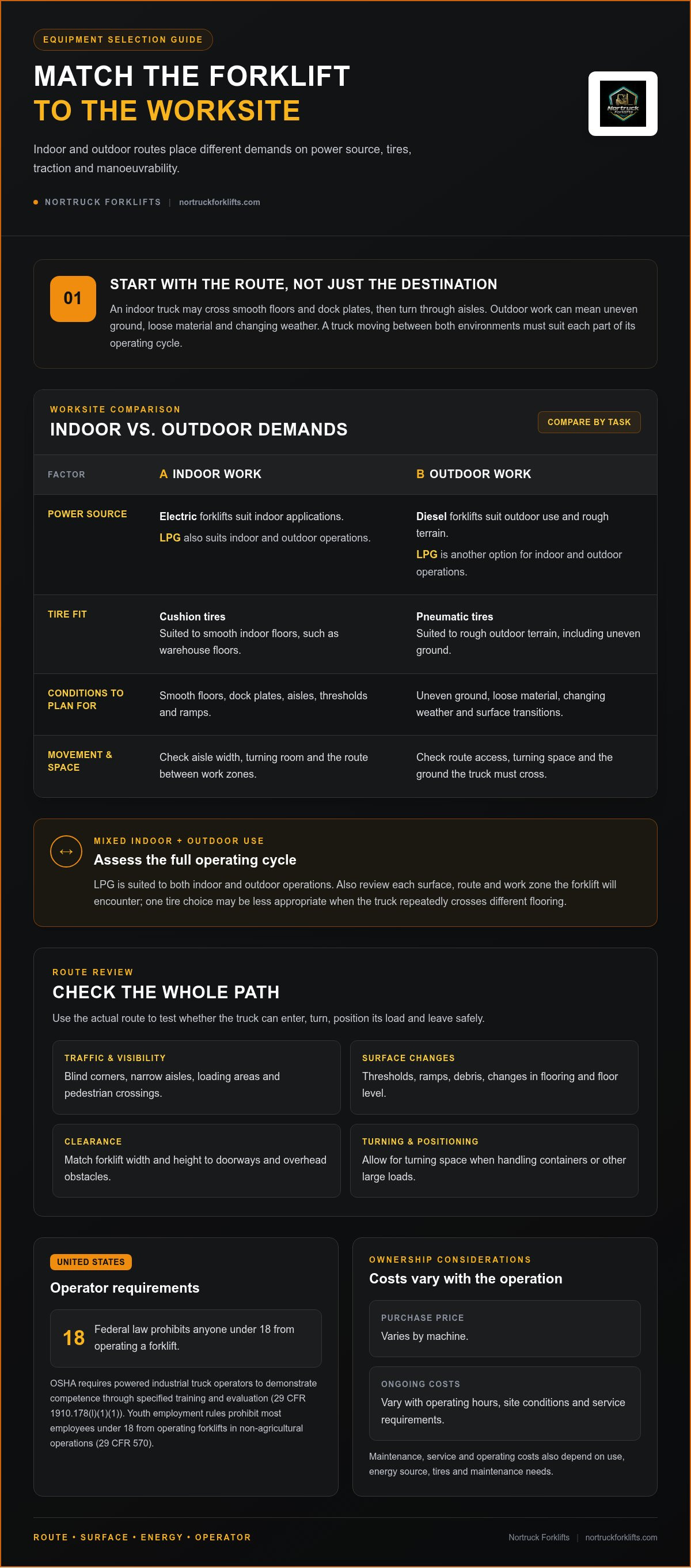
Map the forklift’s route, not just its destination. An indoor truck may travel over smooth floors, cross dock plates and turn through aisles, while outdoor work can involve uneven ground, loose material and changing weather. These differences affect tire choice, power source, traction and manoeuvrability. A forklift moving between both environments needs a configuration suited to each part of its operating cycle.
Choose the fuel type to suit the worksite’s environmental rules and available energy. Diesel forklifts suit outdoor use and rough terrain; LPG forklifts suit indoor and outdoor operations; electric forklifts suit indoor applications. Consider where the truck will run most often, how it moves between work zones, and which energy sources the site can support. An indoor route with a short outdoor crossing presents different demands from sustained work on rough ground.
Tires also need to suit the surface. Pneumatic tires are suited to rough outdoor terrain, where the ground may be uneven. Cushion tires are suited to smooth indoor floors, such as warehouse floors. Before purchasing, examine the route for thresholds, ramps, debris and changes in flooring. A tire suited to one surface may be less appropriate when the truck repeatedly crosses another.
Build a hazard review around actual traffic and obstacles. Note blind corners, narrow aisles, loading areas, pedestrian crossings and changes in floor level. Check the forklift’s width and height against doorways and overhead obstacles, then consider turning space when it handles containers or other large loads. A clear route plan helps establish whether the truck can enter, turn, position its load and leave without unsafe manoeuvres.
In the United States, federal law prohibits anyone under 18 years of age from operating a forklift. OSHA requires powered industrial truck operators to demonstrate competence through successful completion of specified training and evaluation under 29 CFR 1910.178(l)(1)(1). Youth employment regulations under 29 CFR 570 prohibit most employees under 18 from operating forklifts in non-agricultural operations. Training and evaluation should reflect the truck and the tasks performed.
Maintenance, service and operating costs depend on the machine’s use, energy source, tires and maintenance needs. Purchase price varies by machine. Ongoing costs also vary with operating hours, site conditions and the equipment’s service requirements.
Use these conditions to define the specification before comparing capacity figures. An electric forklift working indoors on smooth floors has different operating demands from a diesel truck crossing rough outdoor ground. Matching the equipment to its routes, surfaces, energy supply and trained operators helps make the choice practical for the whole worksite.
Assessing load requirements and attachments
Begin by recording the heaviest load the forklift must lift, then describe its dimensions and shape. A pallet, long steel bundle and bulky machine component can weigh the same but have different centres of gravity. Record how the load is picked up, carried, turned and set down. This gives you a more useful basis for selection than weight alone, particularly when one forklift handles several load types.
Next, compare the load’s weight with the rated capacity for the intended configuration. Standard forklifts typically lift up to 15,000 lb, while a heavy-duty truck is designed for loads beyond that range. The rating applies to defined operating conditions, so don’t assume the headline figure holds for every load position or attachment. For example, a 5-ton rated forklift is recommended for transporting 3-ton pallets.
Load centre is a key part of that comparison. It describes the horizontal distance from the fork face to the load’s centre of gravity. Most standard forklifts have load centres that max out at 24 inches. A longer or uneven load can move its centre farther forward, changing the leverage on the truck. Measure the actual load, rather than assuming a standard pallet position fits every workplace task.
Attachments change the lifting configuration. A clamp, fork extension or other attachment adds weight and can shift the load farther from the mast. Both effects can reduce the capacity available for the load itself. Identify the attachment needed for each task, then use capacity information that matches that equipment and load position. Even a smooth lift with an unsuitable attachment can exceed the configuration’s rated limit.
Lift height matters too. As a load rises, forklift stability decreases, so compare capacity at the height required for the task. A load that can be carried safely at a low position may not have the same available capacity when placed in high storage. Include the mast and storage location in your assessment, and consider how often the truck performs lifts at its maximum working height.
For uneven or oversized items, assess how the forks support the load and whether it remains balanced during lifting and travel. Keep the load centred across the forks where the item allows, and account for any overhang or offset. Heavy-duty forklifts can support load centres of 48 inches and bigger, but that figure doesn’t make every long load suitable. The load’s dimensions and rated configuration still govern.
Bring the details together before selecting a truck: load weight, dimensions, load centre, required lifting height and attachment. Compare those conditions with the capacity information for the exact setup. This helps distinguish a machine that can lift a load once from one suited to repeated handling across the workplace.
4. Durable construction and tires
Assess construction against the forklift’s workload, not its appearance. A truck moving heavy loads across a yard faces different demands from one making repeated transfers inside a warehouse. Record the load types, travel surfaces and handling frequency. Then compare those tasks with the machine’s frame, mast, forks and other load-bearing components. The aim is to match the equipment to the work cycle, rather than assume every heavy-duty design suits every site.
Review the mast and fork assembly as a working system. Consider how the mast moves through its lift range, whether the forks suit the loads, and whether the carriage supports the planned handling method. For example, handling long material calls for careful attention to fork positioning and load support. When assessing used equipment, inspect these components for visible damage or wear and consider how their condition affects safe, consistent operation.
Construction also includes the powertrain. Consider whether the engine or electric drive suits the length and intensity of each operating cycle. Repeated starts, frequent lifting and long travel distances create different demands from occasional movements between nearby work areas. Map a typical shift from pickup to placement, including pauses and travel, then compare that pattern with the truck’s intended application and energy source.
Choose tires by assessing the whole route, not just the loading bay. In a construction yard, uneven ground and loose debris may matter more than smooth sections near a doorway. In warehousing, tight turns and floor transitions may influence tire suitability and manoeuvring. Walk the route and note surface changes, obstacles and areas where traction or clearance could affect travel. Use those observations to evaluate the tire setup.
Condition matters as much as tire type. Check for uneven wear, cuts, embedded debris and differences between the tires. These clues can show whether the truck has worked on surfaces unlike those in its next role. If a forklift will move between outdoor terrain and indoor floors, compare the tire condition with both environments. A tire that appears serviceable in one location may not suit the full route.
Build a simple assessment around three elements: construction, powertrain and tires. For each candidate, match the frame and lifting components to the handling cycle, the engine or electric drive to the duty pattern, and the tires to the site’s surfaces. For instance, assess a forklift used at a construction materials yard against its outdoor travel as well as its loading area. This makes durability a practical question of fit, not a vague claim.
Finally, include serviceability in the purchasing decision. Consider how the machine’s components can be inspected and serviced, and whether its maintenance needs fit the operation’s routines. For a truck assigned to several work centres, compare the routes and tasks at each location. Reviewing construction, tires and operating patterns helps identify where wear is likely and whether the machine suits the job.
5. Heavy-duty forklift product specifications
A useful specification compares more than maximum load capacity. Read the rated load, load centre, lift height, power source, tires and operating dimensions together. For an 18-ton heavy-duty forklift specification, clarify whether “18 ton” refers to the required load or the machine’s stated rating. Ratings in the provided product data are expressed in pounds, so compare units carefully before assessing fit.
Engine and fuel options vary by model. Heavy-duty trucks may use diesel, LPG or electric power; transmission choices also depend on the specific machine and its intended work. Match the powertrain to the duty cycle, loading pattern and site conditions, rather than assuming one option suits every operation. For example, a diesel-powered truck may suit outdoor work, while electric forklifts suit indoor applications.
Heavy-duty forklift product ranges span lifting capacities from 15,000 lb to 125,000 lb. High-capacity cushion forklift models are often rated at 18,000-22,000 lb, while high-capacity electric cushion forklift options cover 15,000-40,000 lb. For pneumatic tires, core internal combustion models typically range at 22,000-30,000 lb, and larger internal combustion ranges scale from 30,000 to 125,000 lb. These variations show why model type and operating surface matter.
Published industry data helps answer which equipment ranges include an 18,000 lb capacity: high-capacity cushion forklifts and high-capacity electric cushion options both include it. Their capacity ranges differ, and the listed cushion and electric cushion configurations should not be treated as interchangeable. Compare the precise model’s intended environment, capacity at the required lift height and load centre before drawing a conclusion about suitability.
Rated capacity and load centre must be read as a pair. Heavy-duty forklifts support load centres of 48 inches and bigger, but this is a general range, not a universal rating for every 18-ton truck. The exact rated load depends on the model and configuration. Check the capacity information for the load centre, attachment and lift height needed for your materials and loading tasks.
Lift height affects capacity because stability decreases as a heavy load rises. Compare capacity at the height your operation requires, rather than relying only on the maximum rating. Also check the turning radius and truck dimensions against the route. A smaller turning radius can help in tight warehouse aisles, while width and height determine access through doors and around other obstacles.
To compare specifications, make a side-by-side record of rated capacity, load centre, lift height, power source, tire type and turning space. Then match each figure to an actual task, such as placing a load at height or moving materials through a confined aisle. This turns the product sheet into a practical selection tool.
Available power options may include diesel, LPG or electric, depending on the model. Transmission choices also vary by machine and its intended work.
Nortruck Forklifts: Kalmar Heavy Lift Trucks
Nortruck Forklifts helps match heavy-lifting requirements with suitable machinery, including Kalmar Heavy Lift Trucks. Turn to Nortruck when your load profile, required lift height, working environment or handling cycle calls for a closer equipment assessment. Comparing those demands with the specification helps narrow the choice to machinery suited to the work, rather than capacity alone. For operations involving different load types or routes, Baumann Sideloaders, Combi-Lift 4-way Trucks and Linde Forklifts are also among the available equipment categories.
Tell Nortruck Forklifts what loads you handle and the conditions in which you move them to discuss suitable machinery.
Turn your requirements into a clear equipment brief
Use the 18 ton heavy duty forklift specification as a working brief, not simply a target capacity. Record the loads and tasks that define a normal shift, then note which demands are essential and which are occasional. This helps keep the selection focused on the work the machine must perform.
Consider how your operation may change. New materials, altered storage layouts or different movement routes can affect a forklift’s usefulness over time. A clear brief gives you a practical basis for discussing priorities and comparing suitable equipment without losing sight of the work ahead.
Nortruck Forklifts advises businesses on heavy lifting equipment to help match a truck to operational needs. Contact the team to discuss your equipment requirements.
A well-defined brief makes the next conversation more productive. You’ll be ready to move forward with clarity.
Frequently Asked Questions
What is a heavy duty forklift?
A heavy-duty forklift is generally classified as a forklift with a lifting capacity of 15,000 lb or greater. That label describes a capacity category, not a guarantee that every truck can handle every load within that weight range. For a specific job, account for the load’s shape, attachment, position and required lift height. A bulky load can impose different demands from a compact load of equal weight.
What are typical specifications of an 18-ton heavy-duty forklift?
Specifications vary by model and configuration, so assess the rated capacity alongside the load centre, lift height, tire type, power source and truck dimensions. Toyota’s High-Capacity Cushion Forklift is rated at 18,000-22,000 lb, while its High-Capacity Electric Cushion Forklift is rated at 15,000-40,000 lb. These examples show why an 18-ton heavy-duty forklift specification should identify the exact model and intended operating setup.
What are the dimensions, turning radius, and mast height of an 18-ton forklift?
Dimensions, turning radius and mast height vary by forklift model and configuration, so there is no single specification for every truck in this capacity class. For a planned route, compare the truck’s overall width and height with doors, overhead obstacles and aisle space. Include turning clearance at corners and the mast height needed for storage or loading. A useful specification matches the machine’s measurements to the actual site layout.
What are the tire types and ground clearance of an 18-ton forklift?
Pneumatic tires suit rough outdoor terrain, while cushion tires suit smooth indoor floors. Ground clearance varies with the forklift’s design and tire configuration, so assess it against the route rather than relying on the capacity class. For example, a truck crossing uneven outdoor ground needs different clearance considerations from one travelling on a smooth warehouse floor. Check thresholds, ramps and surface changes along its full working path.
What attachments are available for an 18-ton forklift, and how do they affect capacity?
Attachment choice depends on the handling task; examples include clamps and fork extensions. An attachment adds weight and may move the load farther from the forklift, reducing the capacity available for the load. Use capacity information for the truck with the intended attachment fitted, and consider the load’s position and lift height. A configuration suited to one attachment may not have the same rating with another.
What engine, transmission, and fuel options are available for 18-ton forklifts?
Diesel suits outdoor use and rough terrain, LPG suits indoor and outdoor operations, and electric power suits indoor applications. The material gives no specific engine or transmission options for 18-ton forklifts.

Article by
Lars Gunnar Tärby
Disclaimer
1. General Information and No AdviceThe information, articles, product descriptions, and specifications provided on this website (www.nortruckforklifts.com) are for general informational and educational purposes only. While we strive to provide accurate and up-to-date content regarding new and used forklifts and heavy machinery, the material published does not constitute professional, technical, or legal advice.
2. Product Specifications and PricingNortruck Forklifts acts as a facilitator for the trade of new and used forklifts. All equipment details, including but not limited to year of manufacture, operating hours, lift capacity, dimensions, conditions, and pricing, are provided based on the information available to us at the time of publication. Specifications and availability are subject to change without prior notice.
3. "As Is" and VerificationAll articles and product listings are provided on an "as is" and "as available" basis without any warranties of any kind, either express or implied. Nortruck Forklifts does not guarantee that the descriptions are entirely error-free, complete, or reliable. Buyers and traders are strongly encouraged to independently verify all technical specifications, machine history, and equipment conditions directly with the seller or an authorized inspector before finalizing any purchase or transaction.
4. Limitation of LiabilityIn no event shall Nortruck Forklifts, its owners, or its contributors be held liable for any direct, indirect, incidental, consequential, or economic loss or damage arising out of the use of, or the inability to use, the information provided on this website, or any transactions facilitated through this platform. This includes, but is not limited to, damages caused by technical inaccuracies, typographical errors, or reliance on the content of our articles.
5. Third-Party LinksOur website may contain links to external websites, dealer networks, or third-party services that are not owned or controlled by Nortruck Forklifts. We have no control over, and assume no responsibility for, the content, privacy policies, or practices of any third-party websites.


