
Heavy-duty forklifts can move engines, steel structures, and palletized cargo around shipyards. They are one part of heavy lifting equipment for shipyard operations, alongside cranes and specialized lifting systems for loads or movements beyond a forklift’s capacity, reach, or maneuverability.
Choosing equipment involves more than lifting the heaviest load. Consider the task, working environment, safe load handling, and how the machine will perform in daily operations. The right fit depends on what you need to move and where the work takes place.
This guide covers equipment for common shipyard tasks, how conditions such as salt exposure and humidity affect selection, and key safety considerations. It also explains how to compare forklift capacity and performance with purchase requirements, so you can focus on equipment suited to the work rather than simply choosing the largest machine.
Key Takeaways
- Match the lifting method to the load’s weight, shape, travel path, and placement needs; lifting attachments can change both load distribution and usable crane capacity.
- Account for humidity, salt exposure, outdoor conditions, and repeated use when assessing equipment suitability and safe operation.
- Use heavy-duty forklifts for suitable cargo such as engines, steel structures, and palletized materials, while considering where their capacity and maneuverability fit the task.
- Compare purchase price with expected performance by weighing capacity, operating demands, ground conditions, and the work the machine must handle.
- Distinguish forklift work from crane, sling, and specialized transport tasks to build an equipment mix that suits shipyard operations.
Environmental and safety considerations
Shipyards expose lifting equipment to humidity, salt, outdoor conditions, and frequent use. Environmental suitability is therefore an important part of equipment selection. Corrosion or wear can affect components, attachments, and load-handling reliability, so inspections should consider the working environment as well as lifting capacity. Equipment used near seawater may need different care from machinery kept in a protected workshop.
Match the lifting method to the load and its route. Heavy-duty lifting slings can reduce the need to lift and carry heavy components by hand. They can also accommodate complex shapes and confined spaces where rigid equipment may not fit. For delicate or thin-walled loads, such as glass panels or tanks, a lifting beam can distribute force instead of concentrating it at one point.
Inspection, maintenance, and operator-certification requirements depend on the equipment and governing jurisdiction. As part of day-to-day operations, document inspections, follow the manufacturer’s maintenance instructions, and ensure operators have appropriate training and certification where required.
- Inspect before use: Look for visible damage, unusual wear, corrosion, and defects in slings, hooks, lifting beams, and connection points.
- Match the attachment: Check that the sling or beam suits the load’s shape and lifting configuration.
- Keep records: Record inspections, maintenance, and defects so equipment condition is traceable.
- Control the work area: Keep people clear of suspended loads and coordinate movement with nearby crews.
Capacity calculations must include the lifting equipment attached to the crane. A 10-ton-rated crane using a 500-pound lifting beam has 9,750 pounds of usable capacity remaining. That example shows why the attachment’s weight must be included before lifting. A 5-ton load suspended from one point also creates different stresses from the same weight distributed across four points. The configuration matters as much as the total load.
Aerial work platforms provide access for shipyard maintenance, painting, inspections, and repairs at height. They are suited to tasks that do not involve lifting a suspended component. Keep the distinction clear: a platform supports workers and their work, while cranes and slings handle loads. Selecting equipment for its intended purpose helps prevent using a lifting tool for an access task.
Planning also means considering how equipment moves through the yard. The U.S. Environmental Protection Agency identifies cranes and industrial vehicles, including forklifts, flatbeds, carts, and special lift vehicles, as typical materials-handling equipment. Account for traffic routes, ground conditions, and nearby work areas. In modular work zones, coordinate crane travel and load placement with teams handling adjacent components. Clear routes and coordinated movements help reduce conflicts around active lifting operations.
Equipment selection criteria
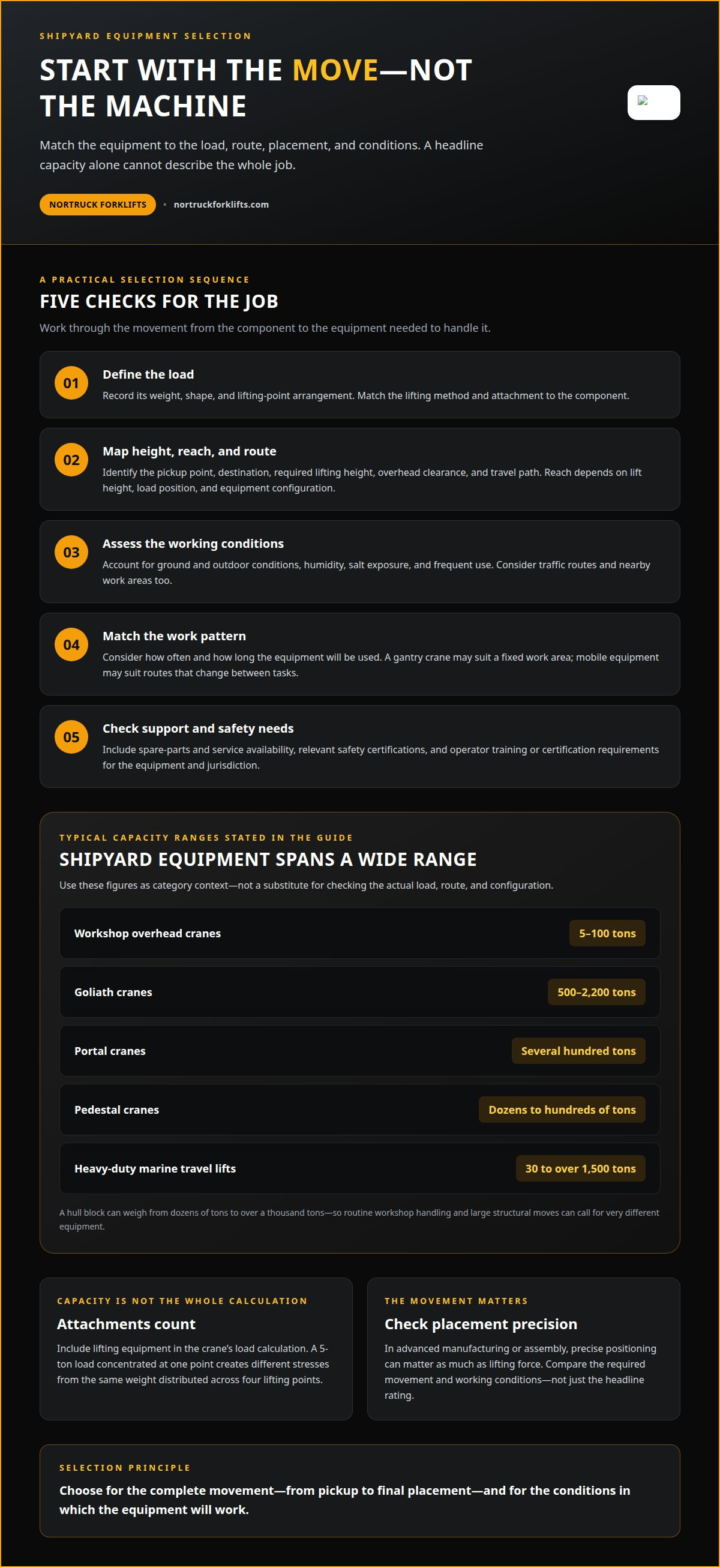
Choosing heavy lifting equipment for shipyard operations starts with the task, not the machine. Define the load, route, required lifting height, and placement point. Equipment must also suit conditions such as humidity, salt exposure, outdoor work, and frequent use. A hull block can weigh from dozens of tons to over a thousand tons, so the needs of routine workshop handling differ greatly from those of large structural moves.
Typical capacities cover a broad range. Shipyard workshop overhead cranes typically lift 5 to 100 tons, while Goliath cranes typically have capacities ranging from 500 to 2200 tons. Portal cranes handle several hundred tons, and pedestal cranes range from dozens to hundreds of tons. Heavy-duty marine travel lifts range from 30 to over 1,500 tons. Reach depends on the lift height, load position, and equipment configuration, so assess the actual placement point and route.
Capacity is only one selection factor. Consider maximum load weight, required lifting height, ground conditions, frequency of use, spare-parts and service availability, and safety certifications. A gantry crane may suit a fixed work area, while mobile equipment may better suit routes that change between tasks. Precise positioning can matter as much as lifting force in advanced manufacturing or assembly. Compare the required movement and working conditions, not just a machine’s headline rating.
- Load: Record the component’s weight, shape, and lifting-point arrangement.
- Height and reach: Identify the starting point, destination, and overhead clearance along the route.
- Ground: Consider surface conditions where equipment will travel and position its load.
- Work pattern: Match equipment to the frequency and duration of its expected applications.
- Support: Include parts and service availability, along with relevant safety certifications.
Attachments affect usable capacity. A 10-ton-rated crane using a 500-pound lifting beam is said to have 9,750 pounds of usable capacity remaining. Include the lifting equipment in the crane’s load calculation. Distribution matters too: a 5-ton load concentrated at one point creates different stresses from the same weight spread across four lifting points. Choose a configuration suited to the component and attachment.
The right heavy lifting equipment for shipyard operations supports the complete movement, from pickup to final placement. Compare each option against a specific load, route, and work frequency. Identify where its capabilities suit the task and where they exceed or fall short of requirements. This clarifies trade-offs and grounds the decision in the yard’s actual work.
For a heavy-load handling assessment, review equipment options against the operating requirements before narrowing the choice.
Heavy-duty forklifts for engines, steel structures, and palletized cargo
Heavy-duty forklifts handle shipyard loads suited to vehicle-based material handling, including engines, steel structures, and palletized cargo. They are useful for moving loads through a yard, between storage and assembly areas, or to a work position. A forklift can support repeated transfers when the route, load, and destination fall within its operating limits.
Consider an engine staged for installation. The forklift needs to approach the load, engage it with suitable forks or an attachment, and travel along a clear route to the assembly area. The load’s shape and center of gravity affect stability. A long steel section presents different handling challenges from a compact engine, even when their weights are similar.
Before assigning a lift, compare the actual load with the forklift’s rated capacity for the planned operating configuration. Capacity can change with the load’s position, attachment, and lifting height. Consult the equipment’s capacity information for that setup, then assess whether the load can be carried safely along the intended route. Do not treat the maximum rating as the target for every lift.
- Engines: Check how the engine is supported, where the forks or attachment engage, and whether the route allows controlled travel.
- Steel structures: Account for long or uneven dimensions that can affect balance, visibility, and turning space.
- Palletized cargo: Confirm the pallet is suitable for the load and that the forks enter securely before movement.
- Assembly positioning: Plan the final approach so the forklift can place material without obstructing nearby work.
Height matters during travel and placement. A forklift carrying a component to a work level needs sufficient clearance, stable ground, and a route free of overhead obstructions. A steel frame carried across the yard, for instance, may need a different route from a pallet delivered to a low staging area. Plan around the operator’s visibility and the load’s position.
The U.S. Environmental Protection Agency identifies forklifts alongside cranes, flatbeds, carts, and special lift vehicles as typical shipyard materials-handling equipment. These machines support different movements, rather than replacing one another. A forklift can transfer compatible cargo across the yard, while cranes handle lifts beyond its practical reach or capacity. Matching each application to the right machine helps organize material flow.
For recurring work, group tasks by load type and destination. Engine movements, steel-stock transport, and pallet deliveries may each require different access and staging arrangements. Review turns, doorways, ground conditions, and nearby workers before setting routes. This planning helps make forklift use more efficient and aligns material handling with the shipyard’s assembly sequence.
Purchase price versus total performance
When buying shipyard equipment, compare the machine’s cost with the work it can perform. A lower-priced option may not suit frequent lifting, while a higher-capacity machine may be unnecessary for occasional pallet movements. Define the intended applications first, then compare how each option fits the workload, routes, and operating environment.
Purchase prices are provided after a quote request and depend on factors such as equipment type, configuration, condition, and project requirements. New and used machinery are both options, but the right choice depends on how well the machine suits the work. A used machine matched to a defined transfer task, for example, may be a better fit than equipment chosen only for its lower initial cost.
Compare performance in the context of a typical workday. Record the loads moved, travel distances, handling frequency, and placement requirements. Then assess whether one machine can perform the tasks efficiently or whether different equipment is needed for distinct applications. A forklift assigned to regular cargo transfers has a different role from an overhead crane serving fixed lifting points.
- Work fit: Compare the machine’s lifting capacity and configuration with the loads it will handle.
- Utilization: Consider how often the equipment will work and whether its capability matches that schedule.
- Operating conditions: Account for outdoor exposure, yard surfaces, and the route between staging and assembly areas.
- Energy use: For an electric option, consider the work cycle, charging arrangements, and where the machine operates.
- Support needs: Include access to service and spare parts when assessing operational continuity.
Electric equipment illustrates why performance depends on the site. A machine handling repeated indoor transfers faces different demands from one moving cargo outdoors across a shipyard. Compare the work pattern and charging arrangements with the planned use. Do not assume one drive type suits every route or shift.
Fixed infrastructure also affects the comparison. Overhead cranes can handle repeated lifts in a defined area, while mobile equipment supports movement between locations. If a task needs both, consider how the systems connect: staging, transfer, and final positioning all affect workflow. Compare the complete movement, not just an individual machine.
Use a simple evaluation sheet to compare options consistently. For each machine, list its intended tasks, required configuration, expected use, energy arrangements, and support needs. Note where its capabilities exceed the requirements or fall short. This makes trade-offs clear without relying on a single headline figure or purchase price.
Tailor the decision to the yard’s actual workload. A machine handling varied cargo movements may need different capabilities from equipment assigned to one repeatable task. Review the comparison when production patterns change, such as when work shifts from pallet transfers to larger assembly components. Performance depends on how well the machine fits the work across the operation.
What types of heavy lifting equipment are used in shipyard operations?
Shipyards use different equipment to lift, transport, and position vessel components. The right type depends on load size, required reach, route, and placement accuracy. A crane may lift a component above a vessel, while a forklift or transporter moves materials across the yard. These machines form a coordinated handling system rather than interchangeable options.
Overhead cranes serve workshops and fixed work areas. Shipyard workshop overhead cranes typically lift 5 to 100 tons, while Goliath cranes typically have capacities ranging from 500 to 2200 tons. Portal cranes handle several hundred tons, and pedestal cranes range from dozens to hundreds of tons. Their fixed or defined working paths suit planned lifts, such as positioning large assemblies near a hull.
For extended reach or elevated access, telehandlers suit tasks that need a long outreach or raised working position. Heavy-duty marine travel lifts move vessels between water and shore, with capacities from 30 to over 1,500 tons. Self-propelled modular transporters can carry hull blocks weighing thousands of tons, making them suited to moving very large structures across a yard.
- Spreader bars: Provide four-point or six-point lifting configurations for loads requiring support at multiple locations.
- Load rotators: Rotate suspended loads through 360 degrees to help orient components during positioning.
- Motorized rotating crane blocks: Installed between a crane hook and lifting attachment, they provide 360-degree rotation.
- Heavy-duty slings: Hoist and position ship components, including raw materials and engine components, through confined spaces.
Attachments affect how a component is supported and controlled. Spreader bars can distribute lifting points across a load, while slings accommodate complex shapes. A load rotator helps turn a suspended component to the required orientation. For example, a complex engine component may need a sling arrangement for secure lifting, followed by controlled rotation during installation.
Equipment also supports routine yard work. The U.S. Environmental Protection Agency notes that shipyards use cranes to lift waste containers out of drydocks and place them onto trucks or empty them into trucks. Although this differs from hull assembly, the task still depends on matching the crane, container, and truck position to the movement.
Start by identifying whether the task involves lifting, transport, rotation, or access. A workshop crane may handle a lift from a fixed point, while a modular transporter carries a large hull block between work areas. Combining equipment types for each stage can make the complete operation more practical.
Nortruck Forklifts: Kalmar Heavy Lift Trucks
Nortruck Forklifts advises on and sources heavy lifting equipment for shipyard handling needs, including Kalmar Heavy Lift Trucks. A heavy-duty truck may suit the job when moving heavy cargo or components requires mobile equipment rather than a fixed crane. The right choice still depends on the load, route, ground conditions, and operating cycle.
For other material-handling requirements, the range also includes Baumann Sideloaders, Combi-Lift 4-way Trucks, and specialized high-capacity counterbalance trucks. Each option serves a different equipment category, so describe the loads and movements involved when discussing your requirements. That gives the conversation a practical starting point, grounded in the work your yard needs to complete.
Contact Nortruck Forklifts for advice on selecting heavy lifting equipment for shipyard operations.
Plan your next equipment decision with confidence
Use your next purchasing decision to clarify the yard’s operating plan. Define the movements the equipment must support, who will use it, and how the work connects with surrounding operations. This gives your team a practical basis for comparing heavy lifting equipment for shipyard operations instead of relying on a single headline capability.
Bring the requirements together before narrowing the options. A clear view of the intended tasks can show where a machine fits, where another equipment type is needed, and which trade-offs matter most to your workflow. Revisit the assessment when production needs or handling routes change, so the equipment plan remains relevant.
A considered choice can give your team a clearer path from operational need to equipment decision. Take the next step at a pace that suits your project.
Frequently Asked Questions
Lifting Equipment for Shipyards: What Actually Works?
Shipyard tasks vary, so a combination of lifting and transport equipment is often useful. A crane can handle a suspended lift, while a heavy-duty forklift can move suitable cargo between staging points. For example, a team might use a crane to position a large component and a forklift to bring tools or palletized materials nearby. Choose equipment for each movement rather than expecting one machine to do every job.
What Does a Shipyard Really Need?
A shipyard needs equipment matched to its work sequence, not simply the largest available machine. A repair yard handling engine replacements has different requirements from a facility assembling hull sections. Map each movement from delivery and storage through work areas to final installation. Include frequently moved loads, access at each stage, and whether tasks involve lifting, carrying, rotating, or reaching.
How much does shipyard heavy lifting equipment cost to buy, lease, or rent in the United States?
There is no single U.S. cost for buying, leasing, or renting shipyard lifting equipment. Price depends on the equipment type, capacity, configuration, condition, and project requirements, and is given after a quote request. Nortruck Forklifts provides equipment sales and advisory services, with financing and leasing options. Rental arrangements are a separate purchasing route, and their terms depend on the equipment and rental period.
What factors determine the right lifting equipment for a shipyard project?
Start with the project’s work sequence and the load’s shape. A long steel section may need a different handling approach from a compact engine, even if both travel to the same assembly area. Consider where the load enters the yard, where it will be staged, and whether another machine must take over. These details help determine the suitable machine type and attachments.
What are the main safety risks when lifting ships, engines, and heavy components?
Key risks include an unstable or shifting load, unsuitable attachments, restricted operator visibility, and people entering the load’s travel path. A suspended engine can swing during movement, while a large ship component may block sightlines or restrict access around the lift. Salt and moisture can also contribute to equipment deterioration. A clear work zone, suitable load support, and coordinated movements help address these hazards.
How should shipyard teams plan and execute a heavy lift safely?
Before moving equipment, agree on the load, route, placement point, and communication method. Assign clear responsibilities so the operator and ground team know who directs each stage. Confirm the attachment suits the component, clear the planned path, and keep bystanders outside the operating area. Move steadily and pause if the load shifts, visibility changes, or the route becomes obstructed.

Article by
Lars Gunnar Tärby
Disclaimer
1. General Information and No AdviceThe information, articles, product descriptions, and specifications provided on this website (www.nortruckforklifts.com) are for general informational and educational purposes only. While we strive to provide accurate and up-to-date content regarding new and used forklifts and heavy machinery, the material published does not constitute professional, technical, or legal advice.
2. Product Specifications and PricingNortruck Forklifts acts as a facilitator for the trade of new and used forklifts. All equipment details, including but not limited to year of manufacture, operating hours, lift capacity, dimensions, conditions, and pricing, are provided based on the information available to us at the time of publication. Specifications and availability are subject to change without prior notice.
3. "As Is" and VerificationAll articles and product listings are provided on an "as is" and "as available" basis without any warranties of any kind, either express or implied. Nortruck Forklifts does not guarantee that the descriptions are entirely error-free, complete, or reliable. Buyers and traders are strongly encouraged to independently verify all technical specifications, machine history, and equipment conditions directly with the seller or an authorized inspector before finalizing any purchase or transaction.
4. Limitation of LiabilityIn no event shall Nortruck Forklifts, its owners, or its contributors be held liable for any direct, indirect, incidental, consequential, or economic loss or damage arising out of the use of, or the inability to use, the information provided on this website, or any transactions facilitated through this platform. This includes, but is not limited to, damages caused by technical inaccuracies, typographical errors, or reliance on the content of our articles.
5. Third-Party LinksOur website may contain links to external websites, dealer networks, or third-party services that are not owned or controlled by Nortruck Forklifts. We have no control over, and assume no responsibility for, the content, privacy policies, or practices of any third-party websites.


