
Waiting 18 months for a factory build won't protect your operations if an off-center load derates your forklift on day one. In severe material handling, brand loyalty matters far less than engineering reality. Executing an effective 32 ton heavy lift truck procurement strategy demands a rigorous look at actual duty cycles, mast stresses, and axle ratings before signing a purchase order.
You're likely balancing punishing lead times against the risk of under-specifying a truck for severe, multi-shift cycles. Sourcing vetted machinery from industrial markets across continental Europe solves the timeline problem, yet evaluating the true mechanical condition and service history of high-capacity equipment across borders often feels like a gamble.
This guide gives you a direct, technical roadmap to cut through that uncertainty. You'll discover how to verify mast and load-center capacity for true 32,000 kg payloads, assess whether factory-ordered builds or pre-inspected used units best match your cycle duty, and manage European procurement with complete mechanical transparency.
Key Takeaways
- Understand why genuine load-center geometry at 1,200 mm matters far more than nominal lift ratings when handling 32,000 kg industrial loads.
- Differentiate between purpose-built heavy platforms and ballasted medium-duty frames to prevent premature chassis fatigue.
- Streamline your 32 ton heavy lift truck procurement by comparing long factory lead times against thoroughly vetted, ready-to-deploy European machinery.
- Eliminate cross-border transaction risks with a verified inspection protocol covering CE conformity, structural integrity, and documented service provenance.
- Leverage independent European sourcing networks to access unadvertised industrial machinery without restricted local dealer markups.
Critical Engineering Specifications for 32 Ton Heavy Lift Truck Procurement
A nominal 32-ton rating tells you very little about how a machine behaves under real working conditions. Successful 32 ton heavy lift truck procurement requires matching chassis rigidity, hydraulic flow, and powertrain cooling to your exact operating envelope. Misjudging load geometry or continuous thermal stress leads straight to structural fatigue and premature component failure.
Seeing how these massive machines are secured and transported highlights the sheer scale of the engineering involved. To better understand this physical footprint, watch this brief overview:
Rated Capacity vs. Load Center Deration
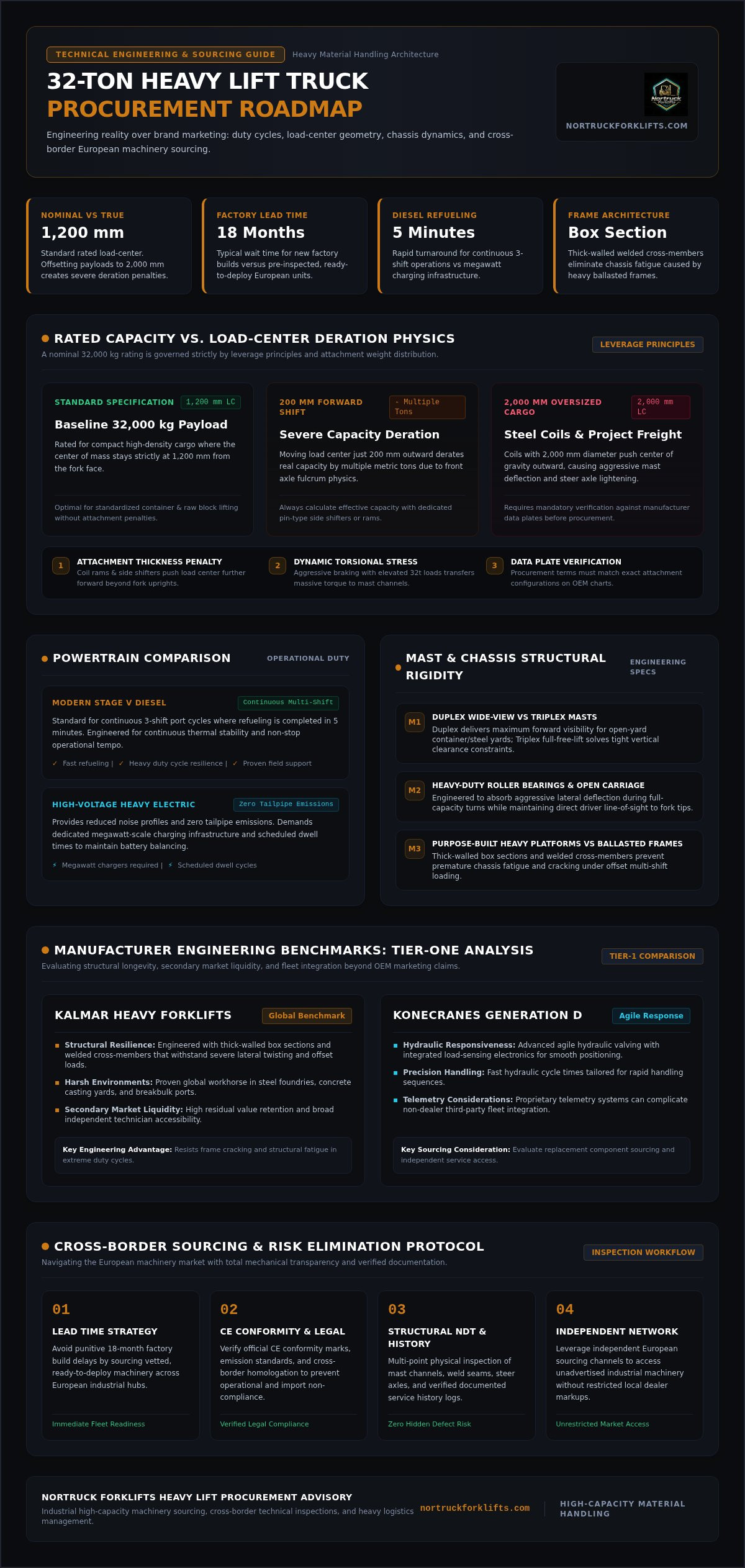
Heavy lift trucks carry their nominal rating at a standard 1,200 mm load center. If your cycle involves handling 2,000 mm steel coils or oversized project cargo, that 32,000 kg threshold drops dramatically. Foundational forklift design and components rely on clear leverage principles; moving a load just 200 mm forward can derate your lifting capacity by multiple metric tons.
- Attachment thickness: Adding a dedicated coil ram or pin-type side shifter pushes the effective center of gravity further forward.
- Dynamic ratings: Aggressive braking while carrying elevated loads places massive torsional stresses on the mast channels and steer axle.
- Manufacturer data plates: Always verify factory load-deration charts for your specific attachment combination before finalizing procurement terms.
Powertrain Selection: Modern Diesel vs. Heavy Electric
Selecting between modern Stage V diesel and high-voltage electric powertrains comes down to operational tempo. Stage V diesels remain the standard for continuous three-shift port cycles where refueling takes five minutes. Heavy electric variants offer reduced noise and zero tailpipe emissions, but they demand dedicated megawatt-scale charging infrastructure and scheduled dwell times to keep batteries balanced.
Mast and Carriage Structural Engineering
Clearance constraints dictate whether your operations need a duplex wide-view mast or a triplex configuration with full free lift. Duplex masts provide maximum visibility for open-yard container handling and raw steel transport. Heavy-duty roller bearing assemblies must handle aggressive lateral deflection during full-capacity turns, while open-carriage designs ensure the driver maintains a clear line of sight directly to the fork tips.
Evaluating Top Manufacturers: Kalmar, Konecranes, and Tier-One Alternatives
Brand prestige won't move tonnage if your engineering architecture locks you into proprietary software or scarce replacement components. When managing 32 ton heavy lift truck procurement, evaluating manufacturers requires looking past marketing claims about lowest total cost of ownership. The real test lies in structural longevity, secondary market liquidity, and whether your local technicians can source assemblies without OEM gatekeeping.
Kalmar and Konecranes dominate the high-capacity landscape, yet their engineering choices create distinct ownership experiences. Kalmar heavy lift trucks remain the global benchmark for resale value and structural resilience in punishing environments like foundries, concrete casting yards, and breakbulk terminals. Konecranes Generation D platforms offer agile hydraulic response and integrated load-sensing electronics, but proprietary telemetry can complicate third-party fleet integration.
Engineering Benchmarks of Kalmar Heavy Forklifts
Kalmar frames are engineered with thick-walled box sections and welded cross-members designed to survive severe torsional stress. In heavy steel handling, where offset loads exert lateral twisting forces, these chassis resist cracking far better than lighter, ballasted alternatives. For deeper technical specifications and model histories, consult our practical guide to sourcing Kalmar heavy lift trucks for sale.
Component Commonality and Drivetrain Standardization
Independent fleet resilience depends on non-proprietary mechanical foundations. Tier-one heavy forklifts often share standardized powertrain components that any seasoned heavy-diesel mechanic can service:
- Industrial diesel power: Volvo Penta inline-six industrial engines deliver consistent low-end torque while ensuring global filters and injectors remain accessible outside restricted dealer networks.
- Heavy drive axles: Kessler planetary axles provide the gear reduction and wet disc braking required to safely manage 32,000 kg dynamic shock loads without premature heat buildup.
- Transmission reliability: Dana Spicer hydrodynamic transmissions offer predictable shifting logic and open diagnostic protocols, simplifying fleet-wide maintenance.
Regardless of the badge on the counterweight, compliance with regional workplace mandates is essential. Equipment operating in regulated industrial yards must align with established standards such as OSHA safety standards for powered industrial trucks to ensure operational compliance and operator protection. If you need independent technical evaluation to compare specific fleet chassis across Europe, partnering with an experienced advisory team at Nortruck Forklifts gives you direct access to multi-brand mechanical assessments without local dealer bias.
New Factory Orders vs. Sourcing Quality Used 32 Ton Forklifts
Procuring high-capacity equipment forces you to balance immediate operational demand against capital allocation schedules. Factory-new builds offer clean machine histories and initial warranty coverage, but OEM order books regularly demand lead times stretching between 12 and 18 months. When contracts require instant material movement, relying solely on new manufacturing queues isn't viable.
Late-model pre-owned machinery bridges this gap by offering rapid deployment at lower initial capital exposure. Sourcing a well-maintained European unit allows your terminal or plant to fulfill sudden commercial commitments without sitting in an extended production queue. The key to mitigating operational risk lies in rigorous technical evaluation rather than blind trust in a dealer's refurbishment stamp.
Capital Allocation and Immediate Operational Needs
Large-scale fleet planning often mirrors institutional frameworks like the Defense Logistics Agency's Heavy Equipment Procurement Program, which enforces strict lifecycle milestones and acquisition deadlines. In the private sector, winning a multi-year industrial handling tender requires equipment on the ground in weeks, not years. Sourcing late-model machinery protects your working capital while maintaining the capacity needed for immediate revenue generation.
Structural Due Diligence on Heavy Used Frames
Evaluating a pre-owned 32-ton forklift requires looking past cosmetic paint jobs to inspect structural load paths. Hour meter thresholds tell different stories based on previous operational intensity:
- Low-hour units (under 4,000 hours): Typically indicate intermittent yard work or backup fleet status, showing minimal carriage wear and tight steer axle geometry.
- Mid-life units (6,000 to 9,000 hours): Require verified transmission pressure logs, hydraulic valve pack inspection, and confirmation that wet disc brake systems were serviced at scheduled intervals.
- High-hour units (12,000+ hours): Demand thorough non-destructive testing (NDT) across the lower mast pivots, fork heel radii, and lift cylinder anchor plates to rule out metal fatigue.
Duty cycles in punishing environments present unique wear patterns. Handling abrasive dust and uneven ground conditions, as outlined in our analysis of heavy duty forklifts for concrete, places severe strain on steer trunnions and mast rollers. Successful 32 ton heavy lift truck procurement for used assets relies on documented fluid sampling histories, verifiable hour records, and complete component provenance to ensure high-hour assets perform reliably from day one.
Step-by-Step Cross-Border European Procurement and Transport Logistics
Moving a 32-ton forklift across international borders involves far more than booking flatbed freight. With an operating tare weight often topping 40,000 kg, these machines exceed standard road transport dimensions and axle-load limits. Executing a seamless 32 ton heavy lift truck procurement plan across Europe demands strict coordination between mechanical teardown teams, heavy-haul carriers, and cross-border regulatory authorities.
A structured acquisition sequence protects your investment before machinery leaves the seller's facility:
- Step 1: Independent mechanical verification. Commission an on-site technical inspection covering engine compression, hydraulic drift under load, and structural weld integrity.
- Step 2: Documentation verification. Confirm unencumbered title, cross-reference serial numbers against manufacturer databases, and secure original conformity documents.
- Step 3: Component disassembly. Demount the mast assembly, detach specialized fork positioners, and remove the counterweight slabs to meet international road transport envelopes.
- Step 4: Permitted route coordination. Contract certified heavy-haul logistics providers capable of securing cross-border transit permits, bridge authorizations, and mandatory escort vehicles.
- Step 5: Port or yard recommissioning. Rehang the mast using certified mobile cranes, bleed the main hydraulic circuits, and perform statutory proof-load testing prior to operational handoff.
Navigating Technical Compliance and European Documentation
Operating industrial machinery within the European Union mandates full regulatory compliance. Every unit requires an authentic CE mark paired with the original Declaration of Conformity to verify compliance with Machinery Directive standards. Buyers must also review engine emission classifications, ensuring Stage IV or Stage V compliance for strict urban or port environments, as detailed in our comprehensive European forklift market guide.
Oversize Transport and Rigging Logistics
A fully assembled 32-ton forklift cannot travel legally on standard European highways. The total transport height of an upright mast exceeds bridge clearances, while combined axle weights trigger severe road penalties. Transport requires splitting the machine into multiple loads: the primary chassis rides on an extendable low-loader, while the mast, carriage, and counterweight travel on secondary flatbeds. On arrival, certified riggers must reassemble the lifting structure using high-tensile fasteners torqued strictly to factory specifications before commissioning.
Securing Your 32-Ton Lift Truck with Independent Sourcing Advisory
Franchised dealerships operate under a clear mandate: sell whatever models sit on their assigned allocation sheets. That commercial structure rarely aligns with your exact engineering requirements, especially when tackling specialized 32 ton heavy lift truck procurement. Working with an independent sourcing partner shifts the entire process from an OEM-driven sales conversation to an objective, engineering-first selection.
Independent advisors tap directly into off-market industrial fleet disposals across continental Europe. Manufacturing operations, port facilities, and steel logistics yards frequently retire or cycle heavy equipment without public auction listings. Reaching these machines gives buyers access to well-maintained, high-capacity units that never appear on open digital marketplaces.
The Value of 40+ Years of Heavy Lifting Specialization
Evaluating high-capacity machinery requires deep mechanical familiarity with how continuous loads affect heavy chassis over time. Anchored by Lars G Tarby's 40+ years of sector expertise, Nortruck Forklifts applies practical workshop knowledge to every machine assessment. Understanding whether a Kalmar heavy lift truck has spent its operating hours idling during container staging or absorbing shock loads in a slag yard makes the difference between a sound acquisition and an ongoing maintenance headache.
- Targeted duty matching: Align mast configurations, valve blocks, and carriage widths specifically for long steel beams, precast concrete culverts, or empty container spreaders.
- Fatigue life calculation: Assess remaining component life by analyzing actual working pressures, torque converter temperatures, and historical fluid analysis reports.
- Brand-agnostic guidance: Compare Kalmar heavy lift trucks against specialized alternatives like Baumann sideloaders or Combi-Lift 4-way trucks when handling long loads in constrained yard lanes.
Streamlining Procurement from Search to Site Delivery
Procuring heavy machinery internationally should not involve juggling half a dozen unfamiliar brokers. A structured advisory service manages the entire timeline from the initial engineering intake to final site delivery. We establish your exact load-center parameters, screen European fleet inventory, and oversee rigorous hands-on technical vetting. By handling contract verification, cross-border haulage permits, and dismantling logistics under one roof, we eliminate unnecessary middlemen, minimize administrative delays, and deliver equipment ready to earn on day one.
Taking Control of Your Heavy Lift Truck Acquisition
Successful 32 ton heavy lift truck procurement comes down to matching verified engineering ratings with transparent sourcing channels. Exact derating calculations at your true load center, realistic duty-cycle evaluations, and methodical cross-border transport logistics protect your operations from costly downtime. Whether your application requires a new build or a vetted late-model unit, objective technical criteria should always guide your purchase.
Backing your decisions with over 40 years of heavy lifting expertise under industry specialist Lars G Tarby removes the guesswork from complex machinery transactions. Our direct sourcing network spans major industrial hubs across continental Europe, uncovering unadvertised fleet opportunities with verified mechanical provenance and complete regulatory compliance.
You don't have to settle for multi-year factory backlogs or restricted local dealer inventories. Sourcing the right high-capacity machine with complete operational clarity is well within reach.
Frequently Asked Questions
What is the standard load center for a 32 ton heavy lift truck?
The standard load center for this capacity class is 1,200 mm from the front vertical face of the forks. Carrying payloads with wider centers of gravity, such as 1,500 mm or 2,000 mm steel coils, derates capacity significantly. Factoring in genuine center-of-gravity calculations prevents dangerous stability losses during 32 ton heavy lift truck procurement.
How do OEM lead times for new 32t forklifts compare to sourcing used machines?
Factory-ordered new builds typically require lead times between 12 and 18 months due to specialized chassis engineering and component backlogs. Sourcing vetted, late-model used equipment compresses this timeframe down to weeks. This makes pre-owned machinery the practical route when sudden industrial contracts demand immediate operational capacity on site.
Can a 32 ton forklift be transported in one piece on European roads?
No, a 32-ton forklift cannot travel fully assembled on European highways without violating transport height and axle-weight regulations. The mast and carriage must be demounted and transported on a secondary flatbed. The chassis and drive axle travel on an extendable low-loader, often requiring separate transport for counterweight sections and specialized route permits.
What engine emissions standards apply to heavy lift trucks in Europe in 2026?
Non-road mobile machinery operating in the European Union must comply with EU Stage V emissions standards. These regulations mandate strict limits on particulate matter and nitrogen oxides, requiring diesel particulate filters and selective catalytic reduction systems. Verifying the original CE Declaration of Conformity ensures your machine remains legally compliant for port and industrial operations.
Is an electric 32-ton forklift capable of replacing a heavy diesel unit?
Electric units deliver comparable lifting torque and lower noise, but continuous three-shift operations remain challenging without extensive battery management. Heavy electric trucks require dedicated high-output charging stations and planned dwell times. For round-the-clock port cycles where five-minute refueling is mandatory, Stage V diesel powertrains often remain the more operationally reliable choice.
What are the most critical inspection points when procuring a used 32t forklift?
Focus primarily on structural load paths and drive assemblies rather than cosmetic condition. Inspect the lower mast pivot pins, carriage roller bearings, and fork heel radii for micro-fractures using non-destructive testing methods. Check the planetary drive axle for hub seal leaks, evaluate transmission clutch pressures, and review oil analysis logs to identify internal component wear early.
Why use an independent equipment specialist rather than a franchised dealer?
Franchised dealers are restricted to their assigned factory allocations and annual brand quotas. An independent specialist prioritizes operational suitability across multiple top-tier manufacturers like Kalmar, Hyster, or Baumann. Nortruck Forklifts leverages over 40 years of heavy lifting expertise under Lars G Tarby to source vetted, off-market European inventory tailored specifically to your site duty cycles.

Article by
Lars Gunnar Tärby
Disclaimer
1. General Information and No AdviceThe information, articles, product descriptions, and specifications provided on this website (www.nortruckforklifts.com) are for general informational and educational purposes only. While we strive to provide accurate and up-to-date content regarding new and used forklifts and heavy machinery, the material published does not constitute professional, technical, or legal advice.
2. Product Specifications and PricingNortruck Forklifts acts as a facilitator for the trade of new and used forklifts. All equipment details, including but not limited to year of manufacture, operating hours, lift capacity, dimensions, conditions, and pricing, are provided based on the information available to us at the time of publication. Specifications and availability are subject to change without prior notice.
3. "As Is" and VerificationAll articles and product listings are provided on an "as is" and "as available" basis without any warranties of any kind, either express or implied. Nortruck Forklifts does not guarantee that the descriptions are entirely error-free, complete, or reliable. Buyers and traders are strongly encouraged to independently verify all technical specifications, machine history, and equipment conditions directly with the seller or an authorized inspector before finalizing any purchase or transaction.
4. Limitation of LiabilityIn no event shall Nortruck Forklifts, its owners, or its contributors be held liable for any direct, indirect, incidental, consequential, or economic loss or damage arising out of the use of, or the inability to use, the information provided on this website, or any transactions facilitated through this platform. This includes, but is not limited to, damages caused by technical inaccuracies, typographical errors, or reliance on the content of our articles.
5. Third-Party LinksOur website may contain links to external websites, dealer networks, or third-party services that are not owned or controlled by Nortruck Forklifts. We have no control over, and assume no responsibility for, the content, privacy policies, or practices of any third-party websites.


