
Browsing a manufacturer's spec sheet won't protect your yard from catastrophic mast fatigue. When you begin evaluating a 50 ton heavy duty forklift for sale, assuming that rated lifting capacity guarantees seamless site integration is the fastest route to an expensive operational bottleneck.
You already know the frustration of facing extended factory lead times for specialized 50-tonne machinery, only to wrestle with complex European heavy-haul transport permits or discover unseen structural wear after committing capital. At this scale, equipment procurement isn't catalog shopping; it's a structural risk assessment where unspotted weld issues or axle stress can halt terminal throughput indefinitely.
This 2026 procurement guide gives you the tools to audit structural integrity, verify yard ground-bearing limits, and navigate cross-border European sourcing directly. We outline the exact inspection criteria for major powertrain assemblies and show you how to partner with experienced European advisors to secure proven machines without the typical lead-time penalties.
Key Takeaways
- Match the machine's gross operating weight and drive-axle footprint directly to your terminal or yard ground-bearing capacity before evaluating lift tables.
- Prioritize structural non-destructive testing on mast weldments and inspect torque converter matching to avoid catastrophic drivetrain failure under continuous high-tonnage cycles.
- Sourcing a vetted used 50 ton heavy duty forklift for sale cuts through typical 12 to 18-month factory lead times while keeping heavy capital expenditures under control.
- Plan cross-border European heavy-haul logistics early, accounting for component breakdown requirements, regional axle-load restrictions, and specialized transit permits.
- Work with an independent equipment advisor across European dealer networks to verify machine provenance objectively without commercial brand pressure.
Understanding the 50-Ton Heavy Duty Forklift Operational Profile
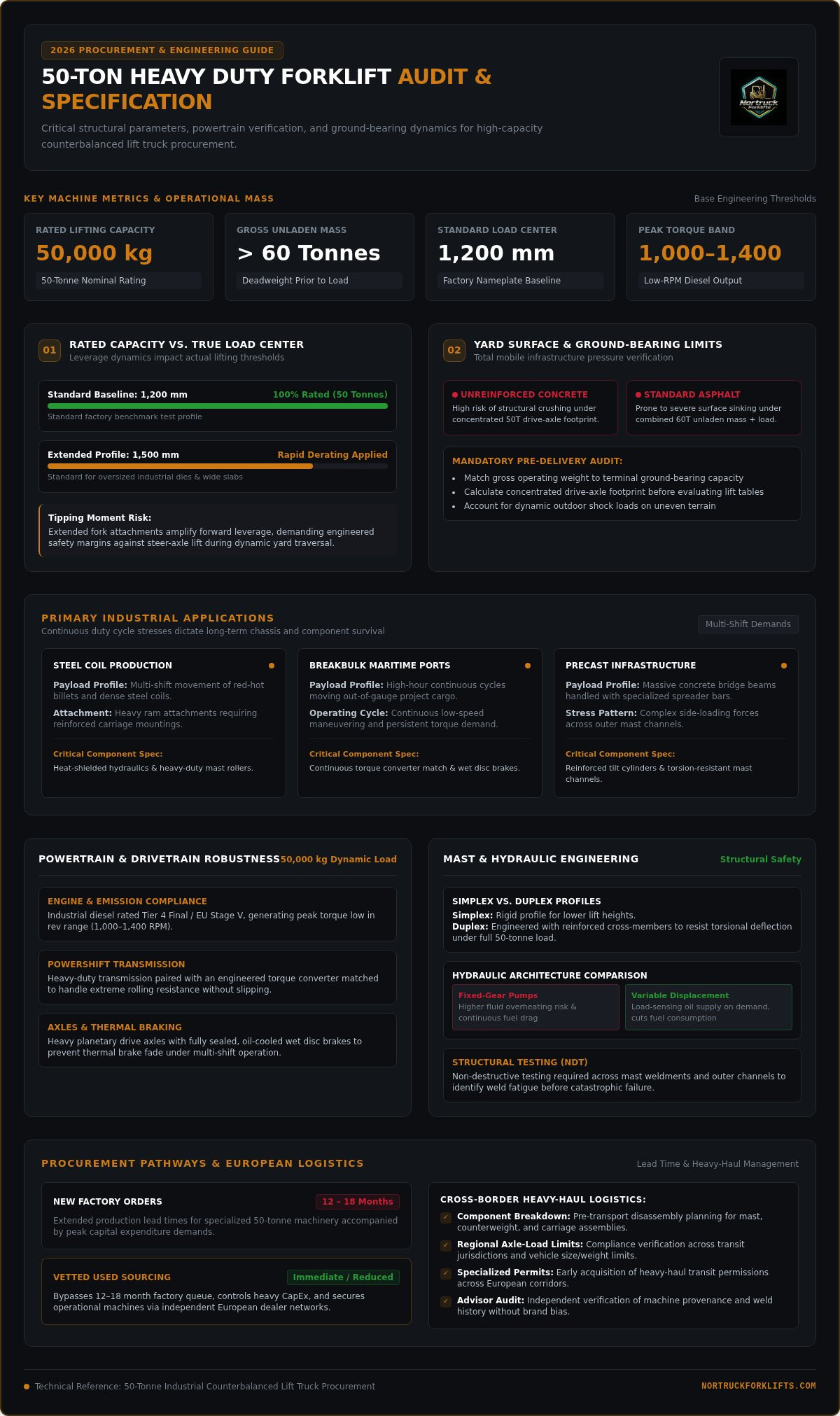
Operating a dedicated 50-tonne counterbalanced lift truck is fundamentally different from running standard yard machinery. While an industrial forklift manages predictable pallets inside warehouse bays, a 50-ton machine operates as mobile infrastructure. These units carry massive deadweights, often tipping the scales at over 60 tonnes unladen. When searching for a 50 ton heavy duty forklift for sale, understanding how that total mass interacts with your yard surface is your first technical hurdle. Concentrated axle loads under full capacity can crush unreinforced concrete or sink into standard asphalt, making ground-bearing pressure audits mandatory before delivery.
To see how these high-capacity machines maneuver and handle extreme structural loads in practical yard conditions, watch this demonstration:
Rated Capacity vs. True Load Center Dynamics
Nameplate ratings can be dangerously deceptive. Most manufacturers calculate a 50-tonne rating at a standard 1,200 mm load center. Move that center out to 1,500 mm, which is standard for wide industrial dies or oversized slabs, and leverage rapidly derates your actual lift threshold. Extended fork attachments further amplify forward tipping moments. Outdoor yard traversal introduces severe dynamic shock loads, meaning you must engineer a conservative safety margin to prevent steer-axle lift over uneven terrain.
Primary Industrial Applications and Duty Cycles
A continuous duty cycle determines whether a chassis survives long term. The operational demands shift dramatically depending on the exact material handled:
- Steel Coil Production: Multi-shift operations handle red-hot billets and dense coils using heavy ram attachments, demanding heat-shielded hydraulics and robust mast rollers.
- Breakbulk Maritime Ports: High-hour cycles move out-of-gauge project cargo, requiring continuous torque converter engagement and high-durability wet disc brakes.
- Precast Infrastructure Yards: Handling massive concrete bridge beams with spreader bars strains tilt cylinders, creating complex side-loading forces across the outer mast channels.
Matching the machine's structural profile to these application stresses ensures you invest in a viable 50 ton heavy duty forklift for sale rather than a chronic maintenance liability.
Technical Specifications to Scrutinize Before Buying
Evaluating a 50-tonne machine requires looking past superficial horsepower numbers. When assessing a 50 ton heavy duty forklift for sale, internal thermal capacity and hydraulic efficiency dictate whether the truck survives arduous multi-shift schedules or spends its operational life sidelined in a repair bay.
Powertrain Robustness and Emission Compliance
Continuous low-speed maneuvering with 50,000 kg on the forks generates immense mechanical heat. Look for proven Tier 4 Final or EU Stage V industrial diesels that produce peak torque low in the rev range, between 1,000 and 1,400 RPM. A heavy-duty powershift transmission must feature a matched torque converter engineered to handle extreme rolling resistance without slipping. Heavy planetary drive axles and sealed, oil-cooled wet disc brakes are critical to prevent thermal brake fade. Remember that these reinforced assemblies push total axle loads to extreme figures, which requires planning against Federal vehicle size and weight regulations whenever machinery moves between terminals.
Mast Engineering, Carriages, and Hydraulics
Mast failure causes immediate operational stoppage. Scrutinize the build profile based on your operational environment:
- Mast Profile: Choose between rigid simplex masts for lower lift heights and heavy duplex masts engineered with reinforced cross-members to resist torsional deflection under full load.
- Hydraulic Architecture: Prioritize load-sensing variable displacement pumps over fixed-gear pumps. They supply hydraulic oil strictly on demand, cutting fuel consumption and eliminating fluid overheating.
- Carriage Assemblies: Verify that integrated sideshifters and fork positioners use heavy-section guide bars capable of resisting continuous off-center torsional stress.
Operator Ergonomics and Visibility Configurations
Maneuvering a chassis that spans over four meters in width demands complete spatial control. Elevated cabins or hydraulically traversing operator stations give drivers an unobstructed line of sight over massive cargo. Dynamic load moment indicators and multi-camera arrays prevent tipping incidents by alerting drivers to shifting load centers in real time. If you need assistance matching powertrain and mast layouts to your specific terminal cycle, you can evaluate technical configurations with Nortruck Forklifts before committing capital.
Sourcing New vs. Used 50-Ton Heavy Duty Forklifts
Factory lead times for newly built 50-tonne machines often stretch beyond 12 to 18 months. When yard throughput cannot wait, acquiring a vetted pre-owned unit solves acute operational bottlenecks while preserving substantial capital. However, self-reported classified listings rarely reveal true operating conditions. Securing a reliable 50 ton heavy duty forklift for sale means verifying past service logs against documented hours, duty harshness, and hands-on structural testing.
Structural Inspection Protocols for High-Capacity Lifters
A machine handling 50 tonnes undergoes continuous structural flexing. Standard visual walkarounds aren't enough to catch impending metal failure:
- Non-Destructive Testing: Apply magnetic particle or dye-penetrant testing around high-stress zones, specifically chassis crossmember welds and steer axle trunnion pivots, to reveal invisible fatigue micro-fractures.
- Mast Channels and Rollers: Measure mast rail flanges with calipers to check wear limits. Excessive roller clearance allows the carriage to twist, putting uneven side-loading on lift cylinder rods.
- Chains and Anchor Pins: Gauge total chain stretch using a leaf chain wear scale. Any elongation exceeding standard engineering tolerances requires immediate scrap and replacement.
Powertrain and Hydraulic Health Diagnostics
Powertrain repairs on high-tonnage equipment cause severe downtime. Pull fluid samples from the engine, powershift transmission, and planetary wheel hubs for laboratory spectrographic analysis. Elevated iron, copper, or bronze counts indicate failing clutch discs or gear tooth spalling. Next, test the main hydraulic circuit with pressure gauges under full load; delayed cycle times or erratic valve relief pressures point directly to internal pump cavitation and scoring.
Total Cost of Ownership Considerations
Looking past the initial invoice price is essential when budgeting long-term operational expenditures. Factor in major rebuild milestones for planetary drive axles, hoist cylinders, and steering linkages around high-hour marks. Industrial pneumatic tyres provide better ground cushioning over gravel, but dense solid rubber options reduce puncture risks in metal processing environments despite transmitting harsher vibrations into the chassis. Premium equipment, such as Kalmar Heavy Lift Trucks, consistently holds higher residual value across secondary markets because structural components and drive packages are engineered for multiple overhaul lifecycles. Choosing a thoroughly vetted 50 ton heavy duty forklift for sale protects your capital expenditure from becoming a catastrophic write-down.
Cross-Border European Sourcing and Delivery Logistics
Securing a machine is only half the battle. Moving an abnormal load across European transit corridors demands meticulous physical planning. When you finalize terms on a 50 ton heavy duty forklift for sale across Europe, the logistics equation shifts immediately to axle load distribution, bridge clearance thresholds, and road authority permits.
De-Rigging and Modular Transit Requirements
Moving a counterbalanced truck of this magnitude as a single piece is rarely permissible on European highways. With unladen weights frequently exceeding 60 to 70 tonnes, the entire assembly exceeds standard gross vehicle weight ratings and bridge load limits. To clear these corridors legally, the unit undergoes modular de-rigging at the collection yard.
Specialized crews detach the multi-tonne counterweights, unpin the mast assembly, and remove the fork carriage. These components travel on separate multi-axle flatbeds and step-frame trailers. Qualified riggers must cap and label every high-pressure hydraulic line to protect sensitive load-sensing valve blocks against road grit, moisture, and contamination during transit.
Permits, Route Surveys, and On-Site Commissioning
Abnormal load transport across national borders requires navigating fragmented regulatory frameworks. Sourcing equipment through transit hubs in Germany, Belgium, or the Netherlands requires specialized permits, route surveys, and coordinated escort vehicles. Swept-path analysis ensures the multi-axle carrier navigates tight port roundabouts and facility pinch points without grounding the trailer.
Once the transport arrives at your yard, site preparation is critical. You need to arrange suitable mobile cranes for offloading, re-hang the mast onto the main pivot bushings, and torque all structural bolts to factory specifications. A certified technician must run full static and dynamic load tests before the machine enters active service.
Partnering with an Independent Heavy Lifting Advisor
Procuring high-tonnage machinery through traditional dealership channels often limits your operational choices. Mainline dealers must clear their own standing stock, while classified aggregators push unvetted units without mechanical accountability. Sourcing the right 50 ton heavy duty forklift for sale requires impartial technical advocacy that prioritizes your site's specific payload demands above brand sales targets.
The Advantage of Unbiased Equipment Sourcing
Every industrial manufacturer builds to slightly different engineering philosophies. While one brand excels in thermal management during prolonged port container handling, another offers superior chassis rigidity for dense steel coils. An independent advisor provides objective guidance across premium platforms, helping you compare builders like Kalmar and Linde without commercial pressure. For a deeper look at fleet integration, review our guide on sourcing Kalmar heavy lift trucks for sale. Matching factory options to your duty cycle prevents paying for features you won't use while ensuring your real-world cycle speeds remain protected.
Navigating European Heavy Machinery Markets
Many of the cleanest, low-hour 50-tonne machines never appear on open classified portals. They change hands privately between specialized fleet operators across northern Europe. Tapping into cross-border industrial networks lets you bypass intermediary price layers and long factory queues. We examine these regional procurement channels in our European forklift market guide. Direct sourcing ensures you receive complete machine provenance, verified maintenance histories, and transparent operating records from previous applications.
Securing Your Machinery Sourcing Strategy
A successful procurement process links mechanical inspection, pavement calculations, and haulage logistics into a cohesive plan. Backed by over 40 years of heavy lifting expertise through Lars G Tarby, this advisory approach ensures your equipment purchase aligns with operational velocity and local safety standards. Don't risk capital on unvetted machinery. Reach out directly to Nortruck Forklifts to locate, inspect, and secure the exact 50 ton heavy duty forklift for sale that fits your terminal profile.
Securing the Right High-Capacity Lifting Solution
Deploying extreme-tonnage equipment demands an uncompromising technical approach. From calculating true load center deration curves and yard pavement limits to executing non-destructive weld inspections, every diagnostic step shields your terminal from catastrophic downtime. Evaluating a vetted 50 ton heavy duty forklift for sale across Europe bypasses lengthy factory backlogs, but success requires coordinating modular heavy-haul logistics and abnormal road permits with precision.
With over 40 years of dedicated industry experience led by Lars G Tarby, Nortruck Forklifts provides unbiased advisory tailored to high-capacity industrial demands. We tap into deep cross-border networks across major European industrial centers, securing proven machines that match your exact operational requirements without commercial dealer bias.
Taking the time to verify structural integrity and transport corridors today guarantees reliable lifting performance and dependable terminal productivity for years to come.
Frequently Asked Questions
What is the typical load center for a 50 ton heavy duty forklift?
The standard rated load center for a 50-tonne forklift is typically 1,200 mm from the fork face. Handling wider industrial loads, such as large steel coils or precast slabs, often pushes that center out to 1,500 mm or more. When evaluating a 50 ton heavy duty forklift for sale, always audit the manufacturer's deration chart to verify the truck's actual capacity at your operational center of gravity.
How much does a 50 ton forklift weigh without payload?
An unladen 50-ton forklift typically weighs between 55 and 70 tonnes, depending on the specific chassis length and counterweight arrangement. That massive deadweight is necessary to counterbalance 50,000 kg payloads at full mast elevation. This unladen mass generates heavy axle ground pressure, making comprehensive yard pavement assessments essential before you take delivery of a machine at your terminal.
Can a 50 ton forklift be transported on public roads in one piece?
No, transporting an intact 50-tonne lift truck on public highways isn't feasible across European corridors due to legal axle-load limits and bridge overhead clearances. Moving these units requires modular de-rigging at the collection yard. Rigging teams detach the counterweights, unpin the upright mast, and remove the carriage so individual components can travel legally on separate multi-axle trailers with abnormal load permits.
How does duty cycle affect the lifespan of a heavy forklift in a steel mill?
Continuous, multi-shift steel production accelerates mechanical wear much faster than intermittent port work. Handling red-hot slabs and dense billets exposes hydraulic cylinders, steer trunnions, and mast rollers to radiant heat and airborne grit. Operating in these harsh conditions shortens component overhaul intervals, requiring regular spectrographic oil sampling and non-destructive weld testing to prevent unexpected structural fatigue failure.
What engine platforms are standard in modern 50-ton heavy forklifts?
Modern 50-tonne lift trucks rely on industrial diesel engines, such as units from Volvo Penta or Cummins, engineered to meet EU Stage V or Tier 4 Final emissions standards. These heavy six-cylinder diesels deliver high low-end torque between 1,000 and 1,400 RPM. That pulling power allows the machine to overcome severe rolling resistance while powering variable-displacement hydraulic pumps without thermal overheating.
Is it better to purchase a new or used 50-ton heavy lift truck?
Deciding between new and used depends on your operating schedule and budget. Factory lead times for newly built units often exceed 12 to 18 months. Sourcing a vetted used 50 ton heavy duty forklift for sale eliminates production downtime and preserves capital, provided the machine passes rigorous non-destructive structural testing and fluid diagnostics conducted by seasoned equipment advisors.
Why are wet disc brakes essential on 50-tonne machines?
Wet disc brakes are completely enclosed and continuously cooled by circulating hydraulic oil, preventing thermal fade under continuous heavy braking. Bringing a combined operating mass of over 110 tonnes to a stop creates extreme friction heat that glazed dry brakes cannot manage. Oil-cooled brake systems protect friction plates from terminal grit, require less frequent servicing, and maintain consistent stopping force.

Article by
Lars Gunnar Tärby
Disclaimer
1. General Information and No AdviceThe information, articles, product descriptions, and specifications provided on this website (www.nortruckforklifts.com) are for general informational and educational purposes only. While we strive to provide accurate and up-to-date content regarding new and used forklifts and heavy machinery, the material published does not constitute professional, technical, or legal advice.
2. Product Specifications and PricingNortruck Forklifts acts as a facilitator for the trade of new and used forklifts. All equipment details, including but not limited to year of manufacture, operating hours, lift capacity, dimensions, conditions, and pricing, are provided based on the information available to us at the time of publication. Specifications and availability are subject to change without prior notice.
3. "As Is" and VerificationAll articles and product listings are provided on an "as is" and "as available" basis without any warranties of any kind, either express or implied. Nortruck Forklifts does not guarantee that the descriptions are entirely error-free, complete, or reliable. Buyers and traders are strongly encouraged to independently verify all technical specifications, machine history, and equipment conditions directly with the seller or an authorized inspector before finalizing any purchase or transaction.
4. Limitation of LiabilityIn no event shall Nortruck Forklifts, its owners, or its contributors be held liable for any direct, indirect, incidental, consequential, or economic loss or damage arising out of the use of, or the inability to use, the information provided on this website, or any transactions facilitated through this platform. This includes, but is not limited to, damages caused by technical inaccuracies, typographical errors, or reliance on the content of our articles.
5. Third-Party LinksOur website may contain links to external websites, dealer networks, or third-party services that are not owned or controlled by Nortruck Forklifts. We have no control over, and assume no responsibility for, the content, privacy policies, or practices of any third-party websites.


