
Expanding your warehouse footprint doesn't always require a construction crew or a new lease. For many facilities handling timber, steel, or plastics, the real bottleneck isn't the four walls; it's the dead space required for standard forklifts to turn. A specialized 4-way forklift for narrow aisle applications changes that math entirely. By moving sideways, these machines eliminate the wide turning radiuses that force your racking further apart.
We understand the frustration of watching valuable square footage go to waste simply because your current fleet can't handle long loads safely in tight corridors. It's a common operational drain that impacts both safety and speed. This guide will show you how multidirectional technology can reclaim up to 50% of your existing warehouse space while securing a machine with a lower total cost of ownership. We'll explore the latest 2026 models from brands like Combi-Lift and Baumann and share our expert methods for sourcing high-quality units across the European market.
Key Takeaways
- Learn how to reclaim up to 50% of your warehouse footprint by eliminating the wide turning radiuses required by standard counterbalance trucks.
- Understand the mechanics of a 4-way forklift for narrow aisle use, including how multidirectional steering solves the challenge of handling long loads.
- Compare the specialized offerings of Combi-Lift and Baumann to choose between agile warehouse maneuverability and high-capacity sideloading durability.
- Navigate the 2026 European market by leveraging cross-border sourcing strategies that provide access to better inventory and specialized machinery.
- Discover why evaluating your specific material flow and warehouse layout is the most critical step in securing a machine with a low total cost of ownership.
The Narrow Aisle Challenge: Reclaiming Your Warehouse Footprint
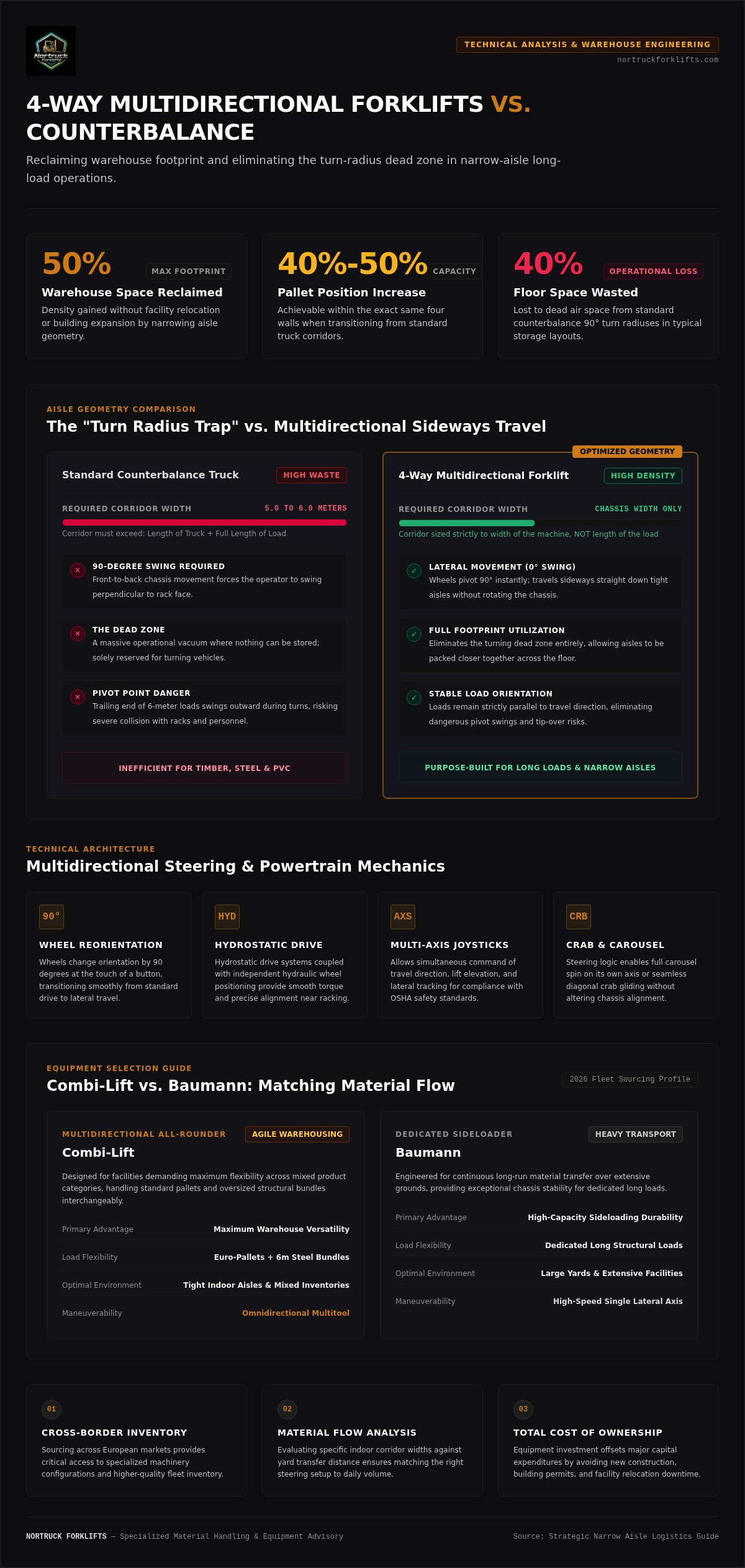
Warehouse expansion is often viewed through the lens of new construction or facility relocation, but the most efficient route lies in optimizing the layout you already have. The primary driver of wasted space in most industrial settings isn't the racking itself, but the wide corridors required to service it. Choosing a 4-way forklift for narrow aisle operations is one of the most effective ways to reclaim lost square footage without moving a single brick. When you rely on standard equipment, you aren't just paying for storage; you're paying for the "air space" required for a truck to turn.
The economic logic is straightforward. The cost of relocating a facility or expanding an existing building typically involves massive capital expenditure, permit delays, and operational downtime. In contrast, upgrading to specialized machinery allows for a denser racking configuration. By narrowing your aisles, you can often increase your pallet positions by 40% to 50% within the same four walls. Advancements in Forklift design and technology have introduced multidirectional steering to solve these specific geometry problems, ensuring that your investment in equipment pays for itself through improved land-use efficiency.
Why Counterbalance Trucks Waste 40% of Your Floor Space
Standard counterbalance trucks are designed for front-to-back movement and require a significant "Turn Radius Trap" to function. To place a load, the truck must turn 90 degrees, meaning the aisle width must exceed the length of the truck plus the length of the load. In environments handling timber or steel, this forces aisles to be five or six meters wide. This creates a "Dead Zone" where nothing is stored, and nothing is happening except for a vehicle swinging into position. Integrating a 4-way forklift for narrow aisle environments eliminates this requirement because the machine travels sideways, allowing aisles to be sized to the width of the machine rather than the length of the load.
Long Load Logistics: The Danger of Wide Turns
Handling materials like piping, PVC, or structural steel with a standard forklift is inherently unstable. When a truck carries a six-meter load perpendicularly, the center of gravity is easily compromised during turns, increasing the risk of tip-overs or product damage. In narrow corridors, the margin for error disappears. The pivot point risk in narrow aisles refers to the dangerous outward swing of a long load’s trailing end when a standard forklift initiates a turn, often resulting in collisions with racking or personnel. Multidirectional trucks solve this by keeping the load parallel to the direction of travel, significantly reducing the physical footprint of the maneuver and protecting your inventory.
What is a 4-Way Forklift? Understanding Multidirectional Technology
A multidirectional truck redefines warehouse geometry through its steering mechanics. Unlike standard units that only move forward and backward, a 4-way forklift for narrow aisle storage can change the orientation of its wheels by 90 degrees at the touch of a button. This enables seamless side-to-side travel. The transition from standard mode to "carousel" or "crab" steering allows the machine to spin on its own axis or glide laterally down a corridor without turning the chassis itself.
This agility relies on advanced engineering components. Most modern units utilize hydrostatic drive systems combined with independent hydraulic wheel positioning. This setup provides smooth torque control and precise wheel alignment, which are essential when maneuvering heavy loads near expensive racking. Because the controls differ from standard layouts, operators typically use multi-axis joysticks that manage direction, lift, and lateral movement simultaneously. While this requires specific training to master, it ensures compliance with international guidelines, including OSHA forklift safety standards, by giving the operator total control over the load path.
Multidirectional vs. Standard Sideloaders
Choosing between these two options depends entirely on your material flow. Dedicated sideloaders, such as those from Baumann, are built for high-speed, long-distance transport of long loads across large yards or extensive indoor facilities. They offer excellent stability but operate primarily in one lateral direction. Conversely, a 4-way truck offers maximum versatility. It handles standard euro-pallets just as easily as six-meter steel bundles, making it an excellent multi-tool for mixed-inventory facilities. If your operations require this level of flexibility, exploring a Combi-Lift 4-way truck for sale can help you consolidate your fleet into fewer, more capable machines.
The Role of 4-Way Tech in Narrow Aisle (VNA) Applications
In traditional setups, wide transfer aisles are mandatory just to let trucks move between storage zones. Multidirectional technology eliminates these large gaps entirely, allowing you to run cantilever racking right up to the edge of your transit paths. The precision steering systems allow operators to guide the machine into guided or unguided narrow aisles with as little as 100mm of clearance on either side. If you are looking to optimize your facility's layout with this technology, reaching out to an experienced advisor at Nortruck Forklifts can provide the technical clarity needed to match a machine to your specific aisle dimensions.
Combi-Lift vs. Baumann: Choosing the Right 4-Way Solution
Selecting the ideal 4-way forklift for narrow aisle operations often comes down to a choice between two industry leaders: Combi-Lift and Baumann. Both manufacturers have spent decades refining multidirectional technology, yet they cater to distinct operational needs. While Combi-Lift focuses on maximizing warehouse density and versatility, Baumann is widely recognized for its engineering excellence in high-capacity sideloading. According to the Material Handling Industry (MHI), selecting equipment that matches specific material flow is the most critical factor in long-term operational efficiency.
In 2026, the market is seeing a definitive shift toward electrification. Electric forklifts are expected to account for over 70% of new truck sales in Europe this year, driven by the adoption of high-performance Lithium-ion batteries. These power sources offer faster charging and longer cycles, making them viable even for heavy-duty 4-way applications that previously required diesel or LPG engines. Whether you need a compact 2.5-tonne unit or a specialized 25-tonne heavy lifter, the move toward sustainable power is now a standard consideration in any sourcing strategy.
Combi-Lift: The King of Multidirectional Versatility
Combi-Lift has built its reputation on the "3-in-1" concept. The C-Series models function as a counterbalance truck, a reach truck, and a sideloader all in one chassis. This versatility allows a single 4-way forklift for narrow aisle use to unload a lorry in the yard and then place long loads directly into high-density indoor racking. This eliminates the need for double-handling materials. While Combi-Lift dominates the warehouse market, it's worth comparing these units against dedicated sideloaders to ensure you aren't sacrificing travel speed for maneuverability. You can learn more about these trade-offs in our Baumann Sideloader Sourcing Guide.
Baumann: Precision Engineering for Long Load Specialists
If your operations involve high-speed, long-distance transport across uneven yard surfaces, Baumann is the specialist choice. Their sideloaders feature advanced auto-leveling systems that maintain load stability even on challenging terrain. Unlike the multi-purpose focus of Combi-Lift, Baumann units are engineered for durability in intense, dedicated sideloading roles. While models like the diesel BHX 50 continue to be manufactured for 2026, their electric counterparts are rapidly gaining ground due to lower total cost of ownership over the machine's lifecycle. We often find that for clients handling heavy timber or steel bundles outdoors, the high-capacity stability of a Baumann justifies the investment.
Sourcing 4-Way Forklifts in Europe: New vs. Used Strategies
Sourcing a specialized 4-way forklift for narrow aisle applications requires a broader perspective than searching local dealership yards. In 2026, factory lead times for new custom multidirectional equipment can extend significantly depending on the manufacturer's backlog. This makes the used market an attractive, cost-effective alternative. Because these machines are highly specialized, the highest concentration of quality inventory is often found across borders in major industrial hubs like Germany, Denmark, and the UK, where large fleets cycle out their machinery regularly.
Procuring a used multidirectional truck requires a strict inspection protocol. Unlike standard forklifts, you must verify the integrity of the multi-directional steering valves, the synchronization of the wheel motors, and the wear patterns on the mast channels. Neglecting these technical details can lead to high repair costs that quickly erase any initial savings. When calculating the Total Cost of Ownership (TCO), smart buyers factor in cross-border transport logistics, local commissioning, and any applicable compliance adjustments to ensure the final investment aligns with their budget.
The Benefits of Independent Advisory in Procurement
Navigating the pan-European market on your own can be challenging due to regional dealer markups and fragmented service histories. Working with an independent advisor allows you to bypass these intermediaries and source directly from vetted European fleets. This approach ensures that you receive transparent equipment histories for used Combi-Lift or Baumann units, protecting you from hidden mechanical issues. For a deeper analysis of current availability and pricing trends across the continent, you can consult our comprehensive European Forklift Market Guide.
Importing Heavy Machinery: Logistics and Compliance
Cross-border procurement requires careful attention to regulatory compliance and transport logistics. Any machine sourced within or imported into the European Union must meet current safety standards and carry valid CE certification. Transporting a 4-way forklift for narrow aisle use also presents unique physical challenges, as the wider chassis configurations of certain multidirectional models require specialized low-loader transport and precise route planning. When evaluating your options, a critical rule of thumb is that a used 4-way forklift typically requires a comprehensive hydraulic and electronic diagnostic assessment once it passes the 5,000-hour operating threshold to ensure long-term reliability.
Contact Nortruck Forklifts to Source Your Next 4-Way Unit
Expert Advisory: Optimizing Your Narrow Aisle Strategy
Acquiring heavy machinery should never be treated as a simple transaction. True optimization occurs when your layout planning precedes your machine purchase. Buying a 4-way forklift for narrow aisle storage without analyzing your physical environment can lead to mismatched equipment capabilities. We focus on evaluating your specific material flow, rack height, and load characteristics before recommending a particular brand or model, ensuring the vehicle integrates seamlessly into your facility.
A recent case study illustrates the impact of this approach. A European timber yard facing severe capacity constraints was considering a costly facility expansion. By reconfiguring their cantilever racking and sourcing a used Combi-Lift multidirectional unit, they reclaimed 35% of their storage capacity within their existing footprint. This operational shift eliminated double-handling and improved material throughput. We provide low-pressure consultations designed to uncover these specific layout opportunities, giving you a clear perspective on your logistics challenges before you invest in hardware.
Customizing Your Sourcing Brief
To find the right unit, you need a precise sourcing brief. This process begins by defining your "Max Load" profile, including the maximum weight, length, and lift height required, alongside your absolute aisle width constraints. You must also match fuel types to your environment. While electric units are ideal for indoor air quality, certain outdoor operations with uneven ground still benefit from diesel or LPG models. Once these parameters are clear, we compile a tailored sourcing report that scans the European market for new or used machinery that fits your exact operational envelope.
Contact Nortruck Forklifts for Independent Lifting Advice
With more than 40 years of industry experience, Nortruck Forklifts specializes in translating technical warehouse challenges into practical, cost-effective solutions. As an independent advisor, Lars G. Tarby guides businesses through the complexities of cross-border procurement without the bias of local dealer agreements or hidden markups. We prioritize direct, transparent communication to ensure you secure reliable machinery with a lower total cost of ownership. If you are ready to evaluate your facility layout and explore the market for specialized multidirectional equipment, we invite you to Consult with Nortruck Forklifts on your narrow aisle requirements.
Securing Your Warehouse Efficiency for 2026 and Beyond
Optimizing your storage layout requires looking beyond local inventory to find the exact machinery your material flow demands. Implementing a 4-way forklift for narrow aisle configurations allows you to maximize your current floor space while maintaining high safety standards. Success depends on matching your specific load profiles with the right manufacturer, whether that means the multi-purpose agility of Combi-Lift or the robust stability of Baumann sideloaders.
At Nortruck Forklifts, we apply over 40 years of heavy lifting expertise to guide you through this selection process. It's an approach built on transparent communication and independent, European-wide sourcing to find the right new or used unit for your fleet without unnecessary dealer markups.
Taking the time to align your layout with specialized multidirectional technology ensures your facility is built for long-term operational success.
Frequently Asked Questions
What is the minimum aisle width required for a 4-way forklift?
The minimum aisle width depends on the chassis width of the machine and the depth of your load rather than its length. For a typical compact 4-way forklift for narrow aisle applications, you can operate comfortably in aisles as narrow as 2.5 to 3 meters. This allows for approximately 100mm to 150mm of clearance on either side of the truck during lateral travel, significantly reducing the space required by standard counterbalance units.
Can a 4-way multidirectional forklift operate on uneven outdoor surfaces?
Yes, specific multidirectional models are engineered for semi-rough terrain and outdoor yards. While compact electric models are optimized for flat indoor warehouse floors, larger internal combustion or heavy-duty electric units feature larger rubber tires and advanced hydrostatic drive systems. Brands like Baumann also include specialized hydraulic cabin leveling systems to maintain stability when transporting long materials across uneven ground or gravel yards.
How does a 4-way forklift differ from a standard reach truck?
A standard reach truck operates primarily in two directions, moving forward and backward while using a pantograph or moving mast to reach into racking. A 4-way forklift introduces independent wheel steering that allows the entire chassis to travel sideways down an aisle. This makes the multidirectional truck far more effective for handling long loads like timber and steel pipes, whereas a standard reach truck remains limited to conventional square pallets.
What are the maintenance requirements for multidirectional steering systems?
Multidirectional steering systems require regular diagnostic checks of the hydraulic proportional valves, wheel alignment sensors, and steering cylinder seals. Because all wheels pivot independently, maintaining proper tire pressure and monitoring mechanical wear at the pivot points is essential. Routine lubrication of the steering linkages and checking the synchronization software during standard service intervals will prevent tracking errors and ensure precise handling in tight spaces.
Is it better to buy a new or used Combi-Lift for narrow aisle operations?
The choice depends on your operational hours and budget constraints. A new Combi-Lift provides the latest battery technology and full factory warranties, which is ideal for high-intensity, multi-shift operations. However, a well-inspected used unit with a verified service history offers excellent value for medium-duty applications, often costing 25% to 50% less than a new model while delivering the same space-saving benefits.
How much warehouse capacity can I realistically gain with a 4-way truck?
Most facilities reclaim between 35% and 50% of their existing floor space by converting to a 4-way forklift for narrow aisle layouts. This capacity gain is achieved by shrinking aisle widths from five meters down to less than three meters. This allows you to install extra rows of cantilever or pallet racking within the exact same building footprint, effectively avoiding the high costs of facility relocation.
What safety features should I look for in a 4-way forklift?
You should prioritize units equipped with automatic speed reduction during cornering, overload protection sensors, and clear all-round cabin visibility. Advanced 2026 models feature integrated display controllers that show the exact wheel direction in real time, which helps operators avoid steering errors. Overhead guards, camera systems for high-level racking, and blue safety spotlights are also critical for protecting personnel in high-density storage zones.
Does Nortruck provide sourcing services for specialized 4-way attachments?
Yes, we source specialized attachments as part of our independent procurement process. Whether your material flow requires hydraulic fork positioners, telescopic forks, or customized spreader beams for exceptionally flexible loads, we locate these configurations through our European network. We focus entirely on advisory-led sales and procurement, ensuring the complete machinery package matches your specific material handling challenges perfectly.

Article by
Lars Gunnar Tärby
Disclaimer
1. General Information and No AdviceThe information, articles, product descriptions, and specifications provided on this website (www.nortruckforklifts.com) are for general informational and educational purposes only. While we strive to provide accurate and up-to-date content regarding new and used forklifts and heavy machinery, the material published does not constitute professional, technical, or legal advice.
2. Product Specifications and PricingNortruck Forklifts acts as a facilitator for the trade of new and used forklifts. All equipment details, including but not limited to year of manufacture, operating hours, lift capacity, dimensions, conditions, and pricing, are provided based on the information available to us at the time of publication. Specifications and availability are subject to change without prior notice.
3. "As Is" and VerificationAll articles and product listings are provided on an "as is" and "as available" basis without any warranties of any kind, either express or implied. Nortruck Forklifts does not guarantee that the descriptions are entirely error-free, complete, or reliable. Buyers and traders are strongly encouraged to independently verify all technical specifications, machine history, and equipment conditions directly with the seller or an authorized inspector before finalizing any purchase or transaction.
4. Limitation of LiabilityIn no event shall Nortruck Forklifts, its owners, or its contributors be held liable for any direct, indirect, incidental, consequential, or economic loss or damage arising out of the use of, or the inability to use, the information provided on this website, or any transactions facilitated through this platform. This includes, but is not limited to, damages caused by technical inaccuracies, typographical errors, or reliance on the content of our articles.
5. Third-Party LinksOur website may contain links to external websites, dealer networks, or third-party services that are not owned or controlled by Nortruck Forklifts. We have no control over, and assume no responsibility for, the content, privacy policies, or practices of any third-party websites.


