
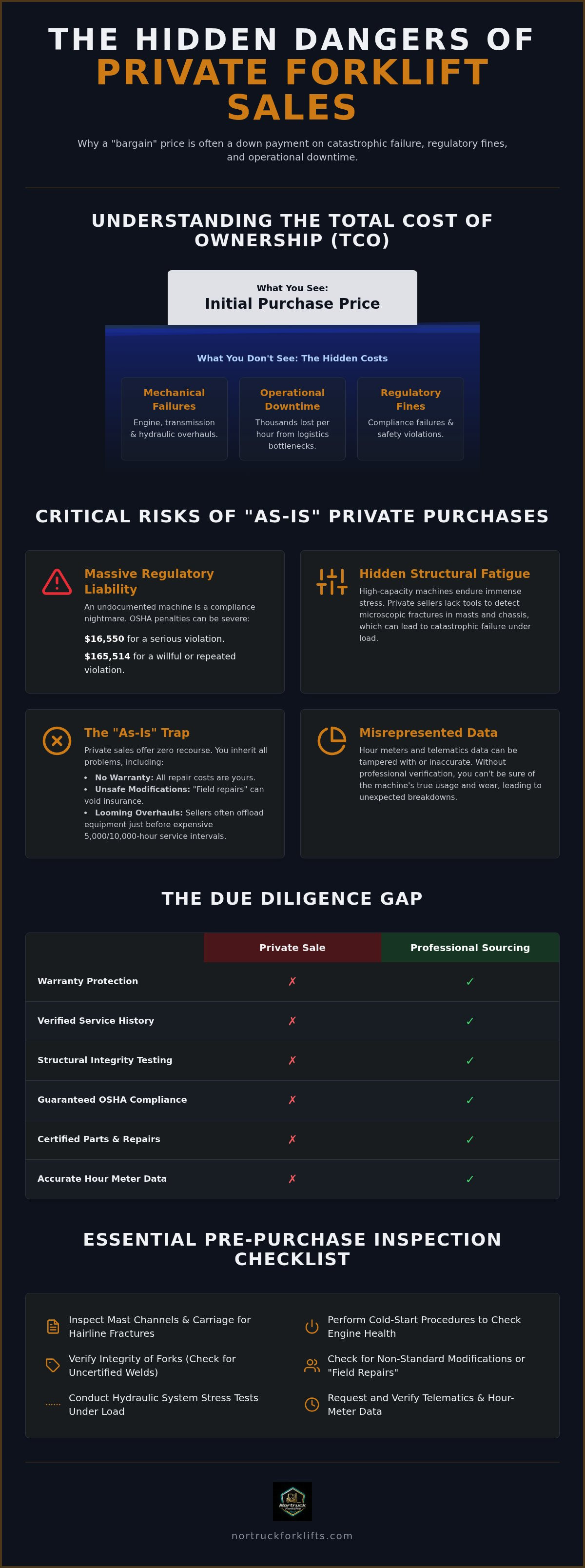
The "bargain" price of a private sale is often just a down payment on a catastrophic structural failure or an obsolete parts nightmare. When you see a used Linde or Toyota listed at a fraction of the market rate on a private forum, it's natural to want to move fast. However, the risks of buying used forklifts privately often outweigh the initial savings. With OSHA penalties for serious violations now reaching $16,550 and a heightened focus on digital maintenance records, an undocumented machine is more than a mechanical gamble; it's a regulatory liability.
We understand the pressure to keep your fleet running while minimizing the total cost of ownership. You need reliable heavy lifting equipment that won't fail during a peak shift or result in a $165,514 fine for a willful safety violation. This article reveals the hidden structural and financial pitfalls of the private market and provides a professional sourcing strategy to protect your investment. We will walk through the 2026 expert checklist, from evaluating "value-per-hour" metrics to ensuring your next Kalmar or Baumann meets every safety and compliance standard before it hits your floor.
Key Takeaways
- Learn to calculate the true cost of ownership beyond the initial sticker price, accounting for hidden mechanical liabilities and operational readiness.
- Discover how to identify structural fatigue in masts and chassis, particularly in high-capacity units exceeding 10 tonnes.
- Understand the major risks of buying used forklifts privately and how to verify telematics and hour-meter data that may be misrepresented.
- Gain access to a professional pre-purchase checklist covering critical cold-start procedures and hydraulic system stress tests.
- Explore how a direct European sourcing strategy removes unnecessary intermediaries to secure reliable, compliant machinery from trusted brands.
The Hidden Cost of Private Forklift Acquisitions in 2026
A low price tag on a private listing for a 16-tonne Kalmar or a heavy-duty Linde often feels like a win for your procurement budget. In the 2026 machinery market, however, these "deals" are frequently a mask for looming mechanical failures. Modern heavy lifting equipment has shifted away from simple mechanical systems toward highly integrated, software-driven architectures. When you bypass professional sourcing, you aren't just buying a piece of iron; you're often inheriting a complex electronic system that the previous owner couldn't or wouldn't maintain correctly. The risks of buying used forklifts privately center on this lack of transparency. Without a verified service history or professional diagnostic report, that initial saving can vanish within the first month of operation.
Understanding Total Cost of Ownership (TCO)
Total Cost of Ownership (TCO) represents the cumulative expense of acquiring, operating, and maintaining a forklift over its entire functional lifecycle. While a standard 2.5-tonne warehouse unit has predictable upkeep, the TCO for a 30-tonne heavy lift truck is a different calculation entirely. Maintaining these high-capacity machines requires specialized technicians and proprietary parts that carry a significant premium. For example, a single set of specialized tires or a major hydraulic seal replacement on a reachstacker can cost more than the purchase price of a smaller used unit. In a port or industrial terminal, the true cost of a private sale isn't the repair bill alone. It's the thousands of dollars lost every hour the machine sits idle, creating a bottleneck that ripples through your entire logistics chain.
The 'As-Is' Trap in Private Sales
Private transactions are almost exclusively "as-is" deals, which leaves you with zero legal recourse when a structural defect appears. This is particularly dangerous for high-capacity trucks where Forklift safety standards are non-negotiable. Many private sellers choose to offload their equipment just as it approaches major service intervals, such as the 5,000 or 10,000-hour mark. These milestones often require expensive overhauls of the transmission or mast assembly that a seller wants to avoid.
- No Warranty Protection: Unlike dealer-certified units, a private sale offers no powertrain or structural guarantees.
- Hidden Modifications: Private owners sometimes perform "field repairs" or non-standard modifications that compromise the machine's integrity and void future insurance claims.
- Regulatory Liability: If a privately purchased machine fails an inspection due to a pre-existing structural crack, the financial burden of bringing it into compliance falls entirely on you.
Buying privately means you're gambling that the previous owner prioritized long-term health over short-term fixes. In the heavy lift industry, that's a bet that rarely pays off. You don't want to find out your "new" sideloader has a hairline fracture in the chassis while it's carrying a full load. The risks of buying used forklifts privately are simply too high when your operational safety and bottom line are at stake.
Technical and Structural Risks in High-Capacity Machinery
Assessing a 15-tonne Kalmar or a heavy-duty Linde demands a technical rigor that standard warehouse checklists simply don't provide. One of the greatest risks of buying used forklifts privately is the presence of structural fatigue that isn't visible to the untrained eye. In high-capacity machinery, the chassis and mast undergo immense cyclical stress. Over time, this leads to microscopic fractures that can cause catastrophic failure under a full load. Private sellers rarely possess the ultrasonic testing equipment needed to verify structural integrity, leaving the buyer to discover these issues during a mandatory safety inspection. Compliance with OSHA forklift operation standards is not optional; a machine with compromised structural welds or non-certified modifications will be immediately decommissioned by regulators.
Mast and Carriage Stress Points
Focus your inspection on the mast channels and carriage pivot points, where hairline fractures typically emerge first. In high-intensity environments like steel mills or heavy manufacturing, duty cycles are far more brutal than in standard logistics. It's common to find "repaired" forks in private fleets. Without a metallurgical certification to prove the repair's integrity, these forks are a massive liability. The heat from welding often changes the temper of the steel, making it brittle. A fork that snaps under a 20-tonne load isn't just an equipment failure; it's a life-threatening event.
Engine and Transmission Health
Heavy lift trucks typically rely on Volvo or Cummins powerplants that require meticulous maintenance. Watch for "blow-by" in the crankcase or erratic idle patterns that suggest fuel system neglect. A common mistake when evaluating private listings is testing the machine while it's empty. A transmission might feel smooth on a flat parking lot but slip significantly once it attempts to lift a heavy container. Replacing a high-capacity torque converter is a massive expense that can instantly double your total investment. If you're concerned about these technical hurdles, consulting a specialized forklift advisor can prevent a costly procurement error.
You must also consider electronic obsolescence. Sourcing a specific controller for an older Linde or Kalmar model can take months if the private seller hasn't kept the system updated. A machine that looks perfect can become an expensive paperweight because of a single unavailable circuit board. Finally, always verify the capacity plate. Private sellers sometimes swap attachments, like side-shifters or rotators, without updating the official plate. This makes the machine illegal to operate and dangerously unpredictable for your staff. These technical nuances are why expert sourcing remains the only way to ensure 100% safety and regulatory compliance.
The Due Diligence Gap: Private Sellers vs. Expert Sourcing
Bridging the information gap between a private seller's claims and a machine's actual history is the most challenging part of procurement. While a professional dealer provides a transparent paper trail, the risks of buying used forklifts privately often manifest as missing or intentionally altered maintenance records. A seller might present a clean-looking machine, but without a verifiable service log, you have no way of knowing if the hydraulic fluid was changed at the correct intervals or if a major component is nearing the end of its fatigue life. Independent advisors serve a critical role here by bypassing the "sticker story" and accessing telematics data that provides an unvarnished look at how the machine was actually treated.
Verifying Machine History and Hours
Don't take an hour meter at face value. In older industrial equipment, "clocking" or replacing meters is a known tactic to inflate resale value. A seasoned advisor cross-references serial numbers with manufacturer databases to confirm the machine's true age and service milestones. It's equally vital to identify the previous application. A 12-tonne forklift used in a salt-water port environment faces aggressive corrosion risks that an indoor warehouse unit never encounters. These environmental factors aren't always visible in photos, but they fundamentally change the machine's remaining lifespan and your future maintenance budget.
European Sourcing Complexities
Moving heavy machinery across European borders adds a layer of bureaucratic and logistical risk that most private sellers are unequipped to handle. You must navigate varying VAT regulations and ensure all import/export documentation is airtight to avoid costly delays at the border. Transporting a 40-tonne unit isn't as simple as hiring a standard freight carrier; it requires specialized low-loaders, permits for oversized loads, and precise route planning. If you are Sourcing Kalmar Heavy Lift Trucks for Sale, you need a partner who understands these cross-jurisdictional nuances to ensure the machine arrives on site without legal or financial surprises.
Finally, safety compliance often hinges on CE Certification. A private seller might have lost the original documentation or purchased a machine that was originally destined for a non-EU market. Operating a high-capacity forklift without valid CE paperwork can lead to immediate site shutdowns and the loss of insurance coverage. The risks of buying used forklifts privately extend far beyond the mechanical; they encompass a web of regulatory requirements that only expert sourcing can reliably navigate.
Your Essential Pre-Purchase Inspection Checklist
Conducting a physical inspection is your last line of defense against a bad investment. The risks of buying used forklifts privately are often masked by a fresh coat of paint or a steam-cleaned engine bay. You must approach the machine with a methodical, technical eye to uncover what the seller might be hiding. A visual walkaround isn't enough when your operational efficiency and staff safety are on the line.
- Step 1: Perform a cold start. Insist that the engine hasn't been run for several hours before you arrive. Listen for knocking and watch the exhaust for blue or white smoke, which signals oil consumption or fuel system failure. Monitor the hydraulic pressure as the oil warms; a pressure drop during warmup suggests a failing pump.
- Step 2: Structural Audit. Use a high-intensity light to inspect every weld on the mast, carriage, and chassis. Look for "stress blooms" or cracked paint. These are early indicators of structural fatigue that we discussed in previous sections.
- Step 3: Plate Verification. Ensure the load capacity plate correctly reflects any fitted attachments. A machine with a side-shifter or rotator has a lower net capacity than the base model. If the plate doesn't match the configuration, the machine is illegal to operate.
- Step 4: History Cross-Check. Compare the wear on foot pedals, steering wheels, and seats with the hour meter. If the meter shows low hours but the cabin looks heavily aged, the hours have likely been misrepresented.
- Step 5: Safety Systems. Test the load-moment indicators (LMI) specifically on reachstackers. These systems are critical for preventing tip-overs and are incredibly expensive to replace if they've been bypassed or neglected.
The Load Test: The Ultimate Proof
Testing a machine while it's empty tells you almost nothing about its true condition. You must operate the unit at 100% of its rated capacity to see how the hydraulics and transmission behave under stress. Watch for hydraulic drift, where the load slowly lowers on its own. This indicates internal seal leakage in the lift cylinders or a faulty control valve. The risks of buying used forklifts privately are highest during this phase, as many privately owned machines haven't seen a full-capacity lift in months. For more context on capacity requirements, see our guide on Heavy Forklift vs Reachstacker.
Safety and Compliance Audit
Verify the presence of the original manufacturer's manual and all safety decals. A missing manual is a common red flag, often indicating the machine has passed through multiple owners without proper documentation. Ensure the machine has a current thorough examination certificate, such as LOLER or PUWER equivalents depending on your jurisdiction. Operating high-capacity machinery without these certificates is a major regulatory risk that can lead to immediate site shutdowns.
Securing Value through Independent Forklift Advisory
The complexity of the 2026 heavy lift market means you need more than just a vendor; you need an advisor. As we've explored, the risks of buying used forklifts privately range from hidden structural fatigue to missing regulatory paperwork. Managing these pitfalls requires technical and logistical expertise that most internal procurement teams don't possess. By partnering with an independent guide, you gain a shield against the liabilities of the private market while securing machinery that's operationally ready from day one.
Nortruck Forklifts operates on a direct sourcing model that removes unnecessary intermediaries. This approach ensures transparency in both the machine's history and its final pricing. We focus on industry pillars like Kalmar, Linde, and Toyota because these brands offer the structural longevity and parts availability required for heavy-duty work. Our goal is to move you away from the "as-is" gamble and toward a strategic acquisition that minimizes your total cost of ownership.
The Nortruck Sourcing Advantage
Our process begins by tapping into an extensive network of off-market fleet liquidations across Europe. These machines aren't always listed on public forums. This allows us to find high-quality units before they're subjected to the competitive bidding of the open market. Every machine we source undergoes a rigorous 100-point inspection that addresses the stress points and hydraulic vulnerabilities we've discussed. We don't just find a machine; we match the specific technical specifications of a sideloader or reachstacker to your unique industrial requirements.
Next Steps for Your Fleet
Professional sourcing is about more than just avoiding a bad purchase. It's about optimizing your fleet for the next decade. Lars G Tarby brings over 40 years of industry experience to every consultation, providing the perspective needed to verify telematics and manage cross-border logistics. This specialized knowledge significantly reduces lead times for high-capacity machinery. It ensures your operations don't stall while waiting for the right unit. If you're ready to bypass the risks of buying used forklifts privately and secure a reliable asset, the process starts with a direct conversation.
Securing Your Operational Future with Professional Sourcing
Every investment in heavy machinery is a long-term commitment to your team's safety and your company's profitability. We've explored how the "as-is" sticker price of a private listing often hides massive total cost of ownership liabilities and structural fatigue. Navigating the risks of buying used forklifts privately requires more than a visual check; it demands a deep dive into telematics, metallurgical integrity, and cross-border compliance.
Lars G Tarby offers over 40 years of heavy lift expertise to act as your independent, unbiased advocate. Our direct access to top European manufacturers allows us to source high-capacity assets that meet the highest regulatory standards. We focus on transparency and operational readiness so you can focus on moving your cargo without the anxiety of unforeseen repairs or safety compliance failures.
Your fleet is the backbone of your business. Choosing the right partner today ensures your operations remain safe, compliant, and efficient for years to come. We look forward to helping you find the perfect lifting solution for your specific industrial application.
Frequently Asked Questions
What is the biggest risk of buying a used forklift from a private seller?
The most significant danger is inheriting a catastrophic structural or mechanical failure with zero legal recourse. Because private sales are almost always conducted on an "as-is" basis, you're responsible for any defects found after the money changes hands. This is why the risks of buying used forklifts privately are so significant; a single hairline crack in a high-capacity mast can decommission your entire investment without any path for a refund or repair.
How can I verify the actual operating hours on a used heavy forklift?
You should cross-reference the machine's serial number with the manufacturer's global service database to find recorded maintenance milestones. Modern units from Linde or Kalmar store hour data in the Electronic Control Unit (ECU), which is much harder to tamper with than a physical meter. Comparing the wear on the operator's cabin, foot pedals, and seat against the reported hours also helps identify if a meter has been replaced or "clocked."
Why is TCO more important than the purchase price for heavy lifting equipment?
Total Cost of Ownership (TCO) accounts for the cumulative expense of parts, specialized labor, and downtime over the machine's life. A low purchase price often signals that a machine is nearing a major service interval, such as a transmission overhaul or hydraulic pump replacement. For heavy lift trucks, these repairs can cost tens of thousands of dollars, quickly making a "cheap" private sale more expensive than a certified unit within the first year.
What structural areas should I inspect on a used 30-tonne Kalmar?
Pay specific attention to the steer axle trunnion and the main lift cylinder mountings on the chassis. These areas bear the brunt of the weight during container handling and are prone to fatigue. You should also check the condition of the spreader welds and twistlock sensors if the unit is configured for port work. These specialized components face extreme stress in high-cycle environments and require expert verification to ensure they aren't nearing failure.
Do private forklift sales come with any form of consumer protection?
No, private forklift sales are typically commercial transactions that offer no consumer protection or warranties. When you buy from an individual or a non-dealer entity, you waive the right to claim for "satisfactory quality" or "fitness for purpose" unless it's explicitly stated in a signed contract. This lack of protection is one of the primary risks of buying used forklifts privately in the current industrial market.
How do I know if a used forklift is safe for port operations?
A machine is safe for port work only if it possesses a valid CE certification and up-to-date thorough examination records like LOLER certificates. Port environments are aggressive; salt-water corrosion can weaken internal hydraulic lines and electrical systems that look fine externally. You must perform a 100% rated capacity load test to verify that the hydraulic system doesn't drift and the safety interlocks function correctly under maximum pressure.
Can I get financing for a forklift purchased from a private individual?
Financing a private sale is significantly harder than financing a dealer purchase because lenders cannot verify the machine's condition easily. Most specialized lenders require a professional appraisal and a clear title before they'll release funds for heavy equipment. With 2026 interest rates for alternative lenders often falling between 10% and 25%, banks view uncertified private sales as high-risk assets and may deny the application entirely.
Why should I use a sourcing advisor instead of searching marketplaces myself?
A sourcing advisor provides technical verification and access to off-market fleet liquidations that aren't available on public marketplaces. We manage the complex logistics of cross-border transport and ensure all import/export documentation is airtight to avoid border delays. This expertise prevents you from overpaying for a machine with hidden liabilities and ensures the equipment you receive is ready for immediate, safe industrial use.

Article by
Lars Gunnar Tärby
Disclaimer
1. General Information and No AdviceThe information, articles, product descriptions, and specifications provided on this website (www.nortruckforklifts.com) are for general informational and educational purposes only. While we strive to provide accurate and up-to-date content regarding new and used forklifts and heavy machinery, the material published does not constitute professional, technical, or legal advice.
2. Product Specifications and PricingNortruck Forklifts acts as a facilitator for the trade of new and used forklifts. All equipment details, including but not limited to year of manufacture, operating hours, lift capacity, dimensions, conditions, and pricing, are provided based on the information available to us at the time of publication. Specifications and availability are subject to change without prior notice.
3. "As Is" and VerificationAll articles and product listings are provided on an "as is" and "as available" basis without any warranties of any kind, either express or implied. Nortruck Forklifts does not guarantee that the descriptions are entirely error-free, complete, or reliable. Buyers and traders are strongly encouraged to independently verify all technical specifications, machine history, and equipment conditions directly with the seller or an authorized inspector before finalizing any purchase or transaction.
4. Limitation of LiabilityIn no event shall Nortruck Forklifts, its owners, or its contributors be held liable for any direct, indirect, incidental, consequential, or economic loss or damage arising out of the use of, or the inability to use, the information provided on this website, or any transactions facilitated through this platform. This includes, but is not limited to, damages caused by technical inaccuracies, typographical errors, or reliance on the content of our articles.
5. Third-Party LinksOur website may contain links to external websites, dealer networks, or third-party services that are not owned or controlled by Nortruck Forklifts. We have no control over, and assume no responsibility for, the content, privacy policies, or practices of any third-party websites.


