
What if the narrowest aisle isn't actually the most efficient choice for your specific inventory? Many warehouse managers assume a standard reach truck is the default answer for high-density storage. However, when you're navigating long loads like timber or steel, that assumption often leads to wasted floor space and increased product damage. Choosing between a multidirectional forklift vs reach truck isn't just about how narrow your aisles are. It's about the geometry of your load and the specific way your equipment moves through the facility.
It's frustrating to see valuable square footage lost to wide turning radiuses or to watch operators struggle with "4-way" terminology that doesn't quite explain a machine's true capabilities. We understand that equipment procurement is a high-stakes decision that impacts your bottom line for years. This guide will help you master the critical differences between these two powerhouses so you can optimize your storage density and handle specialized materials with confidence. We'll provide a clear decision-making framework and show you how the right specialized equipment can increase your storage capacity by up to 40%.
While choosing between heavy-duty forklifts is essential for high-density storage, maintaining efficient ground-level logistics is equally important; resources from Springwell Industries Pte Ltd can help bridge the gap between large-scale racking and everyday manual handling needs.
Key Takeaways
- Understand why load geometry, rather than just aisle width, is the primary factor when moving beyond standard pallet sizes to long or bulky inventory.
- Master the technical differences in a multidirectional forklift vs reach truck comparison, focusing on how sideways travel can reclaim significant floor space.
- Evaluate the long-term operational reality of each machine, weighing the initial investment premium against specialized maintenance profiles and storage density gains.
- Discover the strategic advantage of using an independent advisor to navigate the European market and source specific Combi-Lift or Toyota models.
Defining the Contenders: Reach Trucks and Multidirectional Forklifts
The decision between a multidirectional forklift vs reach truck often comes down to the specific shape of your inventory rather than just the width of your aisles. While both machines are designed to operate in confined spaces, they solve fundamentally different operational problems. Choosing the wrong machine often leads to operational bottlenecks or, worse, damaged racking and inventory.
A standard reach truck is a specialized Forklift designed for one primary goal: vertical density with standard pallets. It's the workhorse of the modern distribution center. In contrast, a multidirectional forklift is a specialist machine. It's designed to travel in any direction, including sideways, at the touch of a button. This capability is essential when your loads are long, bulky, or irregular.
You might hear the terms "4-way" and "multidirectional" used interchangeably, but there's a practical difference to consider. A 4-way unit typically shifts its wheels 90 degrees to move forward, backward, or sideways. A true multidirectional machine, like those from Combi-Lift, offers 360-degree steering. This allows for fluid diagonal movements and much tighter pivots. Why does this matter in 2026? Warehouse trends are shifting toward extreme storage density. Facilities are no longer just storing pallets; they're managing complex mixes of raw materials and finished goods that don't fit into a standard 1200x800mm footprint.
Anatomy of a Reach Truck
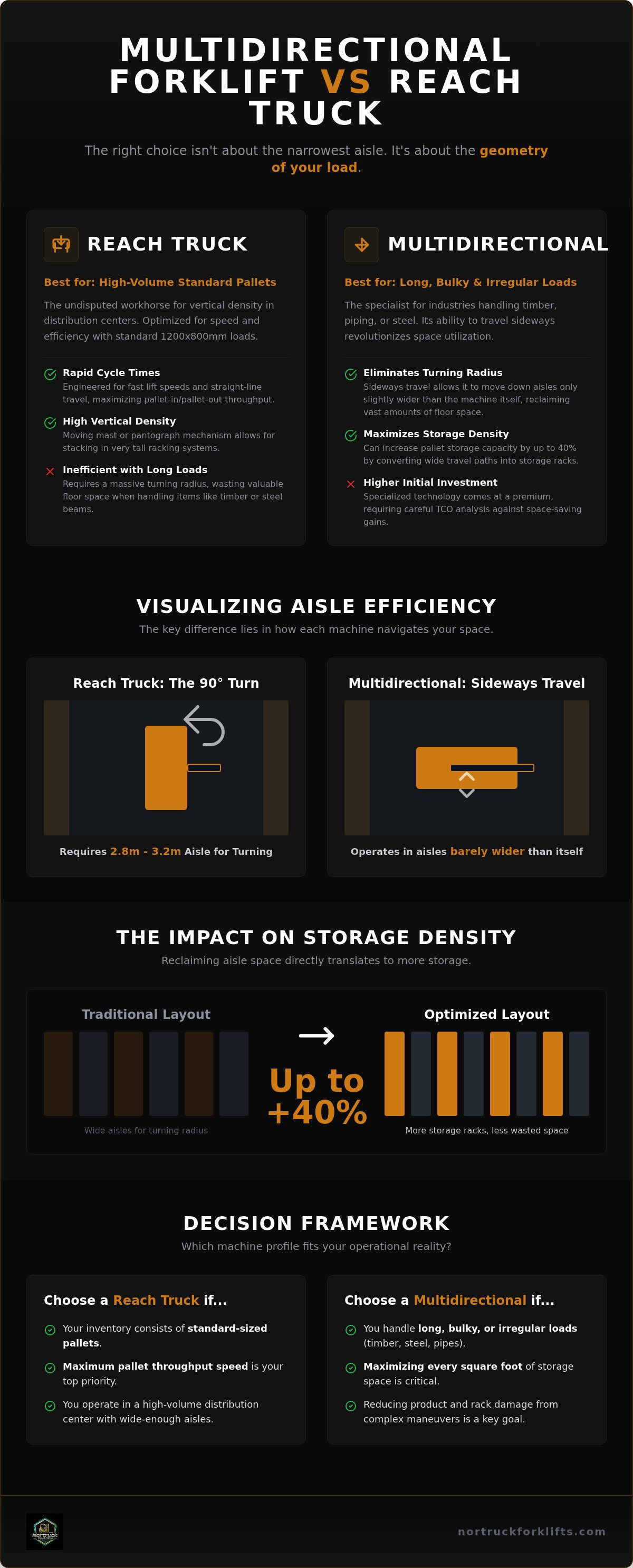
Reach trucks use either a moving mast or a pantograph, which is a scissor-like mechanism, to "reach" out into the racking. This allows the base of the truck to stay stationary while the forks move the load. They're incredibly efficient for high-volume pallet stacking because they can operate in aisles as narrow as 2.5 meters. However, they're limited by their lateral movement. If you try to carry a 6-meter steel beam with a reach truck, you'll need a massive "swing" radius to turn corners. This makes them unsuitable for long-load handling in narrow environments where space is at a premium.
The Multidirectional Advantage
The magic of a multidirectional machine lies in its articulated wheels. By allowing every wheel to steer independently, these trucks can move sideways down an aisle that's only slightly wider than the machine itself. They effectively eliminate the need for a wide turning circle. This is why brands like Combi-Lift and specialized Toyota units are the gold standard for timber, piping, and steel industries. You aren't just saving space; you're reducing the risk of clipping a rack because the machine doesn't need to perform complex maneuvers to change direction. Ultimately, the multidirectional forklift vs reach truck debate isn't about which machine is better, but which one fits your specific inventory profile.
Efficiency Comparison: Performance in Narrow Aisles
Efficiency in a narrow aisle environment is often measured by how much floor space you can convert from travel paths to storage racks. When comparing a multidirectional forklift vs reach truck, the winner depends on whether you're optimizing for pallet throughput speed or maximum storage density. How much revenue is currently sitting in the empty space of your travel aisles?
A standard reach truck requires an aisle width that accounts for its chassis length plus the length of the pallet, typically requiring 2.8 to 3.2 meters. It needs this space to perform a 90-degree turn to face the racking. In contrast, a multidirectional unit can enter an aisle that is only marginally wider than the machine itself. By switching to sideways travel, the truck eliminates the need for a turning radius entirely. This flexibility can increase pallet storage capacity by up to 40% in facilities currently transitioning from traditional wide-aisle setups. While reach trucks can typically operate in aisles under 3.6 meters (12 feet), the multidirectional machine pushes those boundaries even further.
Standard Pallet Handling Throughput
If your operation involves moving standard pallets in a high-intensity environment, the reach truck remains the efficiency leader. Machines from Linde or Toyota are engineered for rapid straight-line travel and fast lift speeds. They're simpler to operate and require less complex maneuvering for every pick. In a pure pallet-in, pallet-out scenario, the reach truck's cycle times are generally shorter. The trade-off is the extra meter of aisle width you must maintain to allow for those 90-degree turns. For many high-volume distribution centers, this speed is worth the sacrifice in density.
Handling Long and Bulky Loads
The dynamic changes completely when handling inventory like 6-meter steel beams or timber packs. Attempting to move these with a reach truck requires massive aisles to accommodate the swing of the load. A multidirectional forklift solves this by carrying the load parallel to the direction of travel. While a Baumann sideloader is excellent for long-distance transport, a multidirectional unit offers better maneuverability within the racking itself. It combines the functions of a sideloader and a reach truck into a single chassis.
Safety and operator confidence are critical components of this efficiency. Compliance with OSHA forklift safety standards requires specific training for these articulated movements, as visibility patterns change when a load is carried laterally. Specialized machines often provide superior all-around visibility for the operator in tight quarters, which reduces the risk of rack strikes. If you're unsure which configuration fits your racking layout, we can help you evaluate your specific warehouse needs based on real-world operational data. Choosing the right tool ensures your operators spend less time maneuvering and more time moving product.
The '4-Way' Factor: Why Load Geometry Dictates Your Choice
Standard pallets are predictable. If your entire inventory fits on a 1200x800mm base, the traditional reach truck is a highly efficient tool. However, the logic of the multidirectional forklift vs reach truck debate shifts the moment your inventory becomes "long." We've seen many operations attempt to force standard reach trucks into handling timber packs, steel sections, or plastic piping. This usually results in wide, inefficient aisles and a high risk of product damage. When your load geometry isn't uniform, the equipment must adapt to the load, rather than the warehouse adapting to the truck.
A 4-way forklift acts as a critical bridge between the vertical stacking power of a reach truck and the long-load stability of a Baumann sideloader. While a reach truck is designed to carry a load in front of the operator, a 4-way unit can rotate its wheels to carry that same load sideways. This lateral flow allows you to design your warehouse with cantilever racking systems that maximize every inch of wall space. Instead of needing a five-meter aisle to turn a six-meter load, you can move that load through a two-meter gap. It's a fundamental shift in how you perceive warehouse logistics.
The Mechanics of 4-Way Travel
The core innovation in machines like the Combi-Lift 4-way Trucks is independent wheel control. This allows for carousel turns, diagonal crabbing, and immediate lateral transitions. This versatility requires a different mindset from your team. Operators transitioning from standard controls need specialized training to master the multi-directional joystick and the different pivot points. While the Total cost of ownership (TCO) for these units involves more complex hydraulic systems, the reduction in rack strikes and product damage often offsets the maintenance profile in high-capacity environments like steel mills and timber yards.
Reach Capabilities in Multidirectional Units
There's a common concern that you might sacrifice lifting height for maneuverability. It's true that some reach trucks are engineered specifically for extreme heights, sometimes reaching up to 12 meters (40 feet). However, modern multidirectional units are increasingly competitive, with many models maintaining excellent mast stability at heights over 8 meters. When integrated with cantilever racking, these machines allow for high-density storage of heavy, long items that would otherwise be relegated to floor storage. You aren't just choosing a truck; you're choosing a storage philosophy that prioritizes the specific geometry of your inventory.
Total Cost of Ownership and Operational Reality
When evaluating the multidirectional forklift vs reach truck financial case, the initial purchase price is only the beginning. A reach truck is a high-volume product, benefitting from economies of scale that keep the entry cost lower for most standard warehouse applications. Multidirectional units are specialized engineering feats that command a premium. However, the true value lies in the storage density you gain. If a multidirectional unit allows you to add two extra aisles of racking by narrowing your travel paths, the equipment often pays for itself through reduced facility overhead and increased inventory capacity.
Operational costs include energy consumption and insurance. Most modern fleets in 2026 are shifting toward electric models to meet battery economics and emissions regulations. While an electric reach truck is highly efficient for standard pallet cycles, high-capacity multidirectional units require robust battery systems to power their complex steering and hydraulic functions. You should also consider operator certification. Because these machines move laterally and diagonally, insurance premiums may reflect the specialized nature of the work. It's a trade-off between the simplicity of a standard fleet and the high-performance capabilities of specialized machinery.
Maintenance and Durability
The complexity of a 4-way steering system means there are more pivot points and hydraulic seals to monitor than on a standard truck. Steering joints and tires on multidirectional trucks often experience unique wear patterns due to frequent 90-degree rotations. This is why we recommend sticking to brands with proven reliability like Linde, Toyota, or Combi-Lift. Sourcing spare parts for a specialized machine can be challenging if you don't have a direct line to the European market. Our 40 years of industry expertise suggests that reliability isn't just about the brand; it's about the depth of the advisory process during procurement.
New vs. Used: The Procurement Strategy
For many businesses, the "New vs Used" dilemma is the most critical hurdle in the multidirectional forklift vs reach truck debate. Sourcing a used Baumann sideloader or a Combi-Lift can drastically reduce your initial capital expenditure while still providing decades of service. In the 2026 market, the residual value of these specialized machines remains high because they are built for heavy-duty industrial environments. Before committing to a purchase, it's vital to use a Used Heavy Lifting Equipment Inspection Checklist to ensure the hydraulic integrity and mast stability meet your safety standards.
Sourcing Your Next Forklift: The Independent Advisor's Role
Selecting between a multidirectional forklift vs reach truck is a technical decision, but sourcing that equipment is a logistical one. Local dealers are often tied to specific manufacturer quotas. This limits your options to whatever is currently in their yard or on their brand's production line. An independent advisor like Lars G Tarby operates differently. We prioritize the operational requirement over the sales target. Our goal is to find the machine that fits your warehouse, not the one that helps us meet a quarterly brand incentive.
When you work with a specialist who understands the internal nuances of heavy lifting, you gain access to a broader range of solutions. Whether your facility requires the vertical precision of a Toyota reach truck or the specialized lateral flow of a Combi-Lift, the sourcing process should be transparent and direct. We act as your advocate, navigating the complexities of the market to ensure you aren't paying for features you don't need or settling for a machine that can't handle your specialized load geometry.
Expert Sourcing Across Europe
Accessing the European market provides a depth of inventory that local markets simply cannot match. This is especially true for the used machinery sector, where high-quality 4-way units are often available at a significant value compared to new builds. The ability to source directly from European hubs ensures you get the right machine at a fair price without the markup of multiple intermediaries. For those specifically looking at multidirectional options, our Combi-Lift 4-Way Truck for Sale: The Expert Guide provides a deeper look at how specialized sourcing works in the 2026 market. Our 40 years of industry expertise allow us to identify units with verified maintenance histories and reliable performance profiles.
Customized Solutions for Complex Logistics
Every warehouse has a unique fingerprint. If your facility handles 12-meter steel sections, a Baumann sideloader might be the precise tool you need. If you're managing a mix of standard pallets and long timber packs in narrow aisles, the multidirectional forklift vs reach truck debate usually ends with a Combi-Lift solution. We help you make this choice by performing a thorough operational audit of your load types and racking layout. Once the right model is identified, the role of Nortruck Forklifts in verifying machine history and performance data becomes essential for your peace of mind. This methodical approach ensures that the equipment delivered to your site is ready for immediate, heavy-duty service. To begin your procurement process, we invite you to start a direct dialogue with our advisory team to discuss your specific lifting challenges.
Optimizing Your Narrow Aisle Strategy for 2026
Choosing between a multidirectional forklift vs reach truck is a strategic investment in your warehouse's future capacity. You've seen how standard reach trucks excel at high-speed pallet throughput, while multidirectional units reclaim floor space by handling long loads with precision. The right choice hinges on your specific inventory geometry and the long-term operational density you aim to achieve.
With over 40 years of heavy lifting expertise, we provide the specialized knowledge required to navigate these complex multidirectional and 4-way solutions. We focus on independent sourcing from Europe's top manufacturers to ensure you get the right machine for your specific operational need. Our direct approach removes the intermediaries and puts the focus back on your bottom line.
We look forward to helping you find a solution that maximizes your square footage and protects your inventory for years to come.
Frequently Asked Questions
What is the main difference between a reach truck and a multidirectional forklift?
The primary distinction lies in the direction of travel and the turning radius required. A reach truck moves forward and backward, requiring a 90-degree turn to face the racking, while a multidirectional forklift can travel sideways at the touch of a button. This lateral movement allows the machine to carry long loads through narrow aisles without needing a wide turning circle.
Can a multidirectional forklift handle standard pallets as efficiently as a reach truck?
Standard reach trucks are generally faster for pure pallet handling in high-intensity environments. They are engineered for rapid straight-line travel and fast lift speeds. While a multidirectional machine can certainly manage pallets, its complex steering systems are better suited for mixed inventory. If your warehouse only moves uniform pallets, the reach truck remains the more economical choice for throughput speed.
Is a 4-way forklift the same as a multidirectional forklift?
These terms are often used interchangeably, but a technical difference exists in their steering capabilities. A 4-way truck typically shifts its wheels 90 degrees to move in four fixed directions. A true multidirectional machine offers 360-degree steering, which allows for diagonal "crabbing" and fluid pivots. This advanced maneuverability is essential for navigating complex warehouse layouts with irregular loads.
Do I need special training to operate a multidirectional forklift?
Yes, operators require specific training to master the articulated steering and lateral movement patterns. Because the machine's pivot points and visibility change depending on the travel mode, standard forklift certification is not sufficient. Specialized training ensures safety compliance and helps prevent product damage when moving long loads in tight quarters. Proper instruction is a critical component of operational efficiency.
Are multidirectional forklifts more expensive to maintain than standard reach trucks?
Multidirectional units typically have higher maintenance profiles due to their complex hydraulic steering and multiple pivot points. When comparing a multidirectional forklift vs reach truck, you'll find that the former has more moving parts that require regular inspection. However, the ability to increase storage density by up to 40% often justifies these higher operational costs over the machine's lifespan.
Can multidirectional forklifts be used outdoors?
Certain multidirectional models are designed with larger wheels and higher ground clearance for semi-industrial outdoor use. In contrast, most reach trucks are strictly indoor machines with small, hard wheels that require perfectly smooth floors. If your operation involves moving long loads from an outdoor yard into a narrow-aisle warehouse, a specialized multidirectional forklift is often the only viable solution.
What brands are the leaders in multidirectional forklift technology?
Combi-Lift is the global leader in multidirectional technology, particularly for long-load applications in timber and steel. Other major players include Toyota, which offers specialized multidirectional reach trucks, and Baumann, which leads in the related sideloader category. Sourcing these brands through an independent advisor ensures you get the right model for your specific logistics needs without being limited by dealer quotas.
How do I decide between a sideloader and a multidirectional forklift for long loads?
Sideloaders are optimized for long-distance transport of heavy loads in straight lines, making them ideal for large external yards. A multidirectional forklift is the better choice if you need to maneuver those same loads within tight internal racking or perform frequent 90-degree turns. The decision depends on whether your priority is high-speed travel or maximum warehouse maneuverability in confined spaces.

Article by
Lars Gunnar Tärby
Disclaimer
1. General Information and No AdviceThe information, articles, product descriptions, and specifications provided on this website (www.nortruckforklifts.com) are for general informational and educational purposes only. While we strive to provide accurate and up-to-date content regarding new and used forklifts and heavy machinery, the material published does not constitute professional, technical, or legal advice.
2. Product Specifications and PricingNortruck Forklifts acts as a facilitator for the trade of new and used forklifts. All equipment details, including but not limited to year of manufacture, operating hours, lift capacity, dimensions, conditions, and pricing, are provided based on the information available to us at the time of publication. Specifications and availability are subject to change without prior notice.
3. "As Is" and VerificationAll articles and product listings are provided on an "as is" and "as available" basis without any warranties of any kind, either express or implied. Nortruck Forklifts does not guarantee that the descriptions are entirely error-free, complete, or reliable. Buyers and traders are strongly encouraged to independently verify all technical specifications, machine history, and equipment conditions directly with the seller or an authorized inspector before finalizing any purchase or transaction.
4. Limitation of LiabilityIn no event shall Nortruck Forklifts, its owners, or its contributors be held liable for any direct, indirect, incidental, consequential, or economic loss or damage arising out of the use of, or the inability to use, the information provided on this website, or any transactions facilitated through this platform. This includes, but is not limited to, damages caused by technical inaccuracies, typographical errors, or reliance on the content of our articles.
5. Third-Party LinksOur website may contain links to external websites, dealer networks, or third-party services that are not owned or controlled by Nortruck Forklifts. We have no control over, and assume no responsibility for, the content, privacy policies, or practices of any third-party websites.


