
Treating high-capacity equipment procurement like a standard catalog order is the fastest way to park an expensive liability in your yard. When daily operations depend on moving steel, precast concrete, or laden containers, successful 25 tonne industrial forklift sourcing demands rigorous engineering scrutiny rather than glossy sales brochures.
You're likely already dealing with punishing factory lead times, only to face captive dealers pushing whatever mismatched machinery happens to sit on their lot. Turning to the secondary market brings separate risks. Hidden mast fatigue, worn planetary axles, and the complexities of cross-border European transport can easily turn an apparent bargain into a permanent workshop fixture.
You don't have to compromise on reliability. This guide provides a clear framework to evaluate heavy duty cycles, establish strict pre-purchase inspection protocols, and source verified machines efficiently across European markets. We'll examine the technical standards, powertrain choices, and vetting strategies you need to secure the right truck for your yard.
Key Takeaways
- Successful 25 tonne industrial forklift sourcing starts with calculating true residual capacity at standard load centres, factoring in front-end attachments like coil rams before comparing base machines.
- Evaluating heavy-capacity manufacturers requires looking beyond horsepower to examine chassis geometry, cabin suspension, and operator sightlines for dense industrial yards.
- Assessing pre-owned heavy trucks demands rigorous structural vetting of mast carriage weldments, hydraulic circuits, and steer axle integrity rather than relying on cosmetic condition.
- Cross-border European procurement runs smoothly when you secure proper regulatory documentation, confirm original CE markings, and verify machine provenance prior to transport.
- Partnering with an independent equipment advisor bypasses captive dealer inventory biases, granting access to unlisted European machines tailored strictly to your operational duty cycle.
Core Technical Specifications for 25 Tonne Industrial Forklift Sourcing
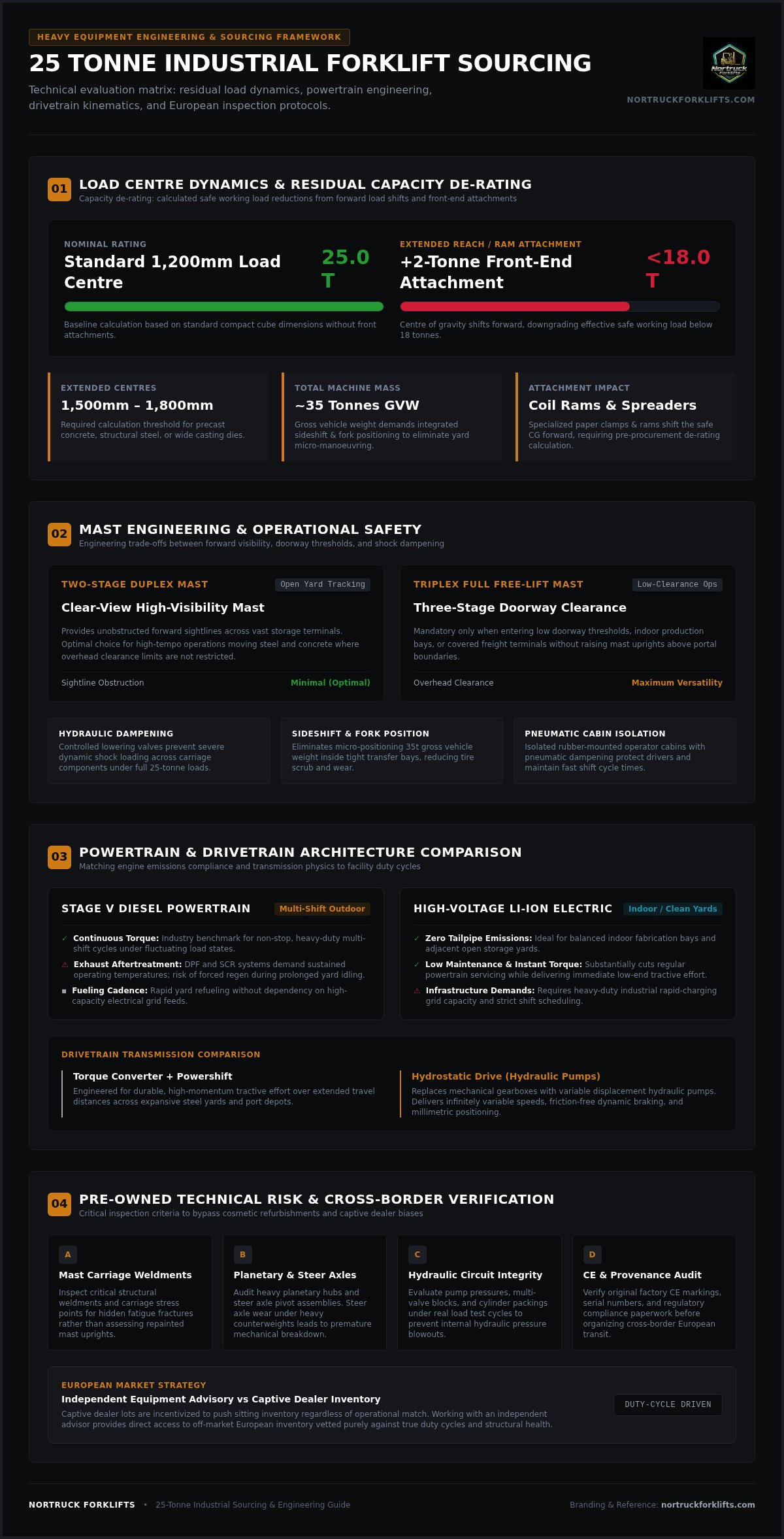
Successful 25 tonne industrial forklift sourcing hinges on a strict understanding of operational geometry rather than baseline nameplate ratings. A 25-tonne machine is typically rated at a standard 1200mm load centre, but deploying heavy coil rams, container spreaders, or specialized paper clamps shifts the centre of gravity forward. Residual capacity de-rating refers to the calculated reduction in maximum safe lifting weight caused by forward-shifting load centres, elevated lift heights, or heavy front-end attachments. Standard principles of forklift design and components dictate that adding a two-tonne attachment at extended reach can downgrade a 25-tonne unit's effective capacity below 18 tonnes.
To see how a 25-tonne machine handles high-capacity duty cycles in active yard conditions, watch this depot operation overview:
Load Centre Dynamics and Mast Engineering
Handling precast concrete beams, structural steel, or casting dies rarely conforms to a compact cube. If your operational load centre extends to 1500mm or 1800mm, you must calculate genuine capacity limits before selecting a chassis. Mast selection presents a direct trade-off between visibility and clearance. A standard two-stage duplex clear-view mast offers superior forward sightlines for yard tracking, whereas a full free-lift triplex mast is required only when clearing low doorway thresholds. Under full tonnage, precise hydraulic lowering dampening prevents dynamic shock loading, while integrated sideshift and independent fork positioning eliminate the need for micro-manoeuvring 35 tonnes of gross vehicle weight inside tight transfer bays.
Powertrain Selection: Stage V Diesel vs Heavy Electric
Powertrain evaluation depends entirely on your shift cadence and site infrastructure. For continuous multi-shift heavy industrial operations, Stage V diesel engines remain the benchmark, delivering dependable torque curves across fluctuating load states. However, Stage V compliance introduces complex exhaust aftertreatment systems, including diesel particulate filters and selective catalytic reduction, which require sustained operating temperatures to avoid forced regenerations during low-speed yard idling. For facilities balancing indoor fabrication with open storage yards, high-voltage lithium-ion electric platforms offer zero tailpipe emissions and immediate low-end torque. They significantly reduce routine powertrain maintenance, provided your site has the electrical capacity to support industrial rapid-charging schedules.
Evaluating Leading Manufacturers in the 25-Tonne Lifting Class
Engineering approaches diverge sharply once you move into the 25-tonne class. Specialized European builders prioritize heavy fabricated chassis, planetary axles, and modular components, while global high-volume manufacturers often scale up medium-duty designs. Operator environment matters just as much as raw structural steel. Isolated rubber-mounted cabins, pneumatic dampening, and unobstructed mast uprights directly influence cycle times and safety in tight industrial terminals. Understanding baseline compliance, including international guidelines like OSHA forklift safety standards, helps operations managers evaluate how different manufacturers engineer visibility, stability, and control layouts for severe operations.
Drivetrain architecture represents another fundamental divergence. Heavy torque converter transmissions paired with powershift gearboxes provide durable, high-momentum tractive effort for long runs across vast steel yards. Hydrostatic systems, by comparison, replace mechanical gearboxes with variable displacement hydraulic pumps. This delivers infinitely variable speed control, dynamic braking without mechanical friction, and exceptional millimetric positioning when feeding high-tonnage fabrication presses.
Kalmar Heavy Lift Trucks: Operational Benchmarks
In demanding environments like breakbulk ports, precast yards, and heavy steel foundries, Kalmar remains the industry benchmark. Their chassis utilize heavy box-section steel paired with Kessler or AxleTech planetary drive axles, designed to absorb punishing multi-shift duty cycles. Fully enclosed oil-cooled wet disc brakes eliminate brake fade and isolate friction components from abrasive road grit, significantly extending maintenance intervals. If you need maximum durability for aggressive yard duty cycles, reviewing a structured framework for a Kalmar heavy lift truck for sale ensures you evaluate mast pivot bushings, steer axle geometry, and transmission configurations built for these harsh settings.
Linde and Specialized Industrial Alternatives
Linde approaches heavy capacity with closed-loop hydrostatic drive engineering. Eliminating clutches, torque converters, and conventional mechanical service brakes reduces wear components significantly. Dual-pedal directional control enables rapid direction reversals without driveline shock. When reviewing a heavy Linde forklift for sale, pay close attention to hydraulic oil cleanliness records, as high-pressure axial piston pumps demand strict fluid purity.
Other operational footprints require alternative chassis engineering. Heavy steel fabricators handling long structural beams often deploy specialized sideloader platforms, while long-load staging yards benefit from multi-directional chassis to clear narrow aisle gates. When navigating 25 tonne industrial forklift sourcing, selecting the right brand philosophy depends entirely on balancing travel distance against precision staging needs. If you want objective guidance on which chassis configuration fits your specific yard flow, you can discuss your site parameters with an independent specialist at nortruckforklifts.com.
New vs Used 25 Tonne Forklifts: Technical Risk and Integrity Assessment
Ordering a factory-new 25-tonne forklift often brings punishing lead times that stretch operational planning past breaking point. When your site needs heavy handling capability immediately, sourcing vetted pre-owned machinery becomes the practical path. However, taking on a machine that has lifted 25,000 kg over thousands of cycles introduces substantial mechanical risk. Thorough evaluation requires applying structured procurement principles, akin to standards outlined in the public sector's Heavy Equipment Procurement Program, to verify structural integrity and verify lifecycle logging before capital is committed.
Do not rely on fresh paint or clean cabin plastics. A reliable pre-purchase assessment balances physical wear against onboard diagnostic telemetry:
- Control wear vs logged hours: Heavily worn brake treadles and polished steering knobs on an odometer showing under 3,000 hours warrant immediate scrutiny.
- Main lift cylinders and seals: Score marks on high-pressure chrome rods or oil weepage around gland nuts point to internal contamination or impending seal failure.
- Hydraulic valve blocks: Inspect multi-spool distribution manifolds under full working temperature to check for internal spool bypass and pressure drops.
- High-pressure hose tracking: Hoses must run free of chafing against mast channels, without outer sheath blistering or oil seepage at crimped unions.
Chassis and Structural Welding Inspections
Under repeated maximum load, micro-fractures develop at high-stress points. Ultrasonic or dye penetrant non-destructive testing should focus on counterweight retaining studs, steer axle trunnion cradles, and mast carriage weldments. Steer axle King pins must be jacked up to measure lateral and radial tolerance play directly. Mast channels require string-line testing for vertical deflection, while heavy roller leaf chains must be measured with a chain wear gauge to verify they haven't exceeded the 2% elongation condemnation threshold.
Verifying Operational History in Heavy Environments
A machine's previous working duty cycle determines its mechanical health. Equipment sourced from dusty, abrasive sites like a dedicated forklift for concrete industry application experiences accelerated wear on air intake circuits and planetary seals compared to a clean container yard truck. Always draw transmission and drive axle fluid samples to test for copper particulates, indicative of clutch disc glazing or planetary gear spalling. Finally, connect diagnostic software directly to the engine ECU to pull historical fuel burn and operating hours, confirming the digital registry matches the hour meter and service records during 25 tonne industrial forklift sourcing.
Step-by-Step European Sourcing and Cross-Border Procurement Process
Limiting your search to local dealerships rarely yields the exact mast height, carriage width, or auxiliary hydraulics your operation requires. Broadening your search across borders is standard practice in heavy industry, but it demands an orderly procurement workflow. Sourcing high-capacity machinery across borders requires technical alignment before initiating transport logistics. You can review broader regional trends in our European forklift market guide to understand machinery distribution and cross-border availability.
Follow a disciplined sequence to protect your capital and operational schedule:
- Establish technical duty requirements: Define load center thresholds, door clearance limits, and mast free-lift parameters before contacting sellers.
- Locate and pre-screen inventory: Filter European machinery listings by verified maintenance records and application history.
- Execute an independent technical appraisal: Never release purchase funds without a physical engineering audit conducted on-site.
- Manage multi-jurisdiction transport: Secure heavy-haul permits and route clearances across every transit country.
- Execute site commissioning: Complete static load testing and fluid level verifications before handing controls to yard operators.
Cross-Border Technical Inspections
Never rely on video walkarounds. A qualified heavy machinery engineer must inspect the truck cold, checking for engine blow-by and oil leaks before ignition. Once up to working temperature, the machine must undergo full-capacity stall and relief valve pressure tests. Verify that original manufacturer plates remain intact and stamped with an authentic CE marking. Complete documentation, including hydraulic schematics, wiring diagrams, and European declarations of conformity, must accompany the machine to prevent regulatory delays at destination facilities.
Heavy Transport and Abnormal Load Logistics
Transporting a 25-tonne forklift is an abnormal load operation. A truck with a 35-tonne unladen curb weight cannot travel on standard flatbed trailers. In most cases, the mast must be unpinned and the counterweight removed to meet European road bridge clearances and axle weight thresholds. This necessitates step-deck or semi-low-loader transport, abnormal transit permits, and scheduled pilot escorts across transit corridors. You must also arrange mobile crane hire at both ends to manage offloading and precision mast re-hanging on site.
Coordinating this logistical sequence requires hands-on heavy equipment expertise. Successful 25 tonne industrial forklift sourcing means planning abnormal transport and engineering validation well before the contract is signed.
Sourcing High-Capacity Forklifts Through Independent Advisory
Captive dealership networks are structurally designed to prioritize their own inventory quotas. When you consult a franchised representative, their recommendations inevitably revolve around the machines currently standing on their yard or upcoming factory allocations. For high-stakes operations in port terminals, concrete manufacturing, or heavy steel fabrication, accepting an off-the-shelf compromise creates long-term mechanical bottlenecks. Independent advisory reorients the procurement process around your actual material handling cycle rather than a seller's lot turnover.
Bypassing standard commercial sales channels protects your investment from mismatched equipment, hidden mechanical fatigue, and inflated intermediary commissions.
The Advantage of Independent Heavy Equipment Sourcing
Navigating cross-border transactions through fragmented machinery boards often introduces multi-tier broker markups, diluting accountability and inflating capital expenditure. An independent specialist operates across established European networks, uncovering off-market machines from vetted industrial fleets before they hit public listings. Independent sourcing also ensures completely objective engineering evaluations across Tier 1 European platforms. Whether your terminal demands the heavy-duty planetary axle durability of a Kalmar or the millimeter-precise hydrostatics of a Linde, an independent advisor matches chassis geometry and hydraulic capacity strictly to your yard throughput.
Partnering with Nortruck Forklifts
Achieving dependable results in 25 tonne industrial forklift sourcing requires seasoned technical insight that goes far beyond catalog specs. Nortruck Forklifts brings over 40 years of heavy lifting equipment expertise led by Lars G Tarby, providing industrial clients across Europe with direct advisory and verified machinery procurement. We evaluate operational parameters, audit structural and hydraulic integrity, and manage cross-border acquisition across verified European networks. Reach out to Nortruck Forklifts to discuss your terminal requirements and identify the right heavy lift truck for your upcoming industrial projects.
Securing Your Next Heavy Lift Asset with Confidence
Procuring a high-capacity forklift is an engineering decision that defines your yard's throughput for years to come. Success comes down to calculating true residual capacities under real attachment loads, enforcing rigorous non-destructive structural testing, and executing cross-border logistics without regulatory missteps. When you approach 25 tonne industrial forklift sourcing with technical clarity, you eliminate costly operational bottlenecks before equipment ever touches your site.
Partnering with independent specialists ensures your purchase aligns strictly with your duty cycle rather than dealer sales quotas. Nortruck Forklifts delivers over 40 years of specialised heavy equipment expertise led by Lars G Tarby. We provide direct access to verified European machinery from premier manufacturers like Kalmar and Linde, backed by unbiased technical guidance tailored to demanding industrial cycles.
The right heavy truck transforms terminal operations from day one. Taking a methodical, transparent approach to procurement ensures your heavy lifting fleet stays productive, compliant, and cost-effective well into the future.
Frequently Asked Questions
What is the standard load centre for a 25 tonne industrial forklift?
The standard load centre for a 25-tonne industrial forklift is 1200mm measured horizontally from the front face of the forks to the centre of gravity of the load. Unlike light warehouse trucks rated at 500mm or 600mm, heavy lift trucks handle wide steel coils, precast slabs, and containers. Carrying loads beyond 1200mm moves the centre of gravity outward, requiring proportional load reductions to maintain longitudinal chassis stability.
Can a 25 tonne forklift operate efficiently on unpaved or rough industrial yards?
Standard 25-tonne industrial forklifts require reinforced concrete or heavily compacted, paved surfaces to operate safely. Because unladen vehicle weight often exceeds 35 tonnes before picking up cargo, ground-bearing pressure is substantial. Operating across unpaved gravel, soft soil, or uneven yard surfaces creates significant risk of sinking, chassis twisting, and premature wear on drive axle trunnions. Operations without paved surfaces require dedicated rough-terrain heavy handlers instead.
How much residual lifting capacity is lost when adding specialized attachments?
Adding specialized attachments can reduce a 25-tonne forklift's effective lifting capacity by 15% to 35% or more. Heavy equipment like hydraulic coil rams, paper roll clamps, or fork positioners adds deadweight to the carriage and pushes the payload centre of gravity forward. A 25-tonne base machine carrying a heavy clamp at an extended 1500mm load centre might safely lift only 17 tonnes. Always inspect the derating data plate.
What are the typical lead times when sourcing a new versus used 25-tonne truck?
Factory-new 25-tonne forklifts frequently carry manufacturing lead times ranging from 6 to 18 months depending on component availability. Sourcing verified pre-owned equipment across Europe compresses this timeline to just two to four weeks for delivery and commissioning. For active terminals facing unexpected machine retirements or immediate contract demands, used 25 tonne industrial forklift sourcing provides rapid operational continuity without enduring extended factory production delays.
How do Stage V emissions standards impact diesel heavy forklift procurement?
European Stage V emissions regulations require modern heavy forklifts to utilize complex exhaust aftertreatment systems, including diesel particulate filters and selective catalytic reduction. These systems require consistent exhaust temperatures to burn off trapped soot. If your terminal operates with frequent idling or short transfer runs, you must manage forced regeneration schedules to avoid exhaust clogging. Fleet operators must also budget for regular diesel exhaust fluid replenishment.
What documentation is required when importing a heavy industrial forklift across Europe?
Cross-border procurement within the EU requires an authentic CE Declaration of Conformity, matching manufacturer chassis plates, and clear commercial bills of sale for Intrastat reporting. Sourcing machinery from outside the EU, such as the UK or Switzerland, requires a Single Administrative Document for customs clearance, payment of applicable import tariffs, and local VAT settlement before transport carriers can move the equipment to your yard.
Why is an independent advisory approach beneficial for high-capacity forklift sourcing?
An independent advisory approach eliminates captive dealership bias and broadens your access to machines across international markets. Franchised dealers must prioritize shifting their own standing stock, regardless of whether mast parameters or hydraulic options suit your application. In 25 tonne industrial forklift sourcing, an independent advisor evaluates your site constraints objectively, helping you select the right machine from premier brands like Kalmar or Linde without dealer markups.

Article by
Lars Gunnar Tärby
Disclaimer
1. General Information and No AdviceThe information, articles, product descriptions, and specifications provided on this website (www.nortruckforklifts.com) are for general informational and educational purposes only. While we strive to provide accurate and up-to-date content regarding new and used forklifts and heavy machinery, the material published does not constitute professional, technical, or legal advice.
2. Product Specifications and PricingNortruck Forklifts acts as a facilitator for the trade of new and used forklifts. All equipment details, including but not limited to year of manufacture, operating hours, lift capacity, dimensions, conditions, and pricing, are provided based on the information available to us at the time of publication. Specifications and availability are subject to change without prior notice.
3. "As Is" and VerificationAll articles and product listings are provided on an "as is" and "as available" basis without any warranties of any kind, either express or implied. Nortruck Forklifts does not guarantee that the descriptions are entirely error-free, complete, or reliable. Buyers and traders are strongly encouraged to independently verify all technical specifications, machine history, and equipment conditions directly with the seller or an authorized inspector before finalizing any purchase or transaction.
4. Limitation of LiabilityIn no event shall Nortruck Forklifts, its owners, or its contributors be held liable for any direct, indirect, incidental, consequential, or economic loss or damage arising out of the use of, or the inability to use, the information provided on this website, or any transactions facilitated through this platform. This includes, but is not limited to, damages caused by technical inaccuracies, typographical errors, or reliance on the content of our articles.
5. Third-Party LinksOur website may contain links to external websites, dealer networks, or third-party services that are not owned or controlled by Nortruck Forklifts. We have no control over, and assume no responsibility for, the content, privacy policies, or practices of any third-party websites.


