
What if the most expensive mistake in your yard isn't the machine you buy, but the storage space you're wasting because of it? Handling long loads like timber or steel profiles is a specialized task that requires more than just a standard forklift. When you're weighing a Baumann sideloader vs Combi-Lift, you aren't just choosing a brand; you're choosing a fundamental engineering philosophy for your facility. You likely already feel the pressure of inefficient yard layouts and the safety risks that come with moving oversized materials. It's a serious concern, especially since research suggests that for every $1 of forklift damage, companies can incur up to $7 in total product and building costs.
I'll help you cut through the noise to discover the critical differences between Baumann’s high-stability sideloaders and Combi-Lift’s multidirectional versatility. This guide draws on 40 years of industry expertise to show you how to maximize storage density and ensure a high resale value. We'll preview the current market trends, including the massive shift toward electric models, and explain how to source a reliable used machine in Europe. You'll gain the expert perspective needed to make an investment that actually fits your specific operational needs.
Key Takeaways
- Identify whether your facility requires the high-speed lateral stability of a traditional sideloader or the 4-way maneuverability of a multidirectional truck.
- Compare the Baumann sideloader vs Combi-Lift to see how engineering differences like auto-deck leveling or hydrostatic drives impact your specific load safety.
- Evaluate the 10,000-hour maintenance threshold to understand the long-term cost of ownership and expected resale value for used machinery.
- Learn how independent advisory and direct European sourcing help you avoid the risks of buying specialized equipment from generalist auctions.
Understanding the Long Load Challenge: Why Sideloaders and 4-Way Trucks Exist
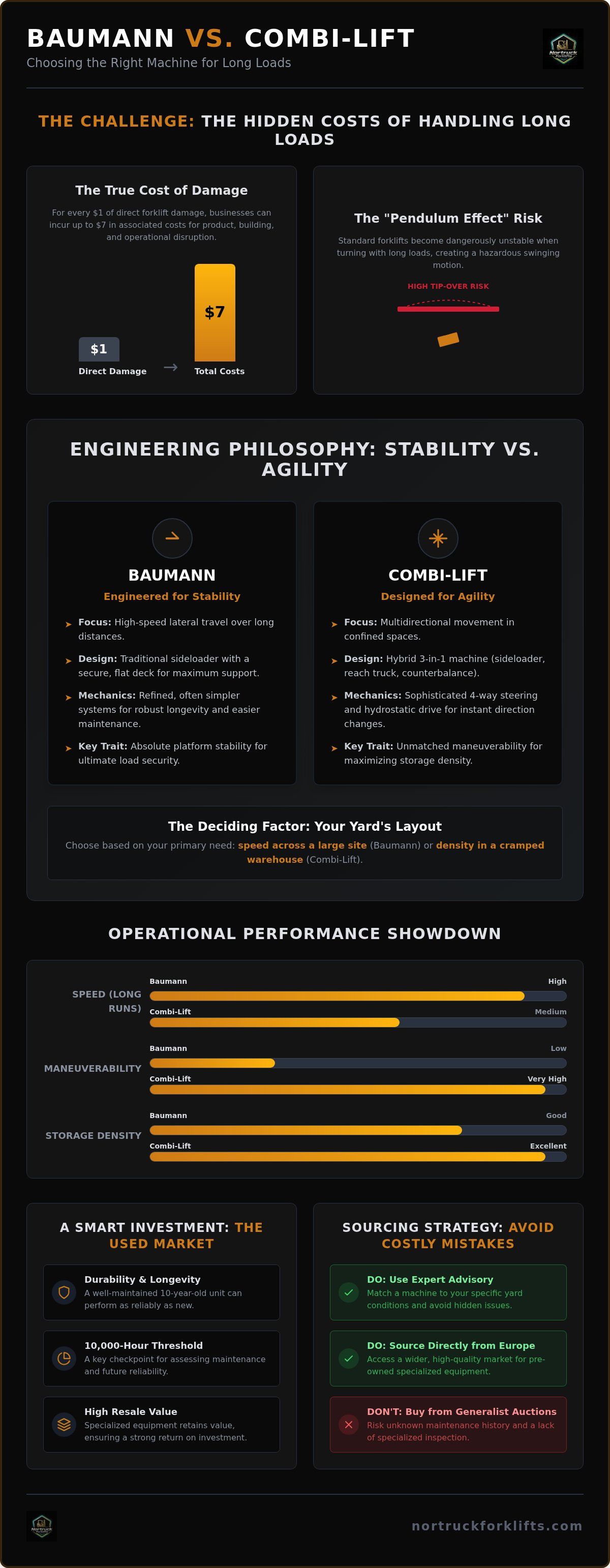
Handling long loads like timber, steel, and pipes with a standard counterbalance forklift is inherently risky. When the load is wider than the truck, it becomes unstable. The "pendulum effect" kicks in during turns; the load swings outward, increasing the risk of the forklift tipping or striking a rack. This isn't just a safety issue; it's a financial one. Industry data shows that for every $1 of forklift damage, businesses can incur up to $7 in associated costs, including material and building repairs. This is why specialized equipment exists; it's about moving toward a solution that prioritizes safety and operational efficiency.
A sideloader is engineered specifically for lateral travel. It picks up the load and rests it securely on a flat deck. This lowers the center of gravity and allows the machine to travel through narrow aisles while carrying material that is several meters long. In contrast, a 4-way truck is a hybrid. It combines the features of a reach truck and a sideloader, allowing for multidirectional movement. When comparing a Baumann sideloader vs Combi-Lift, you'll see two different approaches to solving the same logistical problem. In 2026, the used market for these brands is particularly strong as businesses source high-quality pre-owned units to avoid high capital expenditure.
Why does the used market matter so much right now? These machines are built for durability. A well-maintained 10-year-old sideloader can often perform just as reliably as a new one if the hydraulic systems and steering mechanisms have been properly cared for. However, the complexity of these steering systems means that expert advisory is essential. You aren't just buying a forklift; you're buying a specialized tool that needs to match your yard's specific surface conditions and aisle widths. Identifying these nuances early prevents costly mistakes later.
The Geometry of Long Load Logistics
In a typical yard, aisle widths are dictated by load length rather than truck width. Standard trucks require massive turning circles to move long items, wasting valuable storage space. Specialized sideloaders and 4-way trucks eliminate this by traveling sideways. Deck height is also critical; matching an HGV deck height simplifies loading and reduces the time trucks spend idle. These geometric advantages allow for significantly higher storage density without compromising on safety.
Baumann and Combi-Lift: Two Paths to the Same Goal
Baumann has built its reputation on traditional sideloader excellence. Their machines are designed for high-speed travel and maximum stability over long distances. Combi-Lift disrupted this space with its multidirectional steering, offering agility that traditional machines can't match in tight spaces. When choosing between a Baumann sideloader vs Combi-Lift, the decision comes down to your yard's layout. Do you need speed across a large site or density in a cramped warehouse? Each brand offers distinct advantages depending on your operational constraints.
The Engineering Philosophy: Baumann Stability vs. Combi-Lift Multidirectionality
Engineering choices define your operational limits. When you evaluate a Baumann sideloader vs Combi-Lift, you're looking at two distinct ways to solve the problem of moving long, heavy materials. Baumann approaches this with a focus on refined, traditional sideloader mechanics. Their philosophy centers on high-speed lateral travel and absolute platform stability. In contrast, Combi-Lift prioritizes multidirectional agility, using a hybrid design that functions as a sideloader, reach truck, and counterbalance forklift all in one. This choice between stability and flexibility will dictate your yard's throughput for years.
The mechanical trade-off is clear. Baumann machines often favor mechanical simplicity, which can lead to more straightforward maintenance over a long lifespan. Combi-Lift relies on a sophisticated 4-way steering linkage and hydrostatic drive. While this adds complexity, it grants the operator the ability to change direction at the touch of a button. Engine placement also differs significantly; Baumann typically positions the engine for a low center of gravity and clear visibility over the deck, while Combi-Lift's compact design requires a different ergonomic approach to ensure the operator can see all four corners of the machine during complex maneuvers.
Baumann: The Master of High-Speed Lateral Travel
Baumann’s signature is the auto-deck leveling system. This hydraulic feature keeps the transport deck perfectly horizontal even when traveling over uneven yard surfaces. It’s a critical safety component that ensures safely arranged loads, such as 12-meter steel beams, don't shift during transit. This stability allows for higher travel speeds across large sites. If your operation involves moving timber or steel from a remote storage area to a production line, the dedicated deck and mast tilt stability of a Baumann make it a formidable choice. It’s built for the long haul.
Combi-Lift: The King of Narrow Aisle Density
Combi-Lift changed the industry by making the aisle narrower than the load. Their 4-way steering allows the truck to enter a rack "sideways," then rotate its wheels to drive forward or backward. This eliminates the need for wide turning circles entirely. The versatility is unmatched; you can use the same machine to offload an HGV in the yard and then place the material into narrow-aisle indoor racking. However, the 4-way linkage does introduce a steeper learning curve for operators. Mastering "carousel mode" takes time, but the reward is a massive increase in storage density. If you find yourself struggling to fit more stock into a confined space, you might speak with an expert about how a multidirectional layout could transform your facility.
Operational Performance: Comparing Speed, Maneuverability, and Yard Requirements
Performance isn't just about raw lifting capacity; it's about how that power translates to your specific yard's daily rhythm. In a direct comparison of Baumann sideloader vs Combi-Lift, travel speed is often the first metric where a clear distinction emerges. Baumann machines are built for the long haul. Because they are optimized for lateral travel with a traditional chassis, they generally achieve higher top speeds on large, open sites. If your operators need to shuttle 6-tonne loads across a 10-acre timber yard, the Baumann's powertrain and stability control allow for faster cycle times and better efficiency over distance.
Maneuverability tells a different story. Combi-Lift’s "carousel mode" allows for on-the-spot rotation, where the machine pivots 360 degrees within its own footprint. This is a game-changer for tight warehouses where every square meter is valuable. However, this agility comes with a trade-off in tire wear. The multidirectional steering puts unique lateral stress on tires, especially in 3-wheel configurations. Baumann’s 4-wheel setup distributes ground pressure more evenly. This often results in longer tire life on abrasive concrete surfaces, which is a significant consideration for the total cost of ownership in a used machine.
Maintenance accessibility is another critical factor for anyone looking at the pre-owned market. Baumann often features swing-out engine compartments, making filters and hydraulic lines easy to reach for routine service. Combi-Lift’s compact, multidirectional layout is an engineering marvel, but the density of components can make certain repairs more time-consuming. When you're buying a used unit, these minutes spent on maintenance add up over the machine's remaining life. You need to decide if you have the internal technical expertise to handle these complex steering linkages or if you prefer the more conventional layout of a sideloader.
Aisle Width and Storage Density Analysis
Let's look at the operational footprint. A 5-tonne Baumann ELX series sideloader is impressively compact, measuring under four meters in length. It can navigate narrow aisles with ease, provided the path is straight. However, a 5-tonne Combi-Lift can navigate aisles barely wider than the machine itself by entering sideways and then switching steering modes to drive forward. This eliminates the "dead space" at the end of racking aisles where a traditional sideloader would need room to turn. If your priority is absolute storage density over travel speed, the multidirectional approach is hard to beat.
Surface Suitability: Indoor vs. Outdoor Performance
Surface conditions often dictate the winner. Baumann’s robust deck-leveling system excels on graded or rough outdoor terrain common in steel mills and heavy industrial yards. It keeps the load stable even when the ground isn't. Combi-Lift is the master of the transition; it's designed to offload a truck in a gravel yard and drive straight into a narrow-aisle indoor warehouse. Choosing the right tire compounds-whether solid, pneumatic, or non-marking-is essential for both brands to ensure they perform safely in their intended environment.
The Used Market Perspective: Maintenance, Longevity, and Resale Value
The specialized nature of long-load equipment ensures that resale values remain remarkably resilient. In 2026, a used 2019 Combilift C8000 might still fetch nearly $48,000, while older units from 2005 often hold value between $28,000 and $39,000. When comparing a Baumann sideloader vs Combi-Lift in the pre-owned market, you're looking at two different profiles of longevity. Baumann's focus on robust, heavy-duty engineering often means the chassis and mast outlast the auxiliary electronics. Combi-Lift’s value is tied to its multidirectional utility, but its complex steering sensors require more frequent calibration to maintain that market value. Sourcing from regions like Germany or Scandinavia is often a safer bet, as these markets typically adhere to rigorous, timestamped digital maintenance logs that meet modern safety standards.
The 10,000-hour mark is a critical mechanical milestone for both brands. For a used Baumann, this is typically when the hydraulic system requires a thorough audit. You'll want to look for synchronization issues in the deck leveling system or wear in the hydrostatic drive. For a Combi-Lift, the focus shifts to the 4-way steering linkage and hydraulic wheel motors. If these components aren't maintained, the machine loses its primary advantage: precision. Because OSHA inspectors in 2026 increasingly expect readily available digital records, buying a machine with a documented service history isn't just a preference; it's a compliance necessity.
Inspection Checklist for a Used Baumann Sideloader
- Deck Leveling Cylinders: Check for leaks and ensure the platform remains perfectly horizontal during lift and travel cycles.
- Mast Lateral Stress: Evaluate the mast channels for excessive play. Sideloaders experience unique side-loading forces that standard forklifts don't.
- Hydrostatic Drive: Verify power delivery under full load to ensure the pump and motor are still operating at peak pressure.
Inspection Checklist for a Used Combi-Lift
- Steering Synchronization: Test the transition between forward and sideways modes. Any lag usually points to sensor or solenoid issues.
- Wheel Motors: Inspect the hydraulic hoses and motors at each wheel. These are exposed to more movement and debris than a standard fixed-axle setup.
- Control Responsiveness: Evaluate the multidirectional joystick. It should feel crisp, as any "play" in the stick can make precise aisle entry dangerous.
Total Cost of Ownership (TCO) in the Used Market
Total Cost of Ownership involves more than just the purchase price. You have to consider the logistics of specialized parts. Baumann’s Italian and German components are built for precision but can have specific lead times depending on your location in Europe. Combi-Lift, based in Ireland, has a vast global distribution network that often simplifies part sourcing. However, the complexity of a 4-way truck can lead to more labor hours during repairs compared to the more mechanical layout of a sideloader. Understanding the Forklift Total Cost of Ownership: New vs Used helps you decide if the lower entry price of an older machine justifies the potential for increased downtime in your specific yard.
Sourcing the Right Machine: Why Expert Advisory Outperforms Direct Buying
Buying a specialized long-load handler isn't the same as purchasing a standard counterbalance truck. The complexity of these machines means that generalist auctions are often a minefield for the uninitiated. Auctioneers rarely understand the nuances of a 4-way steering linkage or the specific calibration requirements of a deck-leveling system. When you're deciding between a Baumann sideloader vs Combi-Lift, you're making a significant investment that will dictate your yard's efficiency for the next decade. Relying on a blind bid rather than expert advisory can lead to expensive repair bills before the machine even moves its first load.
Nortruck Forklifts operates with a level of transparency that's rare in the heavy equipment industry. Because we aren't tied to a single manufacturer, we provide an objective brand recommendation based solely on your operational suitability. Lars G Tarby uses his 40 years of industry experience to analyze your yard blueprints and material flow. He doesn't just look at the machine's lifting capacity; he evaluates how the specific turning radius and travel speed of a used Baumann or Combi-Lift will interact with your existing racking and HGV loading bays. This independent perspective ensures you don't end up with a high-quality machine that's simply the wrong fit for your space.
The Nortruck Forklifts Advantage in Heavy Lifting
We specialize in identifying "hidden gem" used machines across a vast European network. Many of the best pre-owned units never reach public auction sites; they move through private industry circles where maintenance standards are high and digital service logs are complete. Our process includes facilitating rigorous inspections and managing the complex logistics of cross-border acquisitions. Whether you're looking for a compact electric sideloader or Sourcing Kalmar Heavy Lift Trucks for Sale, we ensure the unit is mechanically sound and ready for high-capacity logistics before it reaches your facility.
Next Steps for Your Operation
Preparing for a consultation is straightforward. To give you the most accurate advice on a Baumann sideloader vs Combi-Lift, we'll need specific site data. This includes your narrowest aisle width, the maximum length and weight of your loads, and the type of ground surface in your yard. Once we have these details, we can narrow down the search to specific models that meet your needs. The timeline for sourcing and delivering a refurbished machine varies, but our direct sourcing model often cuts weeks off the traditional procurement process by removing unnecessary intermediaries.
Ready to optimize your long-load handling? Contact Nortruck Forklifts today for a tailored assessment of your yard layout and a direct line to the best used machinery in Europe.
Optimizing Your Long-Load Logistics
Choosing between a Baumann sideloader vs Combi-Lift isn't about which brand is objectively better; it's about which engineering philosophy aligns with your yard's specific geometry. If your priority is high-speed stability and load security over long distances, the traditional sideloader remains the industry standard for timber and steel. However, for those struggling with tight warehouse footprints, the multidirectional agility of a 4-way truck offers a clear path to increased storage density. Both machines solve the long-load challenge, but they do so by prioritizing different operational outcomes.
The success of your investment depends on more than just the brand name. It requires a thorough understanding of maintenance thresholds, such as the 10,000-hour service milestone, and a clear-eyed look at your facility's surface conditions. Navigating the used market in Europe requires a partner who understands these machines at a technical level rather than just a sales level. For those managing logistics across different continents, such as importing specialized equipment from China, Lotus Lane Trading offers the expert advisory needed to navigate the Brazilian market's unique importation requirements. Identifying the right machine involves matching technical specifications to your actual yard blueprints to avoid costly logistical bottlenecks.
Efficient yard operations are just one part of the logistics chain; many professionals also rely on The Truckermann for industry news and resources specifically designed for drivers and stakeholders.
With 40 years of heavy lifting experience and a specialist understanding of both Baumann and Combi-Lift technology, Nortruck Forklifts is ready to help you secure a reliable machine. We look forward to helping you transform your yard's operational efficiency and long-term profitability.
Frequently Asked Questions
Is a used Baumann sideloader better than a Combi-Lift for timber yards?
Baumann is typically the superior choice for large outdoor timber yards where travel speed and load stability over distance are paramount. Its auto-deck leveling system handles the uneven terrain of a typical sawmill better than most multidirectional trucks. However, if your yard is extremely congested, the 4-way maneuverability of a Combi-Lift might be necessary to navigate narrow storage lanes.
How long does a Combi-Lift 4-way truck typically last?
A well-maintained Combi-Lift 4-way truck can easily exceed 12,000 to 15,000 operational hours before requiring a major powertrain or hydraulic overhaul. In the used market, machines with 5,000 to 7,000 hours are often considered prime candidates for a second life. The key to longevity is regular calibration of the steering sensors and timely replacement of hydraulic hoses.
Which machine is easier for a standard forklift operator to learn?
Standard forklift operators usually find the Baumann sideloader more intuitive to learn because its movement patterns are more predictable. The lateral travel feels like a natural extension of standard driving. In contrast, the Combi-Lift requires the operator to master various steering modes, including carousel and 4-way modes, which involves a steeper learning curve to operate safely and efficiently.
Can a sideloader work in the same aisle widths as a multidirectional truck?
A sideloader generally requires wider aisles for turning, though it excels in very narrow aisles once it's traveling in a straight line. When comparing a Baumann sideloader vs Combi-Lift for storage density, the Combi-Lift wins on maneuverability. It can pivot on the spot and enter aisles sideways, allowing you to reduce "dead space" at the end of racking rows.
What are the common maintenance issues with used sideloaders?
Common issues include hydraulic synchronization failures in the deck leveling system and wear in the mast channels due to lateral forces. You should also inspect the hydrostatic drive for power loss under full load. Because these machines are specialized, finding a used unit with a clean, digital maintenance history is essential to avoid hidden repair costs.
Is it better to buy a used Baumann or a new lower-tier brand?
Investing in a used Baumann is generally a safer financial move than buying a new, lower-tier brand. Premium European machines are built with high-grade steel and components designed for a 20-year lifespan. Lower-tier brands often lack the same resale value and robustness, making them more expensive in the long run when you factor in downtime and depreciation.
How do I verify the service history of a used forklift sourced from Europe?
Verification in 2026 relies heavily on digital, timestamped records. You should ask for the machine's maintenance logs and operator inspection records, which are now standard for OSHA compliance. Sourcing through an independent advisor ensures that these records are vetted through a direct European network before the machine is shipped to your yard.
Do Combi-Lifts require specialized tires compared to sideloaders?
Combi-Lifts do require specialized tire considerations because their multidirectional steering puts unique lateral stress on the rubber. While a Baumann sideloader vs Combi-Lift comparison shows the sideloader's 4-wheel setup distributes weight more evenly, the Combi-Lift's tires must handle frequent pivoting. Using the wrong tire compound can lead to rapid wear and increased ground pressure issues.

Article by
Lars Gunnar Tärby
Disclaimer
1. General Information and No AdviceThe information, articles, product descriptions, and specifications provided on this website (www.nortruckforklifts.com) are for general informational and educational purposes only. While we strive to provide accurate and up-to-date content regarding new and used forklifts and heavy machinery, the material published does not constitute professional, technical, or legal advice.
2. Product Specifications and PricingNortruck Forklifts acts as a facilitator for the trade of new and used forklifts. All equipment details, including but not limited to year of manufacture, operating hours, lift capacity, dimensions, conditions, and pricing, are provided based on the information available to us at the time of publication. Specifications and availability are subject to change without prior notice.
3. "As Is" and VerificationAll articles and product listings are provided on an "as is" and "as available" basis without any warranties of any kind, either express or implied. Nortruck Forklifts does not guarantee that the descriptions are entirely error-free, complete, or reliable. Buyers and traders are strongly encouraged to independently verify all technical specifications, machine history, and equipment conditions directly with the seller or an authorized inspector before finalizing any purchase or transaction.
4. Limitation of LiabilityIn no event shall Nortruck Forklifts, its owners, or its contributors be held liable for any direct, indirect, incidental, consequential, or economic loss or damage arising out of the use of, or the inability to use, the information provided on this website, or any transactions facilitated through this platform. This includes, but is not limited to, damages caused by technical inaccuracies, typographical errors, or reliance on the content of our articles.
5. Third-Party LinksOur website may contain links to external websites, dealer networks, or third-party services that are not owned or controlled by Nortruck Forklifts. We have no control over, and assume no responsibility for, the content, privacy policies, or practices of any third-party websites.


