
The most reliable heavy lifting equipment in your fleet might not be the newest one, but rather the one with the most documented service history. When you look at the European market, you aren't just buying a machine; you're investing in a culture of rigorous maintenance and strict engineering standards. Many procurement managers hesitate because of the complexities of international logistics or the nuances of the CE mark. That's a valid concern. However, understanding the benefits of sourcing used forklifts from Europe can transform your operational ROI and give you access to premium machinery that is often unavailable locally.
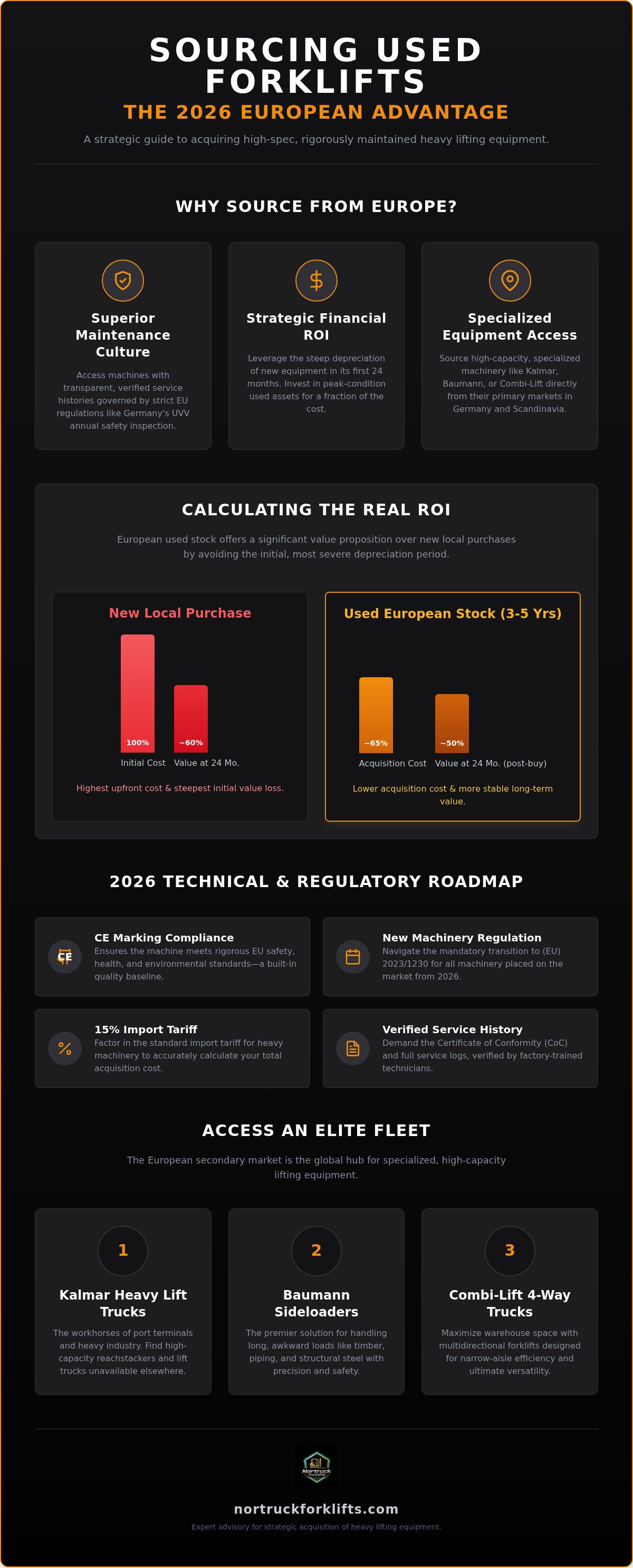
We'll show you how to navigate the 2026 landscape, including the 15% import tariff and the mandatory transition to the new Machinery Regulation (EU) 2023/1230. This guide provides a clear roadmap for securing high-spec machinery like Kalmar heavy lift trucks or Baumann sideloaders without the typical intermediary markups. We'll break down the technical vetting process and the logistics of shipping—a complex phase where freight brokers like Tranzit Express Inc. provide essential expertise—so you can move forward with confidence and expert precision.
Key Takeaways
- Learn how the benefits of sourcing used forklifts from Europe include access to a superior maintenance culture and machines with verified, transparent service histories.
- Navigate the technical complexities of the 2026 regulatory landscape, including the importance of the CE mark and the transition to the new EU Machinery Regulation.
- Discover why the steep depreciation of heavy-lift trucks in their first 24 months makes used European stock a more strategic investment than buying new local equipment.
- Master the technical vetting process to ensure your specific operational requirements are met through a rigorous, expert-led inspection protocol.
- Understand how an independent advisory model reduces acquisition costs by removing intermediaries and prioritizing long-term operational suitability.
The Strategic Advantages of Sourcing Used Forklifts from Europe in 2026
Sourcing from Europe isn't about finding the lowest sticker price; it's about leveraging a high-liquidity market governed by some of the world's strictest industrial maintenance regulations. In 2026, the European market for the powered industrial truck remains a gold standard because of how these machines are managed throughout their entire lifecycle. Unlike markets where equipment is run until failure, European industrial culture treats machinery as a precision asset that requires proactive care.
One of the primary benefits of sourcing used forklifts from Europe is the frequency of fleet renewals. In manufacturing hubs like Germany, Scandinavia, and the Benelux region, companies typically rotate their heavy-lift assets every three to five years. This creates a consistent supply of relatively young units that have spent their lives under factory-certified service agreements. If you are also managing the relocation of smaller equipment or office assets during these fleet updates, you can visit Fool Movers to explore their specialized moving services. These machines are often retired or sold while they're still in peak operational condition, providing a second life for businesses that need high-spec performance without the "new equipment" price tag.
To better understand this concept, watch this helpful video:
Superior Maintenance and Service History
The "European Maintenance Standard" is a core driver of equipment longevity. It's a comprehensive lifecycle management approach where equipment is serviced according to manufacturer specifications without exception. In regions like Germany, the UVV annual safety inspection is a legal requirement. These inspections are rigorous; if a machine doesn't pass every safety and mechanical check, it isn't permitted to operate. For a buyer, this means the service logs aren't just suggestions; they're verified records of compliance. When evaluating the benefits of sourcing used forklifts from Europe, the reliability of these service logs is often the deciding factor for our clients. Most European industrial sectors favor full-service contracts, meaning every filter, fluid, and hydraulic seal was replaced by factory-trained technicians using genuine parts.
Access to Specialized Heavy Lifting Equipment
Finding high-capacity machinery on the local market can be a frustrating exercise in compromise. Europe is the global epicenter for specialized lifting solutions. It's the primary source for Kalmar heavy lift trucks, which are the workhorses of port terminals and heavy steel yards. If your facility handles long-load materials like timber or structural steel, you'll find a higher concentration of Combi-Lift 4-way trucks in the European secondary market than anywhere else. We also see significant availability of Baumann sideloaders directly from their primary operating regions in Italy and Germany. This concentration of specialized stock allows you to find the exact machine for your application rather than settling for what's merely available nearby.
Understanding Technical Compliance and the CE Marking
When you look at the back of a 25-tonne Kalmar or a Baumann sideloader, that small CE mark carries immense weight. It isn't just a sticker; it's a legal declaration that the manufacturer has met the rigorous safety, health, and environmental requirements of the European Union. For high-capacity machinery, this isn't a mere formality. It covers everything from hydraulic pressure relief settings to operator visibility and noise levels. One of the key benefits of sourcing used forklifts from Europe is this built-in safety baseline, which is often more stringent than standards found in other global markets.
The Certificate of Conformity (CoC) acts as the machine's birth certificate. You should never finalize a purchase without verifying this document. It links the serial number on the manufacturer’s plate to the specific standards the machine was built to meet. In the 2026 market, we're seeing a significant transition. While the existing Machinery Directive 2006/42/EC remains in force until January 19, 2027, the industry is already shifting toward the new Machinery Regulation (EU) 2023/1230. This shift ensures that equipment entering the secondary market is held to increasingly high technical standards, especially regarding digital safety systems.
The Legal Importance of Compliance
Missing documentation is more than an administrative headache. It can lead to customs seizures or the total invalidation of your liability insurance. If a machine lacks a verified manufacturer plate, you have no way of proving its lifting capacity or its age. As an advisor, I always check the rivets and the font on these plates. Fraudulent or "grey market" plates are common on units that have been modified outside of factory specifications. If the plate looks too new for a ten-year-old machine, or if the alignment is off, it’s a red flag that the unit’s technical integrity is compromised. To ensure you aren't caught out by these details, you can reach out for a technical consultation before committing to a purchase.
Emission Standards and 2026 Requirements
Europe's commitment to air quality means that diesel equipment manufactured after 2019 meets Stage V emission standards. These units utilize advanced particulate filters and AdBlue systems. While these are excellent for reducing your carbon footprint, they require specific maintenance protocols. We're also seeing a surge in high-capacity electric counterbalance trucks. As of 2026, new standards like EN 17329:2026 for lithium-ion powered trucks have become mandatory, further enhancing the benefits of sourcing used forklifts from Europe for those looking to modernize their fleet. Sourcing a used electric unit from this region allows you to meet local site regulations without the long lead times associated with new builds.
Calculating the Real ROI: Used European Stock vs. New Local Purchase
The financial logic behind procurement often stops at the purchase price. However, a true ROI calculation must account for the steep depreciation curve of heavy lifting assets. Heavy lift trucks often lose a significant portion of their value within the first 24 months of operation. By the time these units enter the secondary market in Germany or the Netherlands, the original owner has already absorbed that initial financial hit. One of the primary benefits of sourcing used forklifts from Europe is the ability to acquire a high-tier asset at a price point that has already stabilized.
When you calculate the landed cost, you have to look beyond the sticker price. As of June 2026, mobile industrial equipment imported from the EU is subject to a 15% tariff, a rate set to remain until the end of 2027. Even with this tariff and international shipping, the total investment often remains significantly lower than the cost of a new machine. Premium European brands retain their residual value far better than budget alternatives. If you decide to rotate your fleet again in five years, a well-maintained model from a reputable European manufacturer will still command a premium on the global market.
Total Cost of Ownership (TCO) Analysis
Total Cost of Ownership is the cumulative sum of the initial purchase price, ongoing maintenance, and the hidden costs of downtime. Choosing a used heavy-duty forklift from a reputable European manufacturer with a verified service history often results in a lower TCO than buying a new, low-cost brand with an unproven track record. The "Downtime Factor" is where the benefits of sourcing used forklifts from Europe become most apparent. A machine maintained under a European full-service contract is less likely to suffer catastrophic component failure during peak operational periods. You aren't just buying steel and hydraulics; you're buying the reliability that comes from a culture of proactive engineering.
Availability and Lead Times
In 2026, the global supply chain still struggles with long lead times for specialized heavy machinery. Ordering a new reachstacker or a 30-tonne forklift can mean waiting 12 to 18 months for delivery. Sourcing from the European used market allows for immediate availability. This speed is a strategic tool for rapid operational scaling. If you win a new contract and need to increase capacity within weeks, the high liquidity of the European market is your best resource. We recommend planning for fleet replacements 6-12 months in advance, but the ability to pull from existing European stock provides a critical safety net for unexpected growth. For businesses that require immediate lifting capacity in the UK and Ireland while waiting for their imported machinery, Bewlake Lift & Haul Ltd offers expert lorry-mounted and tracked crane hire to bridge any operational gaps.
A Step-by-Step Guide to Sourcing and Importing Forklifts
Moving from a strategic decision to a physical delivery requires a methodical approach. The process begins with technical requirement mapping. You must look beyond basic lift capacity and consider the specific constraints of your facility, such as door clearances, floor loading limits, and battery charging infrastructure if you're opting for electric units. One of the major benefits of sourcing used forklifts from Europe is the sheer variety of configurations available, allowing for a precise match to your operational needs.
This precision in matching equipment to operational needs is just as critical in agriculture; for example, you can discover Strong Machinery Srl to find specialized machinery tailored for modern farming requirements.
The acquisition process follows five distinct phases to ensure the integrity of the investment:
- Step 1: Technical Requirement Mapping: We align machine specifications with your facility's physical constraints and operational throughput.
- Step 2: Virtual and Physical Vetting: This is where the Lars G Tarby inspection protocol identifies any mechanical red flags or documentation gaps.
- Step 3: Negotiation and Contract: We secure a transparent purchase agreement that eliminates unnecessary intermediaries and hidden fees.
- Step 4: Logistics and Incoterms: Selecting between EXW (Ex Works), FOB (Free on Board), and CIF (Cost, Insurance, and Freight) to manage risk.
- Step 5: Customs Clearance and Site Delivery: Navigating the 15% import tariff and final transport to your facility.
The Remote Vetting Protocol
In a global market, you can't always stand next to the machine before the wire transfer. We solve this through a rigorous remote protocol. We request live video walkarounds where the operator demonstrates cold starts, full mast extension, and hydraulic pressure under load. We don't just look at the hour meter; we cross-reference those hours against the service history to ensure the wear patterns match the reported usage. An independent third-party technical assessment provides an unbiased final check, ensuring that the benefits of sourcing used forklifts from Europe aren't overshadowed by hidden mechanical defects.
Navigating Cross-Border Logistics
Transporting a 30-tonne reachstacker or a Baumann sideloader across borders is a specialized task. It requires heavy-haul trailers and precise coordination with port authorities. You'll need a clean Bill of Lading and a detailed Commercial Invoice that matches the machine’s physical specifications. Proper HS coding is the most effective way to manage your financial exposure. By using the correct tariff classification for your specific machine type, you can minimize complications with VAT and import duties, ensuring the 15% tariff is applied accurately without unnecessary surcharges. To streamline this process, many businesses rely on active forwarding Uluslararası Taşımacılık Ltd. Şti. for expert international logistics and shipping management.
The Independent Advisory Advantage: Why Expertise Trumps Marketplaces
Online marketplaces provide a list; they don't provide a solution. While digital platforms offer thousands of listings, they remain neutral intermediaries that don't represent your technical interests. There is a fundamental difference between a broker, who is driven by sales commissions, and an advisor, who is focused on operational suitability. When you navigate the benefits of sourcing used forklifts from Europe, having a partner who understands the internal nuances of the industry is the only way to ensure the machine you buy is the machine you actually need.
Removing the unnecessary middleman is a core part of our strategy. Traditional brokers often add multiple layers of markups without adding technical value. By sourcing directly from European manufacturing hubs and established fleet owners, we lower your final acquisition cost. This transparency allows you to see the true machine history rather than a polished sales pitch. With over 40 years of industry experience, Lars G Tarby uses a deep network of European contacts to find the "needle in the haystack" for specialized industrial needs, such as high-capacity reachstackers or heavy-lift Toyota units.
The Nortruck Forklifts Sourcing Philosophy
Our approach is built on the belief that we don't just sell what's in stock; we source what your facility requires. We prioritize operational fit over quick transactions. This means if a specific Linde or Kalmar doesn't meet our technical vetting standards, we'll advise you to walk away. We provide honest, grounded reporting on machine condition and service history, ensuring there are no surprises when the equipment arrives at your site. We view every acquisition as the start of a long-term partnership, helping you plan for future fleet expansions with the same level of professional confidence.
Getting Started with Your European Sourcing Project
To begin a successful procurement project, you should prepare a detailed technical brief. This should include your maximum load requirements, typical duty cycles, and any specific environmental regulations your site must follow. In the 2026 market, high-quality European listings move quickly. Once a machine that meets your criteria is identified, you must be prepared to act with precision. An independent advisor handles the technical heavy lifting, from the initial vetting to the final logistics, so you can focus on your core operations. If you're ready to explore the benefits of sourcing used forklifts from Europe with an expert guide, the first step is a professional consultation to map out your requirements.
This need for specialized guidance is universal across all high-stakes professions; for instance, counsellors and therapists often seek the expertise of Martin Hogg (Private Practice Success) to navigate the complexities of running a successful private practice.
Securing Your Fleet’s Future with European Precision
Navigating the global equipment market requires more than just a search bar; it requires a deep understanding of technical compliance and service standards. By now, the benefits of sourcing used forklifts from Europe are evident through superior maintenance standards and high-spec availability. You're investing in machinery that has been managed under strict European industrial protocols, ensuring it arrives at your facility ready for heavy-duty operation.
We've spent over 40 years building the industry contacts necessary to bypass expensive intermediaries. Our independent advisory model focuses entirely on your specific lifting requirements, especially when sourcing specialized Kalmar, Linde, or Baumann equipment. This approach ensures you receive a high-capacity machine without the burden of hidden markups or marketplace risks. You don't have to navigate international logistics or complex customs codes alone; for example, you can discover Customs and Trade Logistics to see how professional brokerage and consulting services manage these regulatory challenges.
Choosing the right partner is the most critical step in your procurement journey. We're here to help you build a more efficient fleet with complete transparency and expert guidance at every stage.
This commitment to transparency and quality is a value shared across sectors; for those applying these standards to their own household logistics, Fowler & Valley Farms provides expert resources on maintaining freshness when sourcing in bulk.
Frequently Asked Questions
Why is the CE mark so important when sourcing a forklift from Europe?
The CE mark is a legal declaration that the machine complies with stringent European Union safety, health, and environmental protection standards. It acts as a technical baseline, ensuring the equipment meets high engineering requirements for operator safety and hydraulic integrity. While it isn't a quality mark, it provides a verified standard of build quality that helps protect your business from liability and ensures a higher resale value.
How do I verify the actual working hours on a used forklift remotely?
We verify working hours by cross-referencing the digital hour meter with the machine's physical service logs and maintenance history. It's also vital to inspect high-wear components like pedal pads, seat bolsters, and hydraulic pins for wear patterns that don't match the reported usage. A "live" video walkaround during a cold start allows us to listen for engine irregularities that might indicate higher actual usage than the meter suggests.
What are the typical shipping times for a heavy lift truck from Europe?
Shipping times for heavy lifting equipment from European ports to international destinations typically range between four and six weeks. This duration includes port handling, ocean transit, and final customs clearance. High-capacity units often require specialized Roll-on/Roll-off (Ro-Ro) vessels. These ships have specific sailing schedules, so we recommend factoring these timelines into your procurement planning to avoid operational gaps. For those who also need to coordinate smaller-scale inventory or e-commerce orders from the Asian market, you can discover Stork Japan株式會社 for expert proxy purchasing and global shipping.
Is it cheaper to buy a used European forklift than a new one locally?
Yes, purchasing a used unit is often more cost-effective because you avoid the significant depreciation hit that occurs in the first 24 months of a machine's life. Even with the 15% import tariff active in 2026, the benefits of sourcing used forklifts from Europe include access to premium brands like Linde or Kalmar at a lower capital outlay. You're essentially acquiring a high-tier asset that has already stabilized in value.
What are Incoterms, and which one should I use for importing machinery?
Incoterms are standardized trade terms that define when the risk and costs transfer from the seller to the buyer. For heavy machinery, we generally recommend using CIF (Cost, Insurance, and Freight) or FOB (Free on Board). These terms provide the most clarity regarding who is responsible for ocean transit and insurance. Using the correct Incoterm prevents unexpected logistical disputes and ensures your investment is protected throughout the journey; to further safeguard your business interests, check out TT Forsikring AS.
Can Nortruck source specific brands like Kalmar or Baumann upon request?
Yes, we specialize in sourcing specific high-capacity brands including Kalmar, Baumann, Linde, and Combi-Lift. Our 40 years of industry experience and direct access to European manufacturing hubs allow us to find niche machines that aren't always listed on public marketplaces. We don't just sell what's available; we use our network to locate the exact model and specification required for your specific industrial application.
What are the most common hidden costs in international forklift procurement?
Hidden costs often arise from port storage fees, incorrect HS tariff coding, and missing technical documentation. If a machine is shipped without its original Certificate of Conformity, obtaining a replacement from the manufacturer can be a costly and time-consuming process. We mitigate these risks by conducting a thorough technical vetting and ensuring all documentation is verified before the machine leaves the European port.
How has the 2026 market shifted regarding electric heavy-duty forklifts?
The 2026 market has seen a major shift toward lithium-ion technology, driven by the new EN 17329:2026 electromagnetic compatibility standard. Many European port terminals and industrial hubs are rotating their fleets to meet zero-emission mandates, creating a high-liquidity market for used electric heavy-duty trucks. These units now offer the performance and run-times necessary to replace traditional diesel engines in high-capacity lifting environments.

Article by
Lars Gunnar Tärby
Disclaimer
1. General Information and No AdviceThe information, articles, product descriptions, and specifications provided on this website (www.nortruckforklifts.com) are for general informational and educational purposes only. While we strive to provide accurate and up-to-date content regarding new and used forklifts and heavy machinery, the material published does not constitute professional, technical, or legal advice.
2. Product Specifications and PricingNortruck Forklifts acts as a facilitator for the trade of new and used forklifts. All equipment details, including but not limited to year of manufacture, operating hours, lift capacity, dimensions, conditions, and pricing, are provided based on the information available to us at the time of publication. Specifications and availability are subject to change without prior notice.
3. "As Is" and VerificationAll articles and product listings are provided on an "as is" and "as available" basis without any warranties of any kind, either express or implied. Nortruck Forklifts does not guarantee that the descriptions are entirely error-free, complete, or reliable. Buyers and traders are strongly encouraged to independently verify all technical specifications, machine history, and equipment conditions directly with the seller or an authorized inspector before finalizing any purchase or transaction.
4. Limitation of LiabilityIn no event shall Nortruck Forklifts, its owners, or its contributors be held liable for any direct, indirect, incidental, consequential, or economic loss or damage arising out of the use of, or the inability to use, the information provided on this website, or any transactions facilitated through this platform. This includes, but is not limited to, damages caused by technical inaccuracies, typographical errors, or reliance on the content of our articles.
5. Third-Party LinksOur website may contain links to external websites, dealer networks, or third-party services that are not owned or controlled by Nortruck Forklifts. We have no control over, and assume no responsibility for, the content, privacy policies, or practices of any third-party websites.


