
The highest-capacity truck isn’t automatically the right choice. With Combi-CB forklift sourcing Europe, start with the work itself: the loads you handle, the routes they travel and the truck configuration that suits those conditions. Model comparisons can be difficult when variants and specifications don’t line up neatly, so a clear brief helps focus the search.
This guide explains how to define your operational requirements before comparing machines. You’ll consider load type, working environment and configuration, then review product information and documentation consistently. The aim is a practical buying decision based on your operation, not a shortlist built around headline figures alone.
Nortruck advises businesses on sourcing lifting equipment across Europe, with partners in Denmark, Sweden, Germany, France, Spain and Poland. Its Combilift offering includes the C-Series 4-way truck, a distinct model from the Combi-CB, with a stated capacity range of 2.5-14 tonnes. Keeping those product lines separate is important when comparing options. The sections ahead explain how to assess a Combi-CB for your operation and how direct, experienced advice can support a considered sourcing process.
Key Takeaways
- Start with your loads, travel paths and working conditions before comparing truck models.
- For Combi-CB forklift sourcing Europe, match specifications to the exact model and market rather than assuming figures apply across variants.
- Compare a multidirectional counterbalance truck with a conventional forklift by assessing how each handles your loads and routes.
- Keep the Combi-CB distinct from the Combilift C-Series 4-way truck when comparing configurations and specifications.
- Nortruck provides direct sourcing advice across Europe. Its Combilift C-Series 4-way truck has a stated range of 2.5-14 tonnes.
Combi-CB forklift sourcing in Europe: define the operating need first
Start with the job, not a truck listing. Before comparing models, write down what the forklift must move, where it must travel and how often the task occurs. This gives your search a practical basis and helps separate essential requirements from features that would simply be useful.
The Combi-CB combines a counterbalance design with multidirectional travel. Combilift describes applications that include handling palletised goods and moving long loads sideways. This combination may be worth evaluating if your operation handles different load types or needs to manoeuvre in constrained areas. The description alone, however, doesn’t establish whether the truck fits a particular site. Load dimensions, route and working conditions still matter.
Which loads and movements make a Combi-CB worth evaluating?
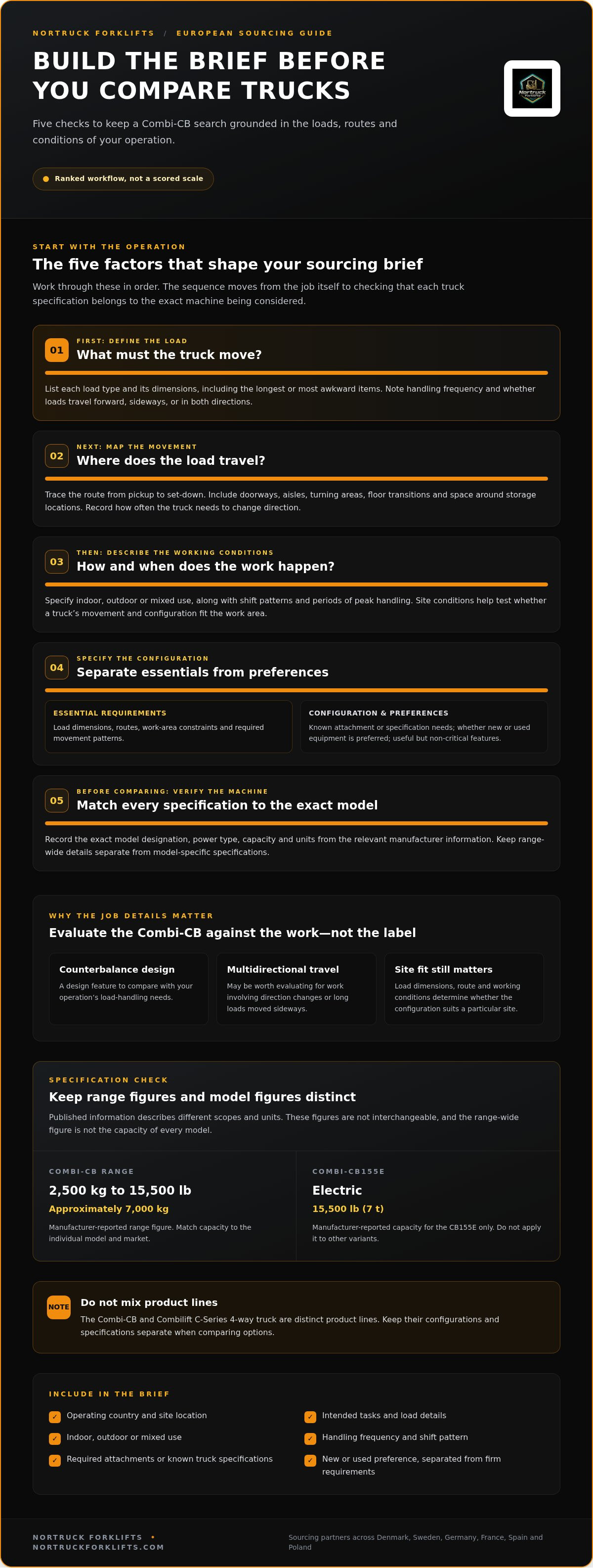
Record each load type and its dimensions, including the longest or most awkward items. Note how often loads are handled, whether they move forward, sideways or in both directions, and how frequently the truck needs to change direction. These details describe the task more precisely than a general label such as “warehouse use.”
Map the route from pickup to set-down. Doorways, aisles, turning areas, floor transitions and space around storage locations all shape the equipment brief. Record whether the work takes place indoors, outdoors or in both settings, along with shift patterns and periods of peak handling. Use these site details to test whether the truck’s movement and configuration suit the route, rather than assuming that a compact or multidirectional truck will fit every layout.
What should a European buyer include in the sourcing brief?
A useful brief gives an advisor enough context to compare relevant machines and configurations. Include the operating country and site location, intended tasks, load details, indoor or outdoor use, handling frequency and shift pattern. State whether you prefer new or used equipment, and distinguish firm requirements from preferences. For a broader industry perspective, the European Materials Handling Federation (FEM) represents material-handling manufacturers and provides technical recommendations.
- Essential requirements: load types and dimensions, routes, work-area constraints and required movement patterns.
- Configuration needs: required attachments or other known truck specifications, linked to the tasks they need to support.
- Preferences: new or used condition and features that could help but aren’t critical to the operation.
Keep model comparisons precise. The Combi-CB and Combilift C-Series are distinct product lines, so specifications for one shouldn’t be applied to the other. In Combi-CB forklift sourcing Europe, match each specification to the exact model and market, then assess it against your written brief. A clear starting document keeps the search focused while leaving room to compare alternatives properly.
Combi-CB configurations and features: compare the exact machine
A model name or headline capacity isn’t enough to compare two trucks. Build your comparison around the precise variant and market, and record only specifications tied to that machine. Manufacturer information describes Combi-CB models with diesel, LPG and electric power, but those power types and capacity figures shouldn’t be assumed to apply to every variant.
How do Combi-CB variants differ?
Use the information below as a starting point, not a substitute for the exact manufacturer specification sheet. The published capacity information uses different units and describes a range, so it shouldn’t be read as the capacity of each model.
| Variant or scope | Power type | Sourced specification | Comparison note |
|---|---|---|---|
| Combi-CB range | Diesel, LPG and electric options are described across the range | Manufacturer-reported range: 2,500 kg to 15,500 lb, approximately 7,000 kg | Range-wide figure only; match capacity to the individual model and market. |
| Combi-CB155E | Electric | Manufacturer-reported capacity: 15,500 lb (7 t) | Keep this figure specific to the CB155E; don’t apply it to other variants. |
For a like-for-like comparison, record the exact model designation, power type, capacity and units shown in the relevant manufacturer information. If a listing presents figures in different units or combines details across variants, keep them separate until you can match them to a model-specific source. This care is central to Combi-CB forklift sourcing Europe: it prevents a range-wide statement from being mistaken for a specification of the particular truck you’re assessing.
Which operating features should buyers assess?
Evaluate each feature by asking which requirement it addresses. Multidirectional handling may matter if your work involves changing travel direction or moving long loads sideways, but its value depends on the load and route. Compare the truck’s stated handling functions with your aisle widths, turning areas and movement patterns. The feature name alone doesn’t prove that the truck suits your site.
Apply the same approach to visibility, controls and attachments. Include these items in a comparison only when manufacturer information for the exact machine describes them, then connect them to a specific operating need. An attachment is a configuration choice, not proof that the truck is suitable for a particular load. For European purchases, include the machine’s conformity information in your documentation review. The EU’s guidance explains CE marking for products sold in Europe.
Keep product lines distinct throughout the comparison. Nortruck’s Combilift offering is the C-Series 4-way truck, with a stated range of 2.5-14 tonnes. Those figures describe the C-Series, not the Combi-CB. If the C-Series is relevant to your requirements, compare it as a separate option through Nortruck’s Combilift C-Series offering.
Combi-CB versus other forklift options: compare the job, not the label
A useful comparison starts with the load and its route, not the product name. A conventional counterbalance truck may suit work where loads are picked up and carried forward along established routes. The Combi-CB adds multidirectional handling, with manufacturer-described applications for palletised goods and long loads moved sideways. Whether that difference matters depends on the loads and movements at your site.
When does the Combi-CB merit closer evaluation?
Consider it when the operation regularly handles both palletised goods and long materials, or when sideways movement is relevant to the route. Test that use case against the full work pattern: load dimensions, pickup and drop-off points, aisle and turning constraints, indoor or outdoor conditions, and handling frequency. Compactness or versatility alone doesn’t guarantee a productivity gain or establish suitability. Compare the machine’s documented capabilities with your site’s actual requirements.
Use a comparison table to make assumptions visible. Fill in the final column using model-specific information and your site assessment, rather than treating a category label as a complete specification.
| Comparison factor | Combi-CB | Conventional counterbalance truck | Information still needed |
|---|---|---|---|
| Load profile | Manufacturer describes palletised and long-load applications | Compare against the operation’s pallet and other load-handling tasks | Load dimensions, weight and handling frequency |
| Route constraints | Assess whether multidirectional movement addresses the planned route | Assess the forward travel and turning required on the same route | Aisle, doorway, turning and set-down conditions |
| Power preference | Compare power type for the exact variant under consideration | Record the preferred power type for the alternative being assessed | Site preference and exact model information |
| Configuration | Compare documented features and attachments with stated needs | Apply the same requirement-based comparison | Required configuration and supporting model documentation |
When should buyers compare a different truck category?
Compare another category if the brief points to a different primary task, such as handling heavier loads, moving long materials in a sideloading arrangement or working in a port terminal. These are reasons to widen the comparison, not proof that a particular truck will fit. Nortruck’s Combilift C-Series 4-way truck is a distinct line from the Combi-CB, and its specifications shouldn’t be transferred between models. For more on that separate category, see the Combi-Lift 4-way truck sourcing guide.
Heavy-lift trucks, sideloaders and reachstackers each suit different handling contexts. Keep them in the comparison only when the work calls for that category. For wider context on equipment types, see Nortruck’s European forklift market guide. A disciplined Combi-CB forklift sourcing Europe comparison makes the decision easier to explain: each option is measured against the same load profile, route constraints and configuration requirements.
How to source a Combi-CB in Europe: a practical buyer sequence
A cross-border search is easier to manage when every candidate is assessed against the same operating brief. For Combi-CB forklift sourcing Europe, define requirements first, then compare the exact machine and its records. Nortruck advises businesses on sourcing new and used lifting equipment across Europe, using direct advice and a partner network to help match the search to the buyer’s requirements.
What information helps narrow a Europe-wide search?
Prepare the brief before starting the search. Include the operating location, intended use, load profile, routes and essential configuration requirements. State whether you’re seeking new or used equipment, and separate must-haves from preferences. If the truck will operate in Spain, for example, include that destination at the outset so the search reflects where the machine is intended to work.
Nortruck’s partner network includes Denmark, Sweden, Germany, France, Spain and Poland. A clear brief helps focus a Europe-wide search across relevant channels, rather than comparing listings that differ in ways unrelated to the task.
How should buyers review a specific machine before proceeding?
Review each candidate as an individual unit. A model name alone doesn’t establish that its configuration or condition fits your needs. Compare the exact variant and configuration with the information supplied for that machine, and keep each detail with the listing or record it describes. This is especially important when comparing multiple units or information gathered from different markets.
- Complete the operating brief. Record loads, movement patterns, site conditions, operating location and essential configuration needs.
- Define the search. State whether you prefer new or used equipment, and identify requirements that are non-negotiable.
- Compare candidate machines. Match each model designation and configuration to information for the specific machine. Keep Combi-CB specifications distinct from those of other Combilift product lines.
- Review unit-specific records. Examine available condition information and equipment documents for the individual machine. Note gaps or differences between the records and the information used in your comparison.
- Make the decision against the brief. Weigh each candidate against the same operational requirements, rather than relying on a broad product description or a single headline specification.
Keep your comparison straightforward: use one row per candidate, with fields for the exact model, configuration, condition information, supporting documents and how well it meets each essential requirement. This makes differences easier to see and helps prevent a preference from being mistaken for a technical need. Nortruck provides direct advice on lifting solutions that fit the operation, drawing on nearly 40 years of combined industry experience. Its Combilift offering is the C-Series 4-way truck, so keep information about that product line separate from any Combi-CB comparison.
To discuss the operating requirements behind your search, visit Nortruck Forklifts.
Work with Nortruck on the right Combilift sourcing decision
A sound sourcing decision is about more than finding a truck with a familiar model name. Nortruck starts by understanding the operation, then advises on a truck and lifting solution that aligns with its load-handling needs. For buyers considering Combi-CB forklift sourcing Europe, keep the Combi-CB comparison separate from the Combilift equipment Nortruck offers.
What Nortruck brings to a European equipment search
Nortruck advises businesses on sourcing new and used lifting equipment across Europe. Its partner network includes Denmark, Sweden, Germany, France, Spain and Poland, supporting a broader search when a suitable machine may be located across a border. Direct advice without middlemen keeps the discussion focused on the buyer’s requirements and the information available for each candidate.
The company’s founders bring nearly 40 years of combined industry experience. That experience informs practical conversations about the work a truck needs to do, the configuration under consideration and the information required for a considered decision. The machine’s own details still matter, so assess each candidate against its specific documentation and your operating brief.
Nortruck offers the Combilift C-Series 4-way truck, with a stated range of 2.5-14 tonnes. This is a separate product line from the Combi-CB. Keep the C-Series range and specifications distinct when comparing Combi-CB equipment.
What to share when discussing your requirements
A concise operating brief makes an advisory discussion more useful. You don’t need every answer before starting, but sharing the details you have helps clarify priorities and identify the questions to resolve. Include:
- Loads: the types handled, their dimensions and how frequently they’re moved.
- Routes and work environment: where loads are picked up and placed, the travel paths, and whether work is indoors, outdoors or both.
- Equipment preference: whether you’re considering new or used equipment, and any essential configuration or attachment requirements.
- Machine information: the exact model and configuration under consideration, plus questions about its condition or supporting documents.
If you’re weighing alternatives, identify which requirements are fixed and which are preferences. That gives Nortruck a clear basis for discussing the broader lifting need without assuming that one product line or specification automatically fits another. You can bring an initial brief, details of a candidate machine or questions about comparing options. Start with the operation and work through the requirements from there.
Share your requirements with Nortruck Forklifts to discuss a sourcing decision.
Turn your shortlist into a clear next step
A useful sourcing decision leaves you with more than a preferred model. It gives your team a clear basis for explaining why a particular configuration meets the work’s demands, which details still need review and what would make another option a better fit. Keep that reasoning with your comparison so the decision stays grounded in the operation, not just the listing.
For Combi-CB forklift sourcing Europe, put your brief and shortlisted machine information side by side. Note open questions about the exact unit, its configuration or supporting records. A focused discussion with an experienced advisor can help you work through those points and identify a practical path forward while keeping product lines distinct.
Bring the details you have, even if some questions are still open. A well-defined conversation is a solid starting point for choosing equipment that fits the work ahead. Discuss your forklift sourcing requirements with Nortruck.
Frequently Asked Questions
What is a Combi-CB forklift used for?
A Combi-CB is a multidirectional counterbalance truck used for applications that include handling palletised goods and moving long loads sideways. This combination may be relevant where a business handles both load types, but the name alone doesn’t establish fit. For example, a buyer comparing warehouse and outdoor-yard work should assess the loads and routes in each area separately.
Is the Combi-CB suitable for both palletised goods and long loads?
Manufacturer-described applications include both palletised goods and long loads, with long materials moved sideways. That doesn’t mean one configuration suits every load or worksite. A buyer handling pallets for most of a shift and occasional long materials should compare the exact machine specifications with both tasks, including the space needed to pick up, travel with and place each load.
What power types are available for Combi-CB forklifts?
Manufacturer information describes diesel, LPG and electric power types across the Combi-CB range. Don’t assume every variant is offered with every power type. Compare the exact model designation with the corresponding manufacturer information, then relate the power type to the operating environment and your site’s preferences. A range-level description isn’t enough to establish the specification of an individual machine.
How do I compare Combi-CB model variants?
Compare variants by exact model name, power type and specifications stated for that model, rather than treating the range as one machine. Keep units as published, and don’t combine figures from different listings. If two sources describe a variant differently, note the market and source beside each figure. This makes discrepancies easier to identify before using a specification to assess a candidate unit.
Can I source a Combi-CB forklift from another European country?
A European search can include equipment located outside your home country. Nortruck advises on sourcing new and used lifting equipment across Europe, with partners in Denmark, Sweden, Germany, France, Spain and Poland. For any candidate, record its location and intended operating destination, then compare the specific machine’s details and documents. A Europe-wide network can support the search while the decision remains based on the individual unit.
What information should I prepare before sourcing a Combi-CB?
Prepare the operating location, load types and dimensions, handling frequency, route, work environment and preferred new or used condition. Include essential attachments or configuration needs, plus questions about any candidate machine. For example, if a load must pass through a particular doorway, include that site constraint in the brief so it informs the comparison instead of relying on a general description of the job.
How is the Combi-CB different from the Combilift C-Series 4-way truck?
They are distinct Combilift product lines, so their specifications shouldn’t be treated as interchangeable. Nortruck’s Combilift C-Series 4-way truck has a stated range of 2.5-14 tonnes; that figure does not describe the Combi-CB. Use the exact model name when comparing product information or discussing a machine. This helps prevent a range figure from being mistakenly applied to a different truck.

Article by
Lars Gunnar Tärby
Disclaimer
1. General Information and No AdviceThe information, articles, product descriptions, and specifications provided on this website (www.nortruckforklifts.com) are for general informational and educational purposes only. While we strive to provide accurate and up-to-date content regarding new and used forklifts and heavy machinery, the material published does not constitute professional, technical, or legal advice.
2. Product Specifications and PricingNortruck Forklifts acts as a facilitator for the trade of new and used forklifts. All equipment details, including but not limited to year of manufacture, operating hours, lift capacity, dimensions, conditions, and pricing, are provided based on the information available to us at the time of publication. Specifications and availability are subject to change without prior notice.
3. "As Is" and VerificationAll articles and product listings are provided on an "as is" and "as available" basis without any warranties of any kind, either express or implied. Nortruck Forklifts does not guarantee that the descriptions are entirely error-free, complete, or reliable. Buyers and traders are strongly encouraged to independently verify all technical specifications, machine history, and equipment conditions directly with the seller or an authorized inspector before finalizing any purchase or transaction.
4. Limitation of LiabilityIn no event shall Nortruck Forklifts, its owners, or its contributors be held liable for any direct, indirect, incidental, consequential, or economic loss or damage arising out of the use of, or the inability to use, the information provided on this website, or any transactions facilitated through this platform. This includes, but is not limited to, damages caused by technical inaccuracies, typographical errors, or reliance on the content of our articles.
5. Third-Party LinksOur website may contain links to external websites, dealer networks, or third-party services that are not owned or controlled by Nortruck Forklifts. We have no control over, and assume no responsibility for, the content, privacy policies, or practices of any third-party websites.


