
The machine with the highest lift capacity isn't always the one that keeps your yard moving during a peak shift. Many operators realize too late that raw power doesn't solve the logistical bottleneck of a crowded port or industrial site. When you're weighing the pros and cons of a heavy forklift vs reachstacker, you're really deciding between vertical speed and horizontal depth. Choosing the wrong tool often leads to poor stacking density and mounting maintenance costs that eat into your margins.
We understand that yard space is your most valuable asset, and underutilizing it is a mistake you can't afford in 2026. With new CARB zero-emission regulations now in effect and OSHA's updated focus on continuous behavioral verification, your choice of equipment must be both efficient and compliant. It's a complex landscape where the right machinery can either be a bottleneck or a competitive advantage. You need a solution that balances immediate operational needs with the long-term health of your fleet.
This article provides a clear comparison of masted heavy forklifts and telescopic reachstackers to help you optimize your operational efficiency. You'll learn how to maximize your storage capacity and reduce the total cost of ownership while ensuring your equipment thrives in harsh environments. We'll break down the technical nuances of each solution so you can make a choice based on long-term suitability rather than just immediate capacity.
Key Takeaways
- Identify whether a vertical mast or a telescopic boom better serves your specific load handling requirements and cycle times.
- Navigate the heavy forklift vs reachstacker debate by comparing vertical lifting speed against the high-density block stacking capabilities of reachstackers.
- Assess your yard’s infrastructure requirements, specifically ground pressure limits, to prevent surface degradation from heavy front-axle loads.
- Discover how visibility and maneuverability differences impact site safety and operational flow in restricted industrial spaces.
- Learn how to source reliable Kalmar or Toyota units from the European market through a partner with 40 years of industry experience.
Defining Heavy Forklifts and Reachstackers for Industrial Use
Selecting the right machinery for a high-stakes industrial yard begins with a clear understanding of mechanical architecture. The choice between a heavy forklift vs reachstacker isn't just about how much weight you can move; it's about how that weight is handled in space. A heavy forklift is essentially a high-capacity masted truck. It uses a rigid vertical mast to lift loads, often reaching capacities up to 50 tonnes. It's built for stability and repetitive, vertical lifting cycles where the load stays close to the machine's center of gravity.
Confusion often arises during procurement between a "reach truck" and a reach stacker. While the names are similar, the applications are worlds apart. A reach truck is a small, nimble machine used for narrow-aisle warehouse work. A reachstacker is a massive industrial tool equipped with a telescopic boom, designed primarily for stacking containers in multiple rows. Getting this distinction wrong in your planning phase can lead to significant infrastructure issues or equipment that simply won't fit your operational needs.
To better understand the practical differences and what to look for in this equipment, watch this helpful video:
The Heavy Masted Forklift: Power and Simplicity
The heavy masted forklift is the standard for straightforward heavy hauls. You'll commonly see these in steel mills, timber yards, and concrete manufacturing sites. The vertical mast offers a rigid structure that facilitates high-speed lifting. Because the mechanism is simpler than a telescopic boom, these trucks often have lower maintenance requirements over time. Industry leaders like Kalmar, Linde, and Toyota have refined these designs to ensure maximum durability in harsh environments. If your operation requires moving heavy loads from point A to point B without the need to reach over obstacles, the masted forklift is your primary candidate.
The Reachstacker: Versatility and Depth
Operational Differences: Mast vs. Telescopic Boom
The mechanical divergence between a vertical mast and an angular telescopic boom dictates how your yard functions on a minute-by-minute basis. A masted truck operates on a strictly vertical plane. This simplicity allows for high stability when lifting loads close to the drive axle. Conversely, a reachstacker utilizes an articulating boom that extends outward. This enables the machine to reach over obstacles, such as a first row of containers, to pick from a second or third rail line. This horizontal reach is the primary differentiator in the heavy forklift vs reachstacker comparison, transforming how you plan your yard layout.
Visibility also differs significantly between these designs. Masted forklifts generally offer superior forward visibility when traveling without a load, as there's no boom structure obstructing the operator's line of sight. However, when carrying large loads, visibility is challenged in both configurations. Adhering to OSHA safety standards is vital here; it ensures operators are trained for the specific blind spots inherent to each machine type. Another practical factor is height. A masted forklift has a fixed minimum height determined by the mast. A reachstacker can often lower its boom below the height of a comparable forklift mast, making it easier to transport under low-clearance structures or bridges.
Cycle Times and Lifting Speed
Speed is often the deciding factor in high-volume environments. Masted forklifts typically deliver faster vertical lift speeds. If your operation relies on single-deep stacking and rapid throughput, the mast is usually more efficient. Reachstackers require more precise positioning because the boom's angle changes the center of gravity as it extends. This complexity can lead to slightly slower cycle times for simple picks. However, the ability to reach deep into a stack often offsets this by reducing the need to "shuffle" containers to reach a specific unit.
Attachments and Load Handling
Versatility in cargo handling is another area where these machines diverge. Heavy forklifts are remarkably adaptable with attachments like forks, paper roll clamps, or coil rams for steel manufacturing. Reachstackers are primarily built around the container spreader. While they can be fitted with specialized hooks or winches for non-containerized heavy lifts, their core design favors ISO containers. If your facility handles a mix of pallets, coils, and odd-sized industrial components, a masted truck might offer more day-to-day flexibility. If you're unsure which configuration fits your specific cargo mix, the team at Nortruck Forklifts can provide a tailored assessment based on your current fleet needs.
Stacking Density vs. Speed: The Efficiency Comparison
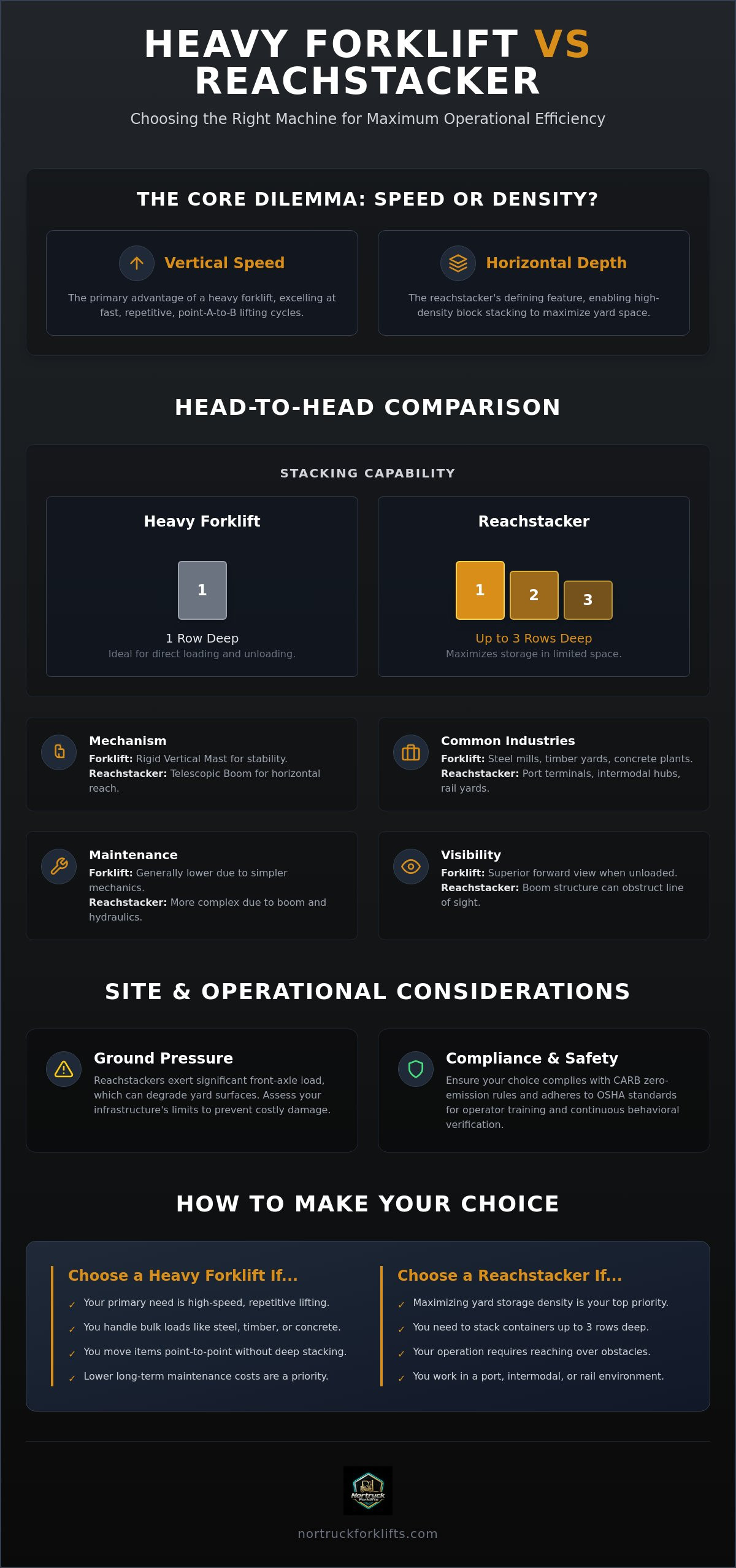
The debate between a heavy forklift vs reachstacker often comes down to a single metric: how many loads you can fit into your available square meterage. While mechanical differences dictate how a machine moves, the real-world impact is felt in your yard layout. A reachstacker allows for "block stacking," which involves placing containers in rows up to three deep. This significantly increases density because you don't need an access aisle for every single row. If your yard is land-constrained, the reachstacker is often the only viable way to scale operations without acquiring more property.
Heavy forklifts, by contrast, require dedicated aisles for 90-degree turning and mast clearance. They are generally limited to "first-row" access. This means every load must be directly accessible from an aisle, which consumes a vast amount of yard space. However, this layout offers a distinct advantage in access speed. You never have to move one load to get to another. Following OSHA load handling guidelines is essential when managing these layouts to ensure that aisle widths are sufficient for safe maneuvering and that load stability isn't compromised during high-speed transit.
Calculating Stacking Capacity
In a typical 2026 port terminal, reachstackers are expected to stack up to five containers high and three rows deep. This 5-high, 3-deep configuration maximizes both vertical and horizontal space. Heavy forklifts are typically restricted to 1-deep stacking. While they can lift high, the inability to reach over the first row means you'll spend more time "shuffling" containers if you try to stack them too densely. For high-throughput environments where every minute counts, the choice depends on whether you value storage volume or immediate selectivity.
Operational Costs and Maintenance
Choosing between these machines also impacts your long-term Total Cost of Ownership (TCO). Heavy forklifts are mechanically simpler. With fewer moving parts in the lifting mechanism, they often require less frequent intervention and can be serviced by general heavy machinery technicians. Reachstackers are more complex. Their hydraulic boom systems and specialized spreaders require expert technician knowledge. As the global reachstacker market grows toward its projected $2.2 billion value in 2026, the demand for these specialists is increasing. You must weigh the higher maintenance intensity of a boom system against the operational savings gained from a more compact yard layout.
Site Suitability: Ground Pressure and Infrastructure
Your yard's foundation often dictates your equipment choice before you even look at a spec sheet. Ground bearing capacity is the most critical infrastructure factor. When a reachstacker extends its boom with a 40-tonne load, the pressure exerted on the front axle is immense. This usually necessitates reinforced concrete pads or high-grade industrial asphalt. If your site currently uses compacted gravel or standard-thickness pavement, a heavy masted forklift might be the more practical choice. It distributes weight more predictably across its chassis during vertical lifts.
Overhead clearance is another logistical hurdle. A masted forklift has a fixed height determined by its mast. If you need to move through a warehouse door or under a low crane rail, that mast stays tall. Reachstackers can lower their booms significantly. This lower transit profile allows them to navigate areas where a tall mast simply won't fit. You must evaluate every bridge, doorway, and overhead obstruction on your site before committing to the heavy forklift vs reachstacker decision.
Manoeuvrability in Tight Spaces
Wheelbase length directly impacts your turning circle and overall yard flow. A 30-tonne forklift typically has a turning radius of approximately 6.5 metres, while a comparable reachstacker often requires 8 metres or more to complete a full turn. However, reachstackers compensate for this by using their boom to reach over obstacles. They don't always need to perform a full 90-degree turn to access a load. This "reach" capability reduces the total travel distance and can save time in a congested yard where space is at a premium.
Environmental and Terrain Factors
Weather conditions play a major role in operational safety and equipment longevity. High-stacking with a boom in high winds requires more caution than using a rigid mast, as the mast provides more centered vertical stability. On uneven or wet terrain, traction control and tyre wear become significant cost factors. Large masted trucks often handle slightly rougher terrain better than reachstackers, which are designed for the flat, level surfaces of a port terminal. Visibility also changes; a reachstacker operator often has a better view of the load at height, whereas a forklift operator has a clearer view of the ground and immediate traffic.
Sourcing Heavy Lifting Equipment with Nortruck Forklifts
Acquiring heavy machinery is a high-capital decision that requires more than just a scan of a technical brochure. With over 40 years of industry experience, Lars G. Tarby and the team at Nortruck Forklifts act as specialized guides in the European market. We prioritize transparency and direct communication over the aggressive sales tactics often found at large dealerships. When navigating the choice of a heavy forklift vs reachstacker, you need an advisor who understands that a machine's suitability depends entirely on your specific yard terrain, stacking density goals, and operational flow. We operate as an independent partner, ensuring you choose the machine that fits your operation rather than a manufacturer's sales quota.
The market in 2026 presents unique challenges, particularly regarding lead times for new equipment. Global demand for high-capacity lifting solutions remains high, and factory orders for new units can often stretch into the following year. Sourcing high-quality used Kalmar reachstackers or Toyota heavy lift trucks from the European market is a strategic way to bypass these delays. By focusing on the used market in Europe, we help businesses acquire reliable, site-ready machinery without the long wait times associated with new builds. This approach allows you to scale your fleet quickly in response to new contracts or operational shifts.
Expert Sourcing Across Europe
Our network provides access to an extensive inventory of used reachstackers and heavy lift trucks across the continent. We don't just locate a machine; we verify its operational history and technical condition to protect our international buyers. This verification process is vital for ensuring that a used unit hasn't been overworked in a harsh environment without proper maintenance. Once a machine is selected, we manage the complex logistics of importing heavy equipment to your site. Handling the transport of a 100-tonne machine requires precision and experience, and we oversee every step from the initial inspection to the final delivery at your yard. For those requiring expert assistance with the installation or relocation of such heavy assets, you can learn more about Silver Knight Haulage & Machineries Ltd.
Consultancy for Long-Term Value
Matching equipment to your specific industry is where our four decades of expertise become a tangible asset. A steel mill requires different visibility and attachment options than a high-volume container terminal. We help you avoid common procurement mistakes, such as underestimating the ground bearing capacity needed for a reachstacker or choosing a masted truck with a turning radius that's too wide for your existing aisles. Our focus is on the total cost of ownership and ensuring the equipment remains a productive part of your fleet for years to come. Contact Nortruck Forklifts for a personal consultation on your next heavy lift acquisition.
Optimizing Your Yard for Long-Term Efficiency
The decision between a heavy forklift vs reachstacker ultimately rests on your specific operational constraints. If your yard layout demands high-density storage through block stacking, a reachstacker is your logical choice. Conversely, if your facility requires rapid vertical cycles and handles a variety of industrial loads like steel or timber, a masted forklift offers the necessary simplicity and speed.
Success in 2026 requires balancing these mechanical capabilities with your site's infrastructure and the evolving regulatory landscape. Procurement shouldn't be a gamble. We provide direct expert consultation based on 40 years of heavy lifting expertise. As specialists in sourcing Kalmar, Toyota, and Linde equipment across Europe, we work without intermediaries to find the exact machine your operation needs.
Let's discuss how the right machinery can transform your yard's throughput. We're here to help you make a confident, data-driven choice for your fleet.
Frequently Asked Questions
Can a heavy forklift lift a shipping container?
Yes, a heavy forklift can lift a shipping container if it's equipped with a specialized spreader attachment or high-capacity forks. These machines are common in empty container depots where they provide rapid vertical lifting. However, they lack the horizontal reach to stack containers multiple rows deep, which limits their use in high-density port terminals.
How many rows deep can a reachstacker stack containers?
A reachstacker can typically stack containers up to three rows deep. This capability allows for block stacking, which significantly increases the number of units you can store per square meter. While the lifting capacity decreases as the boom extends to the second and third rows, this depth is the primary operational advantage over a masted truck.
Is a reachstacker more expensive to maintain than a heavy forklift?
A reachstacker is generally more expensive to maintain due to its complex telescopic boom and advanced hydraulic systems. These components require specialized technician expertise and more frequent inspection intervals. Masted forklifts have a simpler mechanical architecture with fewer moving parts, which often leads to lower long-term maintenance costs and a simpler service schedule.
What is the maximum lifting capacity of a Kalmar reachstacker?
A standard Kalmar reachstacker typically offers a maximum lifting capacity of 45 tonnes in the first row. This capacity is designed to handle fully loaded ISO containers with ease. When evaluating a heavy forklift vs reachstacker for your site, it's essential to review the specific load chart, as capacity drops as the boom extends further from the chassis.
Do I need a special licence to operate a reachstacker vs a heavy forklift?
Yes, most regions require a specific high-risk work license for reachstackers that is distinct from a standard forklift certification. Operating a telescopic boom involves managing shifting centers of gravity, which requires specialized training. You should verify that your operators meet the 2026 OSHA standards for continuous behavioral verification to maintain compliance and safety on your site.
Which machine is better for a steel mill: a masted forklift or a reachstacker?
A masted forklift is almost always the superior choice for a steel mill or timber yard. The vertical mast provides the rigid stability needed for dense, heavy loads like steel coils or large timber packs. In the heavy forklift vs reachstacker debate for industrial use, the forklift's ability to use various attachments like rams and clamps makes it more versatile for non-containerized cargo.
How does ground pressure differ between these two types of equipment?
Reachstackers exert much higher concentrated ground pressure on their front axle, especially when the boom is extended with a load. This requires a heavily reinforced operating surface, such as high-grade concrete. Heavy forklifts distribute their weight more predictably over the wheelbase during vertical lifts, making them slightly more suitable for sites with standard industrial pavement or compacted surfaces.
Can reachstackers be used for non-containerised cargo?
Reachstackers can handle non-containerized cargo if they're fitted with specialized attachments like hooks, winches, or tool carriers. While their primary design is for ISO containers, the telescopic boom allows them to reach over obstacles to pick up heavy machinery or industrial components. If your daily operations don't involve containers, a masted forklift is usually a more cost-effective and efficient solution.

Article by
Lars Gunnar Tärby
Disclaimer
1. General Information and No AdviceThe information, articles, product descriptions, and specifications provided on this website (www.nortruckforklifts.com) are for general informational and educational purposes only. While we strive to provide accurate and up-to-date content regarding new and used forklifts and heavy machinery, the material published does not constitute professional, technical, or legal advice.
2. Product Specifications and PricingNortruck Forklifts acts as a facilitator for the trade of new and used forklifts. All equipment details, including but not limited to year of manufacture, operating hours, lift capacity, dimensions, conditions, and pricing, are provided based on the information available to us at the time of publication. Specifications and availability are subject to change without prior notice.
3. "As Is" and VerificationAll articles and product listings are provided on an "as is" and "as available" basis without any warranties of any kind, either express or implied. Nortruck Forklifts does not guarantee that the descriptions are entirely error-free, complete, or reliable. Buyers and traders are strongly encouraged to independently verify all technical specifications, machine history, and equipment conditions directly with the seller or an authorized inspector before finalizing any purchase or transaction.
4. Limitation of LiabilityIn no event shall Nortruck Forklifts, its owners, or its contributors be held liable for any direct, indirect, incidental, consequential, or economic loss or damage arising out of the use of, or the inability to use, the information provided on this website, or any transactions facilitated through this platform. This includes, but is not limited to, damages caused by technical inaccuracies, typographical errors, or reliance on the content of our articles.
5. Third-Party LinksOur website may contain links to external websites, dealer networks, or third-party services that are not owned or controlled by Nortruck Forklifts. We have no control over, and assume no responsibility for, the content, privacy policies, or practices of any third-party websites.


