A used Volvo wheel loader is only as good as its sourcing network and maintenance transparency, not its listing price. It's a hard truth in an industry where auction fever often masks deep-seated mechanical issues. You're likely looking for a machine that can hit the ground running, yet the fear of hidden failures or complex cross-border paperwork often stalls the process. It's frustrating to face the current inventory shortages of 2026 while worrying if a machine from overseas actually meets EPA Tier 4 Final standards or if it's just a polished liability.
We understand that your goal isn't just to buy equipment; it's to reduce your total cost of ownership and keep your projects on schedule. This guide provides the expert roadmap you need to identify, inspect, and source the most reliable units through specialized European advisory. We'll show you how to navigate current Section 232 tariffs and verify machine history without the typical headaches. By the end of this article, you'll know exactly how to secure a machine with a documented history, ensuring your investment is a functional asset rather than a costly surprise.
Key Takeaways
- Understand why Volvo's unique TP-linkage and fuel-efficient engines provide a distinct operational advantage for heavy-duty applications.
- Learn to distinguish between "auction-ready" and "work-ready" units when evaluating a used Volvo wheel loader to avoid immediate repair costs.
- Identify the critical structural stress points, such as the center hinge and frame, that require rigorous inspection to ensure long-term reliability.
- Discover how leveraging 40 years of European industry experience can simplify cross-border sourcing and secure a machine with a documented history.
Why Used Volvo Wheel Loaders Dominate the Secondary Market
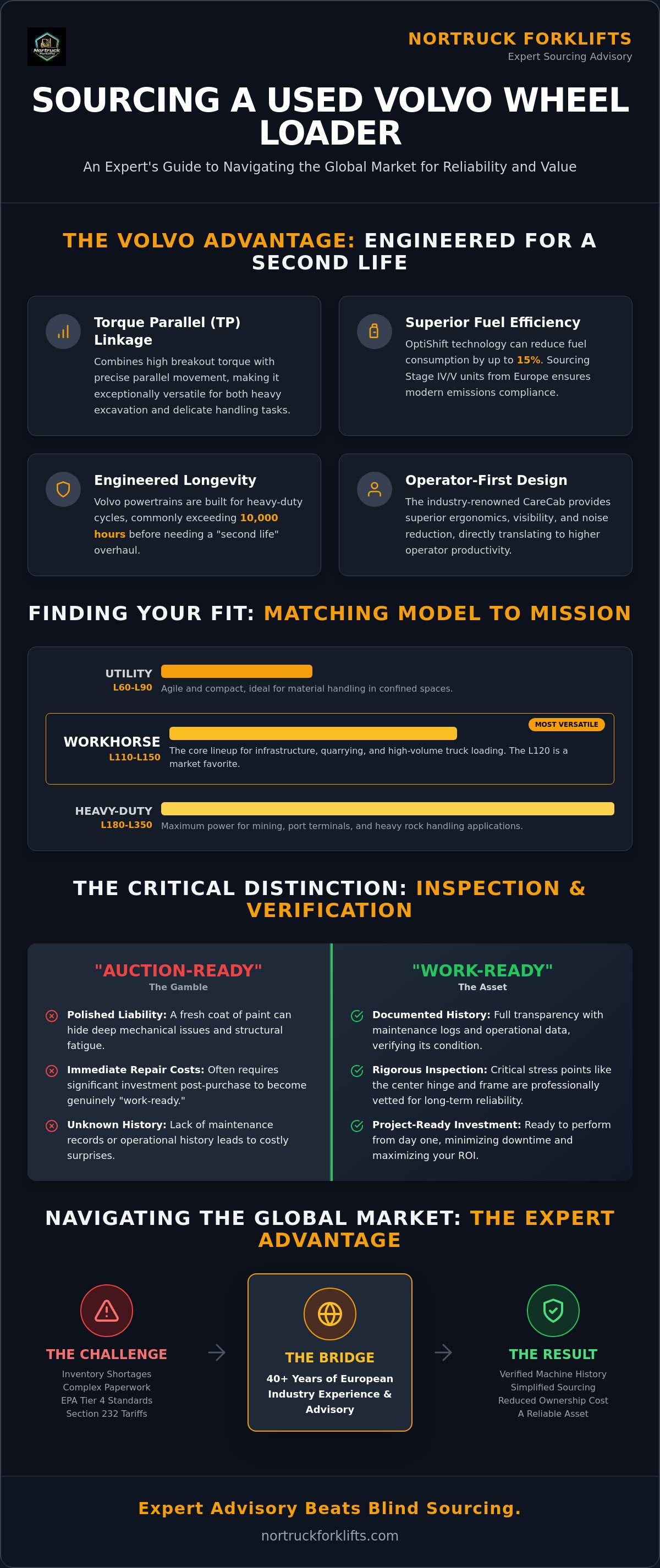
The demand for a used Volvo wheel loader isn't just about brand recognition. It's a calculated decision based on measurable performance metrics. Volvo has spent decades refining a specific set of engineering features that directly impact a contractor's bottom line. While some brands focus on raw power alone, Volvo balances force with precision, making their machines highly sought after in the pre-owned market.
One of the most significant advantages is the Torque Parallel (TP) linkage system. Unlike standard Z-bar linkages found on many competitors, the TP system combines high breakout torque with excellent parallel movement. This means you get a machine that's as effective at heavy excavation as it is at precision pallet handling. This versatility explains why these machines hold their value so well; they can transition between different industries with ease. When you invest in a pre-owned Volvo, you're buying into a lineage that traces back through the history of Volvo Construction Equipment, where durability has always been the primary design pillar.
Don't overlook the operator's environment. The CareCab is industry-renowned for its ergonomics, visibility, and noise reduction. A comfortable operator is a productive one, and this translates into higher machine utilization rates throughout its second and third life. This focus on the human element ensures that even an older machine remains a preferred choice for crews in the field.
The Longevity of Volvo Engineering
Volvo's internal powertrain components, including the transmission and axles, are engineered for heavy-duty cycles that outlast many competitors. It's common to see these loaders reach 10,000 hours and still be considered prime candidates for a "second life" overhaul. This potential for a full refurbishment means the initial investment is spread over a much longer operational window. With a robust global service network, sourcing parts for older L-series models remains straightforward, even in 2026.
Fuel Efficiency and Environmental Standards
Fuel is consistently the largest variable cost in heavy lifting operations. Volvo's OptiShift technology, which integrates a lock-up torque converter and Reverse-By-Braking, can reduce fuel consumption by up to 15% in certain applications. For businesses focused on 2026 ESG targets, these efficiencies are non-negotiable. Sourcing Stage IV or Stage V compliant units from the European market ensures you're meeting modern emissions standards while benefiting from the lower operating costs of a refined diesel engine.
Comparing Popular Models: Finding the Right Fit for Your Operation
Selecting the right model starts with a clear understanding of your material density. A machine that handles wood chips efficiently will struggle with wet gravel if the bucket isn't sized correctly. You need to balance bucket capacity with the static tipping load. This ensures the machine remains stable during full-turn maneuvers, which is a critical part of maintaining OSHA heavy equipment standards on a busy job site.
The L60 to L90 series is generally the go-to for utility work. These machines are agile and perfect for material handling in confined spaces. However, if your operation involves constant truck loading or heavy stockpile management, you'll likely need to step up to the mid-to-heavy sector. The L110, L120, and L150 represent the core of the Volvo lineup. These are the true workhorses for infrastructure projects and quarrying. They offer the breakout force needed for tough digging while maintaining the fuel efficiency discussed in the previous section. If you're unsure which capacity fits your cycle times, you can consult with an industry expert to review your site requirements before purchasing a used Volvo wheel loader.
The Versatile Mid-Range: L120 and L150
The L120 is arguably the most sought-after used Volvo wheel loader in the European market. It hits a "sweet spot" of power and agility that makes it ideal for everything from warehouse yards to large-scale recycling centers. These models often come equipped with hydraulic quick couplers, allowing operators to switch between rehandling buckets and log grapples in seconds. This versatility keeps the machine active throughout the shift rather than sitting idle.
Heavy Duty Power: L220 and Above
For mining, port terminals, and heavy rock handling, the L180, L220, and L350 are the standard. When you're sourcing a used L220 for ore handling, the hydraulic system's health is your top priority. Larger units often work in high-stress, high-heat environments. You should look for documented pressure tests and cycle time reports to ensure the pumps aren't nearing the end of their service life. Sourcing these high-capacity machines requires a deep dive into maintenance logs to avoid inheriting a machine that's been pushed beyond its limits.
When these heavy loaders are deployed in port construction or bridge building, they often work alongside high-tech piling solutions from Anteng México to establish the necessary structural foundations.
The Critical Inspection Checklist for Pre-Owned Volvo Loaders
Buying a used Volvo wheel loader requires more than a quick walk-around. You need a methodical approach to ensure the machine hasn't been abused beyond its design limits. Start with the center hinge; it's the most critical pivot point on the entire chassis. Look for excessive play or signs of recent welding. If you see thick, fresh paint in this area, it might be hiding a structural repair. Check the loader arms for stress fractures, particularly near the pivot points.
Understanding the machine's history is vital. If a unit was used for heavy rehandling or rock loading without the correct Volvo's application-specific packages, the frame may have endured forces it wasn't specifically reinforced for. Always demand a verified service history. In Europe, many fleet owners follow strict manufacturer maintenance schedules, which provides a level of transparency that's often missing in auction-sourced equipment. A documented history reduces the risk of inheriting a machine with a failing transmission or a worn-out engine.
Perform a thorough hydraulic analysis. Check all cylinders for weeping seals and inspect the hoses for dry rot. Testing the cycle times under a full load is the best way to gauge pump health. If the lift or tilt functions feel sluggish compared to factory specifications, you're likely looking at a costly hydraulic overhaul in the near future.
Identifying Wear Patterns in TP-Linkage
The Torque Parallel linkage is a standout feature, but it's sensitive to poor lubrication. Check for excessive play in the pins and bushings by having an operator wiggle the bucket while it's slightly off the ground. Neglecting these components leads to line boring, which is a labor-intensive and expensive repair. You can check for hydraulic pressure consistency by monitoring the gauges during a full stall of the hydraulic functions; any significant flickering suggests a failing relief valve or pump.
Evaluating the Aftertreatment System
On newer models, the health of the Diesel Particulate Filter (DPF) and Selective Catalytic Reduction (SCR) system is paramount. Watch for warning lights or specific error codes during a cold start. A professional diagnostic scan is mandatory before you finalize any purchase. It reveals the regeneration history and can identify if the system has been "patched" to hide underlying sensor failures. In the 2026 market, emissions compliance is a major factor in a used Volvo wheel loader's resale value and operational legality.
For operators transitioning to electric or hybrid fleets, battery state-of-health replaces exhaust diagnostics as the primary concern. To ensure your investment in electrified heavy equipment is sound, you can explore Mobile EV Battery Testing for independent, professional verification of battery capacity and safety.
Sourcing from Europe: Navigating the Global Market
Sourcing a used Volvo wheel loader from the European market isn't just about finding a lower price; it's about accessing a different tier of equipment quality. Because Europe is the home of Volvo Construction Equipment, the density of specialized technicians and authorized service centers is significantly higher than in other regions. This proximity to the manufacturer's core infrastructure often results in machines that have been maintained strictly with OEM parts and factory-approved lubricants.
However, you must distinguish between "auction-ready" and "work-ready" machines. An auction-ready loader is often steam-cleaned and painted to mask leaks or structural wear. A work-ready machine, conversely, comes with a transparent history and has undergone a professional inspection to ensure it can be deployed immediately. If you're importing to the United States, you'll need to navigate the Section 232 tariff on industrial equipment, which can reach up to 15%. You also have to ensure the engine meets EPA Tier 4 Final standards, documented through EPA Form 3520-1, to avoid costly refusals at the port. Managing these variables alone is a complex task that requires more than just a search engine; it requires a boots-on-the-ground presence.
Buying sight-unseen from an unregulated private seller carries immense risk. Without a verified intermediary, you have no recourse if the machine arrives with a cracked frame or a failing transmission. We've seen many buyers lose their initial savings to unexpected customs delays or hidden mechanical failures. If you want to bypass these pitfalls and secure a reliable machine, you can partner with our team to manage your European equipment acquisition from initial inspection to final delivery.
Why European Maintenance Standards Matter
Strict European environmental and safety regulations demand that heavy machinery operates at peak efficiency. This regulatory pressure leads to better-documented machine histories. European-sourced machines frequently possess more comprehensive service logs than those from markets with fewer regulatory requirements. Climate also plays a role. Machines from Northern Europe are often in excellent mechanical health but require a close check for chassis corrosion due to road salt. In contrast, Southern European units generally have cleaner frames but may show more wear on cooling systems and seals due to higher operating temperatures.
The Logistics of Heavy Equipment Transport
Transporting a 15 to 30-ton loader across borders is a methodical process. Machines are typically prepped by removing buckets or attachments to meet height and weight restrictions for road transport. For international shipping, Roll-on/Roll-off (RoRo) vessels are the standard choice, providing a cost-effective way to move large assets without the need for containerization. Managing the timeline from the final wire transfer to on-site delivery usually takes several weeks, depending on the availability of shipping berths and customs clearance speeds at the destination port.
Why Expert Advisory Beats Blind Sourcing
Many contractors believe that finding a used Volvo wheel loader is as simple as scrolling through online auction portals. While these platforms offer volume, they rarely provide the technical depth required for a high-stakes capital investment. Blind sourcing often leaves you at the mercy of a seller's selective transparency. An expert advisor acts as your advocate, peeling back the layers of a machine's history to verify if the listing price actually matches the mechanical condition. How does a four-decade track record change your procurement strategy?
We operate through a professional network that extends far beyond public listings. Many of the highest-quality machines never reach a public auction; they are traded within manufacturer networks or between established fleet owners who value discretion. By tapping into these channels, we help you access inventory that is truly "work-ready" rather than just "market-ready." This approach eliminates the layers of markups added by unnecessary intermediaries, ensuring you communicate directly with the source and receive honest data.
The Lars G Tarby Advantage
With over 40 years of heavy lifting expertise, Lars G Tarby provides an "insider" perspective that a digital platform simply can't replicate. This experience allows an advisor to identify the subtle signs of gear slippage or recognize hydraulic patterns that suggest a pump is nearing the end of its life. This consultancy isn't just about finding a machine; it's about calculating the true Total Cost of Ownership (TCO). We analyze maintenance logs and operational data to predict future repair cycles, helping you avoid a purchase that looks like a bargain but quickly becomes a liability. It's about precision in procurement and suitability for your specific job site.
Your Next Steps in Equipment Acquisition
Securing the right equipment shouldn't be a gamble. Our process begins with a detailed, one-on-one consultation to define your specific operational needs, from bucket capacity to emissions compliance. We take the burden of cross-border logistics, technical verification, and documentation off your plate. This allows you to focus on your core business while we handle the complexities of the European market. If you're ready to fast-track your equipment acquisition without the usual risks, you can Contact Lars G Tarby for Expert Sourcing Advice today. We'll work together to find a used Volvo wheel loader that delivers long-term value to your fleet and keeps your projects moving forward.
Securing Your Operational Future with Volvo
Sourcing a used Volvo wheel loader in 2026 requires a shift from passive searching to active, expert-led procurement. We've explored how Volvo's engineering longevity and the rigorous standards of European maintenance create a unique opportunity for those who know where to look. Success in this specialized market isn't about finding the lowest price on an auction portal; it's about verifying structural integrity and ensuring emissions compliance before the machine ever leaves the yard.
You don't have to navigate these technical and logistical complexities alone. With over 40 years of heavy lifting expertise and direct access to specialized manufacturer networks across Europe, we provide the independent, transparent advisory needed to eliminate uncertainty. Our focus is on bridging the gap between high-quality European inventory and your specific operational requirements. If you're ready to secure a machine with a documented history and a lower total cost of ownership, you can Consult with Lars G Tarby for Your Used Volvo Sourcing Needs. Let's find the right equipment to keep your projects on schedule and your business moving forward.
Frequently Asked Questions
What is the life expectancy of a used Volvo wheel loader?
A well-maintained used Volvo wheel loader can expect a service life of 15,000 to 20,000 hours before a major structural retirement. Many units are designed for a "second life" overhaul around the 10,000-hour mark, where the powertrain is refurbished to extend the machine's utility. This longevity is a primary reason why Volvo machines command higher residual values than many competitors in the secondary market.
Is a high-hour Volvo loader worth the investment?
A high-hour machine is worth the investment if the purchase price accounts for the upcoming component replacement cycles. Volvo's robust frame and transmission often outlast the initial engine life, making them ideal for refurbishment. You should prioritize machines with a verified maintenance history rather than focusing solely on the hour meter. A 12,000-hour machine with perfect service logs is often a safer bet than an 8,000-hour unit with no documentation.
How do I verify the service history of a machine sourced from Europe?
You can verify the history by requesting the "CareTrack" telematics report and digital service logs from the original authorized dealer. European fleet owners are subject to strict regulatory and insurance requirements, which usually results in very detailed maintenance records. We assist our clients by contacting these dealers directly to confirm that all scheduled intervals and manufacturer recalls were addressed throughout the machine's life.
Which Volvo loader model is best for heavy material handling in ports?
The Volvo L220 and L350 models are the preferred choices for heavy material handling in port terminals. These high-capacity loaders provide the necessary static tipping load to handle large rehandling buckets and heavy attachments like log grapples. Their stability and breakout force are critical for the fast cycle times required in high-volume maritime environments where vessel turnaround time is the primary KPI.
What are the most common mechanical issues in the Volvo L-series?
The most frequent issues involve wear in the TP-linkage pins and bushings, which occurs if the automatic lubrication system wasn't properly maintained. You should also check the aftertreatment system on newer models for DPF or SCR sensor errors. While the core powertrain is exceptionally reliable, neglecting these specific areas can lead to expensive line boring or emissions-related downtime that impacts your total cost of ownership.
Can Nortruck Forklifts source specific Volvo loaders that are not currently listed online?
Yes, we specialize in accessing unlisted inventory through a professional network built over 40 years. Many premium machines are traded privately between manufacturers and large fleet owners before they ever reach public auction sites. If you have a specific requirement for a used Volvo wheel loader with a particular configuration, we can often locate it through these "insider" channels that are unavailable to the general public.
How does Volvo’s fuel efficiency compare to other major brands like Caterpillar or Komatsu?
Volvo engines typically offer a fuel efficiency advantage over Caterpillar or Komatsu by delivering high torque at lower engine speeds. Features like OptiShift technology, which uses a lock-up torque converter, can reduce fuel consumption by up to 15% in load-and-carry applications. This efficiency isn't just about saving money at the pump; it also reduces the heat load on the engine and transmission, contributing to longer component life.
What is the typical lead time for sourcing a machine from Europe to a global location?
The typical lead time for sourcing and delivering a machine from Europe ranges from 4 to 8 weeks. This timeline includes the initial technical inspection, inland road transport to a major port, and international RoRo shipping. Factors such as customs documentation, EPA compliance checks for US-bound units, and vessel schedules can influence the final delivery date. We manage this entire progression to ensure the machine arrives on your site ready to work.

Article by
Lars Gunnar Tärby
Disclaimer
1. General Information and No AdviceThe information, articles, product descriptions, and specifications provided on this website (www.nortruckforklifts.com) are for general informational and educational purposes only. While we strive to provide accurate and up-to-date content regarding new and used forklifts and heavy machinery, the material published does not constitute professional, technical, or legal advice.
2. Product Specifications and PricingNortruck Forklifts acts as a facilitator for the trade of new and used forklifts. All equipment details, including but not limited to year of manufacture, operating hours, lift capacity, dimensions, conditions, and pricing, are provided based on the information available to us at the time of publication. Specifications and availability are subject to change without prior notice.
3. "As Is" and VerificationAll articles and product listings are provided on an "as is" and "as available" basis without any warranties of any kind, either express or implied. Nortruck Forklifts does not guarantee that the descriptions are entirely error-free, complete, or reliable. Buyers and traders are strongly encouraged to independently verify all technical specifications, machine history, and equipment conditions directly with the seller or an authorized inspector before finalizing any purchase or transaction.
4. Limitation of LiabilityIn no event shall Nortruck Forklifts, its owners, or its contributors be held liable for any direct, indirect, incidental, consequential, or economic loss or damage arising out of the use of, or the inability to use, the information provided on this website, or any transactions facilitated through this platform. This includes, but is not limited to, damages caused by technical inaccuracies, typographical errors, or reliance on the content of our articles.
5. Third-Party LinksOur website may contain links to external websites, dealer networks, or third-party services that are not owned or controlled by Nortruck Forklifts. We have no control over, and assume no responsibility for, the content, privacy policies, or practices of any third-party websites.


