
The lowest sticker price on a used forklift is often the most expensive mistake a procurement manager can make. While used cushion tire forklift auction values dropped 8.6% in June 2026, a bargain price doesn't account for the hidden costs of mechanical neglect or failing batteries. Learning how to buy a used forklift in 2026 requires more than just a quick visual check; it demands a technical strategy that prioritizes operational uptime and long-term ROI. We know the pressure of sourcing heavy-duty equipment, especially when you're worried about inheriting hidden defects or managing the complexities of cross-border logistics in Europe.
This guide provides a professional framework to help you master the procurement process for heavy lifting equipment. You'll learn how to evaluate specific high-capacity brands like Kalmar and Linde, leverage the 2026 Section 179 deduction limit of $1,220,000, and conduct technical inspections that reveal the true condition of a machine. We'll walk through the ROI of used versus new equipment and provide the technical confidence needed to select a machine that matches your exact operational requirements.
Key Takeaways
- Discover why the 2026 market favors used equipment and how to capitalize on depreciation curves for immediate operational readiness.
- Learn to identify critical mechanical risks by inspecting hydraulic pressure drops and mast alignment to prevent costly post-purchase repairs.
- Understand why the initial purchase price accounts for only 20% of your long-term investment and how to calculate the true cost of ownership.
- Master a step-by-step framework on how to buy a used forklift that aligns with your specific lifting capacity and site requirements.
- Gain insights into navigating cross-border logistics in Europe by leveraging independent advisory over traditional dealership models.
Understanding the Value Proposition of Used Lifting Equipment
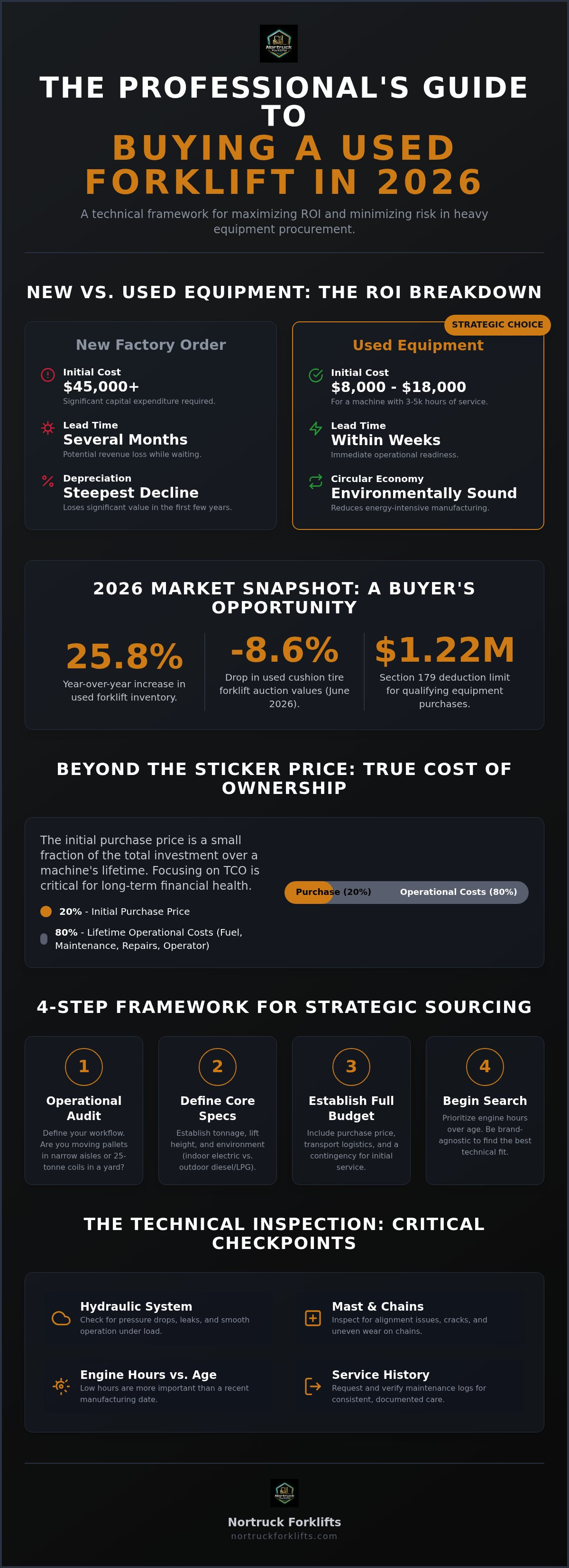
Choosing the right machine starts with understanding that used equipment is a strategic asset, not a compromise. In 2026, the used forklift inventory has increased by 25.8% year-over-year. This surplus creates a unique opportunity for buyers to secure high-capacity machines without the lengthy lead times associated with new factory orders. When you're researching how to buy a used forklift, the first metric to consider is current market availability. This allows you to scale your operations based on immediate demand rather than waiting for production cycles.
The economic advantages are clear. A standard warehouse forklift that costs up to $45,000 new can often be sourced for $8,000 to $18,000 when it has 3,000 to 5,000 hours of service. With auction values for certain types, like cushion tire models, down 8.6% as of June 2026, the market is currently buyer-friendly. This allows you to bypass the steepest part of the depreciation curve while securing a machine that's already proven its reliability. There's also a significant environmental benefit. Refurbishing a heavy-duty machine reduces the demand for energy-intensive manufacturing, aligning your fleet with the growing focus on circular economies in European logistics.
The philosophy of prioritizing reliability and long-term value in the pre-owned market is universal, whether you are scaling an industrial fleet or selecting a high-quality vehicle from a specialist like Stone Road Auto.
New vs. Used: The Operational ROI
The primary advantage of used sourcing is speed. A new factory order can take several months to arrive, but a used Linde or Kalmar can often be on your site within weeks. This immediate readiness means you don't lose revenue while waiting for equipment to arrive. By saving on the initial capital expenditure, you can reallocate funds into other critical areas like fleet telematics or operator training. Premium brands are built to last. A well-maintained used machine from a top-tier manufacturer often provides a decade or more of reliable service.
Identifying Your Core Lifting Requirements
Before browsing listings, you must establish a technical baseline. Understanding Forklift basics, such as load centers and stability triangles, helps you define the necessary tonnage and lift height for your specific application.
- Environment: Indoor operations usually require electric trucks to meet air quality standards. Outdoor yards often need diesel or LPG for power and durability on uneven surfaces.
- Load Type: Standard pallets work for most trucks, but timber or steel pipes require specialized equipment like Baumann sideloaders or Combi-Lift 4-way trucks.
- Capacity: Don't buy a machine that just meets your maximum load. Aim for a buffer to ensure the hydraulic system isn't constantly operating at its technical limit.
A used machine is often a better strategic fit when your operation requires specialized high-capacity equipment that's prohibitively expensive to buy new. By focusing on machines with documented service histories, you minimize the risk and maximize the utility of your investment.
A Step-by-Step Framework for Sourcing Used Forklifts
The technical path of how to buy a used forklift begins long before you look at a listing. Procurement is a methodical process. It isn't a single event. Your first step involves a deep operational audit. You must define exactly how the machine will function within your specific workflow. Are you moving standard pallets in a narrow-aisle warehouse, or are you handling 25-tonne steel coils in an outdoor yard? Documenting these parameters prevents the common mistake of purchasing a machine that's underpowered or physically incompatible with your facility. Once these specs are set, establish a realistic budget. This figure must include the purchase price, transport logistics across borders, and a contingency for an initial comprehensive service to baseline the machine's maintenance schedule.
For businesses looking to increase their available capital for such equipment investments, liquidating non-core assets like precious metals can be an effective strategy; CT Gold & Silver offers professional appraisal and purchasing services for those seeking to convert jewelry or bullion into liquid funds.
Defining the Search Parameters
A brand-agnostic approach often yields the best value. While you might have a preference for a specific manufacturer, focusing on technical specifications rather than just the badge allows you to compare similar high-capacity models from Kalmar, Linde, or Toyota. Priority should be placed on engine hours over chronological age. A five-year-old machine with 8,000 hours may be in worse condition than a ten-year-old machine with only 3,000 hours. Additionally, evaluate if you truly need specialized attachments like rotators or side shifts. These components add complexity and maintenance requirements, so they should only be included if they provide a clear operational advantage. Consulting with an experienced sourcing partner can clarify these variables before you commit capital.
Sourcing Strategy: Where to Look
Public auction sites often feel tempting because of the perceived low entry price. However, these platforms are frequently used to offload equipment with looming mechanical failures or incomplete service histories. For heavy-duty or specialized equipment, the risk of a "blind" purchase is too high. A more reliable strategy involves manufacturer-certified used programs or leveraging independent advisors who have direct access to off-market European inventory. These professional networks provide transparency that public listings lack.
Before finalising any deal, execute a rigorous technical inspection. This process ensures the equipment maintains compliance with OSHA forklift standards regarding safety and operational integrity. Verification of the machine’s history is non-negotiable. You need to see documented proof of major component replacements and consistent hydraulic servicing. With over 40 years of experience in the industry, Lars G Tarby has seen how thorough documentation translates directly to long-term reliability. Once the machine is verified, manage the logistics professionally to ensure the unit arrives ready for immediate integration into your fleet.
The Technical Inspection: Verifying Operational Integrity
A thorough technical inspection is the most critical stage in learning how to buy a used forklift. While the frame might look clean, the machine's operational heart lies in its hydraulic and mechanical systems. Start by examining the hydraulic system for more than just visible leaks. You should look for scoring on the cylinders and test for pressure drops when the mast is fully extended under a rated load. If the mast drifts downward or the tilt cylinders struggle, you're looking at a costly hydraulic overhaul in the near future.
The mast and carriage require a focused eye to identify stress cracks or alignment issues. Even a slight bend in the mast can lead to catastrophic failure under high-capacity loads. This isn't just about operational efficiency; it's about adhering to OSHA forklift safety standards. For heavy-duty equipment like Kalmar or Linde trucks, the powertrain must be analyzed for responsiveness. Listen for unusual engine knocking and check the exhaust for excessive smoke, which often indicates internal wear. The transmission should engage smoothly without hesitation or grinding sounds.
The Critical Components Checklist
Tyres provide a clear story of how a machine was treated. Uneven wear patterns often signal alignment problems or frequent overloading. Beyond the rubber, you must measure the forks and chains. Forks that have lost more than 10% of their original thickness are legally non-compliant and must be replaced. Ensure all safety features, such as seatbelt interlocks and backup alarms, function perfectly. These details separate a reliable asset from a liability. If you aren't comfortable performing these checks yourself, an independent advisor can provide an unbiased technical report.
Verifying Documentation and History
Documentation is your primary defense against hidden defects. A professional sourcing process always includes a review of the service logbook to confirm maintenance was performed at the correct intervals. For machines operating within the European market, verifying the CE marking is essential for legal compliance. Look for evidence of major component replacements, such as a rebuilt engine or a new battery pack in electric models. In 2026, electric forklifts account for over 70% of new truck sales in Europe, making battery health diagnostics vital. Use a voltmeter to check for cell consistency; a single weak cell can compromise the entire pack's performance and significantly increase your total cost of ownership.
Whether you are maintaining an industrial fleet or a personal vehicle, such as the motorhomes and vans serviced by Thurton Auto Centre, thorough inspections and regular maintenance are the keys to protecting your investment.
Evaluating Total Cost of Ownership (TCO) and Brand Suitability
The initial purchase price of a machine is rarely the most significant number on your balance sheet. When you research how to buy a used forklift, you're actually evaluating a five-year financial commitment. The sticker price typically accounts for only 20% of the total cost of ownership. The remaining 80% is consumed by maintenance, energy consumption, and labor. Choosing a brand with high parts availability, such as a Linde forklift for sale, ensures that your machine spends its time on the warehouse floor rather than waiting for backordered components from overseas.
Fuel efficiency and energy consumption vary significantly across different equipment generations. Older diesel models might have a lower entry price, but they can cost thousands more in annual fuel consumption compared to newer, Euro-compliant engines. Resale value is another critical metric for your ROI. Premium brands like Toyota and Kalmar consistently hold their worth better than budget manufacturers. This exit strategy should be part of your original procurement plan. It ensures you can recover a significant portion of your investment when it's eventually time to upgrade your fleet.
Brand-Specific Considerations
Different operational tasks require specialized engineering. If your facility handles high-capacity logistics at a port or heavy industrial site, a Kalmar heavy lift truck for sale provides the structural integrity needed for loads up to 30 tonnes. For those operating in narrow aisles or handling long loads like timber and steel, a Combi-Lift 4-way truck for sale offers multidirectional flexibility that standard trucks can't match. If your priority is long-term reliability in demanding warehouse environments, sourcing a used Toyota heavy forklift remains one of the safest investments due to their proven engineering standards and global support network.
Calculating Maintenance and Downtime Costs
Downtime is the hidden profit killer in any logistics chain. For a critical port or factory operation, the opportunity cost of a stationary machine can exceed the cost of the repair itself within just a few hours. You should estimate annual service costs based on your projected hourly usage. High-hour machines naturally require more frequent hydraulic and powertrain attention. Don't forget to factor in operator training. Specialized machines like sideloaders require specific skills to operate safely. An untrained operator can inadvertently increase wear and tear, leading to premature component failure.
Navigating the European Market with Expert Advisory
Sourcing a high-capacity machine across European borders involves more than just a financial transaction. It requires a deep understanding of regional technical standards, varying maintenance cultures, and complex logistics. When you're determining how to buy a used forklift in this landscape, the most valuable asset you can have is an independent advisor. Lars G Tarby brings over 40 years of industry experience to this process. This isn't just a career milestone; it's a repository of technical knowledge and a direct line to manufacturer networks that aren't accessible to the general public. Having a seasoned veteran on your side ensures that the machine's documented history matches its physical reality.
Our approach at Nortruck focuses on transparency. We believe in cutting out unnecessary intermediaries who often add layers of cost without adding value. By dealing directly with primary sources and manufacturer networks, we ensure that your capital goes toward the equipment's quality rather than a broker's commission. We don't just sell machines; we provide tailored lifting solutions. Whether your operation requires a 30-tonne Kalmar for a port terminal or a specialized Baumann sideloader for a timber yard, the goal is always operational reliability and a clear return on your investment.
Why an Independent Advisor Beats a Dealership
A traditional dealership is naturally restricted by its own inventory. Their goal is to move the stock they have on the lot. An independent advisor is brand-agnostic. They provide unbiased recommendations across all major manufacturers, including Linde, Toyota, and Volvo. This independence allows for a broader search of European fleets and off-market machinery that never reaches public auction sites. Furthermore, an advisor conducts negotiations based on deep technical understanding. They know the specific wear points of a Combi-Lift or a reachstacker, ensuring you don't pay a premium for a machine with looming mechanical issues.
Finalising Your Purchase: Logistics and Handover
The procurement journey doesn't end when the contract is signed. Managing international transport and customs documentation is a critical phase that requires precision. A single error in paperwork can lead to expensive delays at the border. We manage this entire logistical chain, ensuring the machine arrives at your facility ready for work. The process concludes with on-site commissioning and operator familiarisation. This is particularly important for specialized equipment like 4-way trucks, where understanding the machine's unique handling characteristics is essential for safety and efficiency. If you're ready to secure a reliable asset for your fleet, the next step is a professional consultation.
Scaling Your Operations with Technical Confidence
Procurement in 2026 is no longer about finding the cheapest machine on a lot. It's about securing a reliable asset that integrates seamlessly into your workflow. By prioritizing technical integrity over sticker price and understanding the true total cost of ownership, you protect your bottom line from unexpected downtime. Mastering how to buy a used forklift involves a shift from commodity shopping to strategic investment; if you are looking to expand your business interests, visit Own a Russo's New York Pizzeria & Italian Franchise - Pizza Franchise Opportunity for details on premium Italian kitchen ventures.
Our team leverages 40 years of heavy lifting expertise to provide direct European market access. We specialize in the specialized sourcing of Kalmar and Linde equipment that meets your exact technical specifications. This independent guidance removes the uncertainty from cross-border logistics and ensures every machine delivers maximum ROI. You've got the framework; now it's time to put it into practice.
We're ready to help you find a machine that delivers long-term results for your business.
Frequently Asked Questions
What is the most important thing to check when buying a used forklift?
The most critical element is the documented service history combined with a hydraulic pressure test. While a clean chassis looks professional, the maintenance log reveals if the machine was neglected or overworked. A hydraulic test ensures the mast and cylinders can hold a rated load without drifting; this is a common failure point that often requires an expensive overhaul if ignored during the initial inspection.
How many hours is considered high for a used forklift?
High hours vary by brand, but generally 10,000 to 12,000 hours is considered the upper limit for a standard warehouse forklift. If you're researching how to buy a used forklift for long-term reliability, the ideal range is typically between 3,000 and 5,000 hours. Premium brands like Linde or Kalmar are engineered for longevity, but maintenance history always carries more weight than the raw hour count on the meter.
Should I buy an electric or diesel used forklift in 2026?
The choice depends on your operational environment and the upcoming Euro 7 emission standards. In 2026, electric forklifts account for over 70% of new sales in Europe due to their lower total cost of ownership and indoor air quality benefits. However, for heavy-duty outdoor lifting up to 30 tonnes, diesel remains the industry standard for raw power and durability in rugged yard environments.
Is it possible to get a warranty on a used forklift?
Standard warranties are rare in the used market, but you can often secure a limited guarantee through manufacturer-certified used programs. When you learn how to buy a used forklift through an expert advisor, the focus shifts from a traditional warranty to a rigorous technical verification process. This thorough vetting minimizes the risk of immediate failure and provides more security than a basic "as-is" private sale.
Why is it often better to source used forklifts from the European market?
The European market offers superior maintenance standards and a massive inventory of high-capacity machines from brands like Kalmar and Baumann. Strict safety regulations in the EU mean that fleet machines are frequently serviced at manufacturer-specified intervals. This creates a more reliable secondary market where you can find specialized equipment that is often unavailable or prohibitively expensive in other regions.
Who should perform the technical inspection on a used heavy-lift truck?
Technical inspections should be performed by an independent heavy equipment specialist who understands the specific nuances of brands like Kalmar or Linde. A general mechanic might miss subtle wear patterns in specialized hydraulic systems or stress cracks in high-capacity masts. Using an advisor with deep industry experience ensures an unbiased assessment of the machine's true condition, protecting you from inheriting hidden mechanical defects.

Article by
Lars Gunnar Tärby
Disclaimer
1. General Information and No AdviceThe information, articles, product descriptions, and specifications provided on this website (www.nortruckforklifts.com) are for general informational and educational purposes only. While we strive to provide accurate and up-to-date content regarding new and used forklifts and heavy machinery, the material published does not constitute professional, technical, or legal advice.
2. Product Specifications and PricingNortruck Forklifts acts as a facilitator for the trade of new and used forklifts. All equipment details, including but not limited to year of manufacture, operating hours, lift capacity, dimensions, conditions, and pricing, are provided based on the information available to us at the time of publication. Specifications and availability are subject to change without prior notice.
3. "As Is" and VerificationAll articles and product listings are provided on an "as is" and "as available" basis without any warranties of any kind, either express or implied. Nortruck Forklifts does not guarantee that the descriptions are entirely error-free, complete, or reliable. Buyers and traders are strongly encouraged to independently verify all technical specifications, machine history, and equipment conditions directly with the seller or an authorized inspector before finalizing any purchase or transaction.
4. Limitation of LiabilityIn no event shall Nortruck Forklifts, its owners, or its contributors be held liable for any direct, indirect, incidental, consequential, or economic loss or damage arising out of the use of, or the inability to use, the information provided on this website, or any transactions facilitated through this platform. This includes, but is not limited to, damages caused by technical inaccuracies, typographical errors, or reliance on the content of our articles.
5. Third-Party LinksOur website may contain links to external websites, dealer networks, or third-party services that are not owned or controlled by Nortruck Forklifts. We have no control over, and assume no responsibility for, the content, privacy policies, or practices of any third-party websites.


