
Can a high capacity electric forklift truly replace the raw power of a diesel machine in a demanding multi-shift operation? For decades, the industry standard suggested that only internal combustion could handle the 15 to 40 tonne range. You've likely felt the pressure of rising diesel costs and the weight of new EU emissions regulations, yet the anxiety over battery runtime and upfront capital remains a significant barrier. It's a common concern for professionals who prioritize reliability and cannot afford unexpected downtime.
This guide demonstrates how the 2026 shift toward heavy-duty electrification has turned those concerns into outdated myths. With the EU Electrification Action Plan launched in July 2026, the transition is moving faster than many anticipated. You'll discover the practical ROI of switching to electric, which brands are currently leading the heavy-lift segment, and how to navigate the European market to source these units effectively. We'll examine the technical advancements making these machines a superior choice for operational longevity and how you can secure the right equipment for your specific industrial needs.
Key Takeaways
- Learn why the transition to 120V+ systems allows electric motors to deliver superior lifting precision and torque compared to traditional diesel engines in the 30-tonne segment.
- Understand the long-term financial shift where significantly lower energy and maintenance costs offset the initial capital expenditure of a high capacity electric forklift.
- Identify the specific grid requirements and strategic charging cycles needed to maintain multi-shift productivity while protecting battery longevity.
- Discover how to navigate the European secondary market to source rare, specialized heavy-lift units that local dealerships often fail to stock.
- Recognize why heavy industry is increasingly bypassing Stage V diesel equipment in favor of future-proof, zero-emission technology.
The Rise of High Capacity Electric Forklifts in 2026
The 2026 industrial landscape is defined by a shift where "high capacity" no longer refers to niche 8-tonne units. Instead, it describes a robust class of machinery reaching up to 40 tonnes and beyond. This evolution is driven by significant improvements in energy density, allowing heavy-lift electrics to handle the rigors of 24/7 operations without the traditional mid-shift power drop. Many fleet managers are now bypassing Stage V diesel engines entirely, choosing instead to invest in zero-emission technology that eliminates the complexities of exhaust after-treatment and rising fuel costs.
The technical foundation of electric-powered forklifts has matured to a point where power parity with internal combustion is a reality. With the EU Industrial Acceleration Act of 2026 providing a clear framework for clean technology, the transition is no longer a matter of "if" but "when." This shift is particularly evident in large-scale logistics and manufacturing hubs across Europe, where the operational benefits of a high capacity electric forklift are becoming too significant to ignore.
To better understand this concept, watch this helpful video:
Beyond the Warehouse: Heavy Industry Applications
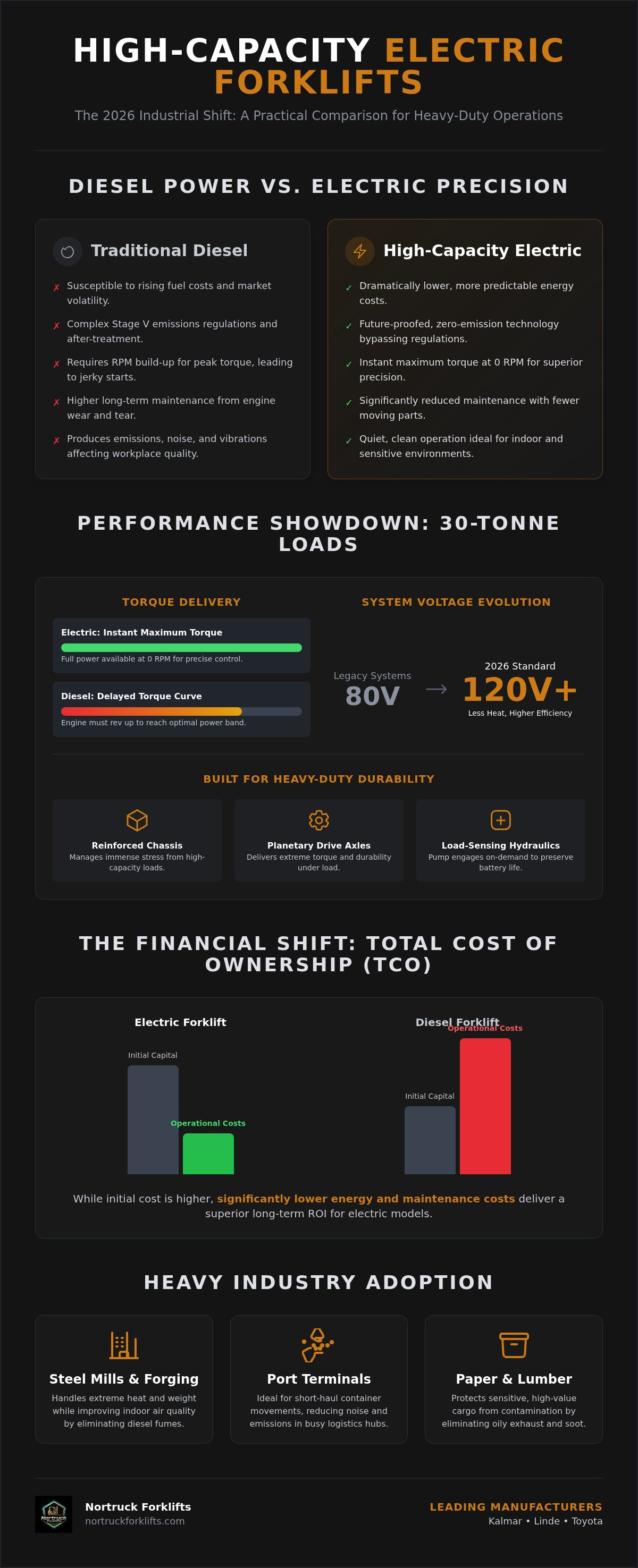
Electric heavy-lift trucks are finding their way into environments once considered the exclusive domain of diesel. In steel mills and forging facilities, these machines handle extreme heat and immense weight without contributing to poor indoor air quality. Port terminals are also seeing a change; while diesel reachstackers remain common, high-capacity electric counterbalance trucks are taking over short-haul container movements. In the paper and lumber sectors, the lack of oily exhaust and soot makes electric power the standard for protecting sensitive, high-value cargo from contamination.
Key Manufacturers Leading the Charge
Kalmar has established a dominant position with an electric heavy-lift portfolio that is fundamentally changing port logistics and heavy manufacturing. Their focus on the 18 to 33-tonne range provides a direct alternative to their own legendary diesel lines. Simultaneously, Linde and Toyota have aggressively expanded their offerings into the 15-tonne plus segment to meet growing demand. If you're currently researching a Linde forklift for sale, you'll find that the 2026 procurement trends favor these high-voltage electric units for their superior precision and lower long-term maintenance requirements. Finding a high capacity electric forklift that matches your specific duty cycle requires looking beyond local inventory to the broader European market where these specialized units are more readily available.
Performance Specs: Can Electric Match Diesel for 30-Tonne Loads?
When handling a 30-tonne load, the most critical factor isn't just raw horsepower; it's how that power is delivered. A diesel engine requires time to reach its optimal torque curve, often resulting in a jerky start when moving heavy tonnage. In contrast, a high capacity electric forklift utilizes electric motors that provide maximum torque at zero RPM. This allows for unmatched precision when positioning massive steel coils or 30-tonne containers. By 2026, the industry standard for these heavy-lift units has shifted from 80V to 120V+ systems. These higher voltage architectures reduce current draw and heat generation, which is essential for maintaining performance during sustained, heavy-duty cycles.
Durability in the 15 to 40-tonne segment requires more than just a large battery. Leading manufacturers like Kalmar, who offer electric models in the 18 to 33-tonne range, utilize reinforced chassis and planetary drive axles to manage the immense stress of high-capacity loads. Hydraulic efficiency has also seen a leap forward through on-demand load sensing. Instead of the hydraulic pump running constantly, it only engages when the operator initiates a lift or tilt. This preserves battery life and reduces wear on components. For those managing fleet budgets, these efficiencies contribute to lower total costs of ownership over the life of the machine. If you're looking to compare these technical specifications across different manufacturers, our team at Nortruck Forklifts can provide a side-by-side analysis of the latest heavy-lift models.
Battery Technology: Lithium-Ion vs. Lead Acid
Lithium-ion has become the only viable choice for high-capacity, multi-shift operations in 2026. Lead-acid batteries simply cannot handle the rapid discharge rates required for 30-tonne lifts without significant voltage drops. Li-ion technology supports opportunity charging, allowing operators to plug in during 15-minute breaks to maintain a 20-80% charge level. This eliminates the need for dangerous and time-consuming battery swapping. While degradation is a concern, modern heavy-duty cells are designed to maintain over 80% of their original capacity after five years of intensive use, provided the thermal management systems are properly maintained.
Manoeuvrability and Operator Comfort
The "Quiet Cabin" advantage is more than a luxury; it's a safety feature. In high-decibel environments like steel mills or ports, reducing engine noise significantly lowers operator fatigue and improves situational awareness. This attention to the human element is increasingly important in heavy industry, where professionals may also benefit from holistic support like that found at Vital Village Metaphysical to maintain their energy and focus. Electric component packaging also offers a visibility advantage. Without a massive diesel engine block and cooling assembly, designers can lower the rear cowl and optimize mast placement. For stability, these machines typically use pneumatic-shaped solid tyres, providing the necessary footprint for 40,000 lb+ capacities while maintaining the high capacity electric forklift's reputation for smooth, vibration-free travel.
Total Cost of Ownership (TCO): Diesel vs. Electric Heavy Lifts
The decision to transition to a high capacity electric forklift often begins with a look at the balance sheet. It's true that the initial capital expenditure (CAPEX) for an electric heavy-lift unit is higher than its diesel counterpart, but focusing solely on the purchase price ignores the dramatic shift in operational costs. In the 15 to 40-tonne segment, the fuel-to-electricity conversion offers the most immediate impact. According to 2026 market data, a typical industrial forklift sees hourly energy costs between $0.60 and $1.20 for electric models, whereas diesel fuel costs range from $2.75 to $5.60 per hour. Over a standard 2,000-hour work year, these savings accumulate rapidly.
Maintenance provides the second major pillar of the TCO argument. By removing internal combustion engines, multi-speed transmissions, and complex fuel systems, you effectively eliminate over 50% of traditional service points. There are no oil filters to change, no spark plugs to replace, and no radiator leaks to patch. This reduction in moving parts doesn't just lower the cost of parts and labor; it significantly increases machine uptime. We've seen that used electric heavy lifts are holding their residual value better in 2026 because buyers recognize these machines face less internal wear and tear over their first 10,000 hours of operation.
Calculating the ROI Period
Determining the exact break-even point requires a clear understanding of your annual duty cycle. For operations running more than 1,500 hours per year, the higher CAPEX of a high capacity electric forklift is typically recovered within 24 to 36 months through energy and maintenance savings alone. Many European nations now offer green subsidies and tax incentives for heavy-duty electrification, which can shorten this period even further. When you're planning your next acquisition, reviewing a comprehensive forklift total cost of ownership guide will help you weigh the long-term benefits of new versus used electric units.
The Hidden Costs of Diesel
Operating diesel machinery in 2026 involves expenses that go beyond the fuel pump. Modern Stage V engines require consistent AdBlue replenishment and expensive Diesel Particulate Filter (DPF) maintenance. Perhaps more costly is the "idling tax." Diesel engines often run while waiting for loads, consuming fuel and wearing down components without performing work. Electric motors, however, draw zero power when stationary. You also need to consider the regulatory landscape; several EU port authorities have introduced "dirty" fuel levies that penalize internal combustion equipment, making diesel an increasingly expensive liability for heavy industry.
Solving the Infrastructure Challenge: Charging and Runtime
Adopting a high capacity electric forklift requires a fundamental shift in how you view facility power. Unlike small warehouse units that plug into standard industrial outlets, a 30-tonne electric machine demands a significant electrical footprint. You'll need to assess whether your current site transformer can support 100kW+ fast chargers without compromising other operations. If your grid capacity is limited, this becomes a critical bottleneck that needs addressing before the equipment arrives on-site. Many facility managers find that upgrading their infrastructure is a one-time investment that facilitates a smoother transition for the entire fleet.
Strategic charging is the key to maintaining multi-shift productivity. Instead of the traditional "charge when empty" model, modern operations utilize opportunity charging. By plugging in during 15-minute breaks and shift changes, operators can keep the battery within the 20-80% "sweet spot." This practice doesn't just prevent downtime; it protects the internal chemistry of the lithium cells, extending the overall lifespan of the battery pack. Advanced Battery Management Systems (BMS) now provide real-time telematics, allowing fleet managers to monitor energy consumption and charging compliance from a central dashboard.
Infrastructure Preparation Checklist
Preparing your site for heavy-duty electrification involves several technical steps. You should start with a load study to determine if you need dedicated transformer upgrades or specialized charging bays. Safety is also a priority; high-voltage charging areas require specific fire suppression systems and clear signage. We are also seeing a growing trend in port terminals where solar arrays are integrated directly into charging carports. This doesn't just lower energy costs; it provides a degree of energy independence for critical heavy-lift operations.
Runtime Realities for Heavy Duty Cycles
It's vital to manage expectations regarding battery range. While a high capacity electric forklift can match diesel performance, environmental factors play a role. Cold weather can reduce battery efficiency, and continuous high-lift cycles at maximum tonnage will drain power faster than horizontal transport. Using telematics data helps operators understand their remaining runtime, effectively eliminating "range anxiety." If you're unsure how your specific duty cycle will translate to electric power, consulting an independent forklift advisor for an infrastructure audit is a sensible first step. They can help you calculate the exact number of chargers and kilowatt capacity required to keep your 15 to 40-tonne fleet moving without interruption.
Sourcing High Capacity Electric Forklifts Across Europe
Finding a high capacity electric forklift in the 15 to 40-tonne range presents a unique set of challenges compared to sourcing standard warehouse equipment. While diesel units are relatively plentiful in the secondary market, the heavy-duty electric segment remains highly specialized. Most local dealerships prioritize high-volume, low-capacity inventory, which means your ideal machine is rarely sitting on a lot nearby. A pan-European search is often the only effective way to locate a unit that aligns with your specific tonnage requirements and facility voltage standards.
The decision between new and used equipment requires a nuanced approach. As we've discussed regarding residual values, used electric heavy lifts are incredibly resilient because they lack the high-vibration internal combustion components that lead to structural fatigue. However, the search must be rigorous. Verifying the battery's state of health and its charging history is the most critical step in the procurement process. You need a transparent view of how the previous operator managed those 120V+ systems to ensure the lithium-ion cells will perform reliably for your own multi-shift operations.
Why an Independent Advisor Wins
Navigating the European market requires more than just a search engine; it requires brand-neutral expertise. An independent advisor isn't bound by manufacturer quotas, allowing for an unbiased comparison between Kalmar, Linde, Toyota, and specialized manufacturers like Combi-Lift. The focus stays on which machine is best suited for your specific port terminal or steel mill environment. With over 40 years of industry connections, we can often identify "off-market" units from fleet rotations that never reach public listings. This technical vetting ensures that the machine you import meets all safety standards and operational benchmarks before it ever leaves the hub.
The Nortruck Sourcing Process
Our approach starts with a comprehensive consultation to define your specific lifting capacity and duty cycle. We don't simply find a truck; we ensure the high capacity electric forklift fits your infrastructure, from charging bay placement to mast height clearances. We then activate our network across major European industrial centers to source from vetted manufacturers and professional fleets. If your next step involves sourcing a used Toyota heavy forklift or a specialized Kalmar unit, we manage the entire technical history review and the logistics of transporting these heavy-lift machines directly to your site. This direct, honest communication removes the uncertainty usually associated with high-value machinery acquisition.
Future-Proofing Your Heavy-Duty Fleet
The transition to zero-emission heavy lifting has moved from a regulatory requirement to a clear operational advantage. As we've examined, the performance of modern electric motors provides the precise torque needed for 30-tonne loads while significantly reducing your long-term energy and maintenance expenses. Integrating a high capacity electric forklift into your operations is no longer a speculative choice; it's a strategic necessity for maintaining a competitive edge in 2026. Success depends on careful infrastructure planning and a sourcing strategy that looks beyond local availability to the wider European market.
Navigating this complex shift requires a partner who understands the specific nuances of Kalmar, Linde, and Toyota heavy-lift units. With over 40 years of heavy lifting expertise, we offer independent sourcing across all major European brands to ensure your equipment meets the exact standards of your port or mill. We handle the technical vetting and logistics so you can focus on your core operations.
The path to a cleaner, more efficient heavy-duty fleet is open, and the right expertise makes all the difference in securing your operational future. For those managing the broader logistics of industrial sites, Pahrump Rentals & Hardware provides a reliable source for the support equipment and tools necessary to maintain a productive and modern workspace.
Frequently Asked Questions
Can a high capacity electric forklift work in the rain and snow?
Yes, modern heavy-duty electric units are engineered with IP65 or higher ratings for critical electrical components. These machines are increasingly common in European port terminals and lumber yards where they face constant exposure to wet and freezing conditions. The sealed motors and protected battery compartments ensure that moisture ingress doesn't compromise the truck's performance or safety.
How long does it take to charge a 30-tonne electric forklift?
Charging a 30-tonne unit typically takes between one and two hours for a 20% to 80% boost when utilizing a 100kW+ fast charger. The exact duration depends on the battery's total kilowatt-hour capacity and the charger's output. Most operations avoid full discharge cycles by using 15-minute opportunity charging during operator breaks to maintain high energy levels throughout the shift.
Is the battery life of a used electric heavy-lift truck reliable?
Reliability in the used market is high, provided you can verify the Battery Management System (BMS) data. Modern lithium-ion cells in a high capacity electric forklift are designed to retain over 80% of their original capacity after five years of intensive service. We focus on auditing this technical history to ensure the battery hasn't been subjected to extreme thermal stress or improper charging cycles.
How does the lifting speed of an electric forklift compare to diesel?
Electric forklifts often provide faster or more consistent lifting speeds because electric motors deliver maximum torque instantly. You don't need to wait for an internal combustion engine to reach a specific RPM to power the hydraulic pump. This results in more responsive mast control and smoother lifting cycles, particularly when handling loads near the 30 or 40-tonne limit.
What are the grid requirements for installing a high-capacity charger?
Installing a high-capacity charger usually requires a dedicated transformer and a grid connection capable of handling at least 100kW to 150kW per charging station. You must conduct a site load study to ensure your facility can support these peak draws without disrupting other industrial processes. Upgrading your electrical infrastructure is a standard step in transitioning a heavy-lift fleet to electric power.
Do electric forklifts require specialized operator training?
Operators don't need a different class of license, but they do require training on high-voltage charging protocols and regenerative braking. Drivers must understand how to maximize energy recovery during travel and how to safely handle heavy-duty charging cables. Most operators prefer the high capacity electric forklift due to the significant reduction in noise and vibration compared to diesel engines.
Which brands offer the best high capacity electric forklifts for ports?
Kalmar is the prominent leader for the 18 to 33-tonne electric segment in European port environments. Linde and Toyota are also expanding their heavy-lift portfolios to include zero-emission models that can handle the corrosive, high-intensity demands of maritime terminals. These brands prioritize high-voltage architectures that maintain performance parity with traditional diesel reachstackers and counterbalance trucks.
Is it possible to retrofit a diesel heavy-lift truck to electric?
While technically possible, retrofitting is rarely cost-effective for heavy-duty machinery. The engineering work required to redistribute weight and integrate a massive battery pack into a chassis designed for an engine is immense. It's almost always a better long-term investment to source a purpose-built electric unit that has been designed from the ground up for optimal battery placement and cooling.

Article by
Lars Gunnar Tärby
Disclaimer
1. General Information and No AdviceThe information, articles, product descriptions, and specifications provided on this website (www.nortruckforklifts.com) are for general informational and educational purposes only. While we strive to provide accurate and up-to-date content regarding new and used forklifts and heavy machinery, the material published does not constitute professional, technical, or legal advice.
2. Product Specifications and PricingNortruck Forklifts acts as a facilitator for the trade of new and used forklifts. All equipment details, including but not limited to year of manufacture, operating hours, lift capacity, dimensions, conditions, and pricing, are provided based on the information available to us at the time of publication. Specifications and availability are subject to change without prior notice.
3. "As Is" and VerificationAll articles and product listings are provided on an "as is" and "as available" basis without any warranties of any kind, either express or implied. Nortruck Forklifts does not guarantee that the descriptions are entirely error-free, complete, or reliable. Buyers and traders are strongly encouraged to independently verify all technical specifications, machine history, and equipment conditions directly with the seller or an authorized inspector before finalizing any purchase or transaction.
4. Limitation of LiabilityIn no event shall Nortruck Forklifts, its owners, or its contributors be held liable for any direct, indirect, incidental, consequential, or economic loss or damage arising out of the use of, or the inability to use, the information provided on this website, or any transactions facilitated through this platform. This includes, but is not limited to, damages caused by technical inaccuracies, typographical errors, or reliance on the content of our articles.
5. Third-Party LinksOur website may contain links to external websites, dealer networks, or third-party services that are not owned or controlled by Nortruck Forklifts. We have no control over, and assume no responsibility for, the content, privacy policies, or practices of any third-party websites.


