
Would you bet your operational uptime on a machine you've only seen in a digital catalog? When you're in the market for a used toyota heavy forklift, the brand's reputation for reliability only carries you so far. In the heavy-duty sector, a machine is only as dependable as the advisory process used to source it. We know the pressure of finding a high-capacity unit that won't fail under industrial loads, especially with 2026 EU regulations like the NRMM framework and Euro 7 standards complicating the compliance landscape.
This guide provides the expert advisory needed to source, inspect, and secure high-capacity Toyota models across Europe to ensure operational reliability. We'll walk through the technical suitability of specific models, how to verify maintenance histories to avoid hidden hydraulic issues, and the realities of total cost of ownership for older units. You'll gain a clear roadmap to manage the European market and land a vetted, operational forklift at a fair price without the typical middleman markups. By prioritizing transparency and technical expertise, you can secure a machine that meets your specific lifting requirements while avoiding the common pitfalls of the second-hand market.
Key Takeaways
- Learn why Toyota’s high-capacity range is the preferred choice for heavy-cycle industries like timber and concrete due to its engine durability.
- Identify the specific 8-Series models that fit your lifting requirements and determine whether pneumatic or cushion tires suit your facility's terrain.
- Master the critical inspection points for a used toyota heavy forklift, focusing on structural mast fatigue and hydraulic pump health under load.
- Discover how to navigate the broader European market to find high-quality inventory that isn't available in your local region.
- Understand how a direct, advisory-first approach eliminates intermediaries and ensures the machine's maintenance history is fully vetted.
The Value Proposition of Used Toyota Heavy Forklifts in 2026
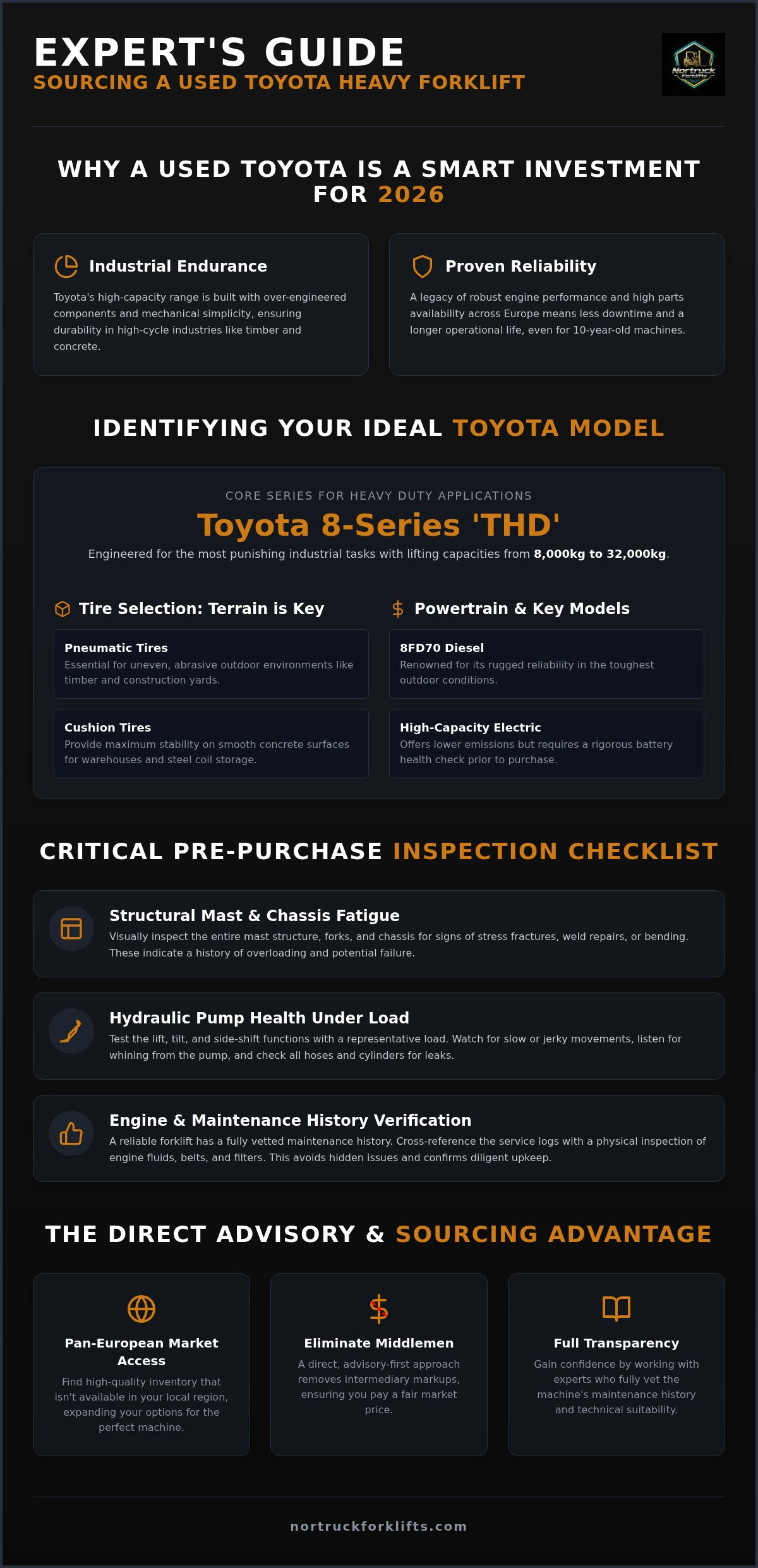
For operators in the European timber and concrete sectors, a used toyota heavy forklift is more than just a piece of machinery; it's a calculated operational investment. These industries demand equipment that can withstand high-cycle lifting in abrasive, outdoor environments. Toyota's high-capacity range has become a staple because it prioritizes mechanical simplicity and over-engineered components over complex, fragile electronics. These machines work hard. When you buy into this range, you aren't just buying a lift truck; you're buying a legacy of industrial endurance that keeps your yard moving when lighter equipment fails.
To better understand the operational capabilities and safety standards of these machines, watch this helpful video:
Engineering Reliability: The Toyota High-Capacity IC Range
Toyota's reputation for durability stems from the heavy-duty chassis and mast construction found in their industrial combustion models. Unlike lighter units, these heavy-lifters utilize reinforced steel structures designed to manage the lateral stresses of high-capacity loads. This focus on structural integrity is a hallmark of Toyota Material Handling, which has refined its heavy IC range to offer precision hydraulic control. This precision is vital when maneuvering 10-ton concrete slabs or dense bundles of timber. From an insider's perspective, the longevity of Toyota's industrial engines is a primary selling point. Parts availability across Europe remains high, ensuring that even a 10-year-old machine can be maintained without the long wait times often associated with niche manufacturers.
Market Trends: Why Used Heavy Equipment is the Strategic Choice for 2026
As we move into 2026, the lead times for new high-capacity machinery can often stretch into several months. A pre-owned unit offers an immediate solution for fleet expansion without the capital strain of a new purchase. The math is simple. Toyota forklifts hold their residual value significantly better than entry-level brands. While a cheaper, new brand might seem attractive initially, the total cost of ownership often favors a used Toyota due to lower depreciation and higher reliability. Choosing a used model allows for a faster return on investment while maintaining the high performance required for industrial lifting. Navigating this market requires a steady hand, as an independent advisor can help you find hidden value in the used market by removing manufacturer bias and focusing on technical suitability for your specific terrain.
Identifying the Right High-Capacity Toyota Models for Your Operation
Selecting a used toyota heavy forklift requires a deep understanding of your specific load dynamics and yard conditions. The Toyota 8-Series High-Capacity range is the undisputed workhorse for operations moving between 8,000kg and 32,000kg. Within this range, you'll encounter the 'THD' (Toyota Heavy Duty) nomenclature. This designation signals a chassis and drivetrain engineered for the most punishing industrial applications. When refining your specs, your first decision is the tire profile. Pneumatic tires are essential for the uneven terrain of timber yards, while cushion tires provide the stability needed for high-density steel coil storage on smooth concrete. Matching mast height and carriage types is the final step; for high-stacking timber, a triple-stage mast is often necessary, though it reduces residual capacity compared to a standard duplex mast.
Top-Tier Models for Heavy Industrial Use
The 8FD series, particularly the 8FD70 diesel model, is renowned for its reliability in rugged, outdoor environments. It's built to handle the grit of concrete plants and the constant cycles of lumber yards. In the 2026 used market, we're seeing more high-capacity electric models. While these offer lower emissions, sourcing a used toyota heavy forklift with an electric powertrain requires a rigorous battery health check before purchase. We often advise sourcing units already equipped with specialized attachments like fork positioners or side-shifters. Finding a machine already tailored to your load type saves significant post-purchase costs and ensures the hydraulic system was originally spec'd for that attachment's weight.
Comparing Toyota to Other Heavy Lift Giants
Choosing between brands is a strategic decision that impacts long-term efficiency. You might consider a Kalmar heavy lift truck for sale if your operation scales into the 40-ton plus range or requires port-specific reachstackers. However, for 8-ton to 25-ton applications, Toyota's ergonomics often win over operators who spend eight hours in the cab. While Linde's hydrostatic drive offers precision, Toyota's conventional torque converter is frequently preferred for its straightforward maintenance in remote regions. Following equipment acquisition best practices means matching the machine's drive system to your local service capabilities. If you're unsure which model fits your specific sector, consulting with an independent specialist can clarify the technical suitability of each brand without manufacturer bias.
Critical Inspection Points for Pre-Owned Heavy Lift Equipment
When you evaluate a used toyota heavy forklift, you're looking for evidence of how it was treated under maximum capacity. Visual aesthetics are secondary to structural integrity. Adhering to rigorous safety benchmarks, such as OSHA's Powered Industrial Truck Standard, ensures the machine remains safe for heavy-duty cycles. Clean oil is a baseline, not a guarantee of health. It doesn't reveal internal scoring in the transmission or the slow degradation of the hydraulic pump. You must look for hairline fractures in the chassis welds, particularly around the mast mounting points where the highest stresses occur during high-capacity lifts.
The Heavy Lift Checklist: 5 Non-Negotiables
Mast deflection is the temporary bending or swaying of the forklift mast under load, a critical metric to monitor because excessive movement in 10-tonne+ machines indicates structural fatigue or worn carriage rollers. Beyond the mast, inspect the steer axle for cracks or excessive play in the kingpins, as these components bear the brunt of the counterweight's force during unladen travel. On modern Toyota units, testing the System of Active Stability (SAS) is non-negotiable. This electronic system manages mast tilt and axle locking to prevent tip-overs; any fault codes here suggest a complex and expensive repair. Verify the hour-meter against the wear on the pedals and seat. In the European market, a machine with 5,000 hours but heavily worn floor mats suggests the meter may have been replaced or tampered with. Finally, check the hydraulic cylinders for "weeping" while the machine is cold, as small leaks often vanish once the metal expands with heat.
Operational Testing: Beyond the Visual Walkaround
A static inspection is insufficient for a used toyota heavy forklift. You must perform a load test at 100% of the rated capacity to identify hydraulic bypass or cylinder leaks that aren't visible at rest. Watch the mast as it reaches full height; it should move smoothly without jerking or hesitation. During sustained operation, monitor the hydraulic fluid temperature. If the system overheats within thirty minutes of work, the pump or cooling system is likely failing. This is common in high-cycle applications where the machine hasn't been properly serviced. Access the electronic error log to find the "hidden" life of the machine. Modern Toyota heavy units store a history of over-revving and sensor failures that a simple visual walkaround misses.
Sourcing Used Heavy Forklifts Across the European Market
The search for a reliable used toyota heavy forklift often leads beyond your local borders. High-capacity machines are specialized assets; the specific model that fits your load profile might be sitting in a yard three countries away. Relying solely on local inventory limits your choices and often forces a compromise on technical specs. By tapping into the broader European forklift market, you gain access to a larger pool of well-maintained units from regions with strict industrial standards. This wider perspective is essential when you're looking for machines that meet the 2026 operational requirements for both performance and regulatory compliance.
The European Inventory Advantage
Germany, the Benelux region, and Scandinavia represent the primary hubs for high-quality used Toyota stock. These markets are characterized by rigorous maintenance cultures and frequent fleet renewals, which creates a steady supply of machines with documented service histories. Regional industrial shifts, such as the modernization of timber processing in Sweden or concrete production in Germany, often result in the release of heavy-duty units that still have thousands of operational hours left. Sourcing from these regions does present challenges; language barriers and varying documentation standards can stall a purchase. Having an expert who understands these local nuances ensures that the technical suitability of the machine isn't lost in translation.
Logistics and Compliance for International Sourcing
International procurement requires a sharp focus on changing regulations. As of January 9, 2025, the EU Framework Regulation for non-road mobile machinery (NRMM) has begun its phased application, impacting how heavy forklifts are approved and used on public roads. Additionally, the Euro 7 standards, set for implementation in November 2026, will influence the long-term viability of diesel units. Verifying that a used toyota heavy forklift carries the correct CE marking and meets these evolving emission standards is vital to avoid operational restrictions. If a machine doesn't comply, the cost of modifications can quickly erode any initial savings.
Moving a 20-tonne machine across borders isn't a standard shipping job. It requires specialized low-loaders, transit permits, and a clear understanding of VAT and customs procedures between different European jurisdictions. Transparency in ownership transfer and tax documentation is just as important as the mechanical state of the forklift. We handle these complexities by removing intermediaries and providing direct, honest communication throughout the logistics chain. This approach ensures that the machine you inspected in a German yard arrives at your facility with all legal and technical boxes checked.
Navigating the Procurement Process with Expert Advisory
Securing a used toyota heavy forklift involves more than just identifying an available listing; it requires a transition from passive searching to active procurement. Our approach at Nortruck prioritizes technical suitability and operational reliability. With over 40 years of industry experience, we identify the hidden value in machinery that a standard visual inspection might miss. We operate on a direct consultancy model. This means there are no middlemen and no hidden markups to inflate the final price. You get a transparent view of the machine's history and its true market value.
The Advisory Advantage vs. Traditional Dealerships
Traditional dealerships often prioritize sales quotas and moving existing inventory. An independent advisor works for your operational needs instead. We often source high-capacity units that aren't even on the open market yet. This "insider" access allows you to secure premium Toyota equipment before it reaches public auction sites. By building a long-term sourcing partnership, you can manage your fleet expansion with the confidence that every machine has been vetted by a seasoned professional. We focus on the long-term solution, ensuring the machine fits your specific industrial cycle for years to come.
Next Steps: Securing Your Used Toyota Heavy Forklift
Closing the deal on a used toyota heavy forklift requires meticulous attention to payment security and final delivery inspections. Before you commit, you must define your technical requirements clearly. Do you need a specific mast height for timber stacking? Is your yard's terrain suitable for pneumatic tires? During an initial consultation with Lars G Tarby, we'll review these specs to ensure the search is targeted and efficient. We handle the final inspections to verify that the machine delivered matches the machine promised. This methodical process ensures your capital is protected and your operation stays productive.
Securing Operational Continuity in the Heavy Lift Sector
Acquiring a used toyota heavy forklift is a strategic move that balances capital efficiency with high-capacity performance. By focusing on the engineering integrity of the 8-Series and conducting rigorous load tests, you ensure your fleet remains operational under the harshest industrial cycles. Navigating the European market requires more than just a search engine; it demands a deep understanding of maintenance standards and the evolving 2026 regulatory landscape.
Choosing the right machine is the first step toward long-term reliability. We leverage over 40 years of heavy lifting expertise to find technical solutions that match your specific terrain and load requirements. Our direct European sourcing network removes the clutter of intermediaries, providing you with a transparent path to ownership. We operate as your independent advisor, prioritizing your operational uptime over sales quotas.
Your next high-capacity investment is out there. We look forward to helping you secure it with confidence and precision.
Frequently Asked Questions
Is a used Toyota heavy forklift as reliable as a new one?
Yes, provided the maintenance history is documented and the unit has been vetted by an expert. Toyota's heavy IC range is built for longevity. While a new unit offers the latest emissions tech, a well-maintained older machine often provides the same mechanical reliability at a lower capital cost. The key is ensuring that high-stress components like the mast and hydraulic pumps have been inspected under load before purchase.
How many operating hours are considered 'too many' for a used heavy-duty forklift?
For a heavy-duty unit, 10,000 to 12,000 hours often mark the threshold where major components require deep inspection. However, "too many" depends on the application. A machine in a clean warehouse lasts longer than one in a concrete plant with 5,000 hours. We look at duty cycles rather than just the meter. A used toyota heavy forklift with higher hours but a perfect service record is often safer than a neglected low-hour unit.
What is the difference between Toyota's standard and high-capacity ranges?
The primary difference lies in the chassis reinforcement and powertrain cooling. Toyota's standard range typically handles up to 5,000kg, whereas the high-capacity and THD lines are engineered for loads up to 32,000kg. These larger machines use wider masts, larger diameter hydraulic cylinders, and specialized steer axles to manage the massive counterweight. They're designed specifically for the continuous stresses found in timber, steel, and port logistics environments where standard trucks would fail.
Can Nortruck help with the shipping of heavy machinery across Europe?
We manage the entire logistical chain from the seller's yard to your facility. Moving a 20-tonne machine across borders requires specialized low-loaders and transit permits that vary by country. We coordinate with experienced heavy-haulage partners to ensure the machine is secured correctly and that all VAT and customs documentation is handled transparently. This removes the logistical burden from your team and ensures the machine arrives safely and legally at your site.
Do used Toyota forklifts come with any form of warranty when sourced through an advisor?
Warranties on used equipment are typically limited and vary based on the specific seller. As independent advisors, we don't provide the warranty ourselves, but we help you negotiate terms with the vendor. Our value lies in the pre-purchase inspection that identifies potential failures before you commit. We focus on ensuring you buy a machine that doesn't need a warranty claim in the first place by vetting its mechanical and structural health thoroughly.
How does Toyota's heavy-duty performance compare to brands like Linde or Kalmar?
Toyota is often preferred for its mechanical simplicity and operator ergonomics in the 8-ton to 25-ton range. While Linde's hydrostatic drive offers extreme precision, some maintenance teams prefer Toyota's torque converter for its straightforward repair profile. Kalmar remains a leader for ultra-heavy port applications, but for industrial yard work, a used toyota heavy forklift often provides a superior balance of residual value and ease of part sourcing across the European market.
What are the most common issues to look for in a 10-year-old Toyota high-capacity unit?
Structural fatigue in the mast and wear in the steer axle kingpins are common in decade-old units. You should also check the hydraulic system for internal bypass, which causes the mast to drift downward under load. Electronic sensors in the System of Active Stability (SAS) can also fail over time. We specifically look for hairline fractures in the chassis welds, as these can be catastrophic if they aren't caught during a professional technical inspection.
Why should I use an independent advisor instead of a local used equipment dealer?
An independent advisor works for you, not a dealership's sales target. Local dealers are limited to the inventory they have on the lot, which may not be the best fit for your operation. We search the entire European market to find the exact model and spec you need. This direct sourcing removes the middleman's markup and provides a transparent, honest assessment of the machine's condition without any pressure to close a quick sale.

Article by
Lars Gunnar Tärby
Disclaimer
1. General Information and No AdviceThe information, articles, product descriptions, and specifications provided on this website (www.nortruckforklifts.com) are for general informational and educational purposes only. While we strive to provide accurate and up-to-date content regarding new and used forklifts and heavy machinery, the material published does not constitute professional, technical, or legal advice.
2. Product Specifications and PricingNortruck Forklifts acts as a facilitator for the trade of new and used forklifts. All equipment details, including but not limited to year of manufacture, operating hours, lift capacity, dimensions, conditions, and pricing, are provided based on the information available to us at the time of publication. Specifications and availability are subject to change without prior notice.
3. "As Is" and VerificationAll articles and product listings are provided on an "as is" and "as available" basis without any warranties of any kind, either express or implied. Nortruck Forklifts does not guarantee that the descriptions are entirely error-free, complete, or reliable. Buyers and traders are strongly encouraged to independently verify all technical specifications, machine history, and equipment conditions directly with the seller or an authorized inspector before finalizing any purchase or transaction.
4. Limitation of LiabilityIn no event shall Nortruck Forklifts, its owners, or its contributors be held liable for any direct, indirect, incidental, consequential, or economic loss or damage arising out of the use of, or the inability to use, the information provided on this website, or any transactions facilitated through this platform. This includes, but is not limited to, damages caused by technical inaccuracies, typographical errors, or reliance on the content of our articles.
5. Third-Party LinksOur website may contain links to external websites, dealer networks, or third-party services that are not owned or controlled by Nortruck Forklifts. We have no control over, and assume no responsibility for, the content, privacy policies, or practices of any third-party websites.


