
Could a forklift rated for 16 tonnes still be the wrong machine for your heaviest load? Yes. The headline capacity doesn’t tell you what the truck can safely lift in the configuration and conditions where you’ll use it. If you’re searching for a 16 tonne forklift for sale, match the rating to the load centre, mast, attachments, lift height and working surface rather than comparing listing figures alone.
Capacity is a natural place to start when handling substantial materials or demanding work cycles. But the right choice also depends on the site, operating conditions and how you plan to source the machine. This 2026 buyer’s guide explains how to define a suitable specification, compare new and used options across manufacturers, and review practical details before purchase. Nortruck Forklifts’ Lars G Tarby brings more than 40 years of lifting-equipment experience to sourcing and buyer guidance, helping you assess the application before narrowing the search.
Key Takeaways
- Separate routine loads from occasional maximum lifts to define a specification that fits the work you actually do.
- When comparing a 16 tonne forklift for sale, look beyond the listing title and assess the configuration, operating history and records.
- Map the truck’s work to the site, including handling method, lift height, travel routes and operating environment.
- A structured sourcing process can help you compare new and used options, including equipment sourced across Europe.
- Nortruck’s specialist advice starts with your application, helping you shape the search around your operational requirements.
What Does a 16 Tonne Forklift for Sale Actually Mean?
A 16-tonne forklift belongs to a heavy-lifting capacity class, but that figure doesn’t mean the machine can lift any 16-tonne load in every situation. Rated capacity applies under conditions set by the manufacturer, including the load’s position and the truck’s configuration. Before comparing a 16 tonne forklift for sale, distinguish the truck’s rated lifting capacity from its own weight. The rating describes the load it can lift under specified conditions, while the machine’s weight is the weight of the forklift itself.
In brief: A 16-tonne forklift is a truck with a manufacturer-rated lifting capacity of 16 tonnes in a defined configuration. Its data plate and load chart show the capacity that applies to the specific machine and setup.
A general overview of forklift designs and operation is available in the Forklift reference. For an individual machine, its own documentation is the relevant guide to capacity.
The video below shows a 16-tonne forklift in an auction listing. Treat it as a visual reference, not a specification sheet for other machines.
Rated capacity versus the load you need to move
Start with the actual load, not just its estimated weight. Record its weight, dimensions, shape and centre of gravity, the point around which its weight is balanced. These details show whether the load will sit close to the forks or extend farther out, and whether it can be handled securely in the intended way.
Load centre is the horizontal distance from the fork face to the load’s centre of gravity. Picture a pallet: if its weight is evenly distributed, its centre is typically near the middle. A long item may place its centre farther from the fork face, increasing leverage on the truck and reducing usable capacity. Any numerical capacity example must come from the load chart for the exact manufacturer, model and setup being considered.
Why configuration changes the capacity question
The applicable capacity can change with the mast, lift height and attachments. For example, a clamp or other attachment adds weight at the front of the truck and may change how far the load sits from the fork face. Load shape and attachment position also affect the lifting arrangement. Don’t assume a rating shown for standard forks applies unchanged to another setup.
Use the machine’s data plate and original documentation to match capacity figures to the exact configuration and the height required for your work. If the plate or chart doesn’t describe the intended mast and attachment combination, the headline rating alone isn’t enough to establish usable capacity. Keep the load details alongside the machine documents so you can compare the specification with the real handling task, not just the category label.
How to Match a 16 Tonne Forklift to Your Loads and Site
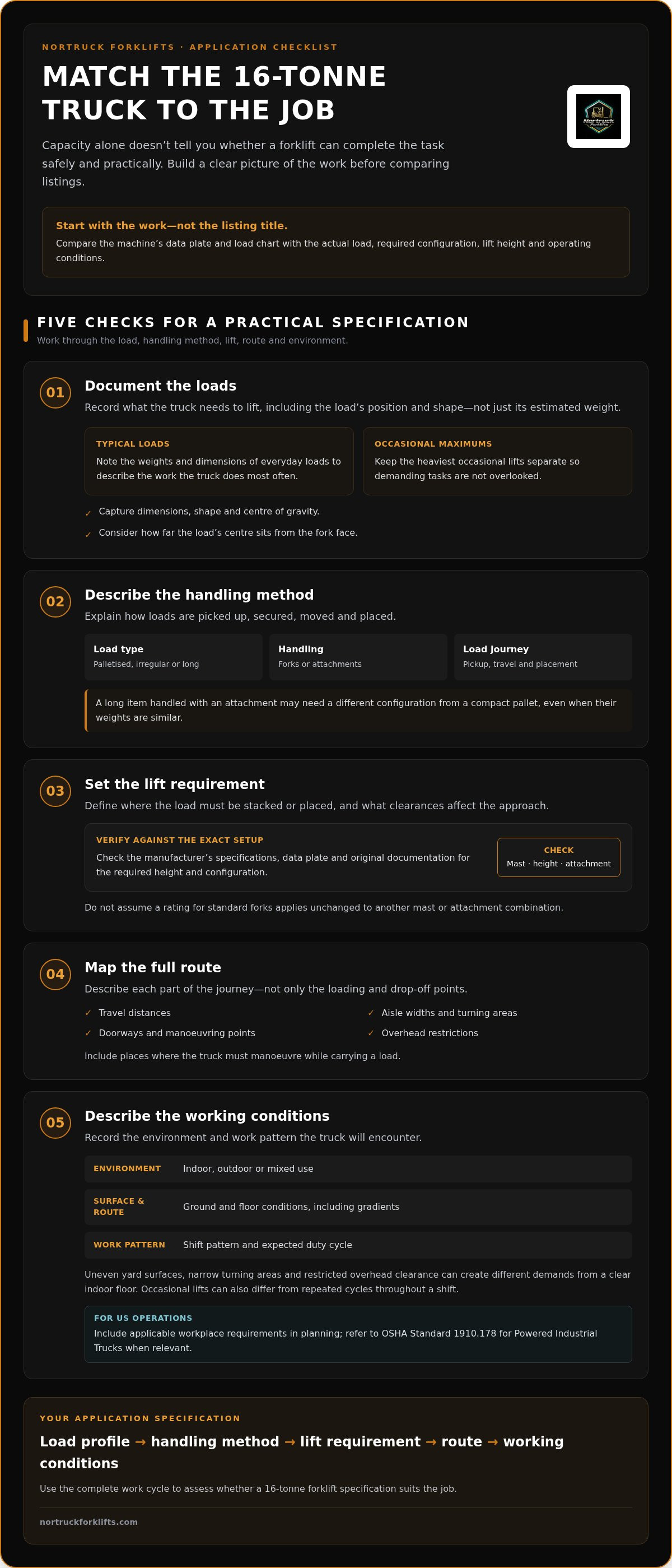
A suitable truck must match both the load and the working conditions. Capacity alone won’t tell you whether a machine can complete the task safely and practically, from pickup through travel to final placement. Build a clear picture of the work before comparing listings or requesting a specification.
Use this sequence to turn your operation into a practical assessment:
- Document the loads. Record typical and maximum weights, dimensions, shape and load centre. Keep everyday loads separate from occasional maximums so the requirement reflects normal work without overlooking demanding lifts.
- Describe the handling method. Note whether loads are palletised, irregular or long, and whether they’re moved with forks or attachments. Include how loads are picked up, secured and placed.
- Set the lift requirement. Record the required stacking or placement height and any clearances that affect the approach. Compare these needs with the manufacturer’s specifications for the relevant configuration.
- Map the route. Identify travel distances, aisle widths, turning areas, doorways, overhead restrictions and points where the truck must manoeuvre with a load.
- Describe the working conditions. Note indoor, outdoor or mixed use, ground and floor conditions, gradients, shift pattern and expected duty cycle.
Build a load and handling profile
Start with what the truck handles most often, then describe the heaviest occasional task separately. Include where the load is picked up, how far it travels, whether it needs to be raised during travel, and where it is deposited. A long item handled with an attachment may call for a different configuration from a compact pallet, even if their weights are similar. This profile gives you a practical basis for comparing specifications against the whole work cycle.
Check the operating environment
Site conditions can rule out an otherwise plausible candidate. A route over uneven yard surfaces, through a narrow turning area or beneath restricted overhead clearance presents different demands from a clear indoor floor. Describe each part of the route, not just the loading point. For US operations, include applicable workplace requirements in your planning and refer to the OSHA Standard 1910.178 for Powered Industrial Trucks when relevant to your operation.
Include the shift pattern and duty cycle in the brief. A truck used for occasional lifts may face different demands from one working repeated cycles throughout a shift. Together, load profile, route, lift height and work pattern form an application specification for assessing whether a 16 tonne forklift for sale suits the job. Nortruck’s advisory approach starts with the application. You can discuss your lifting requirements as you shape the search.
Compare 16 Tonne Forklift Options Without Relying on the Listing Title
A listing title is a starting point, not a specification. Two machines described as “16-tonne forklifts” may differ in configuration, documented capacity, history and suitability for your work. Compare candidates against the same fields, and separate details supported by manufacturer documents from seller descriptions or assumptions that need evidence.
Use a comparison table for each candidate. Record the source of each figure, such as the data plate, load chart, original documentation or seller listing. If a detail is missing or the figures aren’t comparable, mark it clearly rather than treating it as a match.
| Comparison field | What to record |
|---|---|
| Make and model | Exact identification from the machine and its documents |
| Rated capacity | Figure and conditions stated in the load chart |
| Load centre | Documented centre corresponding to the capacity figure |
| Lift height | Required height and the applicable documented capacity |
| Mast and attachments | Configuration fitted, including attachment details |
| Operating environment | Documented or stated suitability for your intended conditions |
| Hours or usage history | Recorded usage and supporting history, where available |
| Condition and records | Documented condition and available machine records |
For broader background on the industry, Grand View Research’s Forklift Market Analysis may help frame market context. It doesn’t replace machine-specific evidence: a market report cannot verify an individual truck’s configuration, condition or lifting capacity.
Compare specifications on a like-for-like basis
Use each machine’s data plate, load chart and manufacturer documentation as the reference for its configuration. Compare capacity only at the load centre, lift height, mast and attachment combination relevant to your work. A headline rating or seller summary may not describe those conditions. Mark missing, unclear or non-comparable details in the table so they remain open questions in your assessment, not assumed matches.
Weigh new and used sourcing routes
New machinery offers a route to a specified configuration. Used equipment calls for close attention to its documented condition, usage history and supporting records. Neither route is automatically the better fit; suitability depends on your requirements and the evidence available for each candidate. Nortruck Forklifts sources new and used heavy lifting equipment from manufacturers including Kalmar, Baumann and Combi-Lift across Europe. Discussing your application helps focus the search on relevant specifications.
Keep the comparison practical. If you’re assessing a 16 tonne forklift for sale, identify which candidate’s documented configuration aligns with the work, then note any gaps that prevent a fair comparison. This gives you a clearer basis for weighing options without relying on listing language alone.
Plan the Sourcing Process for a 16 Tonne Forklift
A clear sourcing process keeps the search tied to your operation rather than to whichever listing is easiest to find. Move from defining the job to preparing a brief, comparing suitable candidates and reviewing their documentation. This sequence also helps you identify important gaps before discussing commercial terms.
Prepare a clear sourcing brief
Summarise the application in a brief that a sourcing adviser can use to identify relevant options. Include the loads and handling method, site conditions, travel route, required lift height and the machine configuration your work calls for. State whether you’re looking for new equipment, used equipment or either. A concise brief makes it easier to compare candidates on the same operational basis.
List the technical documents you need to assess a candidate, such as its data plate details, load chart and manufacturer documentation. For used equipment, review available records on usage history and condition. Add project constraints that affect procurement, such as the intended destination and required delivery arrangements. Nortruck sources new and used heavy lifting equipment from manufacturers across Europe, so the search can extend beyond one local marketplace. The European forklift market guide offers broader context for considering regional sourcing.
Review candidates and procurement logistics
Compare each candidate with the brief before moving to commercial discussions. Record which details come from machine documents and which are seller descriptions, and keep gaps visible. If a candidate’s configuration or records don’t support a useful comparison, treat that as an unresolved point rather than filling it with an assumption.
Plan how the machine’s documentation and condition will be reviewed, along with inspection arrangements appropriate to the purchase. Delivery planning should account for the actual machine and destination. Transport, import and operating requirements vary according to the countries and equipment involved, so verify the relevant requirements for the specific transaction before proceeding. Don’t assume that rules or arrangements in one country apply elsewhere.
Some procurement considerations, such as documenting condition, clarifying records and planning transport, apply across types of heavy equipment. The used reachstacker sourcing guide can provide a broader sourcing perspective, but it isn’t a source for forklift specifications. Keep forklift capacity and configuration assessments grounded in the machine’s own documentation.
With the brief and destination requirements in hand, you can focus the search for a 16 tonne forklift for sale and compare sourcing options against practical needs. Nortruck’s sales and advisory approach starts with your application and draws on sourcing across Europe.
Source a 16 Tonne Forklift with Nortruck’s Specialist Advice
Once you’ve defined the load, site conditions and required configuration, the next step is finding candidates that fit those requirements. Nortruck provides sales and advisory services for heavy lifting equipment, sourcing new and used machines from major manufacturers across Europe, including Kalmar, Linde, Toyota, Baumann and Combi-Lift. The search starts with the application, not an assumption that a machine’s headline capacity tells the whole story.
Lars G Tarby brings more than 40 years of lifting-equipment experience to this work. That background supports a practical conversation about the job and the details that should guide the sourcing brief. Assess each candidate’s capacity and configuration against its own manufacturer documentation.
Turn your operating requirements into a sourcing brief
A useful brief connects your day-to-day work to the machine you’re seeking. Include typical and maximum loads, how they’re handled, the required lift height, the route, and whether the work takes place indoors, outdoors or in both environments. Add relevant handling attachments, shift patterns and procurement priorities, such as whether you’re considering new equipment, used equipment or either option.
These details help shape a focused search across manufacturers and sourcing channels, rather than limiting the process to listings that happen to use the phrase “16-tonne forklift.” Nortruck’s advisory approach is application-led: the requirements guide which candidates are relevant, while model-specific capacity and configuration are evaluated against the machine’s documentation. This helps clarify the search and keeps the assessment grounded in evidence.
If your application points toward Kalmar heavy lifting equipment, the Kalmar heavy lift truck sourcing guide provides further context on sourcing that category. The right direction depends on the work and the specification, rather than brand name alone.
Discuss your 16-tonne forklift requirement
Bring your load profile, operating environment and procurement priorities into the conversation. You can also share documentation or candidate details you’re already reviewing. That gives the discussion a practical starting point: what the truck needs to do, which specifications matter, and how to approach sourcing options across Europe.
Whether you’re at the early research stage or comparing specific machines, a direct discussion can help refine the brief and identify useful next steps. If you’re looking for a 16 tonne forklift for sale, Nortruck can discuss your operational requirements and sourcing needs.
Take the Next Step with a Clear Sourcing Brief
Your next move doesn’t need to be a commitment to a particular machine. Use the requirements you’ve developed to start a focused discussion about sourcing routes and the information that will help compare candidates. Keep the decision grounded in the work the forklift needs to do.
For buyers searching for a 16 tonne forklift for sale, Nortruck sources new and used equipment across a manufacturer network that includes Kalmar, Linde, Toyota, Baumann, Combi-Lift and Volvo. Lars G Tarby brings more than 40 years of lifting-equipment experience to the advisory conversation, helping buyers consider their application and procurement priorities without assuming that one specification suits every site.
Bring your load profile, operating conditions and preferred sourcing approach. A clear starting brief makes the next conversation more useful and helps you move forward with confidence.
Discuss your requirements with Nortruck and start with the load, site and specifications that matter to your operation.
Frequently Asked Questions
Can a 16-tonne forklift lift 16 tonnes at any height?
No, a 16-tonne forklift isn’t guaranteed to lift 16 tonnes at every height. Its rated capacity applies only under the conditions shown in the machine’s load chart. For example, the permitted capacity for a load raised to a high storage position may differ from the figure for handling it near ground level. Use the chart for the exact machine and configuration, and don’t extrapolate a capacity figure beyond the conditions it documents.
How do I find the load centre for a 16-tonne forklift?
Find the load centre by locating the load’s centre of gravity and measuring its horizontal distance from the fork face. For a uniformly loaded pallet, the balance point may be near its midpoint, but contents can shift that point. With long, uneven or irregular loads, use the actual weight distribution rather than assuming the centre is halfway along. Then compare the measured distance with the load chart for the specific truck.
What information is shown on a forklift load chart?
A load chart shows the machine’s allowable lifting capacity under specified operating conditions. Depending on the manufacturer, it may relate capacity to load centre, lift height, mast configuration and attachments. Check the chart’s labels and notes, not just its largest number. Formats vary, so don’t transfer a figure from one model’s chart to another or treat a chart for one setup as valid for a different one.
How wide is a 16-tonne forklift?
There isn’t one standard width for every 16-tonne forklift. Overall dimensions depend on the make, model and fitted configuration, so use the manufacturer’s specification for the individual machine. For a site check, compare the truck’s overall width with the narrowest doorway, aisle or route pinch point. Also account for the load and any attachment, since these can extend beyond the truck and affect practical clearance.
What fuel or power options are available for a 16-tonne forklift?
Power options depend on the machine and the intended work. Diesel is common in the heavy-capacity class, while electric options are emerging: in October 2026, Hyundai Material Handling announced 16-18-tonne electric forklift models. For your application, consider where the truck will operate, ventilation needs, shift pattern and how the power source fits the work cycle. Confirm the specific machine’s powertrain in its documentation.
Do I need a licence to operate a 16-tonne forklift?
Requirements depend on where the truck will operate. In the United States, OSHA doesn’t issue forklift licences; employers must train, evaluate and certify operators for the type of truck and workplace involved. OSHA requires reevaluation at least every three years, or sooner after an incident or other specified trigger. A card or certificate alone doesn’t replace employer evaluation. Check the rules that apply in your operating jurisdiction.
What documents should come with a used 16-tonne forklift?
For a used machine, request its data plate details, load chart and original manufacturer documentation so its identity and operating limits can be assessed. Supporting records may include usage or service history, inspection documents and ownership paperwork. The records available can vary by machine. If you’re evaluating a 16 tonne forklift for sale, note which documents are present and make any gaps clear in your comparison before purchase.
How is a 16-tonne forklift transported to another country?
Transport planning depends on the machine’s dimensions and weight, its origin and destination, and the route and transport method. Before arranging a cross-border move, establish the machine’s transport dimensions and identify the documentation needed for that specific journey. Import, transport and operating requirements vary between countries, so verify them for the countries and machine involved. Don’t assume a process used for one destination applies to another.

Article by
Lars Gunnar Tärby
Disclaimer
1. General Information and No AdviceThe information, articles, product descriptions, and specifications provided on this website (www.nortruckforklifts.com) are for general informational and educational purposes only. While we strive to provide accurate and up-to-date content regarding new and used forklifts and heavy machinery, the material published does not constitute professional, technical, or legal advice.
2. Product Specifications and PricingNortruck Forklifts acts as a facilitator for the trade of new and used forklifts. All equipment details, including but not limited to year of manufacture, operating hours, lift capacity, dimensions, conditions, and pricing, are provided based on the information available to us at the time of publication. Specifications and availability are subject to change without prior notice.
3. "As Is" and VerificationAll articles and product listings are provided on an "as is" and "as available" basis without any warranties of any kind, either express or implied. Nortruck Forklifts does not guarantee that the descriptions are entirely error-free, complete, or reliable. Buyers and traders are strongly encouraged to independently verify all technical specifications, machine history, and equipment conditions directly with the seller or an authorized inspector before finalizing any purchase or transaction.
4. Limitation of LiabilityIn no event shall Nortruck Forklifts, its owners, or its contributors be held liable for any direct, indirect, incidental, consequential, or economic loss or damage arising out of the use of, or the inability to use, the information provided on this website, or any transactions facilitated through this platform. This includes, but is not limited to, damages caused by technical inaccuracies, typographical errors, or reliance on the content of our articles.
5. Third-Party LinksOur website may contain links to external websites, dealer networks, or third-party services that are not owned or controlled by Nortruck Forklifts. We have no control over, and assume no responsibility for, the content, privacy policies, or practices of any third-party websites.


