
The lowest-priced reachstacker can become the more expensive choice over its working life. Reachstacker total cost of ownership depends on more than the purchase price: utilisation, duty cycle, energy use, maintenance, downtime and residual value all shape the comparison. If your assumptions don’t match the work the machine will do, even a detailed estimate can lead you in the wrong direction.
This guide explains how to build a transparent, project-specific TCO model and compare equipment using consistent assumptions. You’ll see which costs to include, how to set realistic operating scenarios, and which uncertainties could change your sourcing decision. It also shows how to compare new and used equipment using the same lifecycle approach, rather than letting the initial price decide. Nortruck Forklifts sources new and used heavy lifting equipment across Europe, including reachstackers for port terminals. Lars G Tarby brings more than 40 years of lifting-equipment experience to Nortruck Forklifts’s advisory services. The steps ahead can help you define your operating profile and turn it into a practical equipment brief.
Key Takeaways
- Start with the terminal’s actual workload so equipment comparisons reflect the lifting demands and utilisation the machine will face.
- Build your reachstacker total cost of ownership model around acquisition, operating and maintenance costs, downtime, and end-of-life value.
- Compare options across the same evaluation period, then test how changes in utilisation or terminal demand affect the result.
- Use actual workload, operating, maintenance, and financing inputs to make your calculation more relevant to the project.
- Apply the findings to equipment requirements and sourcing priorities, including a considered comparison of new and used options.
Why reachstacker total cost of ownership starts with the terminal workload
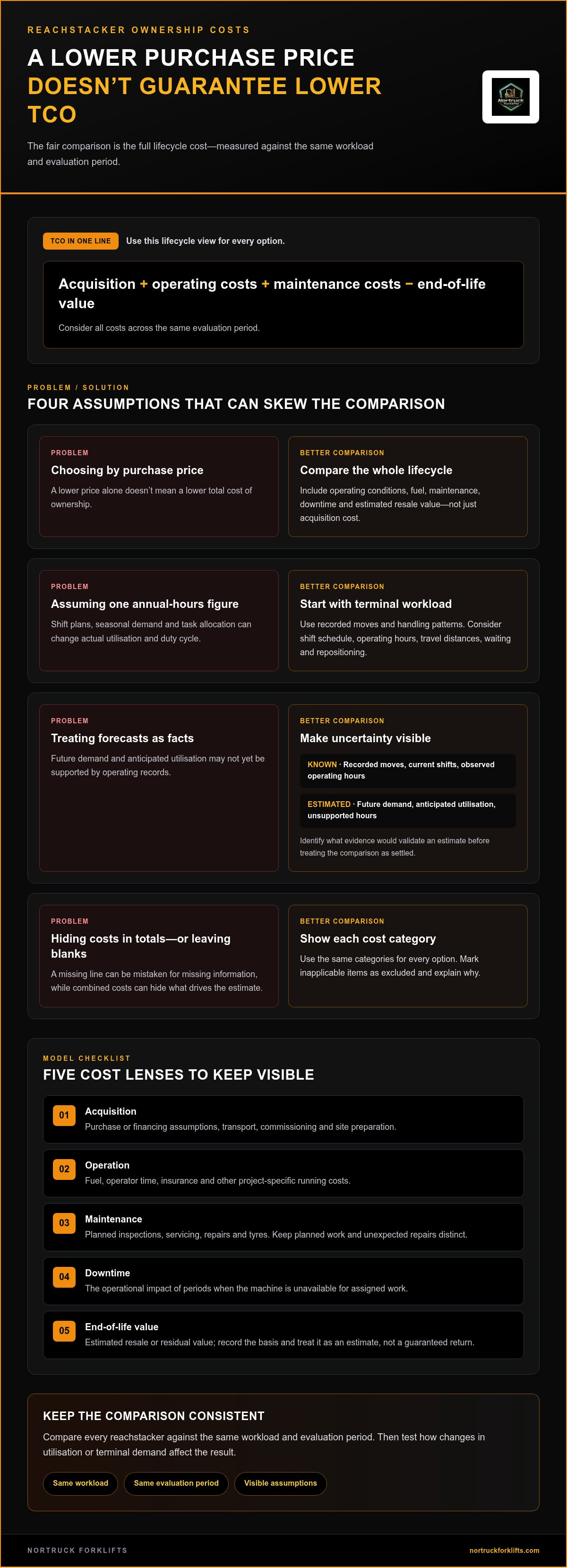
Reachstacker total cost of ownership is the acquisition cost plus operating and maintenance costs over the evaluation period, minus the machine’s end-of-life value. This is a useful starting point, but the result depends on the work the machine is expected to do. The terminal workload shapes both the costs in the model and the relevance of the comparison.
A reachstacker handling frequent container moves in a busy transfer pattern has a different operating profile from one used intermittently or for a narrower set of tasks. The number and type of moves, handling sequence, travel distances, and time spent waiting or repositioning can affect productive hours and resource use. These are core workload inputs, not details to add after comparing machines.
Total Cost of Ownership (TCO) is a lifecycle approach used across different asset categories, including transportation. The overview in Total Cost of Ownership (TCO) Explained provides broader context. For a terminal, the practical test is whether your assumptions reflect its actual work.
Which operating conditions shape reachstacker TCO?
Start with recorded container moves and handling patterns, then map them to expected utilisation. Include the shift schedule and operating hours. A machine used across longer or more frequent shifts accumulates operating time differently from one assigned to occasional work. Don’t present a forecast as an observed fact. Label each input as measured, estimated, or still requiring validation so the uncertainty remains visible.
For example, a terminal planning for higher demand can model its current workload separately from a plausible increase in moves. This shows whether a sourcing option remains suitable if utilisation changes. Avoid relying on a single annual-hours estimate when shift plans, seasonal demand, or task allocation could alter the actual duty cycle.
- Known: recorded moves, current shifts, and observed operating hours.
- Estimated: future demand, anticipated utilisation, and hours not yet supported by operating records.
Keep these categories separate. If an estimate drives the result, identify what evidence would validate it before treating the comparison as settled.
Why purchase price alone can mislead
Two reachstackers with different acquisition costs can have different ownership profiles over the same evaluation period. A lower purchase price doesn’t, by itself, mean lower TCO. Operating conditions and assumptions about fuel, maintenance, downtime, and resale value can change the overall comparison. Treat each as a separate input rather than using purchase price as a stand-in for the entire lifecycle.
Downtime matters because an unavailable machine may affect terminal operations. Maintenance and fuel contribute to ownership costs in different ways, while resale value changes the net cost at the end of the evaluation period. Treat resale value as an estimate, not a guaranteed return. Compare machines against the same workload and time horizon, then identify which inputs most influence the result. This gives decision-makers a clearer basis for weighing price against operational fit.
What to include in a reachstacker total cost of ownership model
A useful reachstacker total cost of ownership model makes every significant cost visible across the same evaluation period. Group inputs into five categories: acquisition, operation, maintenance, downtime, and end-of-life value. This checklist keeps the comparison structured without assuming that every cost applies to every terminal or machine.
- Acquisition: purchase cost or financing assumptions, plus relevant transport, commissioning, and site-preparation costs.
- Operation: fuel, operator time, insurance, and other project-specific running costs.
- Maintenance: planned inspections, servicing, repairs, and tyres.
- Downtime: the operational impact of periods when the machine isn’t available for assigned work.
- End of life: estimated resale or residual value, with the basis for the estimate recorded.
Use the same categories for every option, even when a line item doesn’t apply. Mark it as excluded and explain why, rather than leaving a blank that could be mistaken for missing information.
Separate acquisition and operating costs
Record the acquisition approach consistently. If comparing financed options, show the financing assumptions separately and use the same accounting method for each alternative. Avoid counting the full purchase cost and finance repayments as separate costs without accounting for how the model treats them.
For operating costs, use terminal records where available. Estimate fuel from actual operating data, and calculate operator time using the hours assigned to the reachstacker and the terminal’s own labour-cost basis. Keep transport and commissioning assumptions visible as project-specific entries. These costs may affect sourcing options differently, but they shouldn’t be folded into an unexplained total.
Include maintenance, downtime, and residual value
Give planned maintenance and repairs separate lines. Planned inspections and scheduled work differ from unexpected repairs, so combining them can hide what drives the estimate. Benchmarking the cost and availability of major engine and machinery components with suppliers like Storm Parts Australia helps keep scheduled servicing projections realistic. Add tyres and insurance where they apply, using the same evaluation period and workload basis as the rest of the model.
Estimate downtime’s impact using operational evidence, such as recorded periods of unavailability and their effect on terminal work. Avoid applying general averages that don’t reflect the site. If downtime affects throughput or requires another machine to cover tasks, make the calculation method explicit and ensure the same consequence isn’t counted twice.
Record residual value as an estimate, not a guaranteed return. State its basis, such as available comparable-equipment information or an internal planning assumption, and apply the same approach to each option. When your sourcing decision depends on a specific workload, discuss reachstacker requirements with Nortruck as you shape the equipment brief.
How to compare reachstacker TCO across realistic operating scenarios
A useful comparison changes one assumption at a time. Hold the evaluation period, terminal workload, and cost categories constant across options, then test how the result shifts when demand or operating conditions change. This helps separate equipment differences from financing terms, maintenance estimates, or resale assumptions that happen to favour one option.
For reachstacker total cost of ownership, model at least an expected-utilisation case and plausible lower- and higher-demand cases. Base the expected case on current operating records where possible. Use the alternatives to explore what could happen if container moves fall, rise, or shift between tasks. These are planning scenarios, not predictions, so label them accordingly.
Compare new and used reachstackers on equal terms
Apply the same workload, evaluation period, and cost headings to a new and a used option. Then account for the condition of the specific used machine using unit-level evidence, such as documented service history and inspection findings. Don’t treat “used” as a single cost profile. The evidence for the individual machine should inform your assumptions.
A used reachstacker sourcing guide can help frame the information to gather about an individual unit. Keep differences in financing, maintenance, or expected end value visible rather than attributing them automatically to age or purchase category.
Test utilisation, downtime, and end-value assumptions
Test utilisation separately from downtime and residual value. Lower operating hours can spread fixed ownership costs across fewer hours, while variable costs may change with workload. Model downtime using site evidence and show its operational effect separately. Use a residual-value range only when supporting information justifies its boundaries. Otherwise, state the single planning assumption and its basis.
A clear comparison shows both the result and the inputs behind it. Use a simple scenario sheet, spreadsheet, or table with consistent fields:
- Scenario: expected workload, lower demand, or higher demand.
- Machine option: new or used, with relevant unit-specific condition details.
- Assumption: utilisation, downtime, financing, maintenance, or end value being tested.
- Source: operating records, financing terms, service documentation, inspection evidence, or a planning estimate.
- Confidence: observed, supported estimate, or uncertain input requiring validation.
Keep the machine’s characteristics separate from the assumptions applied to it. For example, compare each option using the same financing basis first, then run a separate view using the actual financing terms under consideration. Apply the same approach to maintenance and residual value. This makes it easier to see whether the apparent difference comes from the equipment or from an input that can change.
Finally, identify which assumptions could reverse the ranking. If a modest change in utilisation, downtime, or end value makes another option preferable, treat the result as sensitive rather than decisive. Prioritise validating those inputs before using the comparison to set sourcing priorities.
How to calculate reachstacker TCO with a repeatable workflow
A repeatable calculation makes it easier to compare options, update assumptions, and explain how you reached the result. Start with the same workload and evaluation period for every machine. Then collect site- and machine-specific inputs, calculate on one consistent basis, and test assumptions that could change the decision. The aim isn’t false precision. It’s a clear model whose strengths and data gaps are visible.
Gather inputs and set a consistent calculation basis
Before calculating, define the expected ownership period and the terminal workload the reachstacker will handle. Gather actual operating hours, move patterns, fuel use, and operator-cost inputs where records are available. Add machine-specific maintenance history, financing terms, and other relevant acquisition costs. Mark estimates clearly, especially those related to future demand or an individual used unit.
- Set the evaluation period. Choose the ownership timeframe for the comparison and apply it consistently to every option.
- Describe the workload. Record the expected container-handling tasks, utilisation, shift pattern, and operating hours that underpin the model.
- Collect cost inputs. Gather acquisition or financing assumptions, operating data, planned maintenance and repair information, downtime evidence, and an end-value estimate.
- Choose one reporting basis. Calculate total lifecycle cost for the defined period, or divide that total by expected operating hours to report cost per operating hour. State which measure you’re using and keep the method consistent.
- Review the result. Check that each cost is included once, the same categories apply across options, and any excluded item is explained.
Financing needs particular care. Decide how the model will treat acquisition and financing costs, then apply that method to each alternative without counting the same expense twice. If operating hours are uncertain, record the estimate and its source rather than presenting the output as an exact forecast.
Run sensitivity checks and document assumptions
Once the baseline calculation is complete, vary utilisation, downtime, and residual value in separate tests. This shows which inputs have the greatest influence and whether a change could alter the comparison. Keep the tests plausible for the terminal. Don’t use a broad residual-value range unless supporting information gives it a defensible basis.
For each input, record its source, date, and confidence level. For example, label operating hours drawn from terminal records as observed, and a future-demand estimate as a planning assumption. Flag missing maintenance or financing information for follow-up. This audit trail helps colleagues understand what the reachstacker total cost of ownership result means and which parts to revisit as better information becomes available.
Use the completed model as a working document, not a fixed verdict. If an uncertain input strongly affects the result, prioritise validating it before setting sourcing priorities. If it has little effect, note that too. A consistent calculation basis and transparent assumptions make the comparison useful for a new-versus-used discussion without implying that one option will always cost less.
Turn reachstacker TCO into a better sourcing decision with Nortruck
A completed model is most useful when it helps define what the terminal needs, not just which option appears cheaper on a spreadsheet. Translate the findings into a practical sourcing brief: describe the work, expected utilisation, operating environment, and lifecycle priorities. Note which assumptions are well supported and which remain uncertain. This gives the sourcing discussion a clear basis and keeps attention on suitability as well as headline price.
The reachstacker total cost of ownership comparison can also clarify trade-offs. If the result is especially sensitive to downtime or utilisation, make those operational requirements explicit in the brief. If you’re considering a new or used option, compare it against the same workload while accounting for the evidence available about the individual machine. The model informs the decision; it doesn’t replace sound equipment judgement.
Translate the TCO findings into equipment requirements
Summarise the terminal’s workload and operating profile in terms that can guide sourcing. Include the handling tasks, expected hours, shift pattern, site conditions, and priorities over the ownership period. Be clear about constraints as well as preferences. A concise brief focuses the search on equipment aligned with the actual application, rather than features or assumptions that don’t affect the work.
- Workload: describe container-handling tasks and expected utilisation.
- Operating environment: note relevant site and shift conditions.
- Lifecycle priorities: identify the cost assumptions and operational risks that matter most.
- Sourcing priorities: state whether new, used, or both options should be considered.
Use this brief to compare suitable sourcing options consistently. Nortruck offers Kalmar Heavy Lift Trucks, which may suit requirements where Kalmar equipment fits the application, alongside reachstackers for port terminals. Keep the selection tied to the work rather than assuming a particular manufacturer or sourcing route will deliver a specific TCO outcome.
Discuss a reachstacker sourcing brief with Nortruck
Nortruck provides sales and advisory services for heavy lifting equipment, sourcing new and used machinery from manufacturers across Europe. A clear TCO model gives that discussion useful starting points: the terminal’s workload, the assumptions behind the comparison, and the questions that still need resolution. This helps align the equipment search with the buyer’s operating profile.
Lars G Tarby brings more than 40 years of lifting-equipment experience to the advisory process. If you’re assessing a port-terminal reachstacker or comparing new and used sourcing options, share your operating profile and priorities with Nortruck. The discussion can focus on your project requirements and the equipment options that merit consideration, with the model’s estimates kept in perspective.
Make your next sourcing decision with confidence
A TCO model is most valuable when it informs the next decision, not when it sits untouched after the initial comparison. Keep the assumptions alongside your equipment brief so you can revisit them if terminal demand, shift patterns, or operating priorities change. This keeps your reachstacker total cost of ownership assessment connected to the work the machine is expected to perform.
Before moving forward, identify the input that matters most to your decision and what evidence would strengthen it. A clear conversation about workload and sourcing priorities can help turn the model into a practical brief for evaluating suitable options. You don’t need every uncertainty resolved before taking the next step, but you do need to know which ones could change the choice.
With a defined operating profile and transparent assumptions, you’re better placed to make a sourcing decision that fits your terminal’s needs. Share your reachstacker requirements with Nortruck to discuss your equipment brief and sourcing priorities.
Frequently Asked Questions
Does reachstacker TCO include operator training?
Yes, include operator training in a reachstacker total cost of ownership model when it’s a relevant project expense and you can support the estimate with a quote or documented internal cost. Keep initial training and refresher training distinct from operator wages, which relate to working hours. Record the cost basis and period consistently for each option so the comparison remains fair.
How often should a reachstacker TCO forecast be updated?
Update the forecast when a material change affects its assumptions, rather than following an arbitrary calendar interval. A shift-pattern change, altered fuel-use assumptions, new maintenance records, or a revised ownership plan may warrant a review. As actual operating and maintenance records accumulate, use them to replace earlier estimates where appropriate. Record the update date and information source so future comparisons show how the forecast evolved.
Can two reachstackers be compared if they handle different container workloads?
Yes, but make the workload difference explicit. Otherwise, the result may suggest a false like-for-like comparison. State which tasks each machine is expected to perform, and identify differences in capacity or task suitability separately from cost. Where appropriate, compare on a shared basis such as cost per operating hour or per comparable task. Don’t assume the machines are interchangeable if their assigned duties differ.
Should financing costs be included in reachstacker TCO?
Include financing costs when the decision compares financed acquisitions or different ownership structures. Keep a cash-purchase case distinct from a financed scenario, and specify the terms and period represented. Apply the same treatment to each alternative. Including financing for one option while excluding it from another can distort the comparison. Make clear whether the model reflects the buyer’s intended purchase approach, rather than blending assumptions from different scenarios.
How should a buyer estimate a used reachstacker’s resale value?
Treat resale value as an uncertain estimate supported by relevant market evidence, the machine’s documented condition, and its expected use during ownership. Don’t present one figure as assured. If the available evidence supports more than one plausible outcome, model separate scenarios and explain the basis for each. Without current, equipment-specific information, don’t use general resale percentages or market averages as if they reliably predict a particular machine’s future value.
What records help track actual reachstacker ownership costs?
Keep consistent records of operating hours, container workload, fuel use, planned maintenance, repairs, downtime, and ownership-related expenses. Note the dates covered and use the same time periods when comparing records with forecasts. For example, matching monthly operating hours with fuel and maintenance entries can help identify gaps or changing patterns. Reliable, consistently recorded information makes later estimates more grounded and supports clearer sourcing decisions without depending on a particular software tool.

Article by
Lars Gunnar Tärby
Disclaimer
1. General Information and No AdviceThe information, articles, product descriptions, and specifications provided on this website (www.nortruckforklifts.com) are for general informational and educational purposes only. While we strive to provide accurate and up-to-date content regarding new and used forklifts and heavy machinery, the material published does not constitute professional, technical, or legal advice.
2. Product Specifications and PricingNortruck Forklifts acts as a facilitator for the trade of new and used forklifts. All equipment details, including but not limited to year of manufacture, operating hours, lift capacity, dimensions, conditions, and pricing, are provided based on the information available to us at the time of publication. Specifications and availability are subject to change without prior notice.
3. "As Is" and VerificationAll articles and product listings are provided on an "as is" and "as available" basis without any warranties of any kind, either express or implied. Nortruck Forklifts does not guarantee that the descriptions are entirely error-free, complete, or reliable. Buyers and traders are strongly encouraged to independently verify all technical specifications, machine history, and equipment conditions directly with the seller or an authorized inspector before finalizing any purchase or transaction.
4. Limitation of LiabilityIn no event shall Nortruck Forklifts, its owners, or its contributors be held liable for any direct, indirect, incidental, consequential, or economic loss or damage arising out of the use of, or the inability to use, the information provided on this website, or any transactions facilitated through this platform. This includes, but is not limited to, damages caused by technical inaccuracies, typographical errors, or reliance on the content of our articles.
5. Third-Party LinksOur website may contain links to external websites, dealer networks, or third-party services that are not owned or controlled by Nortruck Forklifts. We have no control over, and assume no responsibility for, the content, privacy policies, or practices of any third-party websites.


