
Is the most expensive forklift on the showroom floor actually the cheapest one for your 2026 budget? Most procurement managers feel the sting of high upfront acquisition costs, especially when trying to calculate the Linde forklift total cost of ownership for a skeptical board. It's easy to get tunnel vision on the purchase price while overlooking the hidden maintenance expenses that often creep into aging fleets. We understand that comparing electric versus internal combustion models can feel like a moving target in a shifting energy market.
This guide helps you master the financial variables of your fleet to move beyond the initial sticker price and optimize your long-term operational budget. You'll gain a clear framework to justify your procurement decisions to stakeholders based on hard data rather than guesswork. We'll explore how direct sourcing and high residual values can significantly lower your per-hour operating costs. From energy efficiency trends to the insider perspective on which models hold their value best, you're about to transform your fleet from a cost center into a lean operational asset.
Key Takeaways
- Learn why the initial purchase price is only one part of the equation and how to account for maintenance and disposal costs.
- Understand how Linde’s hydrostatic drive technology reduces wear and tear costs compared to traditional mechanical systems.
- Use our 2026 framework to calculate the Linde forklift total cost of ownership, factoring in shifting energy prices and operational hours.
- Discover why a three-year-old used Linde often provides the best balance between lower acquisition costs and long-term reliability.
- Find out how direct sourcing across Europe eliminates middleman markups to protect your operational budget from the start.
Beyond the Sticker Price: Defining Linde Forklift TCO in 2026
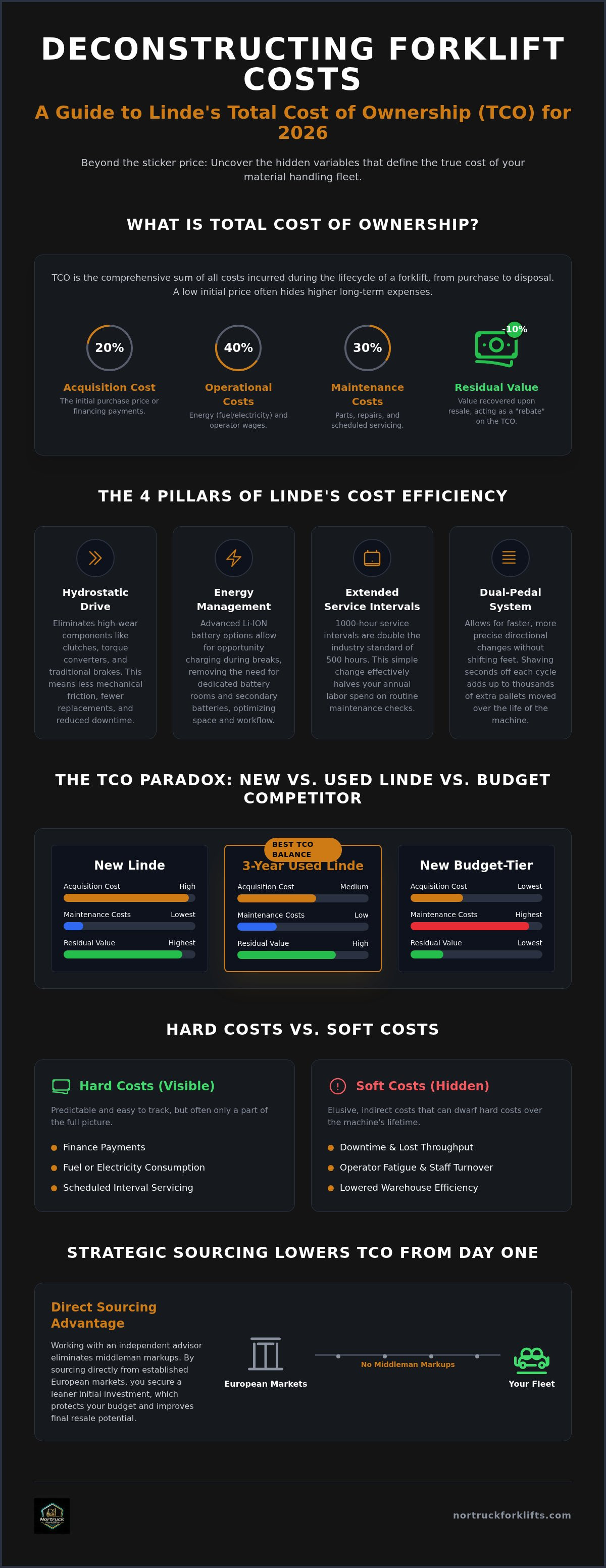
Procurement teams often fall into the trap of prioritizing the lowest invoice price. While a budget-tier truck might look attractive on a balance sheet today, the long-term financial reality is often quite different. Linde forklift total cost of ownership represents the total financial impact of the asset from the moment of procurement through to its final resale. It is the comprehensive sum of acquisition, operational, maintenance, and disposal costs over the machine's entire working life.
Linde's engineering philosophy purposely targets long-term value rather than a low entry point. By investing in premium components and specialized drive systems, they aim to reduce the frequency of repairs and energy consumption. As we move through 2026, new variables like fluctuating carbon taxes and industrial energy price volatility have become critical components of the TCO model. A truck that is 15% more fuel-efficient isn't just a green initiative; it's a hedge against rising operational overheads that can make or break a warehouse budget.
Soft Costs vs. Hard Costs in Material Handling
Effective fleet management requires distinguishing between direct hard costs and the more elusive soft costs. Hard costs are predictable and easy to track, including finance payments, fuel or electricity consumption, and scheduled interval servicing. However, these are often dwarfed by indirect soft costs over time. Consider the following factors:
- Downtime: Every hour a machine sits idle for unscheduled repair represents lost throughput and idle operator wages.
- Operator Fatigue: Linde's focus on ergonomics isn't just about comfort. It's a strategic move to reduce operator errors and lower the high cost of staff turnover.
- Warehouse Efficiency: Precision handling and faster lift speeds allow for more pallets moved per shift, directly lowering the per-unit handling cost.
When you reduce the physical strain on an operator, you're protecting your most expensive asset: your workforce. A fleet that is easier to operate leads to fewer accidents and a more stable team, which significantly stabilizes your Linde forklift total cost of ownership.
The Role of Residual Value in Your ROI
One of the most overlooked aspects of TCO is what happens at the end of the machine's life. Linde equipment consistently holds a higher resale value compared to budget-tier competitors. This residual value acts as a "rebate" that is only realized at the end of the cycle, effectively lowering the net cost of the years the machine was in service. While a cheaper truck might lose 70% of its value in five years, a well-maintained Linde often retains a much larger portion of its original worth.
Sourcing your fleet through an independent forklift advisor is a proven way to secure better resale potential. By avoiding middleman markups and sourcing directly from established European markets, you ensure your initial investment is as lean as possible. This transparency in the advisory process allows you to select models known for their durability, ensuring that when it's time to refresh your fleet, your old assets still command a premium price on the secondary market.
The Four Pillars of Linde’s Operational Cost Efficiency
Linde’s reputation for premium pricing is balanced by an engineering approach that aggressively targets the most expensive parts of a machine's life cycle. The Linde forklift total cost of ownership is kept low through four primary technological pillars. First, the hydrostatic drive system eliminates high-wear components like clutches, torque converters, and traditional brakes. By using hydraulic pressure to control movement, the truck experiences significantly less mechanical friction. This leads to fewer part replacements and less unscheduled downtime.
The second pillar involves energy management. In 2026, the choice between Li-ION and Lead-Acid batteries depends heavily on your shift patterns. Li-ION models allow for opportunity charging during breaks, which removes the need for battery rooms and secondary batteries. Third, Linde’s extended 1000-hour service intervals are double the industry standard of 500 hours. This effectively halves your annual labor spend on routine maintenance. Finally, the dual-pedal system increases operator productivity by allowing for faster, more precise directional changes. Shaving just a few seconds off each cycle adds up to thousands of extra pallets moved over the life of the asset.
Mechanical Longevity and Parts Sourcing
Maintaining the integrity of your fleet requires a disciplined approach to parts. While aftermarket alternatives might offer a lower price point, they often fail to meet the tight tolerances required by Linde’s hydrostatic systems. Using genuine components ensures the machine operates at peak efficiency, which protects the Linde forklift total cost of ownership from the "repair cliff" often seen in older machines. Linde’s enclosed mast profiles prevent debris damage and lower repair TCO by shielding sensitive hydraulic hoses and rollers from the harsh warehouse environment. If you're planning a fleet expansion, it's wise to partner with an independent advisor who can help you navigate the European sourcing market for the best value.
Energy Consumption: Electric vs. IC Engine
Calculating the "Fuel Gap" is the most important step in 2026 procurement. This is the point where the energy savings of an electric truck outweigh its higher initial purchase price. With new European energy regulations increasing the cost of operating internal combustion (IC) engines, electric models are becoming the standard for indoor applications. Transitioning to an electric fleet isn't just a matter of sustainability; it's a strategic hedge against volatile diesel and gas prices. Integrating these trucks into a green-energy warehouse strategy allows you to lock in more predictable operational costs for the next decade.
The TCO Paradox: Comparing New vs. Used Linde Forklifts
Choosing between a brand-new machine and a pre-owned asset is more than a simple budget decision. It's a calculated risk regarding the Linde forklift total cost of ownership. While a new truck offers the latest efficiency and a full warranty, the immediate depreciation is a heavy financial hit. Conversely, an older unit saves capital upfront but risks hitting the "Repair Cliff"—a point where cumulative maintenance costs suddenly spike and exceed the machine's remaining value. Balancing these factors is the only way to protect your long-term ROI.
Industry data suggests that a 3-year-old used Linde often represents the "sweet spot" for TCO. At this age, the steepest part of the depreciation curve has passed, yet the truck still possesses the majority of its operational life. However, verifying this value requires a rigorous used heavy lifting equipment inspection checklist to ensure you aren't inheriting someone else's expensive mechanical problems. Without a clear view of the machine's history, the initial savings can quickly vanish into a cycle of emergency repairs.
Verifying Service History for Used Equipment
Modern Linde models feature digital service logs that provide a level of TCO transparency previously unavailable in the used market. These logs allow you to see exactly when the 1000-hour service intervals were performed and if any recurring issues were ignored. You should be particularly wary of "ghost hours." This occurs when a meter shows low usage, but the physical wear on the chassis and hydraulics suggests a much harder life. Having an independent expert advisor audit the technical health of an asset is a small upfront cost that prevents a massive maintenance budget blowout later.
Refurbishment Costs: Factory vs. Local
Deciding whether to "buy and repair" or "buy ready-to-work" is a pivotal TCO choice. A Linde-certified refurbishment might carry a higher price, but it ensures that every critical component, from the hydrostatic drive to the electronic controllers, meets factory standards. Local, non-certified repairs might use aftermarket parts that degrade the truck's performance and resale value. Strategic sourcing of used Linde heavy forklifts from reputable European markets often provides access to machines that were maintained under strict factory contracts, offering better long-term reliability than locally sourced alternatives.
Consider the capital efficiency of sourcing a used Linde heavy forklift from the European market. By looking beyond local borders, procurement teams can often find high-spec machines that were maintained under strict factory service contracts. This approach provides a level of capital efficiency that is difficult to match with new equipment, provided the asset's history is fully transparent.
A Step-by-Step Framework for Calculating Your Forklift Fleet TCO
Calculating the true financial impact of your fleet requires more than a simple comparison of dealer quotes. To build an accurate 2026 procurement model, you need a disciplined framework that accounts for every cent spent from delivery to disposal. The Linde forklift total cost of ownership is often misunderstood because its benefits are back-loaded; you pay more now to save significantly more over the next decade. Follow these five steps to reveal the actual cost of your equipment.
- Step 1: Determine the net purchase price. This includes the base invoice plus shipping, commissioning, and any specialized attachments required for your application.
- Step 2: Estimate annual operating hours and energy costs. Use your specific shift patterns to project fuel or electricity consumption based on 2026 energy price forecasts.
- Step 3: Factor in maintenance and wear parts. Account for scheduled 1000-hour service intervals and the replacement cycle of high-wear items like tires and forks.
- Step 4: Add soft costs. Include operator training and the estimated cost of downtime based on the reliability history of the specific model.
- Step 5: Subtract the projected residual value. Research the resale price at year 5 or 10 to find your net lifetime expenditure.
The Formula for Cost Per Hour
The only number that truly matters in procurement is your cost per hour. By dividing the total lifetime cost by the total projected operating hours, you gain a clear view of operational efficiency. This formula often exposes the hidden weakness of budget forklift brands; while their purchase price is lower, their higher maintenance needs and lower resale value drive the hourly cost up. Using this math is essential when justifying high capacity forklift investments to stakeholders who focus solely on the initial capital outlay.
Adjusting for Inflation and Energy Volatility
A static model is a dangerous one in a shifting economy. To future-proof your 2026 TCO model, you must account for rising labor costs for technicians and the potential for energy price spikes. We recommend including a 15% contingency buffer for all TCO calculations to handle unforeseen mechanical issues or market shifts. You also need to factor in 2026 carbon credits or taxes that may apply to heavy lifting operations. These regulatory costs will directly impact the viability of internal combustion fleets, making the efficiency of the Linde forklift total cost of ownership even more critical for long-term planning.
Strategic Sourcing: How Independent Advisory Minimizes Long-Term Costs
The final variable in the Linde forklift total cost of ownership equation isn't found in a manual; it's found in your sourcing strategy. Most procurement teams default to local OEM dealers, unaware that these intermediaries often add significant markups to cover their own overheads. By contrast, an independent advisory model focuses on direct sourcing across the European market. This approach strips away unnecessary layers of cost, ensuring that your initial capital outlay is as low as possible without sacrificing the quality of the machine.
Lars G Tarby brings over 40 years of industry experience to this process, providing a level of technical scrutiny that a standard sales representative cannot match. His expertise allows him to identify the "lemons"—machines with hidden hydraulic issues or poorly documented histories—before they ever enter your fleet. This level of transparency is essential for maintaining a stable Linde forklift total cost of ownership. While a dealer's goal is to move inventory, an independent consultant's goal is to ensure the asset matches your specific operational requirements, whether that involves Kalmar, Toyota, or Linde equipment.
Navigating the European Forklift Market
Price variations across EU borders create unique opportunities for savvy procurement managers. A machine in one region might be priced lower due to local market saturation, yet it may have been maintained to the exceptionally high standards typical of German or Scandinavian industrial fleets. We manage the complexities of logistics, customs, and technical verification to bring these assets to your facility. Finding Linde forklifts for sale that have spent their lives under strict factory service contracts is the most effective way to ensure long-term mechanical reliability.
Customized Advisory for Heavy Lifting
Modern logistics requires moving beyond the mindset of simply "buying a machine." You're securing a logistics solution that must perform under pressure for a decade or more. This specialized knowledge is particularly vital when dealing with high-capacity equipment. Our experience with port terminal reachstackers and heavy-duty lift trucks informs how we evaluate the TCO of heavy Linde models. We look at the chassis integrity, mast wear, and drive-unit health to ensure the machine won't become a liability in year three. This holistic view of the market allows you to optimize your fleet for both performance and profit.
Securing Your Operational Future with Data-Driven Procurement
Mastering the Linde forklift total cost of ownership requires a shift from viewing equipment as a simple purchase to viewing it as a long-term financial asset. By focusing on high residual values and the mechanical efficiency of hydrostatic drives, you protect your budget from the hidden expenses common in budget fleets. Utilizing a cost-per-hour framework allows you to justify premium investments to stakeholders with absolute clarity and confidence.
Strategic sourcing across Europe eliminates middleman markups and ensures access to machines maintained to strict factory standards. With over 40 years of heavy lifting expertise and direct access to Lars G Tarby, we provide the independent insight needed to navigate the 2026 market without the pressure of OEM dealer quotas.
You don't have to tackle complex procurement alone when you have a partner dedicated to your fleet's long-term efficiency. We look forward to helping you find the right solution for your specific operational needs.
Frequently Asked Questions
What is the average lifespan of a Linde forklift for TCO calculations?
Linde forklifts are generally modeled with an economic lifespan of 10,000 to 15,000 operating hours. While the physical machine can often last much longer with proper care; this range is the standard for calculating the Linde forklift total cost of ownership before maintenance expenses begin to outweigh the machine's residual value. High-intensity multi-shift environments may reach this threshold faster, making regular technical audits essential for accurate financial planning.
How does Linde's hydrostatic drive affect long-term maintenance costs?
The hydrostatic drive system significantly lowers maintenance costs by removing high-wear mechanical components like clutches, torque converters, and traditional brakes. Since the hydraulic system handles both acceleration and deceleration, there is less friction-related heat and physical wear on the drivetrain. This engineering choice reduces the frequency of part replacements and unscheduled downtime, which are two of the largest contributors to a fleet's long-term operational expenditure.
Is electric or diesel Linde TCO lower in 2026?
Electric Linde models typically offer a lower TCO in 2026 for indoor and medium-duty applications due to rising carbon taxes and diesel price volatility. While the initial acquisition cost for electric trucks is higher, the lower energy-per-hour cost and reduced maintenance requirements often lead to a faster return on investment. Heavy-duty outdoor applications still utilize diesel, but the fuel-efficiency gap is closing as battery technology improves for high-capacity models.
Does buying a used Linde forklift significantly increase the TCO due to repairs?
Buying used doesn't automatically inflate your TCO if you source machines with verified service histories. A three-year-old Linde often represents the ideal balance between a lower purchase price and high remaining reliability. The risk only increases if you purchase "blind" without an expert audit. By using an independent advisor to verify digital service logs, you can avoid the "repair cliff" and secure a machine that performs like new.
How much should I factor in for Linde forklift residual value after 5 years?
You can typically expect a well-maintained Linde forklift to retain between 40% and 50% of its original value after five years. This high residual value acts as a significant financial offset at the end of the machine's life cycle. Compared to budget-tier competitors that depreciate much faster, this resale potential is a primary reason why the Linde forklift total cost of ownership remains competitive despite the higher initial sticker price.
Can an independent advisor help reduce the acquisition cost component of TCO?
Yes, an independent advisor like Nortruck Forklifts reduces acquisition costs by sourcing equipment directly across Europe. This strategy eliminates the markups typically added by local dealers and intermediaries. By accessing a broader inventory and leveraging 40 years of market expertise, an advisor can find specific models that offer the best value. This transparency ensures your TCO model starts with the leanest possible capital investment.
What are the hidden costs in a forklift TCO model that most managers miss?
Managers often overlook "soft costs" such as operator fatigue and turnover caused by poor ergonomics. If a truck is difficult to operate, productivity drops and the risk of accidents increases. Other hidden costs include the price of downtime when parts aren't readily available and the impact of "ghost hours" on used equipment. Accurate TCO models must account for these variables to reflect the true financial impact of the fleet.
How do 2026 energy prices impact the TCO of high-capacity Linde models?
Energy price volatility in 2026 makes fuel and electricity efficiency the most critical variables for high-capacity machines. Linde's precise energy management systems help hedge against these fluctuations by maximizing work output per unit of energy. For heavy-duty operations, even a small percentage gain in efficiency can save thousands in annual operational costs. Monitoring these trends is essential for procurement teams looking to lock in predictable long-term handling costs.

Article by
Lars Gunnar Tärby
Disclaimer
1. General Information and No AdviceThe information, articles, product descriptions, and specifications provided on this website (www.nortruckforklifts.com) are for general informational and educational purposes only. While we strive to provide accurate and up-to-date content regarding new and used forklifts and heavy machinery, the material published does not constitute professional, technical, or legal advice.
2. Product Specifications and PricingNortruck Forklifts acts as a facilitator for the trade of new and used forklifts. All equipment details, including but not limited to year of manufacture, operating hours, lift capacity, dimensions, conditions, and pricing, are provided based on the information available to us at the time of publication. Specifications and availability are subject to change without prior notice.
3. "As Is" and VerificationAll articles and product listings are provided on an "as is" and "as available" basis without any warranties of any kind, either express or implied. Nortruck Forklifts does not guarantee that the descriptions are entirely error-free, complete, or reliable. Buyers and traders are strongly encouraged to independently verify all technical specifications, machine history, and equipment conditions directly with the seller or an authorized inspector before finalizing any purchase or transaction.
4. Limitation of LiabilityIn no event shall Nortruck Forklifts, its owners, or its contributors be held liable for any direct, indirect, incidental, consequential, or economic loss or damage arising out of the use of, or the inability to use, the information provided on this website, or any transactions facilitated through this platform. This includes, but is not limited to, damages caused by technical inaccuracies, typographical errors, or reliance on the content of our articles.
5. Third-Party LinksOur website may contain links to external websites, dealer networks, or third-party services that are not owned or controlled by Nortruck Forklifts. We have no control over, and assume no responsibility for, the content, privacy policies, or practices of any third-party websites.


