
Is a lower upfront price on a heavy-duty machine actually a saving, or are you just subsidizing future downtime? Most terminal managers understand that the search for a reliable reachstacker for port terminal for sale often feels like a gamble between multi-month lead times for new units and the "black box" of used equipment history. You need a machine that hits the ground running, not a mechanical liability that drains your operational budget while sitting idle in the yard.
We've spent over 40 years helping port operators handle these high-stakes acquisitions with transparency and technical precision. This guide provides the expert framework you need to master the complexities of the European market and total cost of ownership. We'll look at how to verify maintenance logs, match duty cycles to terminal throughput, and manage the logistics of cross-border delivery. By the end, you'll have a clear roadmap for securing a high-performing asset without the traditional headaches of heavy equipment sourcing. It's about finding the right fit for your specific operational needs, not just what's currently sitting on a lot.
Key Takeaways
- Identify the operational thresholds where transitioning from standard forklifts to specialized container handlers becomes necessary for terminal efficiency.
- Evaluate the long-term ROI of used machinery by analyzing engine reliability and hydraulic precision across tier-1 European brands.
- Secure a high-quality reachstacker for port terminal for sale by leveraging the European secondary market to bypass long factory lead times.
- Mitigate procurement risks through multi-point technical inspections that verify maintenance history and mechanical integrity before the commissioning process begins.
- Prioritize an advisory-led sourcing model to remove unnecessary intermediaries and ensure your equipment matches your specific duty cycle requirements.
Understanding the Role of Reachstackers in Modern Port Terminals
A reachstacker is more than just a heavy forklift; it's a precision instrument designed for the high-density environment of a modern terminal. While standard forklifts are limited to vertical lifting, reach stackers in intermodal terminals provide the ability to stack containers multiple rows deep. This versatility allows operators to access containers behind the first row without moving the entire stack, which directly translates to faster turn times for trucks and vessels. When you're searching for a reachstacker for port terminal for sale, it's essential to understand that you aren't just buying a machine. You're investing in the fluidity of your entire yard layout.
To better understand how these machines function in a real-world environment, watch this helpful video:
The transition from standard heavy forklifts to specialized port machinery usually happens when a terminal hits a specific throughput threshold. If your yard is becoming congested, the reachstacker's ability to stack up to six containers high and reach into second and third rows becomes a necessity. This machine selection dictates your total capacity. A poorly matched machine leads to bottlenecks, while the right one ensures your duty cycle stays consistent even during peak arrival windows. When looking for a reachstacker for port terminal for sale, the decision usually hinges on your specific yard density and the expected number of moves per hour.
Reachstackers vs. Empty Container Handlers
An empty container handler is a specialist. It's lightweight and fast, designed specifically for high-volume depots where containers are stored without cargo. However, it lacks the raw lifting power of a full reachstacker. In narrow aisles, an empty handler might offer a tighter turning radius, but it can't match the row-depth flexibility of its heavier counterpart. If your terminal handles a mix of laden and unladen units, a versatile reachstacker is often the more resilient investment for long-term growth.
Key Performance Indicators for Port Machinery
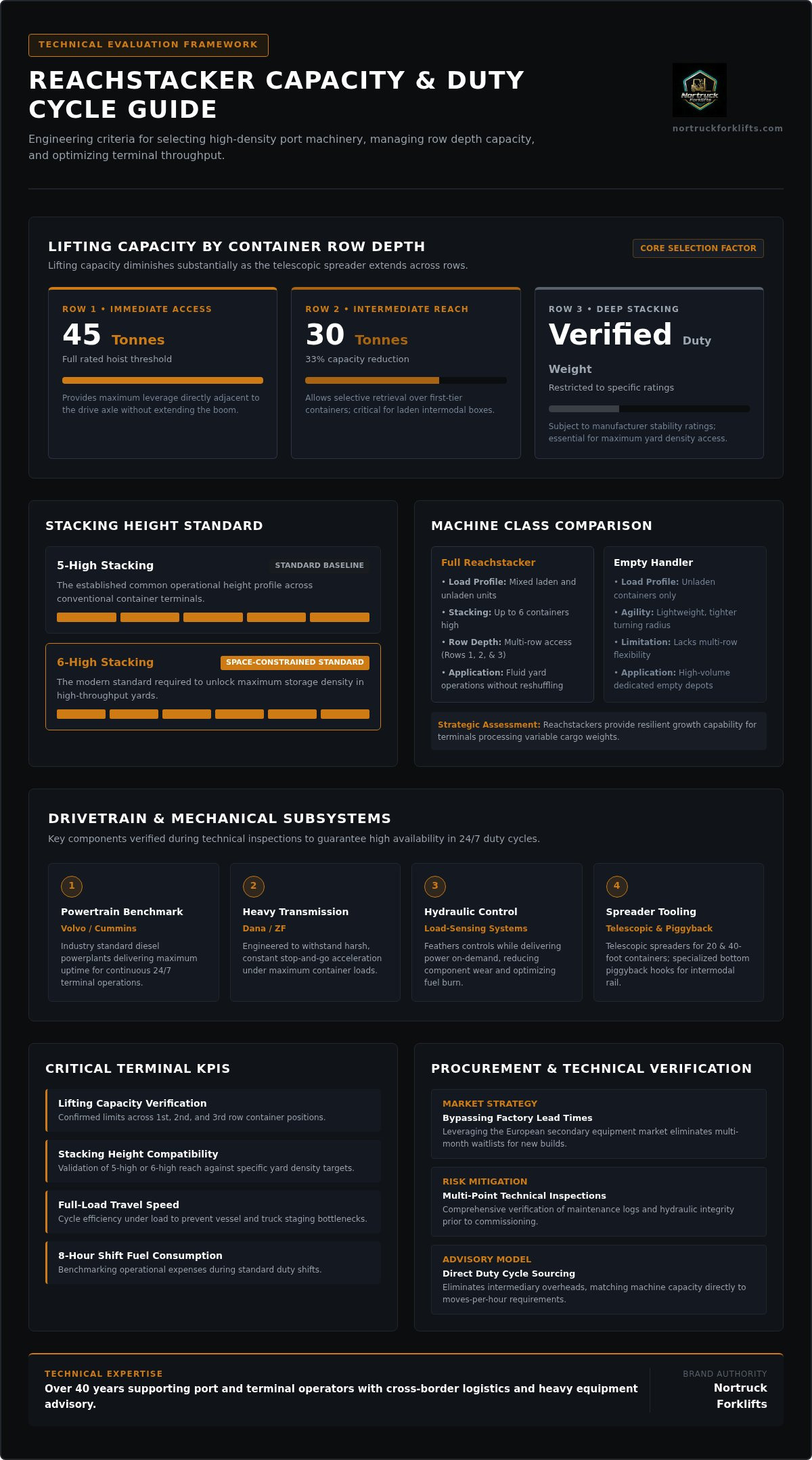
Performance isn't just about the maximum weight the spreader can hold. You must evaluate lifting capacity at different row depths. A machine that lifts 45 tonnes in the first row might only manage 30 tonnes in the second. Stacking height is another critical factor; 5-high stacking is common, but 6-high capabilities are becoming the standard for space-constrained ports. Consider these KPIs during your evaluation:
- Lifting Capacity: Verified weights for 1st, 2nd, and 3rd row positions.
- Stacking Height: Ability to reach 5-high or 6-high stacks based on your yard layout.
- Travel Speed: Efficiency under full load to maintain terminal flow.
- Fuel Consumption: Operational costs over a standard 8-hour shift.
Technical Specifications: Matching Machine Capacity to Your Duty Cycle
Selecting a reachstacker for port terminal for sale requires looking past the paint and into the drivetrain. For most heavy-duty applications, Volvo and Cummins engines remain the industry benchmarks for reliability. These powerplants, paired with robust transmissions from manufacturers like Dana or ZF, ensure the machine can handle the constant stop-and-go nature of container movements. Electric alternatives are gaining ground in 2026, particularly for terminals with strict emissions targets, but the traditional diesel-mechanical setup still offers the highest uptime for 24/7 operations.
Hydraulics are the heart of handling precision. A machine is only as good as its ability to feather the controls while hoisting 40 tonnes. You should prioritize load-sensing hydraulic systems that only deliver power when needed. This reduces component wear and lowers fuel costs. Spreader choice also matters; while standard telescopic spreaders handle 20 and 40-foot containers, intermodal rail hubs often require specialized "piggyback" attachments to lift trailers from below. Cabin visibility and ergonomics shouldn't be secondary thoughts; they're primary safety features that reduce operator fatigue and minimize cycle times.
Lifting Capacity and Row Depth
Load charts are often misunderstood by procurement teams. A machine's capacity isn't a single number; it's a curve that drops sharply as the boom extends into the second and third rows. For instance, a unit rated for 45 tonnes in the first row might only safely lift 15 tonnes in the third. Stability depends largely on the wheelbase length. A longer wheelbase provides a greater resistive moment against the load, ensuring the rear wheels stay firmly planted during high-stacking maneuvers.
Modern Features: Telematics and Automation
Modern fleet management relies on data. Integrating your equipment with a Terminal Operating System (TOS) allows for real-time tracking of fuel levels, engine health, and container locations. Implementing EPA cargo handling equipment best practices helps operators optimize duty cycles and reduce unnecessary idling. Safety is equally critical; 360-degree camera systems and automatic overload protection are now standard requirements to prevent accidents in busy aisles. Matching these technical nuances to your specific yard requirements is where expert guidance pays off. If you're unsure which drivetrain or wheelbase fits your throughput, consulting with an experienced advisor can prevent a costly mismatch.
Port Reachstacker Sale: New vs. Used Machines
Deciding between a new factory order and a pre-owned machine is often a choice between long-term warranty security and immediate operational need. For a reachstacker for port terminal for sale, the depreciation curve is steepest in the first few years of operation. Savvy terminal managers often look for units that have completed their initial lease cycle to capture the best ROI. At this stage, the primary mechanical systems are still within their peak performance window, but the initial capital outlay is significantly lower than a new build.
Total Cost of Ownership (TCO) must factor in more than just the sticker price. Fuel consumption, maintenance schedules, and the eventual resale value are what define the true cost. A machine with a slightly higher upfront price but superior fuel economy often proves more profitable over a five-year horizon. Resale value also hinges heavily on brand reputation; a well-maintained Kalmar or Linde will retain its value far better than budget alternatives when it's time to refresh your fleet.
The Pros and Cons of Used Equipment
The most compelling reason to source used machinery is the lead time. While a new build can take 12 to 18 months to reach your yard, a verified used unit can be delivered and commissioned in a fraction of that time. However, this speed comes with the burden of due diligence. You must verify service history and actual operating hours to avoid inheriting a maintenance nightmare. For a deeper look at this process, see our Used Reachstacker Sourcing: 2026 Port Procurement Guide. Ensuring compliance with OSHA marine terminal equipment standards is mandatory, regardless of the machine's age, so focus on units with clear safety documentation and visible rated capacity plates.
Brand Comparison: Kalmar, Linde, and Toyota
In the European market, Kalmar is widely considered the benchmark for heavy-lift reliability. Their dominance ensures that parts and technical expertise are readily available across almost every major port. Linde offers a different advantage with its hydrostatic drive systems, providing unmatched precision for operators handling delicate loads in tight spaces. While these brands lead for primary container handling, we often source Volvo wheel loaders and Toyota forklifts for auxiliary terminal tasks. These supporting machines ensure that the "last mile" of cargo movement within the terminal is as efficient as the primary stack. When you find a reachstacker for port terminal for sale, checking the brand's local service network is just as important as the machine's technical specifications.
The European Sourcing Strategy: Inspections and Logistics
Limit your search to local dealers and you'll likely overpay or settle for a machine that doesn't fit your duty cycle. The European market offers a vast inventory of high-tier equipment, but finding a quality reachstacker for port terminal for sale across borders requires a disciplined strategy. You aren't just buying the steel; you're buying the maintenance history of a machine that has likely worked in a completely different regulatory and operational environment. Expanding your reach beyond local borders is the only way to beat the current long lead times for new machinery.
Logistics for heavy-duty port equipment are complex. A reachstacker can weigh between 70 and 110 tonnes. Shipping via Ro-Ro (Roll-on/Roll-off) is the most efficient method for port-to-port transfers, but inland delivery often necessitates partial dismantling. This requires specialized technicians at both the origin and the destination to ensure the machine is reassembled and commissioned correctly. Don't overlook the customs documentation; ensuring VAT compliance and export declarations are handled correctly prevents costly delays at the border.
Critical Inspection Checkpoints
A visual walk-around isn't enough. Our process focuses on structural integrity, specifically looking for stress fractures in the boom and chassis welds that indicate a history of overloading. Engine diagnostics must include fluid analysis to check for internal wear that a standard pressure test might miss. We pay close attention to the spreader and its sensor array. These are the most frequent points of failure and can lead to immediate downtime if not verified before you finalize the purchase of a reachstacker for port terminal for sale.
The Value of Independent Advisory
Most dealerships are incentivized to move the stock currently sitting on their lot. An independent advisor works exclusively for you, the buyer. We leverage over 40 years of industry experience to identify "red flag" machines that look good on paper but have underlying hydraulic or electronic issues. This advisory-led approach removes the noise of the middleman and focuses on technical suitability. For a broader look at current inventory trends, read our European Forklift Market Guide 2026. We treat every inspection as a risk-mitigation exercise for your high-value assets.
Why Expert Advisory Outperforms Standard Equipment Dealerships
Dealerships often prioritize clearing their existing inventory. If they have a machine on the lot, that's the one they'll recommend, even if it doesn't perfectly fit your yard's duty cycle. Our approach is fundamentally different. We prioritize transparency and integrity, acting as an extension of your procurement team rather than a vendor. By removing the "middleman" noise, we connect port terminals with the right assets based on technical specifications rather than sales quotas.
Consultancy vs. Sales
A sourcing partner focuses on long-term suitability. When evaluating a reachstacker for port terminal for sale, we look at the machine's history through the lens of four decades of experience. Lars G Tarby personally vets high-capacity units to ensure they meet the rigorous demands of modern logistics. This level of scrutiny is essential for high-value assets like Kalmar heavy lift trucks, where mechanical integrity is non-negotiable. We've seen cases where a terminal nearly purchased a machine with an insufficient wheelbase for their stacking requirements; our intervention saved them from a multi-million dollar procurement error.
Looking toward the 2026 outlook, the industry is shifting toward more sustainable lifting solutions. While diesel remains the workhorse, the rise of electric and hybrid reachstackers is changing how terminals plan their infrastructure. A standard dealership might not have the expertise to advise on the charging requirements or the duty-cycle trade-offs of these newer technologies. An independent advisor provides the objective data you need to decide if an eco-mode diesel or a full-electric unit is the right move for your specific operation.
Securing Your Next Port Asset
Starting the sourcing process is a matter of defining your parameters. We begin by analyzing your terminal's required lifting capacity, stacking height, and budget constraints. This technical consultation is low-pressure and focused entirely on your operational outcomes. If you're ready to find a reachstacker for port terminal for sale that matches your throughput without the risks of hidden mechanical issues, contacting an expert is the first step. We don't just find a machine; we secure a long-term solution for your fleet.
Optimizing Your Terminal Fleet for 2026 and Beyond
Mastering the procurement of heavy-duty port equipment requires moving away from standard dealership transactions toward technical consultation. You've seen how matching duty cycles to machine history and navigating the European market can transform your yard's efficiency. Finding the right reachstacker for port terminal for sale isn't just about the lowest price; it's about securing an asset with a verified maintenance history that handles your specific container throughput. It's a high-stakes investment that demands technical precision.
Leveraging over 40 years of heavy lifting expertise allows you to bypass the traditional risks of used machinery. We specialize in tier-1 brands like Kalmar and Linde, using a transparent European sourcing model to find machines that local stocks often lack. This advisory-led approach ensures your next acquisition is a precise fit for your terminal’s operational future without the noise of unnecessary intermediaries.
We're ready to help you navigate the complexities of international logistics and technical inspections. Let's ensure your fleet remains productive and efficient for years to come.
Frequently Asked Questions
What is the difference between a reachstacker and a container handler?
A reachstacker uses a telescopic boom to stack containers up to six high and three rows deep, offering superior yard density. In contrast, a dedicated container handler usually features a vertical mast and is limited to first-row operations. While empty handlers are faster for high-volume depots, a reachstacker for port terminal for sale is the better choice for laden units and intermodal versatility where row-depth access is a primary operational requirement.
How many hours is too many for a used reachstacker?
Mechanical condition matters more than a specific number, but 15,000 to 20,000 operating hours is typically when major drivetrain components require intensive inspection or overhaul. Machines exceeding 30,000 hours often face higher maintenance costs unless they've undergone a documented refurbishment. We prioritize maintenance history over the hour meter; a well-serviced unit with 18,000 hours often outperforms a neglected machine with only 10,000 hours in the long term.
Which brands are the most reliable for port terminal operations?
Kalmar and Linde are the industry benchmarks for heavy-lift reliability in European ports. Kalmar is prized for its robust chassis and global parts availability, while Linde is noted for the precision of its hydrostatic drive systems. We also source Toyota and Volvo equipment for auxiliary terminal tasks. Reliability depends on matching the brand's technical strengths to your specific duty cycle and ensuring a local service network exists for major components.
How much does it cost to ship a reachstacker across Europe?
Logistics costs vary significantly based on the machine's dimensions and the transport method. Shipping via Ro-Ro is often the most efficient for port-to-port transfers, while inland delivery requires heavy-haul trailers and potentially partial dismantling to meet bridge clearances. You must factor in the costs of specialized technicians for reassembly and commissioning at your terminal. We manage these international transfers by coordinating with heavy-lift specialists to ensure a seamless delivery process.
Can a reachstacker handle intermodal rail containers?
Yes, reachstackers are highly effective for intermodal rail operations when equipped with the correct attachments. While standard spreaders handle ISO containers, intermodal terminals often require "piggyback" legs to lift trailers and swap bodies from underneath. The machine's ability to reach into the second rail track is a major advantage over traditional forklifts. When evaluating a reachstacker for port terminal for sale, verify the spreader's compatibility with your specific rail hub requirements.
What are the main maintenance costs associated with reachstackers?
Tires and fuel represent the highest ongoing operational expenses. A single set of tires for a 45-tonne machine is a significant investment, making proper yard surfacing and operator training essential. Beyond consumables, hydraulic system overhauls and drivetrain servicing are the primary long-term costs. Regular oil analysis and pressure testing help mitigate these expenses by identifying internal wear before it leads to a catastrophic component failure during a peak shift.
Is it better to buy a new reachstacker or a refurbished one in 2026?
The decision hinges on your required commissioning date and budget parameters. In 2026, new factory orders still face lead times that can exceed twelve months. A high-quality refurbished unit offers a faster path to operational readiness and a lower upfront cost, which often results in a better ROI for mid-sized terminals. We focus on sourcing machines with transparent service logs so you can capture the benefits of used pricing without the associated mechanical risks.
How does a sourcing advisor find machines that aren’t listed publicly?
We leverage over 40 years of industry relationships to access equipment before it hits the open market. This includes direct contacts within major European port authorities and private terminal operators who are planning fleet refreshes. By working through these established networks, we identify high-quality assets that haven't been picked over by traditional dealers. This insider perspective allows us to secure specific Kalmar or Linde models that meet your exact technical requirements.

Article by
Lars Gunnar Tärby
Disclaimer
1. General Information and No AdviceThe information, articles, product descriptions, and specifications provided on this website (www.nortruckforklifts.com) are for general informational and educational purposes only. While we strive to provide accurate and up-to-date content regarding new and used forklifts and heavy machinery, the material published does not constitute professional, technical, or legal advice.
2. Product Specifications and PricingNortruck Forklifts acts as a facilitator for the trade of new and used forklifts. All equipment details, including but not limited to year of manufacture, operating hours, lift capacity, dimensions, conditions, and pricing, are provided based on the information available to us at the time of publication. Specifications and availability are subject to change without prior notice.
3. "As Is" and VerificationAll articles and product listings are provided on an "as is" and "as available" basis without any warranties of any kind, either express or implied. Nortruck Forklifts does not guarantee that the descriptions are entirely error-free, complete, or reliable. Buyers and traders are strongly encouraged to independently verify all technical specifications, machine history, and equipment conditions directly with the seller or an authorized inspector before finalizing any purchase or transaction.
4. Limitation of LiabilityIn no event shall Nortruck Forklifts, its owners, or its contributors be held liable for any direct, indirect, incidental, consequential, or economic loss or damage arising out of the use of, or the inability to use, the information provided on this website, or any transactions facilitated through this platform. This includes, but is not limited to, damages caused by technical inaccuracies, typographical errors, or reliance on the content of our articles.
5. Third-Party LinksOur website may contain links to external websites, dealer networks, or third-party services that are not owned or controlled by Nortruck Forklifts. We have no control over, and assume no responsibility for, the content, privacy policies, or practices of any third-party websites.


