
Why are so many fleet managers still settling for standard machines that choke on dust and struggle with 15-tonne precast sections? You know that the concrete yard is where general-purpose equipment goes to die. Between the abrasive slurry and the sheer weight of structural beams, a standard forklift for concrete industry applications often fails long before it's paid for itself. It's frustrating to watch a six-figure investment sit idle because of a fouled intake or a cracked mast; you need equipment that treats these conditions as the baseline, not the exception.
This 2026 guide will help you select and source the most durable, high-capacity forklifts designed to thrive in the high-stakes environment of concrete manufacturing. We'll show you how to find a truck that lasts 10-plus years despite the dust and how to optimize your yard space for long concrete beams using specialized sideloaders. We'll also preview the latest European sourcing trends, including how to access high-quality used Kalmar or Baumann units that meet the strict EU Stage V emission standards. With the European concrete market projected to reach $492.66 billion this year, you'll have a clear roadmap for securing machinery that delivers operational efficiency rather than constant downtime.
Key Takeaways
- Identify the specific engineering failures common in masonry yards and how to avoid them with dust-resistant components.
- Match truck geometry to your product profile, selecting the right forklift for concrete industry applications from palletized blocks to oversized precast sections.
- Evaluate 2026 technical requirements like reversible cooling fans and heavy-duty drivetrains that protect your investment from abrasive concrete dust.
- Navigate the European used market to source premium brands like Kalmar and Baumann, ensuring high-tier performance without the lead times of new equipment.
- Leverage independent advisory to find application-specific machinery that fits your yard's unique layout and load requirements.
Lifting Challenges: Why a Standard Forklift for Concrete Industry Fails
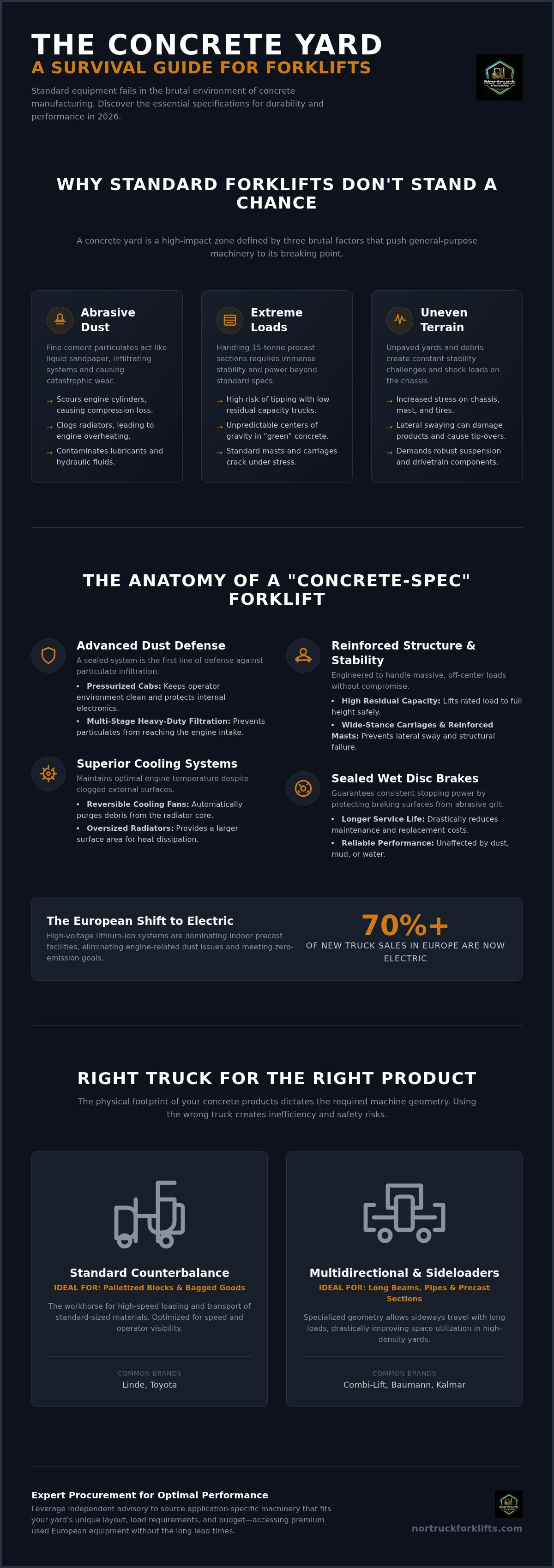
Concrete manufacturing plants are notoriously unforgiving environments for heavy machinery. Unlike a clean, climate-controlled warehouse, a concrete yard is a high-impact zone defined by three brutal factors: abrasive dust, uneven terrain, and extreme load weights. While a basic powered industrial truck serves well in a standard logistics hub, it quickly becomes a liability in a masonry yard. Standard internal combustion (IC) pneumatic trucks often suffer from premature engine and hydraulic failure because they aren't engineered for this level of environmental stress.
The core problem lies in the fine particulates that permeate the air. In a typical concrete facility, this dust isn't just a nuisance; it acts as a grinding paste. It breaches standard seals, clogs cooling systems, and contaminates lubricants. By 2026, the industry has seen a significant shift toward high-capacity electric counterbalance trucks for indoor precast facilities. These units, often utilizing high-voltage lithium-ion systems, eliminate the risk of engine-related dust infiltration while meeting the growing demand for zero-emission operations in enclosed spaces. In fact, electric models now account for over 70% of new truck sales in Europe, proving that power no longer requires a diesel engine.
The Abrasive Reality of Concrete Dust
Concrete dust is essentially liquid sandpaper. When a standard forklift operates, its air intake sucks in these microscopic cement particles. If the filtration isn't specialized, these particulates bypass the secondary filter and scour the cylinder walls, leading to a rapid loss of compression. Radiators also suffer, as the dust mixes with ambient moisture to create a hard crust that blocks airflow and causes the engine to overheat. To combat this, high-tier machines like those from Kalmar or Linde utilize oversized cooling cores and reversible fans to blow out debris automatically. Sealed wet disc brakes are equally vital; they keep abrasive grit away from the braking surfaces to ensure consistent stopping power and a much longer service life. A "Concrete-Spec" forklift is characterized by its integration of pressurized cabs and multi-stage, heavy-duty filtration systems.
Weight and Stability Requirements
Concrete is one of the most difficult materials to handle because its weight is uncompromising and its center of gravity can be unpredictable. Large precast sections, especially those that are still "green" or recently cast, may have shifting moisture content that affects balance. You need a machine with high residual capacity, meaning it can lift its rated load to full height without the risk of tipping. Wide-stance carriages and reinforced masts are essential for handling blocks and bricks, as they prevent the lateral swaying that can lead to product damage or tip-overs. When you're moving 15-tonne beams across an uneven yard, the stability of the truck's chassis determines whether your operation stays on schedule or grinds to a halt due to a safety incident.
Matching Forklift Geometry to Concrete Product Types
Selecting the right forklift for concrete industry operations requires more than just checking a weight rating. Concrete isn't uniform. The physical footprint of your product dictates the geometry of the machine you need. While a standard counterbalance truck remains the primary choice for palletized blocks and bagged cement, its utility drops sharply when you introduce long-span precast beams or oversized pipes. In high-density storage yards where space is at a premium, a 4-way multidirectional truck like a Combi-Lift can be the difference between adding a new production line or running out of room. These machines allow you to travel sideways with long loads, effectively turning wide aisles into narrow pathways.
For operations focused on masonry and bagged goods, speed and visibility are the main drivers. Standard trucks from brands like Linde or Toyota are often the best fit here. However, as the load becomes more specialized, the machine must follow suit. Using the wrong geometry doesn't just slow down your yard; it creates significant safety risks and increases the likelihood of product damage. If you're currently evaluating your fleet, seeking guidance from an expert at Nortruck Forklifts can ensure you don't over-spec or under-perform.
Handling Long Loads: Beams and Pipes
Moving a 12-meter concrete span with a standard front-loading truck is a recipe for disaster. You're constantly fighting the "pendulum effect," where the load swings out during every turn. This creates massive instability and forces your operators to move at a crawl. Sideloaders, particularly those from Baumann, solve this by carrying the load on a dedicated platform. This keeps the center of gravity low and the load parallel to the direction of travel. Secure transport like this is essential for staying compliant with OSHA forklift operation standards. If you're torn between different long-load solutions, you can read our comparison on a Baumann Sideloader vs Combi-Lift to see which geometry fits your specific yard layout.
Block and Brick Logistics
In high-volume block production, cycle time is everything. You need to clear the production line and load trailers with minimal downtime. This is where specialized attachments become more important than the truck itself. Multiple pallet handlers allow a single operator to move twice the volume per trip, while block clamps eliminate the need for pallets entirely in certain applications. Even if your primary focus is concrete, you can learn a lot from other industries; for instance, the visibility and grip principles discussed in choosing the best sideloader for plastic pipe handling apply directly to concrete pipe logistics. The goal is always to maximize the amount of product moved per hour while keeping the operator's line of sight clear of obstructions.
Technical Specifications for Durability in 2026
Engine and transmission choices for a forklift for concrete industry use require a focus on survival as much as strength. While heavy-duty diesel engines from Kalmar or Volvo remain the standard for 20-tonne precast loads, the transmission is where the real battle against downtime is won. You need a powertrain designed for high-cycle, stop-and-go work on abrasive, unpaved surfaces. Standard transmissions often overheat when pushing through slurry and grit; however, modern heavy-lift trucks now utilize torque-converter systems with enhanced cooling loops to maintain internal integrity during long shifts.
The hydraulic system is another critical failure point in masonry yards. O-ring face seals are now a non-negotiable requirement for preventing leaks. Traditional flared fittings often fail when microscopic concrete dust works its way into the threads, but O-rings provide a flat-face seal that resists vibration and abrasive ingress. Beyond the hydraulics, cooling systems have evolved. Modern machines feature reversible fans that automatically blow out the radiator every twenty minutes. This prevents concrete dust from mixing with ambient moisture and hardening into a crust that would otherwise lead to engine overheating and expensive repairs.
Ensuring your fleet meets these technical standards is a cornerstone of maintaining forklift safety in precast concrete plants, where mechanical reliability directly impacts ground-level safety. When a machine is engineered for the environment, operator fatigue also drops. High-vibration yards can be punishing, so look for isolated cabs and full-suspension seats that protect the driver from the constant jolts of uneven concrete slabs.
The Rise of Heavy Electric Forklifts
A major trend in 2026 is the rapid adoption of 10-18 tonne electric trucks in urban precast facilities. These machines are no longer limited to light warehouse work; they now possess the torque required for massive concrete sections. The Total Cost of Ownership (TCO) is becoming the primary driver for this shift, as businesses eliminate diesel fuel costs and the heavy maintenance associated with internal combustion engines. The ROI tipping point for electric trucks in double-shift concrete operations is generally reached within the first three years of service as fuel and engine maintenance costs vanish.
Advanced Attachments and Load Monitoring
Precision is becoming as important as brute force. Integrated weighing scales are now frequently built into the carriage to prevent the accidental overloading of transport trucks. In the noisy, busy environment of a masonry yard, 360-degree camera systems provide the operator with total situational awareness, reducing the risk of collisions with ground staff or finished inventory. For those looking to upgrade their fleet with these technologies, Sourcing Kalmar Heavy Lift Trucks for Sale offers a deep dive into acquiring high-capacity machines that are purpose-built for these rigorous demands.
Sourcing Strategy: New vs. Used Heavy Equipment in Europe
Sourcing a forklift for concrete industry applications often presents a dilemma: do you buy a new, mid-tier machine locally or look for a premium, used unit abroad? In 2026, the European used market remains the most reliable source for high-capacity equipment. With equipment financing rates for well-qualified borrowers currently ranging from 6% to 14%, the lower entry price of a used Kalmar or Baumann can significantly offset interest costs while providing a more robust machine than a budget-tier new alternative. The European heavy construction equipment market is projected to reach $474.19 billion this year, ensuring a deep pool of available inventory for those who know where to look.
To secure the right machine, follow this methodical procurement process:
- Step 1: Define your specific requirements. Be precise about your heaviest load and highest lift point. Don't over-spec; an oversized truck increases fuel consumption and reduces maneuverability in tight yards.
- Step 2: Evaluate the European market. High-tier brands like Kalmar, Linde, and Baumann are often available as well-maintained ex-lease units with full service histories.
- Step 3: Conduct a technical audit. Prioritize mast integrity and hydraulic pressure tests over superficial paint condition.
- Step 4: Navigate logistics. Use independent inspections to verify the machine's condition before it leaves the port to avoid surprises upon delivery.
- Step 5: Finalize through an advisor. Working with an independent consultant helps you avoid the hidden dealer margins that often inflate the final price.
Why Source Used Machinery from Europe?
Europe's industrial density means a higher volume of specialized heavy-lift trucks. These machines are often maintained under strict service contracts, ensuring they reach the secondary market in excellent mechanical health. A used Kalmar typically retains its value far better than a new, lower-tier brand because parts and expert service are globally accessible. An independent advisor acts as your eyes on the ground, verifying machine hours and history to ensure the unit hasn't been abused in a corrosive environment. This transparency is vital when you're making a six-figure investment from across an ocean.
The Inspection Checklist for Concrete Trucks
When inspecting a truck for concrete work, the environment it worked in is more telling than the hour meter. You must look for hydraulic cylinder pitting and steer axle wear, which are common in abrasive settings. Check the mast for hairline cracks, especially near the load-bearing welds. A machine that has spent its life in a dry, indoor precast plant is a much better investment than one with lower hours that worked in a wet, slurry-filled masonry yard. Identifying these signs of previous corrosive exposure can save you thousands in premature seal and bearing replacements.
Expert Procurement: The Nortruck Advisory Advantage
Navigating the acquisition of a forklift for concrete industry use is a high-stakes decision that requires more than a simple equipment catalog. At Nortruck, we provide a grounded, professional advisory service backed by over 40 years of heavy lifting expertise. Unlike traditional dealers who are incentivized to sell whatever inventory is currently sitting on their lot, we operate as independent advisors. Our priority is finding the exact machine your yard requires, whether that's a high-capacity Kalmar for massive precast sections or a specialized Baumann sideloader for long concrete spans.
This independence allows us to scan sourcing networks across Europe to find the best value and the most suitable specifications. We prioritize transparency and direct communication, ensuring there are no unnecessary intermediaries between you and your equipment. By eliminating these middlemen, we provide a clear, honest view of the machine's history, condition, and total landed cost. When you're managing the high-intensity demands of a concrete facility, you need a partner who understands the internal nuances of your operation and values long-term reliability over a quick transaction.
From Advisory to Acquisition
Our process begins with a consultation rather than a sales pitch. We work to understand your specific operational bottlenecks; perhaps your current fleet lacks the residual capacity for new, larger product lines, or your yard layout is becoming too congested for standard trucks. Once the need is defined, we leverage our global network to identify rare, high-capacity specifications that are often unavailable in local markets. For example, we recently facilitated the sourcing of a 25-tonne Kalmar for a major precast infrastructure project, ensuring the client had the precise brute force required for heavy bridge components without the multi-year lead time of a new factory order.
Contact Nortruck for Specialized Concrete Solutions
Every concrete yard has its own unique challenges, from tight storage aisles to abrasive ground conditions. We invite you to discuss your specific yard layout and product geometry with us to see how a tailored sourcing strategy can improve your bottom line. Whether you need a new high-voltage electric unit for indoor work or a robust, used diesel truck for outdoor heavy lifting, we have the specialized knowledge to guide you. Integrity and expert guidance are the foundations of our service, and we're ready to help you secure a forklift for concrete industry applications that will last for years to come.
Securing Your Fleet's Future in Concrete Logistics
Building a resilient fleet in 2026 requires moving beyond standard specifications. The concrete yard is a unique environment. Abrasive dust and extreme loads demand specialized cooling systems and reinforced masts. By matching your equipment geometry to your specific product profile, you don't just improve safety; you optimize your entire yard's efficiency. Selecting the right forklift for concrete industry applications is a matter of precision engineering and strategic sourcing.
Sourcing these high-capacity machines from the European market offers a distinct advantage in both quality and value. With over 40 years of industry experience, we specialize in identifying high-tier Kalmar and Baumann units purpose-built for these rigorous tasks. As an independent advisor, we focus on finding the machine you actually need, ensuring transparency throughout the procurement process. Your next heavy lift investment should be a long-term asset rather than a source of constant downtime.
We look forward to helping you navigate the complexities of international sourcing. Let's ensure your operations remain productive and profitable well into the future.
Frequently Asked Questions
What is the best forklift capacity for handling precast concrete beams?
The ideal capacity for precast beams typically ranges from 12 to 18 tonnes for most standard sections. Some larger infrastructure components require machines rated up to 33 tonnes to maintain safe residual capacity at full lift height. It's vital to choose a truck that exceeds your heaviest load to prevent mechanical strain. We frequently recommend Kalmar heavy-lift units because their masts are specifically engineered to handle the high stress of oversized concrete spans.
Can electric forklifts handle the dust and heat of a concrete plant?
Modern high-voltage electric trucks are specifically engineered to thrive in these harsh environments. By 2026, advances in lithium-ion technology and IP-rated sealing have made electric models a viable forklift for concrete industry indoor plants. These machines lack the air-intake vulnerabilities of diesel engines, meaning they don't ingest abrasive dust. As long as the hydraulic systems and electrical cabinets are properly sealed, they offer a cleaner, lower-maintenance alternative to internal combustion models.
Why should I choose a sideloader over a standard forklift for concrete pipes?
Sideloaders provide superior stability for long, cylindrical loads by carrying the weight on a dedicated bed. Unlike a standard forklift, where a concrete pipe can swing and create a dangerous pendulum effect, a Baumann sideloader keeps the load parallel to the direction of travel. This geometry allows for safer transport through narrow gates and aisles. It also significantly reduces the risk of the pipe rolling or shifting during transit across uneven yard surfaces.
How often should I service a forklift working in a concrete environment?
You should implement a rigorous daily inspection routine alongside a shortened preventative maintenance schedule. In concrete environments, air filters and radiators require attention every shift to prevent abrasive buildup. While standard machines might go 500 hours between oil changes, a forklift for concrete industry use often benefits from 250-hour intervals for hydraulic fluid checks. Utilizing reversible fans can help extend these windows by automatically clearing debris from the cooling system.
What are the advantages of sourcing used heavy lift trucks from Europe?
Sourcing from Europe provides access to a wider inventory of well-maintained, ex-lease machinery from top-tier brands. European industrial standards often mandate strict service histories, which means used units are frequently in better mechanical condition than those found in other markets. Working with an independent advisor allows you to bypass dealer markups and secure a high-specification machine, like a Baumann or Kalmar, that fits your specific operational budget and technical requirements.
Is a Combi-Lift 4-way truck durable enough for outdoor concrete yards?
Combi-Lift multidirectional trucks are highly durable when ordered with the appropriate outdoor specifications. These machines are designed to combine the features of a sideloader and a counterbalance truck, making them ideal for high-density concrete yards. To ensure longevity, you should prioritize models with large pneumatic tires and fully enclosed, pressurized cabins. This setup protects the sensitive 4-way steering components from the abrasive slurry and uneven terrain typical of masonry production sites.
What specialized attachments are essential for the concrete industry?
Essential attachments include block clamps, multiple pallet handlers, and integrated weighing systems. Block clamps allow for the secure handling of cured masonry without the need for wooden pallets, which saves on consumable costs. Multiple pallet handlers can double your throughput by allowing an operator to move two stacks at once. Additionally, integrated scales are vital for ensuring that transport trailers aren't overloaded, which helps you avoid costly weight-related fines and safety violations.
How does concrete dust affect the total cost of ownership (TCO) of a forklift?
Abrasive dust can drastically increase TCO if the machine isn't properly protected, leading to frequent engine overhauls and brake failures. However, investing in concrete-spec features like sealed wet disc brakes and multi-stage filtration actually lowers TCO over a 10-year period. While the initial acquisition cost might be higher, the reduction in unplanned downtime and the extension of component life cycles ensure that the machine remains a profitable asset rather than a constant expense.

Article by
Lars Gunnar Tärby
Disclaimer
1. General Information and No AdviceThe information, articles, product descriptions, and specifications provided on this website (www.nortruckforklifts.com) are for general informational and educational purposes only. While we strive to provide accurate and up-to-date content regarding new and used forklifts and heavy machinery, the material published does not constitute professional, technical, or legal advice.
2. Product Specifications and PricingNortruck Forklifts acts as a facilitator for the trade of new and used forklifts. All equipment details, including but not limited to year of manufacture, operating hours, lift capacity, dimensions, conditions, and pricing, are provided based on the information available to us at the time of publication. Specifications and availability are subject to change without prior notice.
3. "As Is" and VerificationAll articles and product listings are provided on an "as is" and "as available" basis without any warranties of any kind, either express or implied. Nortruck Forklifts does not guarantee that the descriptions are entirely error-free, complete, or reliable. Buyers and traders are strongly encouraged to independently verify all technical specifications, machine history, and equipment conditions directly with the seller or an authorized inspector before finalizing any purchase or transaction.
4. Limitation of LiabilityIn no event shall Nortruck Forklifts, its owners, or its contributors be held liable for any direct, indirect, incidental, consequential, or economic loss or damage arising out of the use of, or the inability to use, the information provided on this website, or any transactions facilitated through this platform. This includes, but is not limited to, damages caused by technical inaccuracies, typographical errors, or reliance on the content of our articles.
5. Third-Party LinksOur website may contain links to external websites, dealer networks, or third-party services that are not owned or controlled by Nortruck Forklifts. We have no control over, and assume no responsibility for, the content, privacy policies, or practices of any third-party websites.


