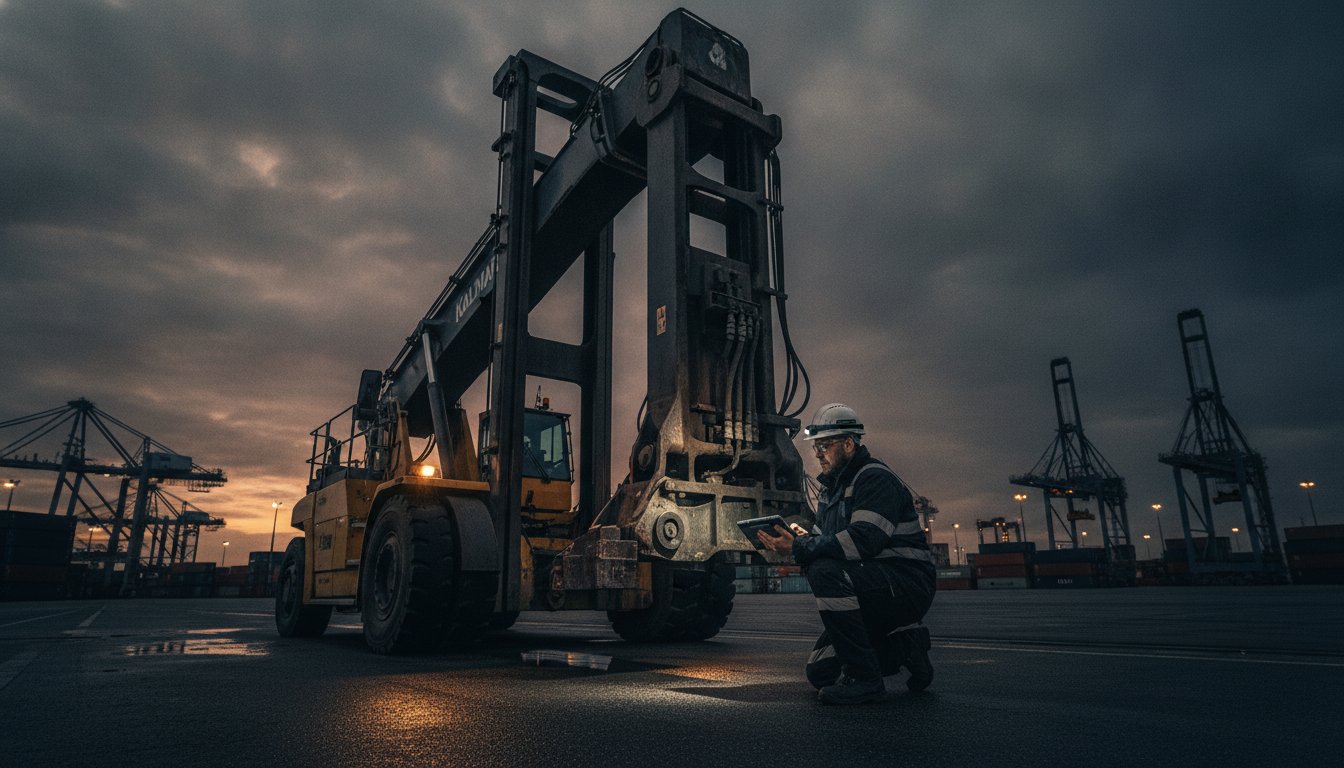
A reachstacker is the single most important asset in your terminal's workflow, yet most buyers treat the inspection like they're checking over a standard forklift. When you search for a Kalmar reachstacker for sale, you're looking for a decade of reliable uptime, but a machine with undocumented structural fatigue or a neglected hydraulic system can quickly become a liability. You understand that Kalmar represents the industry benchmark, but you also know that the gap between a "good deal" and a "money pit" is often invisible to the untrained eye.
We've designed this guide to help you bridge that gap by mastering the technical nuances of sourcing heavy lift equipment in 2026. You'll learn how to conduct a professional-grade inspection that goes far beyond the hour meter. We'll examine the critical differences between model generations like the older DRF and the newer DRG series, providing you with a transparent framework to secure a unit with a verified service history. This article provides the insider perspective needed to navigate European borders and finalize a procurement process that prioritizes operational reliability over marketplace guesswork.
Key Takeaways
- Understand why Kalmar units maintain high residual value and how their structural integrity supports long-term terminal efficiency.
- Learn to identify hidden risks like hydraulic pump pressure inconsistencies and structural stress fractures using our professional 10-point audit framework.
- Master the technical differences between the DRF and DRG Gloria series when evaluating a Kalmar reachstacker for sale to ensure you select the right generation for your workload.
- Discover the strategic advantages of sourcing inventory from specific European regions and the necessity of independent technical audits before any financial commitment.
- Gain an insider’s perspective on why independent advisory services offer more security and transparency than standard equipment marketplaces.
Why Kalmar Reachstackers Define Port Terminal Efficiency
In the high pressure environment of a container terminal, the equipment you choose dictates your throughput speed. A reachstacker is essentially a heavy lift vehicle designed to handle intermodal cargo containers with precision. To understand the technical foundations of these machines, it helps to ask: What is a Reachstacker? Unlike standard material handling equipment, these machines are engineered for the specific stresses of stacking containers several rows deep and several high. When searching for a Kalmar reachstacker for sale, you're not just buying a truck; you're investing in a system that has set the global standard for terminal logistics since the industry's inception.
The Role of Reachstackers in Modern Logistics
Traditional heavy forklifts are limited by their vertical masts, which restrict them to the first row of containers. Reachstackers use a telescopic boom that provides the reach needed to access the second and third rows, maximizing yard density. This versatility makes them the backbone of rail terminals and sea ports alike. Key operational advantages include:
- Row Access: The ability to stack and retrieve containers up to three rows deep.
- Stacking Height: High-capacity lifting that allows for stacking up to five or six containers high.
- Intermodal Flexibility: Efficiently handling both containers and swap bodies at rail hubs.
You need to consider the lifting capacity carefully. First-row capacity is always higher than second-row, and a Kalmar DRG450 provides the stability required to maintain safety while working at full extension. This balance of reach and power is why reachstackers have replaced traditional forklifts in most high-volume container operations.
While the reachstacker is the primary mover, overall terminal productivity also relies on the quality of the containers and trailers in circulation. For those seeking reliable storage and transport equipment outside the European market, you can visit Atlanta Container & Trailer to see industry-standard solutions.
Reliability and Resale: The Kalmar Advantage
Kalmar units consistently maintain higher residual value than regional competitors because their chassis are built to withstand decades of structural fatigue. The shift toward the DRG Gloria generation marked a significant leap in fuel efficiency and operator ergonomics, making these units highly sought after in the secondary market. Because Kalmar has such a dominant presence in Europe, finding spare parts and specialized technicians is straightforward, which reduces long term operational risk. Kalmar remains the undisputed market leader in the reachstacker category by delivering a combination of structural durability and advanced hydraulic control systems.
For growing terminals, sourcing a used Kalmar reachstacker for sale is often the most pragmatic strategy. It allows you to acquire Tier 1 technology without the long lead times or high capital expenditure of a brand new unit. By choosing a well maintained used machine, you gain access to the same Gloria-class efficiency that defines the world's most productive ports. Success depends on knowing exactly what to look for during the inspection process to ensure the machine’s previous life hasn't compromised its future performance.
The Critical 10-Point Technical Inspection Checklist
Identifying a Kalmar reachstacker for sale is the first step in a procurement process, but the technical audit determines your return on investment. A machine might look pristine under terminal lights, but its true condition is hidden in the hydraulic pressures and structural welds. You need a methodical approach to ensure that a second-hand unit can handle the rigors of 24/7 operations. Maintaining high levels of Port Terminal Efficiency requires equipment that performs exactly to its load chart specifications without unexpected downtime.
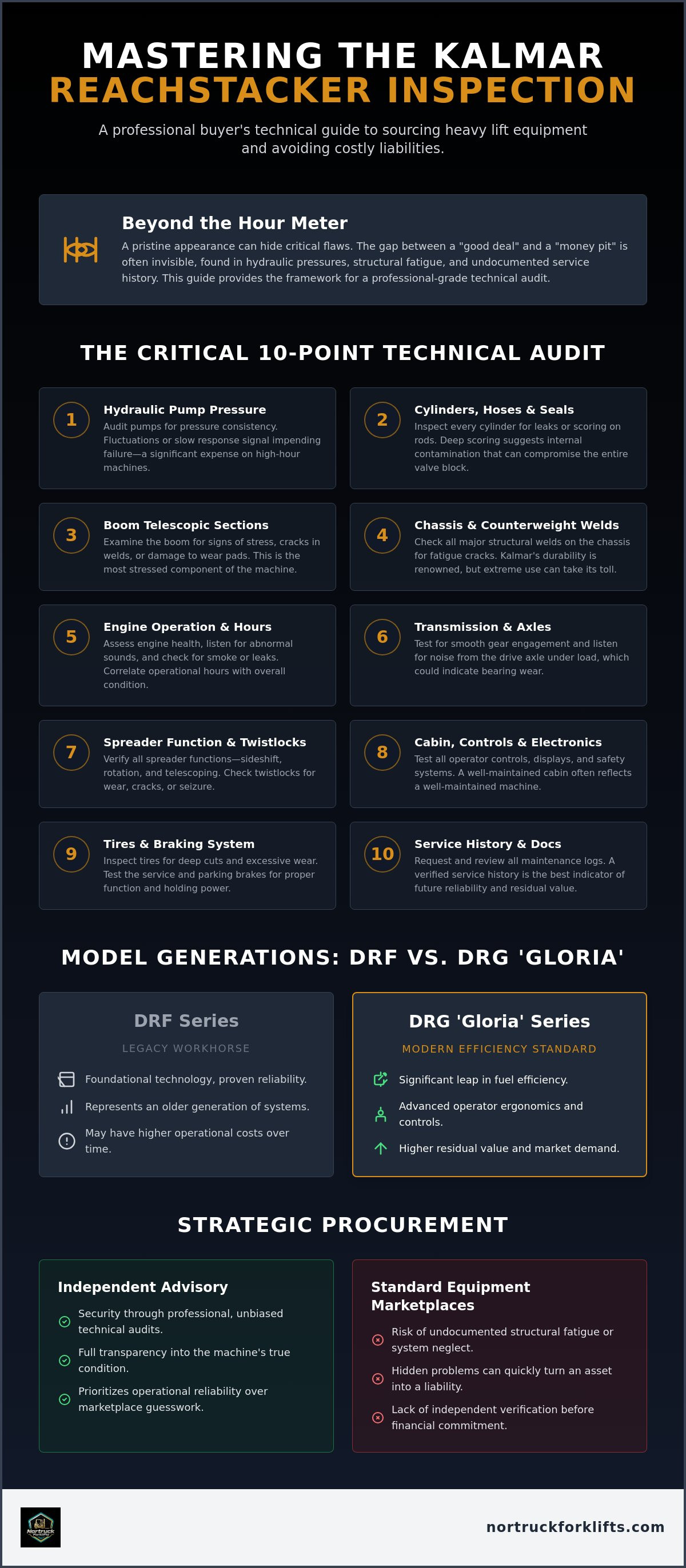
Our framework focuses on four primary areas: the hydraulic system, structural integrity, the drivetrain, and the spreader. Start by auditing the hydraulic pumps for pressure consistency. Fluctuations often signal an impending pump failure, which is a significant expense on high-hour machines. Simultaneously, inspect every cylinder for leaks or scoring on the rods. Small leaks are manageable; deep scoring suggests internal contamination that could compromise the entire valve block. If these technical details seem overwhelming, seeking an independent lifting logistics expert can provide the clarity needed before you commit to a wire transfer.
The Boom and Lifting Mechanism
The telescopic boom is the most stressed component of the machine. You must check for excessive play in the boom wear pads; if they are worn beyond tolerance, the boom will "chatter" during extension, leading to uneven structural loading. Look closely at the weld points for stress fractures, particularly around the boom foot and the head where the spreader attaches. Don't forget to verify the Load Moment Indicator (LMI) calibration. An uncalibrated LMI isn't just a maintenance issue; it's a critical safety risk that can lead to a tip-over during "second-row" lifts.
Engine and Transmission Health
Most Kalmar units utilize Scania or Volvo power units paired with Dana or ZF transmissions. Requesting oil sample reports is non-negotiable for a professional buyer. These reports reveal internal wear patterns that a simple test drive won't show. During the physical test, run the machine until it reaches full operating temperature to see if the transmission shifts remain crisp under load. Watch for signs of cooling system neglect, such as scale buildup in the radiator or discolored coolant, which are common in machines that have operated in harsh, salty coastal environments. A healthy drivetrain should move through the gears without hesitation or unusual vibration.
Finally, test the spreader functionality. Twistlocks must engage and disengage with absolute precision, and the side-shift should move smoothly without binding. Any delay in these functions will directly slow down your container throughput. By following this 10-point audit, you transform a risky purchase into a calculated strategic acquisition. If you are looking for expert support with heavy-duty hydraulic and equipment maintenance, learn more about Tim Halpin Equipment Corp.
Evaluating Performance: Model Generations and Operational Hours
Selecting the right Kalmar reachstacker for sale requires a clear understanding of how the machine's age and technology level impact your bottom line. While the core structural design of a Kalmar remains remarkably consistent, the internal systems have evolved significantly over the last two decades. This evolution affects everything from fuel consumption to the speed of troubleshooting. You're choosing between the proven mechanical simplicity of older generations and the high-efficiency, data-driven performance of modern units.
DRF vs. DRG: Which Generation Suits Your Budget?
The DRF series is often regarded as the reliable workhorse of the industry. It lacks the sophisticated digital interfaces of newer models, but many terminal managers prefer it for its straightforward maintenance and fewer electronic sensors. However, the move to the DRG series, commonly known as the Gloria generation, introduced superior cabin ergonomics and advanced CAN-bus diagnostics. These digital tools allow your technicians to pinpoint faults in minutes rather than hours. While the initial investment for a DRG is higher, the "Eco-Drive" modes and optimized maintenance intervals often result in a lower Total Cost of Ownership (TCO) over a five-year period. Since 2020, newer units have also been built to meet the EU Stage V emissions standard, which is a critical consideration for ports with strict environmental mandates.
The "Hours" Myth: Maintenance History vs. Clock Time
Don't let the hour meter be your only guide. A 15,000-hour unit that has spent its life in a clean, European rail terminal with a documented service history is a far better investment than a 10,000-hour machine from a harsh coastal environment with no records. It's essential to distinguish between "Port Hours," where the machine is under constant load, and "Idle Hours," which represent engine time without hydraulic stress. You can often find this data within the digital logs of DRG models. By the time a machine reaches the 20,000-hour mark, you should expect to see evidence of major component replacements. This includes hydraulic pumps, engine overhauls, and boom wear pads. If these haven't been addressed, you should factor those costs into your acquisition price. Modern Volvo engines in these units are also certified to use HVO fuel, which can reduce CO2 emissions by up to 90%, potentially extending the operational life of the machine in regulated zones.
Understanding these nuances allows you to look past the surface-level specs of a Kalmar reachstacker for sale. You're looking for a machine that matches your specific operational tempo. A high-hour unit with a meticulous service record can still provide years of reliable service if the price reflects the upcoming maintenance milestones.
How to Source Reachstackers from the European Market
Sourcing a Kalmar reachstacker for sale across European borders requires more than just a successful bid on an equipment portal. Europe is the global hub for these machines, but the quality of inventory varies significantly by region. Northern European hubs, particularly in Germany and the Benelux region, often produce the highest quality inventory. These machines typically come from high-throughput terminals that follow rigorous, manufacturer-recommended service schedules. While the units may face colder climates, their mechanical maintenance is usually documented with clinical precision.
In contrast, units sourced from Southern Europe may offer a lower initial purchase price. However, you must be more vigilant regarding corrosion from salty coastal air and potentially less consistent service records. Regardless of the location, never authorize a wire transfer based on digital photos alone. A 70-tonne machine has too many critical failure points that a camera cannot capture. An independent technical audit is your only real protection against buying a unit with structural fatigue or a failing hydraulic block. If you need a partner to manage this complexity, you can consult with our heavy lift sourcing experts to ensure a transparent procurement process.
The Independent Sourcing Advantage
Traditional equipment dealers often add significant markups to cover their holding costs and showroom overhead. By using an independent advisory approach, you gain direct access to the industrial inventory of major terminals before it reaches the retail market. This strategy allows you to see the machine in its "working clothes" rather than after a cosmetic respray. You're looking for an advisor who understands the fleet history of major ports and can verify if a specific machine was a reliable performer or a frequent source of downtime. Reputation in this industry is built on honesty; verify your source by asking for references from past intra-European transactions.
Logistics and Reassembly
Moving a reachstacker is a complex engineering project. These are not machines that you simply drive onto a standard trailer. The boom and chassis must be moved as separate loads due to weight and height restrictions, requiring specialized low-loader transport and permits for every country the convoy passes through. Professional reassembly on your site is mandatory. Improper pinning of the boom or incorrect hydraulic bleeding can cause catastrophic failure during your first lift cycle. The typical lead time for sourcing, inspecting, and delivering a Kalmar unit from the European mainland is approximately six to eight weeks.
Strategic Procurement: Why Independent Advisory Outperforms Marketplaces
Public marketplaces offer a wide selection, but they lack the technical accountability required for a six figure machinery investment. When you browse a Kalmar reachstacker for sale on a standard equipment portal, you're viewing a sanitized version of the machine's history. These platforms are built for volume, not for the granular technical verification that a port terminal requires. Choosing the right equipment is about more than the lowest price tag; it's about ensuring the machine's hydraulic capacity and structural life expectancy align with your specific terminal throughput goals.
The Nortruck Forklifts approach shifts the focus from a simple transaction to an independent advisory model. Lars G Tarby acts as your advocate, using 40+ years of industry experience to vet machines before they ever reach your site. We understand the internal nuances of the heavy lifting industry, allowing us to identify units with genuine service histories versus those that have been cosmetically refreshed for a quick sale. This transparent process ensures you aren't just buying a machine, but securing a reliable asset for your terminal's future.
The Value of 40 Years Experience
Deep industry connections often uncover high quality units that are never listed on public marketplaces. Many of the best maintained Kalmar reachstackers are traded privately between terminals or through trusted advisors. Our technical audits have frequently identified "hidden" issues, such as hairline fractures in the boom foot or internal pump bypass, that would have led to catastrophic failure under load. We prioritize a long term operational partnership over a one time sale. If a machine doesn't meet our standards for structural integrity, we'll advise you to walk away, regardless of how attractive the price might seem.
Your Next Steps in Reachstacker Procurement
Initiating a sourcing request is a straightforward process that starts with your operational requirements. To find the ideal Kalmar reachstacker for sale, we consider your stacking height needs, average container weight, and expected annual hours. This data allows us to filter the European secondary market for units that offer the best balance of price and remaining service life. We manage the technical audit, the price negotiation, and the logistics of international transport so you can focus on your terminal's daily operations. Ready to secure a reliable lifting solution? Consult with Lars G Tarby for your Kalmar sourcing needs and leverage 40 years of expertise for your next acquisition.
Securing Your Terminal's Next High-Performance Asset
Acquiring a reachstacker is a multi-layered technical decision that directly impacts your port's operational uptime. You've seen how a rigorous 10-point inspection and a clear understanding of model generations like the DRG Gloria can prevent costly surprises. Success in the secondary market isn't about finding the lowest price; it's about verifying structural integrity and ensuring the machine's hydraulic health matches your workload. By looking beyond the hour meter and focusing on documented service history, you're investing in long-term reliability.
When you're ready to look for a Kalmar reachstacker for sale, remember that an independent advisory approach offers a level of transparency that standard marketplaces can't provide. We leverage over 40 years of heavy lifting expertise and direct access to European machinery networks to find units that meet our strict standards. We prioritize your total cost of ownership and technical suitability to ensure your equipment performs from day one. Discuss your Kalmar sourcing strategy with Lars G Tarby to gain an expert advocate for your next acquisition. We look forward to helping you optimize your fleet with confidence.
Frequently Asked Questions
What is the lifting capacity of a standard Kalmar reachstacker?
A standard Kalmar reachstacker typically offers a lifting capacity of 42 to 45 tonnes in the first row. Industrial models designed for specialized cargo can reach capacities up to 130 tonnes. Most container handling units focus on the 30 to 45 ton range because it provides the best balance of speed and versatility for standard ISO containers in port terminals.
How long does a Kalmar reachstacker typically last in a port environment?
A well-maintained unit can operate for 20,000 to 30,000 hours before it requires a major mid-life overhaul of the engine or hydraulic system. In a high-pressure port environment, this lifespan depends heavily on the consistency of preventive maintenance and the quality of the operator's handling. Machines used in cleaner rail terminals often outlast those exposed to corrosive coastal air.
What is the difference between a Kalmar DRF and DRG model?
The DRF series is the older mechanical workhorse known for its simpler electronics, while the DRG Gloria series represents the modern generation with advanced CAN-bus diagnostics and improved fuel efficiency. DRG models feature a more ergonomic cabin design and "Eco-Drive" modes that can significantly reduce fuel consumption. Choosing the right Kalmar reachstacker for sale often comes down to balancing this technology against your team's electronic diagnostic capabilities.
Should I buy a new or used reachstacker for a mid-sized terminal?
Used reachstackers are often the preferred choice for mid-sized terminals because they allow for immediate fleet expansion without the long lead times associated with new factory orders. Buying used reduces initial capital expenditure while still providing a machine with high residual value. If you find a Kalmar reachstacker for sale with a documented service history, it can offer nearly identical uptime to a new truck at a lower price point.
How much does it cost to transport a reachstacker across Europe?
Transporting a 70-tonne machine involves dismantling the boom and chassis into separate loads, which requires specialized low-loader trailers and international permits. The total expense depends on the distance from the origin hub and the specific route requirements for heavy-haul convoys. You should also factor in the cost of professional reassembly and commissioning on your site to ensure the machine is operationally safe before its first lift.
What are the most common points of failure on a used Kalmar reachstacker?
The most common failure points include excessive play in the boom wear pads, hydraulic pump pressure drops, and stress fractures in the spreader twistlocks. You should also inspect the main lift cylinders for scoring on the rods, which can lead to internal seal failure and hydraulic bypass. Identifying these issues early through a technical audit prevents minor wear from becoming a catastrophic operational failure.
Can I source a Kalmar reachstacker with a specific engine like Scania or Volvo?
Yes, you can source units with either Scania or Volvo power units to match your existing fleet's engine commonality. Most modern Gloria models utilize Volvo TAD series engines, which are certified for HVO fuel use. Choosing an engine that your local technicians are already familiar with simplifies long-term maintenance and ensures you have a reliable local supply of spare parts.
How do I verify the service history of a used reachstacker?
Verifying the history requires a combination of digital log analysis and physical documentation audits. For newer DRG models, you can extract operational data directly from the onboard computer to check for "idle hours" versus "work hours." We also recommend requesting oil sample reports for the engine and transmission to identify internal wear patterns that aren't visible during a standard physical walk-around.

Article by
Lars Gunnar Tärby
Disclaimer
1. General Information and No AdviceThe information, articles, product descriptions, and specifications provided on this website (www.nortruckforklifts.com) are for general informational and educational purposes only. While we strive to provide accurate and up-to-date content regarding new and used forklifts and heavy machinery, the material published does not constitute professional, technical, or legal advice.
2. Product Specifications and PricingNortruck Forklifts acts as a facilitator for the trade of new and used forklifts. All equipment details, including but not limited to year of manufacture, operating hours, lift capacity, dimensions, conditions, and pricing, are provided based on the information available to us at the time of publication. Specifications and availability are subject to change without prior notice.
3. "As Is" and VerificationAll articles and product listings are provided on an "as is" and "as available" basis without any warranties of any kind, either express or implied. Nortruck Forklifts does not guarantee that the descriptions are entirely error-free, complete, or reliable. Buyers and traders are strongly encouraged to independently verify all technical specifications, machine history, and equipment conditions directly with the seller or an authorized inspector before finalizing any purchase or transaction.
4. Limitation of LiabilityIn no event shall Nortruck Forklifts, its owners, or its contributors be held liable for any direct, indirect, incidental, consequential, or economic loss or damage arising out of the use of, or the inability to use, the information provided on this website, or any transactions facilitated through this platform. This includes, but is not limited to, damages caused by technical inaccuracies, typographical errors, or reliance on the content of our articles.
5. Third-Party LinksOur website may contain links to external websites, dealer networks, or third-party services that are not owned or controlled by Nortruck Forklifts. We have no control over, and assume no responsibility for, the content, privacy policies, or practices of any third-party websites.


