
What if the forklift with the highest capacity on paper is still the wrong choice for your coils? A heavy forklift with coil ram attachment must suit both the load and the work. Coil dimensions, attachment fit and operating conditions all affect whether a truck-and-ram combination is appropriate for your operation.
Start with capacity, but don’t stop there. An attachment changes the truck’s working configuration, so compatibility and the demands of the duty cycle belong in the decision from the outset. A sound comparison considers the truck, attachment, coil range and route together.
This 2026 buying guide explains how to describe coil size and handling conditions, compare equipment configurations, and evaluate new and used machinery across manufacturers. Use the steps to turn your operating requirements into a practical sourcing brief.
Nortruck Forklifts provides sales and advisory services for forklifts and heavy lifting equipment, sourcing new and used machinery across Europe. With more than 40 years of lifting-equipment experience, Lars G Tarby can help translate your requirements into clear criteria for comparing equipment.
Key Takeaways
- Define the requirement using your actual coil range and handling positions, not truck capacity alone.
- Assess a heavy forklift with coil ram attachment as a complete configuration, using manufacturer documentation to establish fit and capacity.
- Compare each option against the same operating pattern and site conditions, recording verified specifications rather than estimates.
- Include load range, routes, work frequency and sourcing preference in your buying brief.
- Experienced sourcing advice can help turn that brief into a comparison of new and used equipment options across Europe.
When a heavy forklift with coil ram attachment fits the job
A coil ram is an attachment intended to engage and move coiled material as part of a specified truck-and-attachment configuration. Designs and terminology vary by manufacturer, so use the equipment maker’s description when defining the required setup. Some general forklift references describe pole attachments for metal coils. The Forklift with attachments overview provides background, but it does not replace model-specific information.
Assess the equipment in three parts. The truck provides the lifting platform; the attachment is fitted to handle the load; and the operating configuration is the truck and attachment considered together for the task. Naming a truck and attachment separately does not establish that they are compatible or suitable as a combination. That depends on the equipment documentation and the job requirements.
What does a coil ram attachment do?
A coil ram is designed to engage and handle coils using the contact method specified for that attachment. Depending on the design, engagement may involve a coil’s central opening or another manufacturer-defined interface. Don’t assume every model works the same way. Check the attachment documentation for its intended contact method, then compare that information with the coil’s construction and handling needs.
The term “coil ram” describes a handling purpose, but it may not fully specify the equipment. For a useful sourcing brief, record the manufacturer’s exact attachment name, its intended application and the truck configuration it is designed to work with. This gives you a more reliable basis for comparing options than a broad label alone.
Which operations should assess this configuration?
Consider a dedicated coil-handling configuration when coils are a recurring load or their form makes the existing handling method unsuitable for the task. Start with the material, then map how it moves through the site. A steel operation, paper facility or other coil-handling workplace should not assume a configuration will fit based on industry alone. Coil dimensions, travel paths, storage arrangements and loading points determine the practical requirement.
Build an operating brief that captures:
- Coil type, outside dimensions, opening dimensions where relevant, and weight range.
- How often coils are moved, and whether loads vary between shifts or work areas.
- Travel routes, including turning space, floor conditions and constrained access.
- Storage layout, stacking or placement needs, and the points where coils are loaded or unloaded.
These details show whether a dedicated configuration may suit the task and provide useful inputs for evaluating equipment. If coils move between a production line, storage area and vehicle, document each handling stage rather than describing only the lift. A clear operating picture helps keep the decision tied to the work instead of assuming that one truck or attachment suits every coil-handling job.
How truck and coil ram compatibility affects handling
Evaluate a truck and coil ram as one working configuration, not as two pieces of equipment selected independently. Attachment fit, position and effect on the load can change how the forklift handles. A truck’s headline capacity alone cannot establish whether it will manage a particular coil in the intended configuration.
Attachment fit can affect the machine’s rated capacity. Use the manufacturer’s capacity information for the specific truck-and-attachment combination, not the truck’s general class or rating without the attachment. The load’s weight and dimensions, its centre of gravity, and the position in which it is carried all help define the configuration to assess.
Which coil and load details belong in the brief?
Record the full range of coil weights and dimensions, including width and diameter, and note the orientation in which each coil is picked and carried. Describe the entire handling sequence: how the truck approaches and engages the coil, the route it travels, where the load is set down, and how it is stored. Include less common load variations, since an unusual profile may need closer review against manufacturer documentation.
Be precise about handling positions. A coil picked up at one point and carried in another orientation may create different clearance and visibility requirements. If loads vary, document the heaviest and largest examples as well as routine ones. This gives the equipment review a practical operating brief instead of a single figure detached from the work.
What compatibility data should buyers compare?
Compare the attachment’s approved fitment with the truck’s carriage and configuration data, then review capacity information for that exact combination. Manufacturer documentation is the reference for fit and rated performance. OSHA’s powered industrial truck guidance provides broader context on safe operation and hazard reduction, but does not replace equipment-specific documentation.
Check the working setup against the site as well. A configuration that fits the truck must also suit aisle widths, turning areas, doorways, storage positions and the operator’s view of the coil and route. Map tight points and loading or unloading locations. Then assess whether the attachment and carried load allow the required movement and visibility. This distinguishes a technically compatible match from one that suits the actual task.
- Truck: record the model and relevant carriage or configuration details.
- Attachment: capture its manufacturer, model and documented fitment.
- Combined rating: use capacity data for the specified truck-and-attachment setup.
- Worksite: compare clearances, visibility and operating needs with the route and storage layout.
For a heavy forklift with coil ram attachment, this evidence-based comparison keeps the equipment decision tied to the load and working environment. Nortruck Forklifts’ advisory services help translate lifting requirements into sourcing criteria. Read more about Nortruck Forklifts.
Compare coil ram configurations and heavy forklift options
Begin a comparison with the operating brief, not a shortlist of truck names. Assess each candidate against the coil range and work pattern, then record what the manufacturer documents for that specific truck and attachment combination. A heavy forklift’s general class or an attachment’s standalone rating does not replace verified combined configuration data.
Which comparison criteria matter most?
Use the same template for every option. Include information supported by relevant manufacturer documentation or candidate records. If a specification is missing, leave it blank until reliable documentation is available rather than filling the gap with an estimate.
| Comparison item | What to record | How to assess it |
|---|---|---|
| Truck and attachment | Manufacturer, model and documented fitment | Compare the specified combination, not separate product descriptions. |
| Rated capacity | Manufacturer-rated data for the configuration | Relate it to the documented coil loads and handling position. |
| Coil range | Coil dimensions and load range the candidate is intended to handle | Look for a match across routine and less common loads. |
| Visibility and clearances | Documented operating details and site measurements | Compare with routes, turns, storage positions and loading points. |
| Operating pattern | Candidate information relevant to the planned work sequence | Assess how well it fits the frequency and stages of handling. |
The right trade-off depends on the operation. A compact site may make clearances and the handling sequence especially important, while a varied coil range puts greater emphasis on documented capacity and fitment. MHI offers broader context on material handling; use manufacturer records for configuration-specific specifications. For high-capacity procurement considerations, see Nortruck’s Kalmar heavy lift truck sourcing guide.
How should new and used options be weighed?
New and used equipment are sourcing routes to compare, not automatic indicators of suitability. Review the documented configuration, condition and performance information available for each candidate, then assess it against the same coil and site requirements. Keep two questions separate: whether the machine’s condition suits the purchase, and whether the truck-and-attachment combination is documented for the intended work.
For a used candidate, record condition findings separately from attachment fitment and capacity information. Available machine history and inspection evidence can inform the condition review. A well-maintained truck still needs a suitable, documented configuration; a matching configuration alone does not establish the condition of a used machine. Operations managing hydraulic integrity and auxiliary line wear during used evaluations often rely on specialists like Ms. Hydraulics LLC for heavy equipment inspection and mobile repair support.
Apply this method to every heavy forklift with coil ram attachment under consideration, including Kalmar Heavy Lift Trucks where relevant. Nortruck Forklifts sources new and used heavy equipment across Europe and provides advisory services to help turn requirements into a structured comparison.
Build a buying specification for a heavy forklift with coil ram
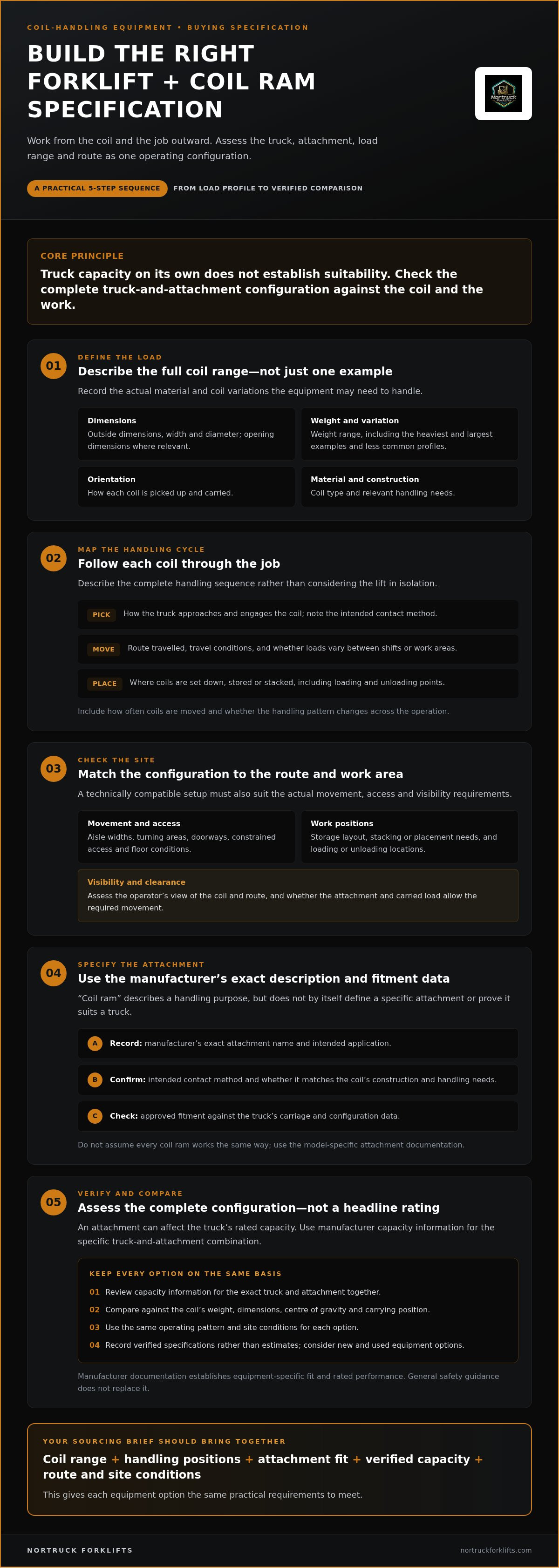
A clear specification turns an operating need into a practical basis for comparing equipment. Separate essential requirements from preferences before reviewing candidates. Essential requirements define what the truck-and-attachment configuration must do; preferences help distinguish otherwise suitable options. Ground both in the work rather than assumptions about a truck class or attachment type.
What should the equipment brief include?
Describe the full coil range, including dimensions, weight variation and how often loads move. Map each handling stage, from pick-up through travel to set-down and storage. Note travel distances, floor conditions, aisle limits, loading points and storage arrangements. Record operator needs, shift pattern and expected utilization too, based on how the machine will actually be used rather than an assumed duty cycle.
How can buyers assess a candidate machine?
Compare the proposed truck and attachment against the written brief as a combined configuration. For used equipment, review available machine history and inspection evidence separately from the attachment’s documented fitment. Record missing or unresolved specifications as questions for the project evaluation. An incomplete record is not proof that a candidate meets the requirement.
Work through the specification in order:
- Describe the task. Record coil types, minimum and maximum dimensions, weight range, handling frequency and the movement sequence from collection to final placement.
- Map the site. Note route distances, floor conditions, aisle and turning constraints, storage layout, and the exact loading and unloading points. Include any site feature that could affect access or visibility.
- Define the operating pattern. State who will operate the truck, the shift arrangements and expected utilization. Describe peaks or variation in demand where known. Use operating information rather than a generic duty-cycle assumption.
- Separate must-haves from preferences. List non-negotiable load and site requirements first, such as handling the documented coil range within the available space. Then record preferences, including a preferred sourcing route or other operational priorities. This keeps attractive extras from obscuring a mismatch with the essential task.
- Verify each candidate. Match its truck, attachment, fitment and combined capacity information to the brief using applicable manufacturer data. For used machinery, review available history and inspection evidence separately as part of the condition assessment. Keep unresolved questions visible during the project evaluation.
Final capacity and fitment decisions depend on manufacturer data for the specific configuration, not a general truck rating or an assumption based on appearance. Specify a heavy forklift with coil ram attachment as a complete working setup, documenting the load, site and operating pattern alongside the equipment information.
Source a coil-handling heavy forklift with experienced guidance
A well-prepared operating brief gives sourcing discussions a clear starting point. Nortruck Forklifts’ advisory services help translate an application into equipment requirements and compare potential machinery against the work the truck must do. With more than 40 years of lifting-equipment experience, Nortruck sources new and used heavy equipment across Europe and advises on specific lifting needs.
What information helps start a sourcing discussion?
Bring the details that define the job, not just a preferred truck capacity or model. A concise brief describes the coil range and the conditions in which it will be handled. Include details that could affect fit, movement or equipment choice, and identify project constraints early.
Useful information includes:
- Coils: type, dimensions, weight range and variations between routine and less common loads.
- Handling: how frequently coils move, how they are picked up and set down, and the travel distances involved.
- Worksite: floor conditions, access routes, aisle constraints, storage arrangement, and loading or unloading points.
- Equipment needs: essential truck and attachment requirements, operator and shift arrangements, and preferred sourcing route, such as new or used machinery.
- Project constraints: timing requirements, site restrictions or other considerations that may shape the search.
Mark requirements as mandatory or preferred. This focuses the evaluation while leaving room to consider alternatives. Assess capacity, attachment fitment and configuration-specific operating information against applicable manufacturer documentation, rather than assuming suitability from a general truck description.
How does specialist advice support the decision?
Equipment requirements vary across manufacturers, and a familiar model name alone does not show whether a particular configuration fits an application. Specialist advice helps organize the brief into comparison points: the loads, working environment, operating pattern and evidence needed to assess each candidate. It also keeps machine condition and configuration suitability as separate parts of the evaluation.
Nortruck’s heavy equipment advisory and sourcing services are shaped around the buyer’s stated lifting requirements. Its experience sourcing new and used machinery across Europe helps bring relevant options into view without treating one sourcing route as right for every project. Share the documented application and open specification questions to refine the sourcing requirement and consider suitable next steps.
If you’re planning a heavy forklift with coil ram attachment, a clear brief makes the sourcing discussion more focused. Read about Nortruck Forklifts’ heavy-lifting equipment services.
Turn your equipment brief into a clear next step
Before moving from research to a sourcing decision, make sure everyone involved shares the same definition of a successful setup. Operations can clarify how the equipment will work day to day, while procurement can use agreed requirements to structure candidate discussions. That alignment keeps the decision focused on the application rather than a single specification viewed in isolation.
For a heavy forklift with coil ram attachment, keep a short record of the most important requirements and the questions still to resolve. Use it as a working document when assessing options, so new information can be compared against the same priorities. This leaves room to evaluate suitable alternatives without losing sight of what the operation needs.
A well-defined next step makes a complex equipment decision more manageable. With a clear brief in hand, you can focus the discussion on a setup that supports the work.
Frequently Asked Questions
What is a coil ram attachment?
A coil ram is an attachment used for a particular coil-handling application. Its design and fitment can differ between models, so use the manufacturer’s exact description when identifying equipment. The name alone does not establish how an attachment contacts a coil or whether it suits a specific truck. Consider it alongside the truck, coil characteristics and task, and include the relevant product documentation in the equipment specification.
Can one coil ram handle coils of different sizes?
That depends on the attachment design and its approved operating specifications. If your operation handles coils with different widths or weights, record the full range rather than basing the purchase on the most common coil alone. Compare that range with manufacturer information for the proposed configuration. Don’t assume an attachment can be adjusted for different sizes, or that an adjustment is permitted, unless its documentation supports it.
How do I know whether a truck is compatible with a coil ram?
Assess compatibility using the truck’s configuration information and the attachment manufacturer’s fitment data. Compare the specified mounting arrangement and capacity information for the combined setup, then relate them to the intended loads. A truck’s headline capacity does not establish that a heavy forklift with coil ram attachment is suitable. Keep the truck and attachment records together during procurement so the configuration can be reviewed against the same load requirements.
Does a coil ram affect a forklift’s rated capacity?
Fitting an attachment can affect a forklift’s rated capacity and operating characteristics. Applicable capacity depends on the specific truck, attachment and configuration, so it should not be estimated from a general truck specification. Use the manufacturer’s information for the proposed combination and assess it against the actual loads and handling position. If the operating brief includes different coil profiles, account for those variations during the equipment evaluation.
What should I check when buying a used heavy forklift with a coil ram?
Review the machine’s identity and configuration, available operating and maintenance records, and the attachment documentation. Treat condition and suitability as separate questions: inspection evidence can inform the machine’s condition, while fitment and capacity documentation address the intended coil-handling setup. A truck that appears serviceable still needs a compatibility review. Assess the proposed truck-and-attachment combination alongside the used machine’s condition.
What information should I provide when sourcing a coil-handling forklift?
Provide coil weights and dimensions, handling frequency, travel distances, site layout, floor conditions, and loading and storage arrangements. Include operator or shift considerations that may affect use, along with project constraints. State whether you prefer new or used equipment, and separate essential requirements from preferences. This gives the sourcing discussion a clear brief for evaluating a proposed configuration against manufacturer documentation.
To discuss your lifting requirements and equipment sourcing options, contact Nortruck Forklifts.

Article by
Lars Gunnar Tärby
Disclaimer
1. General Information and No AdviceThe information, articles, product descriptions, and specifications provided on this website (www.nortruckforklifts.com) are for general informational and educational purposes only. While we strive to provide accurate and up-to-date content regarding new and used forklifts and heavy machinery, the material published does not constitute professional, technical, or legal advice.
2. Product Specifications and PricingNortruck Forklifts acts as a facilitator for the trade of new and used forklifts. All equipment details, including but not limited to year of manufacture, operating hours, lift capacity, dimensions, conditions, and pricing, are provided based on the information available to us at the time of publication. Specifications and availability are subject to change without prior notice.
3. "As Is" and VerificationAll articles and product listings are provided on an "as is" and "as available" basis without any warranties of any kind, either express or implied. Nortruck Forklifts does not guarantee that the descriptions are entirely error-free, complete, or reliable. Buyers and traders are strongly encouraged to independently verify all technical specifications, machine history, and equipment conditions directly with the seller or an authorized inspector before finalizing any purchase or transaction.
4. Limitation of LiabilityIn no event shall Nortruck Forklifts, its owners, or its contributors be held liable for any direct, indirect, incidental, consequential, or economic loss or damage arising out of the use of, or the inability to use, the information provided on this website, or any transactions facilitated through this platform. This includes, but is not limited to, damages caused by technical inaccuracies, typographical errors, or reliance on the content of our articles.
5. Third-Party LinksOur website may contain links to external websites, dealer networks, or third-party services that are not owned or controlled by Nortruck Forklifts. We have no control over, and assume no responsibility for, the content, privacy policies, or practices of any third-party websites.


