
The right forklift is not necessarily the easiest one to find. Choose a truck type or capacity without accounting for loads, space, surfaces and work patterns, and it may not suit the operation. An independent forklift advisor can help turn those everyday demands into a clear equipment brief, then compare options across manufacturers against the same requirements.
Useful advice connects practical experience to a transparent comparison: what the work requires, which equipment categories could fit and how the sourcing process supports a purchase. In this article, you’ll learn what an independent forklift advisor does, how to assess the value of that advice and what to consider when comparing new and used equipment. Nortruck Forklifts provides advisory and sourcing support across major manufacturers. Lars G Tarby brings more than 40 years of lifting-equipment experience to discussions about matching equipment to an application.
Key Takeaways
- An independent forklift advisor can turn operating demands into a practical equipment brief before you narrow the shortlist.
- Compare trucks against the same requirements, including the task, site constraints and whether new or used equipment fits your needs.
- When considering used machinery, include its condition in the sourcing brief alongside operational requirements.
- Separate essential requirements from preferences to keep equipment discussions focused.
- Nortruck’s cross-manufacturer sourcing and Lars G Tarby’s more than 40 years of experience can help move your decision from requirements to equipment options.
What Does an Independent Forklift Advisor Do for Buyers?
An independent forklift advisor helps buyers define the job a truck must do, identify equipment categories that could suit it and prepare a sourcing brief. The advice focuses on equipment selection and purchasing. It is distinct from forklift operation, maintenance or rental, and from browsing one manufacturer’s product listings. Its value is in connecting the work to suitable options before the buyer narrows the choice by brand.
Capacity alone does not determine whether a forklift fits. The truck needs to handle the load’s weight and dimensions at the required lift height, while working within the site’s clearances, ground conditions and operating pattern. Handling frequency and duty cycle help describe how intensively the equipment will be used. Aisle width and travel distance affect how it needs to move. Together, these details create a shortlist based on the actual job rather than a headline capacity figure.
Forklifts come in different designs for different applications, as the general overview of Forklift types and uses illustrates. An advisor makes that broad range relevant to a specific operation by focusing the discussion on the buyer’s requirements. Advice does not replace checking site conditions, but it gives buyers a structured basis for deciding what equipment to investigate and source.
Set the criteria from the application first. Consider brand preferences after the equipment requirements are clear.
When Is Independent Forklift Advice Useful?
Advice is particularly useful when a purchase involves specialised loads, demanding working conditions or more than one equipment category. A long or awkward load, for example, may require a different handling approach from standard pallet work. Limited space or changing ground conditions can make a like-for-like comparison even more important.
A cross-brand perspective can organise the comparison around operational fit instead of one manufacturer’s range. The buyer still needs to assess routes, clearances, surfaces and work practices at the site. A precise brief helps focus that assessment on the factors that affect the equipment choice.
What Should an Advisor Help You Clarify?
Start with the work itself, then record the site conditions that affect equipment selection. Useful details include:
- Load weight and dimensions, including unusual shapes or handling requirements.
- Handling frequency, required lift height and typical travel distance.
- Aisle width, ground conditions, and whether work takes place indoors, outdoors or in both settings.
- Operator requirements that affect how the truck will be used in daily work.
These details form an initial equipment brief. Separate fixed requirements from preferences so the shortlist stays practical without committing to a brand too early.
How an Independent Forklift Advisor Connects Requirements to Equipment
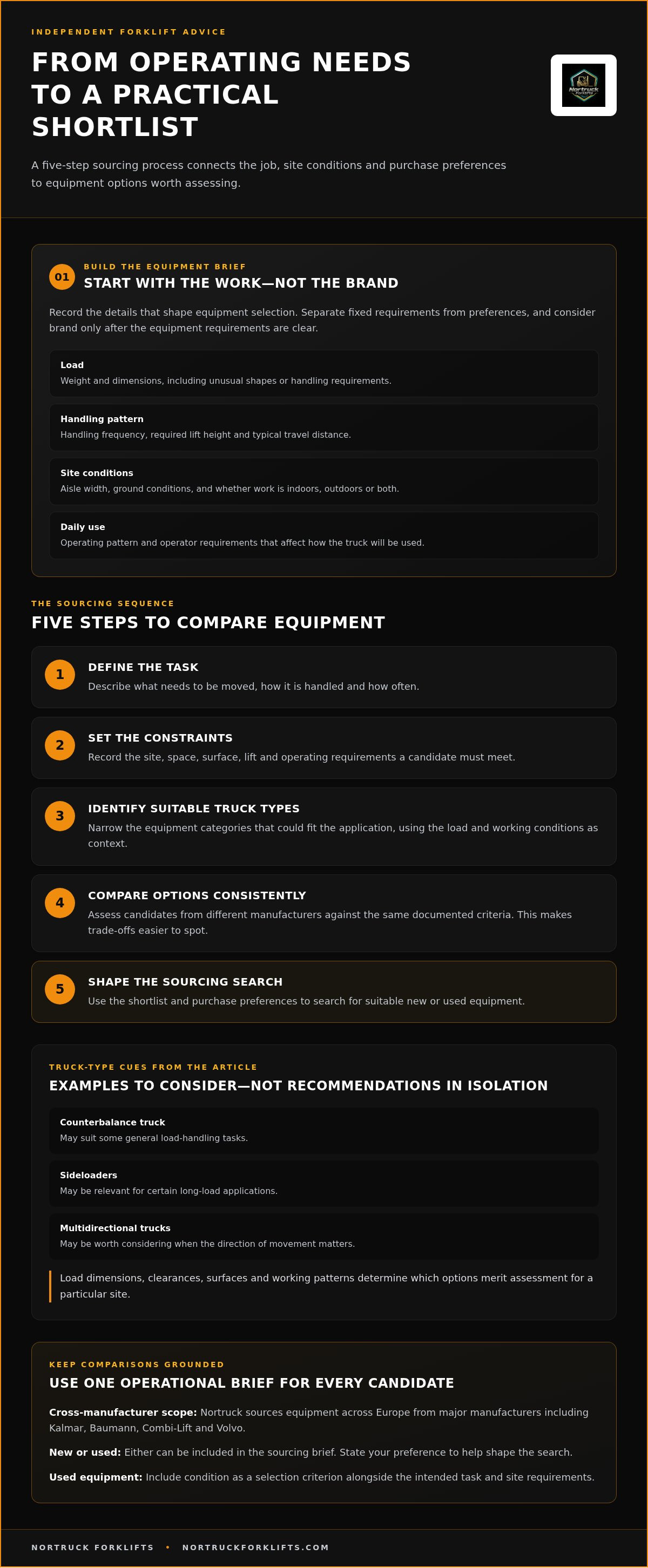
Once the operating brief is clear, turn it into a structured sourcing process. An independent forklift advisor can help move from the handling task to a focused set of equipment options, then compare candidates using consistent criteria. This keeps the decision tied to the work instead of letting a familiar brand or a convenient listing define the shortlist.
- Define the task: Describe what needs to be moved, how it is handled and how often.
- Set the constraints: Record site, space, surface, lift and operating requirements that a candidate must meet.
- Identify suitable truck types: Narrow down the equipment categories that could fit the application.
- Compare options: Assess candidates from different manufacturers against the same documented criteria.
- Source: Use the shortlist and purchase preferences to shape the search for suitable new or used equipment.
A useful shortlist links each candidate to the buyer’s documented requirements. This makes trade-offs easier to identify. One truck may meet the handling need but not fit a site constraint; another may warrant further evaluation. The OSHA Forklift Classifications resource provides background on truck classifications and fundamentals, which can help frame a discussion about the categories to compare.
From Handling Task to a Practical Shortlist
Load characteristics, work environment and handling frequency help identify which truck types to consider. A counterbalance truck may suit some general load-handling tasks. Sideloaders may be relevant for certain long-load applications, while multidirectional trucks may be worth considering when the direction of movement matters. These are starting points, not recommendations in isolation. Load dimensions, clearances, surfaces and working patterns determine which options merit assessment for a particular site.
How Cross-Manufacturer Sourcing Supports Comparison
Comparisons are more useful when every candidate is assessed against the same operational brief, rather than against different catalogue descriptions. Nortruck sources equipment across Europe from major manufacturers including Kalmar, Baumann, Combi-Lift and Volvo. This cross-manufacturer scope gives buyers options to consider across relevant categories while keeping the application at the centre of the decision.
New and used equipment can both be included in the sourcing brief. For used machinery, describe the intended task and site requirements, and include condition as a selection criterion. Your preference for new or used equipment also helps shape the search. These details make it easier to compare candidates against the same needs.
With the requirements and comparison criteria set out, you can discuss your forklift requirements with Nortruck Forklifts and move from an equipment brief to a focused sourcing discussion.
Independent Forklift Advisor vs Manufacturer-Led Advice: What Changes?
Manufacturer-led advice and cross-brand guidance serve different purposes. A manufacturer’s catalogue describes its own equipment range, and product guidance can help buyers understand options within that range. An independent forklift advisor brings a broader comparison by assessing the application across equipment and manufacturers, instead of starting and ending with one catalogue. Each perspective can be useful at a different stage of a purchase.
| Perspective | Equipment scope | Comparison basis | Likely buyer use case |
|---|---|---|---|
| Manufacturer catalogue | One manufacturer’s listed equipment | Product categories, descriptions, and stated applications | Learning what that manufacturer offers or exploring a known range |
| Manufacturer or seller product guidance | Equipment the seller represents | Product details and suitability within that scope | Understanding a specific candidate or getting detail about a product |
| Cross-brand advisory support | Potential options across manufacturers and truck types | Buyer requirements applied consistently to each candidate | Building a shortlist when several approaches may suit the operation |
What Does “Independent” Mean in Equipment Advice?
Here, “independent” means evaluating the buyer’s requirements beyond a single manufacturer’s catalogue. It does not mean equipment sourcing has no commercial connection. Nortruck combines advisory support with sourcing new and used lifting equipment. Clear advice should show how the assessment of needs leads to equipment options and a purchasing decision. Buyers can then understand the basis of a shortlist and how the advice connects to sourcing.
When Is Cross-Brand Guidance Most Valuable?
Cross-brand guidance is useful when the task could suit more than one truck type or when buyers want to compare candidates from different manufacturers against shared requirements. A consistent framework shows where options align and where trade-offs remain. Manufacturer conversations can add product-specific detail; cross-brand advice puts that detail in the context of the wider shortlist.
For example, a buyer handling the same load in a constrained work area may need to compare more than one equipment category. The useful question is not simply which machine has the most attractive specification. It is how each option fits the handling task, working conditions and purchase requirements. Applying the same criteria reduces the risk of comparing one candidate by capacity and another by a less relevant feature.
Industry context can also help buyers understand the wider equipment sector. The Industrial Truck Association represents manufacturers and suppliers and offers a reference point for industry information and initiatives. That perspective complements a project-specific comparison based on the buyer’s requirements.
When reviewing a recommendation, look at how the advice connects to sourcing and equipment sales. Nortruck’s advisory and sourcing work brings those steps together, supporting buyers as they assess equipment options across manufacturers. A clear shortlist makes it easier to weigh operational fit and commercial options and understand how the recommendation relates to a purchase decision.
How to Prepare for a Forklift Advisory Conversation
A focused conversation starts with a clear picture of the work, not a preferred make or model. Before speaking with an independent forklift advisor, gather the facts you know and note anything that still needs measuring or technical review. This separates firm operating requirements from assumptions and gives the equipment discussion a practical starting point.
Build a Clear Operational Brief
Describe a typical working day as well as the most demanding task the truck may need to handle. Note the load, route, work area and what you want the equipment to help improve. If handling is slowing a process or making a manoeuvre difficult, explain where the bottleneck occurs instead of choosing a truck type in advance.
- Loads: Record typical and maximum weights, dimensions, shape and any attachment needs.
- Lifting: Note required lift heights and where loads are picked up or placed.
- Work pattern: Describe handling frequency, shifts and travel distances.
- Site conditions: Include operating surfaces, aisle or doorway constraints, and indoor or outdoor use.
- Desired outcome: State the current handling challenge and what a suitable equipment choice should support.
Keep observations distinct from measurements. Label an aisle width, load weight or lift height as an estimate if it has not been measured. This makes it easier to identify assumptions that need checking before they become selection criteria.
Set Comparison Priorities Before Reviewing Options
Divide the brief into essential requirements and preferences. Essentials are conditions a candidate must meet to do the job. Preferences help distinguish between options that already fit. For a high-capacity application, for example, record the actual load and handling conditions before focusing on a particular truck category or brand.
Rank priorities such as capacity, configuration, condition and application fit by their importance to the operation. A preferred manufacturer should not take precedence over a non-negotiable site constraint. If you are considering used equipment, state your condition preferences and what information you need to assess a candidate.
Include sourcing context in the brief. Note whether you are considering new equipment, used equipment or both, the geographic scope for sourcing and your intended purchasing timeframe. These details help shape the search. If high-capacity handling is central to the task, say so clearly so heavy lift equipment can be assessed against the same criteria as other options.
A practical brief can fit on one page: key facts, ranked essentials, preferences, open questions and the outcome you need. It gives an advisor a clear basis for structuring the comparison and keeps site measurements and technical decisions visible for review.
How Nortruck’s Independent Forklift Advice Supports Your Next Step
Once you have outlined the application and priorities, connect that brief to equipment options worth considering. Nortruck provides advisory and sourcing support for new and used lifting equipment, helping buyers bring operational requirements into a purchasing discussion. The process starts with the need, then considers suitable options against it.
Experience Across Heavy Lifting Equipment
Lars G Tarby brings more than 40 years of lifting-equipment experience. That background informs discussions about varied handling requirements and the equipment categories buyers may need to compare. Nortruck sources equipment across Europe from major manufacturers including Kalmar, Linde, Toyota, Baumann, Combi-Lift and Volvo. This range supports cross-manufacturer comparisons; the application determines which options are relevant.
For buyers, experience combined with cross-manufacturer sourcing can connect an equipment brief to a wider set of options. A shortlist can be discussed in relation to the work, site constraints and purchase preferences already identified. This keeps brand recognition from becoming the selection criteria and brings advice and sourcing together as part of the purchasing process.
Start with the Requirement, Then Discuss Sourcing
Start with the details that shape equipment suitability: load characteristics, required capacity and lift, operating environment, and any space or surface constraints. If you are considering used equipment, include your condition preferences. If you are open to new machinery or either option, state that too. These points help frame the sourcing brief and the comparison.
It is also useful to distinguish firm requirements from open questions. You may know the typical load but still need to verify its maximum weight, or have a preferred truck configuration that needs to be assessed against the work area. An experienced advisor can use that distinction to focus the conversation, identify the criteria for comparison and explain how sourcing relates to the options discussed.
Nortruck’s advisory and sourcing work supports a considered equipment decision. Start with your application and constraints, then develop the equipment brief and discuss relevant sourcing options. You do not need to have every detail settled before the conversation; a clear outline of the task provides a useful foundation.
Make Your Next Equipment Decision with Confidence
A forklift purchase is easier to evaluate when everyone involved understands what the equipment needs to achieve. Use the brief to align operations, procurement and anyone responsible for assessing the site. A shared starting point keeps discussions focused on practical fit and makes the reasons behind a final choice easier to explain.
An independent forklift advisor can help turn those priorities into a considered sourcing discussion. Nortruck brings Lars G Tarby’s more than 40 years of lifting-equipment experience to its advisory work and sources new and used equipment across Europe from major manufacturers. Share your application and constraints with the team to move from requirements to equipment options.
A clear brief is a strong first step. Use it to keep the decision grounded in the demands of your operation.
Frequently Asked Questions
What is an independent forklift advisor?
An independent forklift advisor helps a buyer assess equipment options against the needs of an operation, rather than limiting the discussion to one manufacturer’s catalogue. The advice can clarify what to compare and how sourcing fits the purchase. For example, a buyer handling varied loads can use an advisor to structure a shortlist around the task and site conditions before reviewing specific machines.
Is an independent forklift advisor the same as a forklift dealer?
No, the roles are different, though they can overlap. A dealer sells equipment within its commercial offering and can provide product guidance on those machines. An advisor focuses on evaluating the buyer’s requirements and can help compare options across manufacturers. Nortruck combines advisory support with equipment sales and sourcing, so buyers can discuss how recommendations relate to the purchase process.
Can an independent forklift advisor help source used equipment?
Yes. Nortruck sources both new and used lifting equipment. For a used machine, outline the intended application and condition preferences, then identify the information needed to assess a candidate, such as its operating history and current condition. This helps make the sourcing brief more precise and the comparison more relevant.
What information should I give a forklift advisor?
Share what the equipment needs to handle and where it will work. Useful details include the heaviest and most common loads, how they are handled, work-area clearances, surface conditions and operating constraints. If exact measurements are not available, label estimates clearly. For instance, distinguishing a measured doorway width from a rough observation helps flag what needs checking before selecting a machine.
Can an advisor compare forklifts from different manufacturers?
Yes. Cross-manufacturer sourcing helps buyers assess different candidates against shared priorities instead of comparing unrelated features. Nortruck sources equipment from manufacturers including Kalmar, Linde, Toyota, Baumann, Combi-Lift and Volvo. A useful comparison relates each candidate to the same application and purchase criteria, with product-specific details considered as part of the evaluation.
Does using a forklift advisor commit me to buying equipment?
No. Discussing an application or developing an equipment brief does not, by itself, mean you have decided to buy. The conversation can clarify which options deserve consideration and what questions remain before a purchasing decision. You decide whether and when to proceed. Be clear about your current stage, whether you are exploring possibilities, preparing a shortlist or ready to evaluate equipment options.

Article by
Lars Gunnar Tärby
Disclaimer
1. General Information and No AdviceThe information, articles, product descriptions, and specifications provided on this website (www.nortruckforklifts.com) are for general informational and educational purposes only. While we strive to provide accurate and up-to-date content regarding new and used forklifts and heavy machinery, the material published does not constitute professional, technical, or legal advice.
2. Product Specifications and PricingNortruck Forklifts acts as a facilitator for the trade of new and used forklifts. All equipment details, including but not limited to year of manufacture, operating hours, lift capacity, dimensions, conditions, and pricing, are provided based on the information available to us at the time of publication. Specifications and availability are subject to change without prior notice.
3. "As Is" and VerificationAll articles and product listings are provided on an "as is" and "as available" basis without any warranties of any kind, either express or implied. Nortruck Forklifts does not guarantee that the descriptions are entirely error-free, complete, or reliable. Buyers and traders are strongly encouraged to independently verify all technical specifications, machine history, and equipment conditions directly with the seller or an authorized inspector before finalizing any purchase or transaction.
4. Limitation of LiabilityIn no event shall Nortruck Forklifts, its owners, or its contributors be held liable for any direct, indirect, incidental, consequential, or economic loss or damage arising out of the use of, or the inability to use, the information provided on this website, or any transactions facilitated through this platform. This includes, but is not limited to, damages caused by technical inaccuracies, typographical errors, or reliance on the content of our articles.
5. Third-Party LinksOur website may contain links to external websites, dealer networks, or third-party services that are not owned or controlled by Nortruck Forklifts. We have no control over, and assume no responsibility for, the content, privacy policies, or practices of any third-party websites.


