Why would a seasoned fleet manager choose a decade-old machine over a brand-new alternative? When you're managing heavy industrial environments, the steep cost of new machinery often feels like an unnecessary tax on your growth. You know you need the legendary durability of a used Toyota heavy forklift, but the fear of hidden mechanical failures or units that don't meet the current EU Stage V emissions standards can make the secondary market feel risky. It is a common frustration to search local markets only to find overworked machines that lack proper documentation.
We believe that a machine's service history is far more important than the number on its odometer. This guide will show you how to evaluate, source, and secure high-capacity Toyota assets that deliver long-term ROI at a fraction of the new price. We provide a clear framework for expert verification, help you navigate 2026's mandatory safety inspections, and compare Toyota's heavy-lift capabilities against other industry leaders. You'll gain the confidence to find the right machine without the usual local market limitations or dealer bias.
Key Takeaways
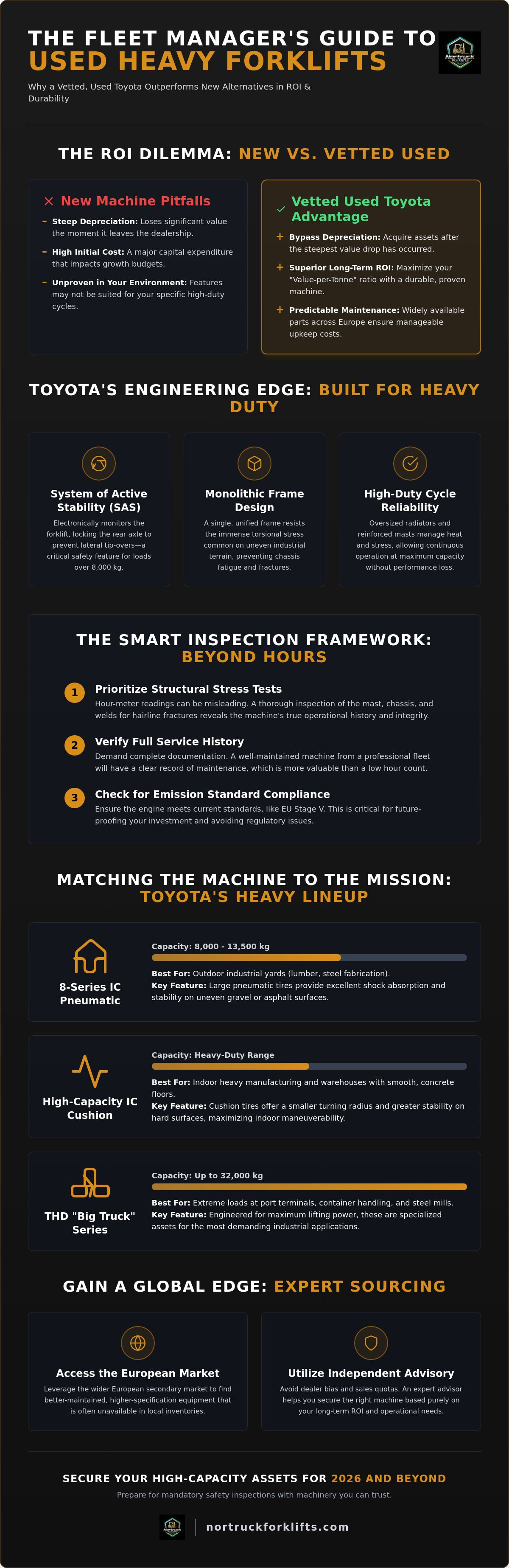
- Understand why Toyota’s engineering philosophy, particularly the System of Active Stability (SAS), remains a critical safety advantage for loads exceeding 8,000 kg.
- Learn a specific inspection framework for a used Toyota heavy forklift that prioritizes structural stress tests over misleading hour-meter readings.
- Identify the operational differences between the 8-Series High-Capacity Pneumatic and Large IC Cushion models to ensure your machine fits your specific environment.
- Discover how to leverage the European secondary market to access better-maintained, high-specification equipment that is often unavailable in local inventories.
- See how an independent advisory model can help you avoid dealer bias and secure a machine based on long-term ROI rather than sales quotas.
The Case for Toyota in Heavy-Duty Industrial Applications
A core reason for this preference is the System of Active Stability (SAS). When you're lifting 10 tonnes, the center of gravity shifts with every movement. Toyota’s SAS electronically monitors forklift operations and locks the rear axle to prevent lateral tip-overs. Understanding Toyota's history in material handling helps one appreciate how these safety systems have evolved from warehouse innovations into essential features for high-capacity industrial assets. This established track record provides a level of reassurance that budget brands simply cannot match.
Reliability Factors in High-Capacity Engineering
The large-chassis models feature a monolithic frame design that resists the torsional stress of uneven terrain. Unlike smaller units, these masts are reinforced with thicker steel plates and heavy-duty rollers to prevent hairline fractures during high-cycle operations. Engine cooling is equally critical. Toyota integrates oversized radiators and high-flow fans to manage the heat generated during continuous heavy-duty cycles. In these environments, a Duty Cycle is defined as the percentage of time a machine operates at its maximum rated capacity without cooling down. Toyota machines consistently maintain high performance in these demanding cycles, making them a safer bet on the used market.
The ROI of Buying Used for Heavy Operations
A new high-capacity forklift loses a significant portion of its value the moment it leaves the dealership. By sourcing a 5-year-old unit, you've already bypassed the steepest part of the depreciation curve. We often advise clients to look at the "Value-per-Tonne" ratio. This is calculated by dividing the total acquisition cost by the machine's remaining operational life in tonnes moved. Because Toyota parts are widely available across Europe, maintenance costs remain predictable even as the machine ages. Choosing a used Toyota heavy forklift allows you to secure a premium, durable asset for a fraction of the cost of a new machine, provided you have a clear picture of its operational history.
Selecting a used Toyota heavy forklift requires matching the specific chassis to your terrain and load profile. While warehouse models are ubiquitous, the high-capacity lineup is highly specialized. You'll primarily encounter three distinct families in the secondary market: the 8-Series IC Pneumatic, the High-Capacity Cushion, and the specialized THD series. Each is engineered for a specific industrial environment, and choosing the wrong one can lead to premature wear or operational bottlenecks.Toyota 8-Series: The 8,000 to 13,500 kg Range
The 8-Series High-Capacity IC Pneumatic serves as the standard workhorse for outdoor industrial yards. These units are frequently powered by Cummins diesel engines, which are favored for providing the high torque necessary for lifting heavy lumber or fabricated steel. For operators, the cabin design prioritizes visibility and ergonomic controls. These features are vital for maintaining safety during long shifts in demanding environments. Because these machines often operate on uneven gravel or asphalt, their large pneumatic tires provide the necessary shock absorption to protect the drivetrain. Adhering to OSHA forklift safety guidelines is particularly important with these mid-range heavy units, as their sheer power requires disciplined operation and regular maintenance checks.The "Big Trucks": Toyota THD and Beyond
For operations requiring extreme lifting power, the Toyota Heavy Duty (THD) series handles loads up to 32 tonnes. These are the "Big Trucks" of the industry, commonly found in port terminals for container handling or in massive steel mills for coil transport. Sourcing a used THD model is significantly more challenging than finding a standard 8-Series. These units are often kept in primary fleets for their entire service life, making the secondary market for them quite tight. If your application demands this level of capacity, it is often best to have an expert consult with you on European inventory to find units that haven't been pushed past their structural limits.Indoor and Electric Alternatives
Technical Inspection: What to Verify Before Purchase
Acquiring a used Toyota heavy forklift requires more than a casual walk-around. You're investing in an asset designed to handle extreme stress, which means the inspection must be equally rigorous. Many buyers make the mistake of over-valuing the hour meter. In high-capacity environments, a machine might idle for hours while waiting for a specific load, or it might have spent its entire life under maximum load in a corrosive port environment. The meter doesn't tell the whole story; the service logs and physical wear do.
Current trends in the material handling industry outlook suggest that as operational costs rise, the demand for verified, reliable used machinery is increasing. Transparency isn't just a courtesy; it's a financial safeguard. You must demand the machine's full service history, including any major component overhauls. Without these documents, you're essentially gambling on the machine's internal health. A well-documented history reveals whether the unit has been maintained according to factory specifications or merely patched together to keep it running.
The Mast and Carriage: The Critical Points
The mast is the heart of any heavy-lift machine. We look for hairline fractures in the weld points and excessive play in the carriage rollers. Lift chains are another critical failure point; they should be measured for elongation with a chain gauge. If a chain shows more than 3% wear, it's a safety hazard that requires immediate replacement. Tilt cylinders in heavy-duty Toyota models face immense pressure when holding a 10-tonne load at height. Any signs of pitting on the cylinder rods or weeping seals suggest an expensive repair is imminent. We always recommend ultrasonic testing of the forks for heavy lifts to detect internal cracks that are invisible to the naked eye.
Engine and Transmission Health
Large-displacement engines in Toyota's heavy range are built for longevity, but they aren't invincible. We listen for "lugging" or uneven idling, which can indicate fuel system issues or internal wear. The transmission is equally vital. A heavy-duty torque converter should engage smoothly without hesitation or harsh shifting. We treat fluid analysis, both engine oil and hydraulic fluid, as a mandatory "blood test" for the machine. These lab results reveal the presence of metal shavings or contaminants that signal premature component failure. This level of due diligence is what separates a reliable industrial asset from a costly project.
Just as a "blood test" for a forklift ensures its internal health, proactive personal care is essential for long-term well-being; for those needing specialized dental health support, Concept Dental offers comprehensive periodontal therapy to restore and maintain your health.
Sourcing Strategy: Accessing the European Used Market
Accessing the right used Toyota heavy forklift often requires looking beyond your local borders. Europe serves as a global hub for high-capacity machinery because of its dense industrial infrastructure and strict corporate maintenance cycles. In countries like Germany, the Netherlands, and Denmark, heavy equipment is frequently replaced according to scheduled fleet upgrades rather than waiting for mechanical failure. This creates a secondary market filled with well-documented, high-specification units that offer significant value compared to new purchases. You aren't just buying a machine; you're buying the disciplined service history that comes with European industrial standards.
The Advantage of Pan-European Sourcing
The European market provides a level of inventory diversity that local dealers simply can't match. If your operation requires a specific 12,000 kg configuration with a specialized mast, the "needle in the haystack" is much easier to find when searching across multiple countries. You can also avoid regional price premiums by shifting your focus to areas where supply currently exceeds local demand. Most European fleets operate under comprehensive service contracts, meaning the machines have been maintained with genuine parts throughout their entire primary life. This level of care translates directly to the longevity you expect from a used Toyota heavy forklift.
Logistics and Compliance
Moving a 15-tonne machine requires more than just a standard freight carrier. You've got to account for specialized low-loader transport, cross-border permits, and potential port handling fees. As of 2026, compliance with EU Stage V emissions standards is a primary concern for any buyer within the Union. If you're sourcing a machine for use in Europe, you must verify its CE marking to ensure it meets the Machinery Directive (2006/42/EC). We always recommend calculating the Total Landed Cost before finalizing a deal. This figure includes the purchase price, logistics, and any necessary compliance adjustments. It's the only way to determine the true ROI of your investment.
Navigating these logistical and regulatory hurdles is part of the advisory process we provide. We help you identify the best units across the continent and manage the delivery to your site. Learn how we can streamline your European equipment sourcing.
The Nortruck Advantage: Expert Sourcing and Advisory
Securing a used Toyota heavy forklift requires a partner who understands the difference between a quick sale and a long-term operational solution. Lars G Tarby has spent over 40 years in the heavy lifting industry, transitioning from the traditional sales model to a specialized advisory role. This legacy of experience means we don't just look at what's available; we look at what's right for your specific load profile. Traditional dealerships are often restricted by the inventory currently sitting on their lots. As an independent consultancy, we operate without those boundaries, prioritizing your ROI over manufacturer quotas. Why settle for what's in stock when you can source exactly what your facility requires?
Tailored Equipment Sourcing
Our sourcing strategy focuses on identifying machines that never make it to public listing sites. Many of the best-maintained units are traded within private networks or come from fleet renewals that we track across Europe. Before we recommend any used Toyota heavy forklift, it undergoes a multi-point inspection that goes beyond the standard checklist. We've successfully sourced high-capacity lifts for complex environments like specialized steel yards, where mast precision and chassis durability are non-negotiable. This proactive approach ensures you're seeing the best the market has to offer, not just what's easiest to find. We act as the filter between you and the "overworked" machines found on generic listing sites.
Consultancy vs. Sales
The traditional dealer-buyer relationship is often transactional. Our model is built on advocacy. We work as your consultant, analyzing the Total Cost of Ownership (TCO) to ensure the machine remains an asset rather than a liability. This analysis includes parts availability, expected maintenance intervals, and the eventual resale value of the unit. We eliminate the hidden margins found in traditional dealerships by providing transparent pricing and direct communication. You're treated as a professional peer, receiving honest advice based on technical data and decades of industry insight. Our goal is to find the "needle in the haystack" that fits your budget and your operational demands.
Securing Your High-Capacity Assets for 2026 and Beyond
Investing in a used Toyota heavy forklift is a strategic decision that balances legendary durability with immediate cost savings. Success in the secondary market depends on looking beyond the surface and prioritizing a machine’s operational history and structural integrity over its odometer reading. By expanding your search into the European market, you gain access to a diverse inventory of high-specification units that have been maintained to the highest industrial standards. This approach ensures you aren't just buying a piece of equipment, but a reliable partner for your most demanding tasks.
Navigating this process alone can be daunting, especially with evolving emissions regulations and complex cross-border logistics. We provide the independent advisory you need to avoid dealer bias and hidden mechanical risks. With over 40 years of heavy lifting expertise, we focus on finding the "needle in the haystack" that fits your specific operational load and long-term ROI goals. Our specialized sourcing across the European market eliminates the middleman and brings transparency back to equipment acquisition. Are you ready to find a machine that truly meets your demands?
Let Lars G Tarby source your next heavy forklift—Contact Nortruck today
We look forward to helping you secure a durable, high-capacity asset that drives your business forward.
Frequently Asked Questions
What is the typical lifespan of a used Toyota heavy forklift?
A well-maintained Toyota heavy forklift can reliably operate for 20,000 to 30,000 hours before requiring a major powertrain overhaul. In typical industrial environments, this translates to 15 to 20 years of productive service. The machine's longevity depends heavily on the consistency of its service history and the severity of its duty cycle. Units used in clean manufacturing environments often outlast those in corrosive port or chemical settings.
How much does a used 10-tonne Toyota forklift cost in 2026?
Market prices for a 10-tonne model vary significantly based on the unit's age, operational hours, and specific configuration. While newer models command a premium, sourcing an older, well-maintained machine can offer substantial savings compared to new inventory. We recommend conducting a Total Landed Cost analysis to account for logistics and any required emissions compliance. This ensures you understand the full investment before finalized the purchase.
Can I convert a used diesel Toyota heavy forklift to electric?
Converting a high-capacity diesel unit to electric is technically feasible but often proves cost-prohibitive for heavy-lift applications. The structural modifications and battery integration costs usually exceed the price of sourcing a purpose-built electric forklift. For eco-conscious sites, it's more efficient to source an 80V electric model designed for high-capacity loads from the start. This ensures you maintain the necessary torque and runtime for heavy operations.
What are the most common maintenance issues with high-capacity Toyota models?
High-capacity models often experience wear in the mast rollers and lift chains due to the extreme torsional stress of heavy loads. Hydraulic seal weeping and radiator clogging in dusty environments are also common concerns. Regular fluid analysis is the best way to catch internal engine or transmission wear before it leads to a catastrophic failure in a used Toyota heavy forklift. Consistent lubrication of the carriage is also vital.
How do I verify the service history of a forklift sourced from another country?
You can verify history by requesting digital service logs from authorized dealers or checking the machine's telematics data. In Europe, many fleets maintain comprehensive paper trails that document every scheduled service and component replacement. We coordinate with local technical experts to perform physical inspections and cross-reference the machine's condition with the provided documentation. This ensures transparency and helps you avoid units with hidden mechanical problems.
Is it better to buy a used Toyota or a used Linde for heavy-duty work?
Toyota is often preferred for its System of Active Stability (SAS) and straightforward mechanical design, which simplifies long-term maintenance. Linde is known for its hydrostatic drive, offering high precision in tight spaces. The choice depends on your specific application; Toyota generally offers better parts availability and lower maintenance complexity for standard heavy-duty industrial cycles. We help you compare these brands based on your specific operational needs.
What safety features should I look for in a 10-year-old heavy forklift?
A 10-year-old Toyota should feature the System of Active Stability (SAS) and an Operator Presence Sensing (OPS) system. You should also verify the integrity of the overhead guard and the functionality of load-sensing hydraulic valves. Ensure the machine is equipped with proper lighting and mirrors that meet current site safety standards. These features are critical for maintaining a safe environment when moving high-capacity loads in 2026.
How does Nortruck Forklifts handle the inspection of machines located in Europe?
We leverage a pan-European network of technical specialists to conduct hands-on inspections of a used Toyota heavy forklift before making a recommendation. Our process focuses on structural integrity, hydraulic pressure testing, and a thorough review of the service history. This independent approach ensures that we identify potential risks that might be omitted from a standard dealer listing. We act as your advocate throughout the entire technical verification process.

Article by
Lars Gunnar Tärby
Disclaimer
1. General Information and No AdviceThe information, articles, product descriptions, and specifications provided on this website (www.nortruckforklifts.com) are for general informational and educational purposes only. While we strive to provide accurate and up-to-date content regarding new and used forklifts and heavy machinery, the material published does not constitute professional, technical, or legal advice.
2. Product Specifications and PricingNortruck Forklifts acts as a facilitator for the trade of new and used forklifts. All equipment details, including but not limited to year of manufacture, operating hours, lift capacity, dimensions, conditions, and pricing, are provided based on the information available to us at the time of publication. Specifications and availability are subject to change without prior notice.
3. "As Is" and VerificationAll articles and product listings are provided on an "as is" and "as available" basis without any warranties of any kind, either express or implied. Nortruck Forklifts does not guarantee that the descriptions are entirely error-free, complete, or reliable. Buyers and traders are strongly encouraged to independently verify all technical specifications, machine history, and equipment conditions directly with the seller or an authorized inspector before finalizing any purchase or transaction.
4. Limitation of LiabilityIn no event shall Nortruck Forklifts, its owners, or its contributors be held liable for any direct, indirect, incidental, consequential, or economic loss or damage arising out of the use of, or the inability to use, the information provided on this website, or any transactions facilitated through this platform. This includes, but is not limited to, damages caused by technical inaccuracies, typographical errors, or reliance on the content of our articles.
5. Third-Party LinksOur website may contain links to external websites, dealer networks, or third-party services that are not owned or controlled by Nortruck Forklifts. We have no control over, and assume no responsibility for, the content, privacy policies, or practices of any third-party websites.


