
What if the multi-month wait for a factory-fresh 40-tonne Kalmar is actually the greatest risk to your 2026 operational budget? When you're managing assets in the 10-50 tonne range, the decision between a new vs used forklift isn't just about the sticker price. It's a complex calculation of lead times, mechanical transparency, and long-term residual value. You likely feel the pressure of high upfront capital requirements while worrying about the invisible maintenance history of a second-hand unit.
We understand that reliability is non-negotiable in heavy lifting. This guide provides a clear decision framework based on your specific usage hours and operational intensity. You'll learn how to master the financial trade-offs across various equipment manufacturers to optimize your fleet's total cost of ownership. Nortruck Forklifts also explores how sourcing off-market European assets can bypass current supply chain delays, ensuring you get the machinery you need without the wait.
Key Takeaways
- Determine how to balance asset liquidity and immediate availability in the 2026 economic climate.
- Identify why certain heavy-duty brands like Kalmar hold their worth, protecting your equity over time.
- Master the 2,000-hour rule to decide between a new vs used forklift based on your specific operational demands.
- Learn the steps for auditing your lifting requirements and scanning European networks for off-market assets.
- Discover how independent advisory expertise uncovers the true mechanical history of specialized machinery.
New vs Used Forklift: Navigating Heavy Equipment Procurement in 2026
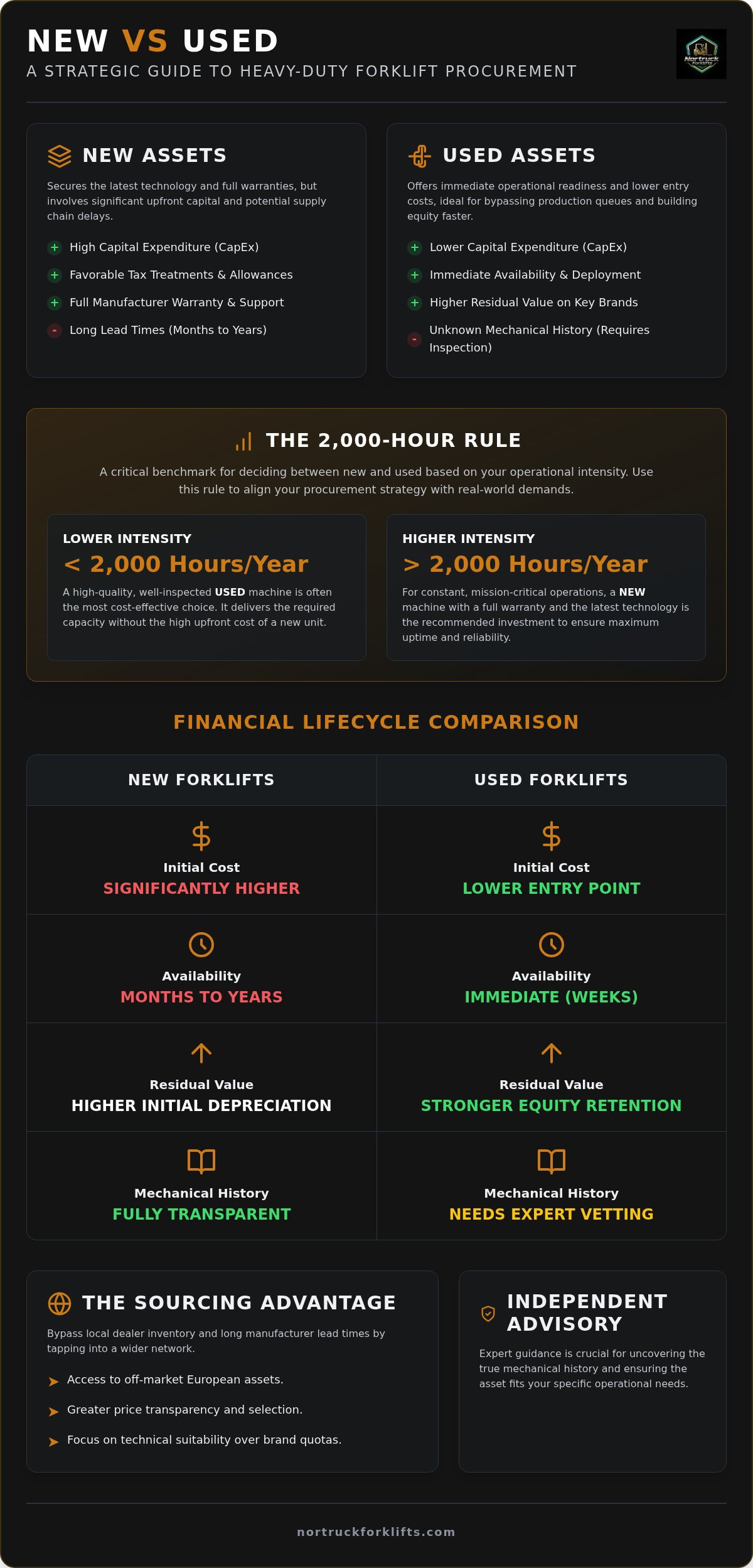
Deciding between a new vs used forklift in the 10 to 50-tonne range is no longer a simple matter of comparing price tags. In 2026, the dilemma centers on Capital Expenditure (CapEx) versus Operating Expenditure (OpEx) within a volatile market. Buying new secures the latest technology and full warranties but requires significant upfront capital. Conversely, high-quality used assets offer immediate operational readiness and lower entry costs. For mission-critical machinery like reachstackers or heavy-lift trucks, the choice directly impacts your balance sheet's liquidity.
The distinction between utility and mission-critical assets is vital. A standard three-tonne warehouse truck is a commodity that's easily replaced. However, a 40-tonne Kalmar or a specialized Baumann sideloader is a strategic asset. In the current global supply chain, "new" often doesn't mean "available." Lead times for specialized factory orders can stretch into several months or even years. This makes the secondary market a necessary destination for firms that cannot afford to wait for a manufacturer's production slot. When debating the merits of a new vs used forklift, remember that the most expensive machine is the one that isn't working because it's stuck in a production queue.
The Shift Toward Strategic Asset Sourcing
Market volatility and 2026 interest rates have changed the financing landscape. High borrowing costs make every procurement decision more weighted. Many firms now seek independent advice to navigate these complexities. Ownership remains a powerful hedge against the rising costs of long-term rentals. By owning the asset, you build equity in machinery that retains its value. This is especially true for heavy-duty brands known for their robust chassis and long service lives. In an environment where rental rates can fluctuate, a fixed-cost asset provides much-needed operational stability.
When "Expert Guidance" Outperforms "Dealer Inventory"
Relying solely on a local dealer often limits your options to their specific brand or current stock. This inventory-first approach rarely prioritizes your specific technical needs. Sourcing across Europe provides a wider lens on price transparency and mechanical specifications. Independent procurement is a strategy for bypassing manufacturer quotas by sourcing equipment based on technical requirements rather than brand-specific inventory. It focuses on finding the right machine for the job, whether it's a new unit or a well-maintained used asset from an off-market European network. This approach ensures your fleet is built on suitability rather than just what happens to be on the lot.
The Financial Lifecycle of High-Capacity Lifting Assets
Acquiring a 10 to 50-tonne asset is a significant financial commitment. Unlike smaller warehouse units, these high-capacity machines are engineered for decades of service. When evaluating a new vs used forklift, you must consider how brands like Kalmar or Linde hold their value. These heavy-duty chassis are designed for rebuilds, meaning they retain a higher percentage of their original price compared to lighter equipment. This residual value factor turns a purchase into an equity-building exercise rather than a simple expense.
New machinery often attracts favorable tax treatments, such as capital allowances or accelerated depreciation. These incentives can lower your effective tax bill, making the higher upfront cost more palatable. However, the used market offers a distinct advantage in terms of deployment speed. While a new factory order may involve a 12-month wait, a used unit can be on-site within weeks. This immediate availability often outweighs the tax benefits if your operation is currently losing money due to equipment shortages.
Calculating the Total Cost of Ownership (TCO)
Determining the forklift total cost of ownership requires looking past the initial invoice. For heavy Toyota or Linde models, you'll have to factor in specialized operator training and major overhaul cycles that occur every few thousand hours. Insurance premiums also vary significantly based on the asset's age and safety features. When you project costs over a decade, a high residual value effectively reduces the net monthly expense of the asset by offsetting the initial purchase price upon resale.
Sourcing Used for Lower CapEx
For mid-sized ports or industrial yards, used Volvo or Kalmar equipment often provides the best return on investment. You get the same lifting capacity and durability for a fraction of the new price. The risk, of course, lies in the machine's history. Expert inspection is mandatory. It's the only way to verify the integrity of hydraulic systems and structural components. Our European forklift market guide offers deeper insights into finding these high-value assets across international borders. If you need a partner to verify a machine's condition before purchase, consulting with an independent advisor can help you navigate the new vs used forklift market with confidence.
Operational Intensity: When Usage Hours Dictate the Choice
Operational intensity is the most objective metric for resolving the new vs used forklift debate. For high-intensity applications exceeding 2,000 hours per year, the argument for new equipment is often centered on warranty protection and maximum uptime. When a machine is running multiple shifts daily, the cost of unplanned downtime far outweighs the initial purchase premium. New units provide a predictable maintenance schedule and the latest fuel-efficiency standards, which are critical for high-cycle environments.
Low-hour or backup applications present a different financial reality. If a machine only operates 500 to 800 hours annually, the depreciation on a new unit becomes difficult to justify. In these scenarios, a high-quality used Linde forklift for sale is often the logical choice. These machines offer the same lifting capacity and structural integrity as new models but at a significantly lower entry point. Many savvy fleet managers adopt a hybrid strategy. They invest in new primary units for heavy lifting while utilizing used specialized trucks for peak periods or specific tasks.
The "Threshold of Ownership" Decision Matrix
Industrial firms frequently identify 1,000 hours per year as the break-even point for asset procurement. Below this threshold, the capital tied up in a new machine rarely generates a sufficient return. You must also assess the specialized nature of the lift. A standard forklift is easily sourced, but bespoke requirements like unique mast heights or attachments might push you toward a new build. The break-even point is where the annual cost of lease payments for a new machine matches the projected depreciation and maintenance of a used asset.
Application Specifics: Reachstackers and Sideloaders
Procuring a used reachstacker for port operations requires a deep understanding of the machine's previous environment. Port air is notoriously corrosive. A used unit with 5,000 hours in a dry inland terminal is a vastly different asset than one used in a coastal salt-spray environment. Similarly, the long service life of Baumann sideloaders affects the new vs used forklift calculation. Because these machines are built on heavy-duty industrial chassis, a well-maintained used unit can often provide another decade of reliable service. Matching the asset's remaining service life to your specific project contract length ensures you aren't over-investing in capacity you won't fully utilize.
The European Sourcing Advantage: Finding Value Beyond Local Dealers
Expanding your search beyond local inventory is often the most effective way to resolve the new vs used forklift dilemma. While a regional dealer might be limited by their current stock or brand quotas, the European market offers a vast reservoir of specialized machinery. Navigating this landscape requires a methodical approach to ensure you're acquiring a reliable asset rather than someone else's problem. This process begins with a rigorous internal audit. You must define your precise capacity, mast, and attachment needs to avoid paying for excess capability or settling for an under-specced unit.
The procurement journey follows a structured path:
- Step 1: Auditing Requirements. Define your specific lifting requirements to ensure the asset matches your operational reality.
- Step 2: Market Scanning. Scan the European market for "off-market" heavy assets that aren't visible on standard dealer sites.
- Step 3: Verification. Conduct independent technical inspections and verify the machine's service history.
- Step 4: Logistics. Manage the complexities of cross-border transport and the necessary import documentation.
- Step 5: Commissioning. Complete the final commissioning on-site to ensure the machine is ready for immediate deployment.
Why Sourcing from Europe Wins in 2026
The European market provides access to a significantly wider pool of Kalmar heavy lift truck for sale listings than any single local market. By working with an independent advisor, you bypass the traditional middleman markups that often inflate local prices. This direct access is particularly valuable when seeking specialized units like Combi-Lift 4-way trucks or Baumann sideloaders. These machines are often rare in local inventories but more readily available across the broader European industrial network, where specialized manufacturing is more concentrated.
Verifying Machine History and Performance
Assessing the true value in the new vs used forklift market depends entirely on data integrity. It's essential to identify "clocked" hours or hidden structural fatigue in heavy chassis that may not be apparent from a cursory glance. Sourcing from reputable networks in Germany, Scandinavia, and the Benelux provides a higher level of confidence, as these regions often maintain rigorous service records and adhere to strict maintenance protocols. Transparency in machine history is the most valuable currency in procurement, as it allows for an accurate projection of future maintenance costs and operational lifespan.
Sourcing with Certainty: The Role of an Independent Advisor
Lars G Tarby brings more than 40 years of heavy lifting expertise to every consultation. This depth of experience is vital when you're deciding between a new vs used forklift, as it provides an "insider" perspective that standard dealers simply cannot offer. While a traditional seller is restricted to their own inventory or specific brand quotas, an independent advisor focuses entirely on the suitability of the asset for your specific operational environment. We understand which chassis are prone to fatigue and which manufacturers have maintained the highest reliability standards over the last decade. This transparency ensures you aren't just buying a machine; you're acquiring a verified asset with a clear mechanical history.
The Nortruck Forklifts Advisory Process
Our methodology shifts the focus from a simple transaction to solving a complex lifting challenge. We take a brand-agnostic approach, sourcing equipment from Kalmar, Linde, Toyota, Baumann, and Combi-Lift based on performance data rather than sales targets. This specialization is particularly beneficial for high-stakes environments, such as sourcing heavy duty forklifts for concrete and steel manufacturing. In these sectors, the difference between a standard unit and a specialized heavy-lift truck can mean the difference between operational success and costly downtime. We prioritize long-term partnerships, acting as your advocate throughout the entire European procurement process.
Next Steps for Your Operation
Initiating a fleet procurement audit with Nortruck Forklifts is the most effective way to prepare for your next acquisition. We start by helping you document your precise technical requirements, including load centers, mast heights, and necessary attachments. This ensures that our search across European networks is targeted and efficient. Once your requirements are established, we leverage our independent network to find high-value assets that local dealers often miss. If you're looking to optimize your fleet's total cost of ownership while navigating the new vs used forklift market, we invite you to start a dialogue. Contact us today for a confidential consultation on your heavy lift sourcing needs.
Securing Your Fleet's Operational Future
Optimizing your heavy lifting fleet requires a shift from simple price comparisons to strategic asset management. You've seen how balancing upfront capital with immediate operational availability is essential in the 2026 market. By using annual usage hours as your primary metric, you can make an objective choice between a new vs used forklift that protects your bottom line. Accessing specialized European networks further ensures you aren't limited by local dealer quotas or extended factory lead times.
Lars G Tarby provides the transparency needed to navigate these high-stakes decisions. With 40 years of industry expertise, he identifies the best machinery regardless of its age, specializing in Kalmar, Baumann, and other high-capacity brands. This independent approach ensures your procurement strategy is built on technical suitability and long-term residual value. It's about finding the right tool for your specific lifting challenge, whether that's a factory-fresh unit or a well-maintained off-market asset.
We look forward to helping you build a more efficient and resilient operation through direct, honest communication and deep technical knowledge.
Frequently Asked Questions
Is it better to buy a new or used forklift for a low-hour application?
It's generally more cost-effective to buy a used forklift for low-hour applications. If a machine operates fewer than 1,000 hours annually, the depreciation on a new unit often exceeds the operational value it provides. When debating a new vs used forklift, a well-maintained second-hand model offers the same lifting capacity at a fraction of the price. This approach preserves cash flow while still providing the necessary specialized capability for backup or intermittent tasks.
What is the typical residual value of a Kalmar heavy lift truck after 5 years?
Kalmar heavy lift trucks are known for maintaining high residual value due to their robust industrial chassis and long service life. These machines are often engineered for rebuilds, making them attractive assets on the secondary market even after several years of operation. While specific market values vary based on maintenance history and environment, premium brands like Kalmar generally retain a higher percentage of their original cost compared to lighter warehouse equipment, effectively protecting your equity.
How do I verify the service history of a used forklift sourced from Europe?
Verifying the service history of a used forklift from Europe requires a combination of detailed service log audits and independent technical inspections. We focus on sourcing from reputable networks in regions like Scandinavia and Germany, where maintenance protocols are traditionally rigorous. An expert advisor can identify signs of structural fatigue or hour-meter tampering that may not be apparent to the untrained eye, ensuring the asset's history is transparent and accurate for your peace of mind.
What are the main advantages of buying a new Baumann sideloader?
The main advantages of a new Baumann sideloader include full manufacturer warranties, access to the latest fuel-efficiency technology, and the ability to order bespoke specifications. New units are ideal for high-intensity operations where maximum uptime is a priority. Buying new also ensures you receive a machine with zero structural fatigue, which is a significant factor for specialized sideloaders handling long or heavy loads in demanding timber or steel yards where precision and reliability are required daily.
Can I still get financing for a used forklift that is over 5 years old?
Financing is often available for used forklifts over five years old, especially for premium brands like Linde or Toyota that demonstrate high durability. Lenders typically evaluate the asset's remaining service life and the reputation of the manufacturer. While interest rates may differ from new equipment financing, the lower purchase price of a used asset often results in more manageable monthly payments. It's advisable to consult with a specialist who understands the residual value of heavy lifting machinery.
How do usage hours affect the total cost of ownership for a reachstacker?
Usage hours are a primary driver of the total cost of ownership for a reachstacker. High-hour machines require more frequent major overhaul cycles and specialized maintenance, which increases Operating Expenditure. Conversely, a low-hour used machine reduces the initial Capital Expenditure while slowing the rate of depreciation. Finding the right balance between the new vs used forklift choice depends on whether the machine's productivity outweighs its hourly running and maintenance costs over its entire operational lifecycle.
Why should I use an independent advisor instead of a local dealer?
An independent advisor provides a brand-agnostic perspective that isn't restricted by manufacturer quotas or local inventory. Unlike a dealer who must sell their specific stock, an advisor focuses on finding the right technical solution for your lifting challenge. This approach offers greater transparency and access to off-market European assets. You benefit from expert experience to verify machine history and negotiate fair terms across multiple brands like Volvo and Combi-Lift without being locked into a single dealer.
What are the expected lead times for new heavy-duty forklifts in 2026?
Expected lead times for new heavy-duty forklifts in 2026 can range from several months to over a year, depending on the manufacturer and specialized specifications. Global supply chain complexities continue to impact production slots for high-capacity machinery like Kalmar reachstackers. This makes the secondary market a vital alternative for operations that require immediate deployment. Planning your procurement at least 12 to 18 months in advance is recommended if you're committed to a factory-fresh unit.

Article by
Lars Gunnar Tärby
Disclaimer
1. General Information and No AdviceThe information, articles, product descriptions, and specifications provided on this website (www.nortruckforklifts.com) are for general informational and educational purposes only. While we strive to provide accurate and up-to-date content regarding new and used forklifts and heavy machinery, the material published does not constitute professional, technical, or legal advice.
2. Product Specifications and PricingNortruck Forklifts acts as a facilitator for the trade of new and used forklifts. All equipment details, including but not limited to year of manufacture, operating hours, lift capacity, dimensions, conditions, and pricing, are provided based on the information available to us at the time of publication. Specifications and availability are subject to change without prior notice.
3. "As Is" and VerificationAll articles and product listings are provided on an "as is" and "as available" basis without any warranties of any kind, either express or implied. Nortruck Forklifts does not guarantee that the descriptions are entirely error-free, complete, or reliable. Buyers and traders are strongly encouraged to independently verify all technical specifications, machine history, and equipment conditions directly with the seller or an authorized inspector before finalizing any purchase or transaction.
4. Limitation of LiabilityIn no event shall Nortruck Forklifts, its owners, or its contributors be held liable for any direct, indirect, incidental, consequential, or economic loss or damage arising out of the use of, or the inability to use, the information provided on this website, or any transactions facilitated through this platform. This includes, but is not limited to, damages caused by technical inaccuracies, typographical errors, or reliance on the content of our articles.
5. Third-Party LinksOur website may contain links to external websites, dealer networks, or third-party services that are not owned or controlled by Nortruck Forklifts. We have no control over, and assume no responsibility for, the content, privacy policies, or practices of any third-party websites.


