
Is the lowest sticker price on a used Baumann sideloader actually the best deal, or is it just the first installment of an expensive mistake? It's a question that keeps many fleet managers awake. You want the reliability of a premium brand without the steep depreciation of a new unit, but finding a fair used Baumann sideloader price is often complicated by a lack of transparency. The fear of hidden repair costs or buying a machine with high hours and low remaining life is a valid concern when you're looking across different European regions where maintenance standards vary.
We understand that making a confident investment requires more than a quick search on a marketplace. It demands an insider’s perspective on how operating hours and maintenance history truly impact value. In this guide, you'll discover the critical factors that determine current market rates and learn how to secure the best value through expert European sourcing. We'll provide a clear framework for evaluating equipment and show you how a transparent, direct approach eliminates unnecessary intermediaries. By the end of this article, you'll have the tools to assess the 2026 market with confidence and find a machine that serves your operation for years to come.
Key Takeaways
- Understand how the 2026 industry pivot toward electric models is creating new value opportunities in the market for used diesel units.
- Learn why a used Baumann sideloader price is determined more by mast configuration and technical history than by the year of manufacture alone.
- Master a professional evaluation checklist that compares hour meter readings against physical wear on critical components like pedals and mast channels.
- Discover how to navigate the pitfalls of international marketplaces by leveraging a direct European sourcing network for verified equipment.
- Identify the specific operational advantages of the HX and GX series to ensure your investment matches your site's narrow aisle or heavy-lift requirements.
Understanding the 2026 Market for Used Baumann Sideloaders
Baumann has long set the benchmark for handling long, heavy loads in the timber and steel sectors. Their machines aren't just tools; they're specialized assets designed for precision in environments where standard industrial forklift types simply can't perform. In August 2026, the market for these machines is evolving rapidly. We're seeing a distinct shift in how a used Baumann sideloader price is calculated, moving away from simple age-based depreciation toward a model that prioritizes drivetrain technology and regional emission compliance.
To better understand the scale and capability of these machines, watch this demonstration of a high-capacity Baumann sideloader:
The current year marks a significant turning point as more operations transition to the electric EGX series. This shift is creating a unique opportunity for buyers who don't face strict indoor emission mandates. As larger fleets modernize, the availability of well-maintained diesel GX and HX models has increased. However, this doesn't mean prices are crashing; rather, the market has split. High-quality diesel units remain in high demand for outdoor timber yards, while electric models command a premium due to their lower total cost of ownership. We categorize these units into three tiers: refurbished machines with verified histories, work-ready units that have passed recent safety inspections, and "as-is" machines that often require immediate investment. Understanding which category a machine falls into is the first step in evaluating a used Baumann sideloader price.
Why Baumann Sideloaders Command a Premium
Baumann engineering focuses on stability and deck leveling, features that preserve the machine's structural integrity over decades of use. Unlike lower-tier competitors, these sideloaders retain a higher percentage of their original value because the European parts network is robust. A machine built ten years ago can still be serviced with genuine components, making it a viable long-term investment rather than a liability. Their precision in narrow aisles translates directly to operational efficiency, which is why they remain the preferred choice for heavy-duty industrial applications.
The 2026 Outlook for Sideloader Availability
Supply chains have finally stabilized, resulting in a healthier influx of three-to-five-year-old units coming off lease across Europe. We're also seeing increased demand for multidirectional and 4-way capabilities, which is influencing the market value for models equipped with advanced steering systems. Environmental regulations in certain European zones are driving diesel prices down locally, but the international demand for these rugged machines keeps the global floor steady. If you're sourcing today, the key is identifying machines from regions with high maintenance standards to ensure long-term reliability.
Key Factors That Influence Used Baumann Sideloader Prices
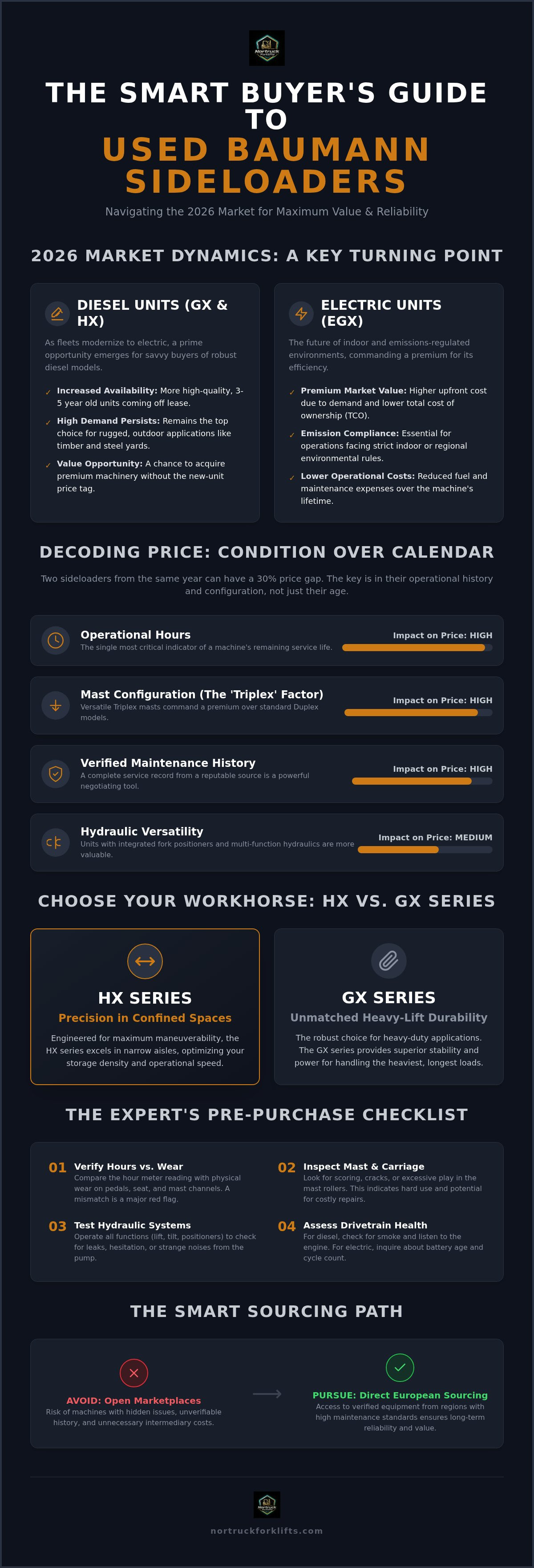
Pricing a heavy-duty asset isn't as simple as checking a standard depreciation table. While age provides a baseline, a used Baumann sideloader price is fundamentally driven by the intersection of mechanical condition and specific mast configurations. Market data from the Association of Equipment Manufacturers (AEM) suggests that industrial equipment values are increasingly tied to technological specifications and verified maintenance records rather than the year of manufacture alone. In the sideloader market, two machines from the same year can have a price gap of 30 percent based solely on their operational history.
- Operational Hours: A machine with 5,000 hours is viewed as a different class of asset than one with 15,000 hours, even if the latter is newer.
- The 'Triplex' Factor: Triplex masts offer higher lift heights with lower collapsed heights, making them more versatile and valuable than standard duplex masts.
- Hydraulic Versatility: Units equipped with integrated fork positioners or sideshifts save operators significant time, adding immediate value to the spec sheet.
- Regional Compliance: Machines that meet the latest European emission standards retain higher value in urban industrial zones.
Evaluating Engine and Battery Health
For diesel models, the engine tier is a primary price driver. Older engines that don't meet modern Stage V requirements may face operational restrictions in certain EU cities, which can lower their resale value in those specific markets. Conversely, when evaluating the electric EGX series, the battery's remaining life is the most critical variable. A battery nearing the end of its cycle can represent a significant future expense, often reflected in a lower asking price. We always recommend verifying the full service history; a documented maintenance trail acts as a price protector, ensuring you aren't inheriting someone else's neglected repairs.
Capacity and Configuration Variables
The jump in price between a 3-tonne and a 5-tonne capacity unit is often steeper than expected due to the heavier chassis and reinforced hydraulics required for the higher load. Platform width also plays a decisive role. A wider deck is essential for timber yards handling long bundles, while narrower decks are prized for high-density steel storage. Specialized attachments like pantographs significantly increase a machine's market value by enabling double-deep racking capabilities that standard forks cannot achieve. If you're unsure how these variables affect your specific budget, speaking with an independent equipment advisor can provide the clarity you need to make an informed decision.
Comparing Prices Across Popular Baumann Series: HX, GX, and EGX
Understanding the hierarchy of Baumann’s model range is essential for accurately benchmarking a used Baumann sideloader price. The manufacturer doesn't take a one-size-fits-all approach; instead, they've engineered distinct series to handle different space constraints and load weights. When you're browsing the European market, you'll primarily encounter the HX, GX, and EGX series, each occupying a specific price bracket based on its technical capabilities and power source. Resources from U.S. machinery industry associations highlight how equipment specialization directly correlates with resale value, a trend clearly visible in the sideloader market.
The HX Series: Value in Compact Spaces
The HX series, particularly the HX 40 and HX 50 models, represents the compact end of the spectrum. These machines are the workhorses of high-density warehouses where every centimeter of aisle width counts. Because of their smaller footprint, the entry-level used Baumann sideloader price for an HX unit is often more accessible for smaller timber merchants or specialized manufacturing plants. They offer an exceptional return on investment in environments that prioritize maneuverability over massive lifting capacity. Common configurations for the HX series include load capacities between 3 and 5 tonnes, often found with standard duplex masts that suit lower-ceiling facilities.
The GX and EGX: High Capacity and Innovation
Moving into the heavy-duty range, the GX series, specifically the GX 60 and GX 70, remains the gold standard for diesel-powered performance. These units are built to withstand the rigors of 24/7 steel production and large-scale timber handling. While the GX series holds its value remarkably well due to its ruggedness, the newer EGX electric series sits at a higher capital price point. This premium is justified by significantly lower fuel and maintenance costs over the machine's life, especially as emission regulations tighten across Europe.
For those looking for 'sleeper' value, older GS or AS series models can often be found at a lower cost, though they may lack the refined ergonomics of the modern GX line. It's also vital to note that as you move from the 5-tonne range up to 7 tonnes and beyond, the price floor rises significantly. This reflects the reinforced chassis and high-torque drivetrains required to handle such substantial loads safely. Finding the right balance between series and capacity is the most effective way to ensure your equipment investment matches your operational reality.
How to Evaluate Condition vs. Price: The Expert’s Checklist
A used Baumann sideloader price shouldn't be accepted at face value without a rigorous technical audit. While we've discussed how series and capacity set the baseline, the final valuation depends on the machine's physical reality. A unit that looks clean might harbor systemic failures that double your total cost of ownership within six months. We use a methodical approach to separate high-value machines from those that are simply polished for a quick sale. Every inspection should follow these five critical steps:
- Verify the hour meter: Compare the recorded hours against physical wear on pedals, floor mats, and seat bolsters. If a meter reads low but the cabin is heavily worn, the data is likely unreliable.
- Inspect mast channels: Look for scoring or signs of stress in the mast channels. Baumann's precision depends on smooth mast movement; poor lubrication here leads to expensive structural repairs.
- Check hydraulic integrity: Audit the reach cylinder and tilt mechanisms for seepage. Sideloaders rely on complex hydraulic movements to shift the mast, making these high-priority inspection points.
- Audit maintenance logs: Consistent interval servicing is the best predictor of longevity. A machine with missing records should always command a lower price to account for the increased risk.
- Perform a load test: Test the machine at its rated capacity. Listen for excessive hydraulic noise or "whining" and observe for any drift in the mast or deck leveling systems.
Red Flags That Indicate Overpricing
Fresh paint is often the oldest trick in the industry. While a clean machine is professional, a brand-new coat of paint on an older unit can hide structural rust or active hydraulic leaks. We also look for non-original parts in critical systems. If a previous owner used generic components for hydraulic valves or steering linkages, the machine's reliability is compromised. Inconsistent wear patterns on tires are another warning sign; they often indicate underlying alignment issues or a bent chassis, both of which are costly to rectify.
Leveraging Technical Inspections for Negotiation
Identifying wear items isn't just about avoiding a bad deal; it's a powerful tool for price adjustment. If an inspection reveals that chains are nearing their stretch limit or that tires require immediate replacement, these costs should be deducted from the asking price. For cross-border transactions, we recommend a professional third-party inspection to ensure transparency. You can find a more detailed breakdown of these technical points in our Used Heavy Lifting Equipment Inspection Checklist. This level of due diligence ensures that the price you pay reflects the machine's true remaining operational life.
Sourcing Your Baumann Sideloader via Expert European Advisory
Buying directly from an unvetted international marketplace often feels like a gamble. While these platforms display hundreds of listings, they offer zero buyer protection or technical verification of a seller's claims. You're left to decipher if a used Baumann sideloader price is fair on your own, often without knowing the machine's true history. This is where independent advisory changes the dynamic. We don't just point you to a listing; we identify high-value machines through a specialized European network that isn't accessible to the general public. Our focus remains on finding the right machine for your specific load requirements, whether you're handling long timber bundles or heavy steel sections.
The procurement process should be methodical and transparent. We streamline everything from initial sourcing to the final delivery at your facility. By removing unnecessary intermediaries and brokers, we ensure that the information you receive is direct and honest. This approach doesn't just save time; it eliminates the hidden markups that often inflate the cost of heavy equipment in cross-border transactions.
The Nortruck Advantage: 40 Years of Lifting Expertise
Lars G Tarby brings over 40 years of industry expertise to every consultation. This deep background allows us to see past fresh paint and marketing fluff to identify the true operational health of a sideloader. We often secure off-market units through a deep network of European contacts before they ever reach a public marketplace. Our commitment to transparency means you get an "insider" perspective on every machine we recommend. We prioritize long-term solutions over quick transactions, acting as your advocate throughout the entire acquisition phase.
Next Steps for Your Fleet Procurement
Ready to upgrade your fleet with a machine that actually fits your workflow? The process begins with a detailed sourcing request where we match your operational needs to the right technical specification. We analyze your aisle widths, load weights, and shift patterns to ensure the machine we find is a perfect match. For a broader look at the current landscape, you can review our European Forklift Market Guide 2026. Once we've identified a candidate, we handle the logistics to ensure a smooth transition from the seller's yard to your warehouse floor.
Securing Your Operational Advantage with Baumann
Finding a fair used Baumann sideloader price in 2026 requires looking past the surface of online marketplaces. You've learned that the intersection of technical specifications, such as mast height and power source, dictates true value more than the year on the data plate. By prioritizing verified service records and utilizing a professional evaluation checklist, you can avoid the hidden costs that often follow unvetted equipment. Success in this market comes from having an advocate who understands the nuances of European heavy lifting equipment.
Lars G Tarby offers over 40 years of specialized expertise and an independent, transparent advisory process. This ensures you're matched with a machine that fits your specific load requirements rather than just whatever happens to be listed on a public site. Accessing a Europe-wide machinery network allows us to find off-market units that meet the highest maintenance standards. Your fleet deserves the reliability of a premium brand without the uncertainty of cross-border sourcing.
We look forward to helping you find a high-quality machine that drives your business forward with confidence and operational efficiency.
Frequently Asked Questions
What is the average lifespan of a Baumann sideloader?
A well-maintained Baumann sideloader typically lasts between 15 and 20 years in a professional industrial environment. Many units manufactured in the early 2000s remain fully operational in timber yards across Europe today. The machine's longevity depends on the structural integrity of the chassis and mast. While engines or battery packs may require replacement, the heavy steel components are engineered for decades of rigorous lifting cycles.
Is it better to buy a used electric or diesel Baumann sideloader in 2026?
The choice depends on your specific emission requirements and infrastructure. In 2026, electric EGX models are the preferred choice for indoor operations or urban zones with strict noise and air quality regulations. However, diesel GX models remain the rugged standard for outdoor yards where charging stations aren't available. You'll find that a diesel used Baumann sideloader price is currently more accessible, though electric units offer lower long-term energy costs.
How much do operational hours affect the price of a used sideloader?
Operational hours are the most significant driver of value, often carrying more weight than the year of manufacture. A machine with under 5,000 hours commands a premium because it hasn't reached major component overhaul intervals. When the meter exceeds 12,000 hours, the used Baumann sideloader price typically drops to account for potential engine rebuilds or hydraulic pump replacements. We always recommend cross-referencing hour meters with cabin wear for accuracy.
Can I source a Baumann sideloader from another European country easily?
Sourcing across European borders is highly efficient when managed by an experienced advisory partner. The European Union's single market simplifies the movement of heavy machinery, but you must account for varying regional maintenance standards. We manage the technical verification and logistics, ensuring the machine is transported safely to your facility. This approach gives you access to a much broader inventory than what is available in any single local market.
What are the most common maintenance issues with used sideloaders?
Hydraulic leaks in the reach cylinders and wear in the mast chains are the most frequent concerns. Since sideloaders utilize traversing masts, the rollers and channels require consistent lubrication to prevent scoring. You should also inspect the deck leveling system for any drift, as this affects load stability during transit. Uneven tire wear is another common sign of underlying alignment issues or chassis stress that requires professional attention.
Does Baumann offer better parts availability than other sideloader brands?
Baumann maintains a robust parts network that is widely considered the industry standard in Europe. Their commitment to long-term support ensures that components for machines over 15 years old are still readily available through central distribution hubs. This availability is a primary reason why Baumann units retain higher resale value than budget competitors. You won't face the long lead times for genuine seals or valves that often plague other specialized brands.
What is the difference between a Baumann HX and GX series?
The HX series is a compact workhorse designed for maneuverability in narrow aisles, typically covering the 3 to 5-tonne capacity range. It's the ideal choice for high-density warehouses where space is at a premium. The GX series is a larger, heavy-duty platform built for loads up to 8 tonnes. It features a reinforced chassis and higher ground clearance, making it better suited for the uneven terrain found in outdoor steel and timber yards.
Should I consider a 4-way Combilift instead of a Baumann sideloader?
A Baumann sideloader is superior if your operation requires high-speed transport of long loads over significant distances. Sideloaders offer better stability on the deck and faster travel speeds than multidirectional trucks. A 4-way Combilift is the better choice only if you're working in extremely tight storage where the machine must move sideways directly into a rack. For moving material from production to outdoor storage, the Baumann's durability and speed provide a better return.

Article by
Lars Gunnar Tärby
Disclaimer
1. General Information and No AdviceThe information, articles, product descriptions, and specifications provided on this website (www.nortruckforklifts.com) are for general informational and educational purposes only. While we strive to provide accurate and up-to-date content regarding new and used forklifts and heavy machinery, the material published does not constitute professional, technical, or legal advice.
2. Product Specifications and PricingNortruck Forklifts acts as a facilitator for the trade of new and used forklifts. All equipment details, including but not limited to year of manufacture, operating hours, lift capacity, dimensions, conditions, and pricing, are provided based on the information available to us at the time of publication. Specifications and availability are subject to change without prior notice.
3. "As Is" and VerificationAll articles and product listings are provided on an "as is" and "as available" basis without any warranties of any kind, either express or implied. Nortruck Forklifts does not guarantee that the descriptions are entirely error-free, complete, or reliable. Buyers and traders are strongly encouraged to independently verify all technical specifications, machine history, and equipment conditions directly with the seller or an authorized inspector before finalizing any purchase or transaction.
4. Limitation of LiabilityIn no event shall Nortruck Forklifts, its owners, or its contributors be held liable for any direct, indirect, incidental, consequential, or economic loss or damage arising out of the use of, or the inability to use, the information provided on this website, or any transactions facilitated through this platform. This includes, but is not limited to, damages caused by technical inaccuracies, typographical errors, or reliance on the content of our articles.
5. Third-Party LinksOur website may contain links to external websites, dealer networks, or third-party services that are not owned or controlled by Nortruck Forklifts. We have no control over, and assume no responsibility for, the content, privacy policies, or practices of any third-party websites.


